
KAIO (KAIO), formerly known as Libre Capital, is a sovereign AppChain protocol purpose-built to transition institutional-grade financial assets into the decentralized finance (DeFi) ecosystem. By providing a compliant, programmable infrastructure, KAIO allows global asset managers to tokenize and distribute alternative investment funds, such as private credit, money markets, and hedge funds, directly on-chain.
As of May 2026, the KAIO ecosystem has achieved over $95.6 million in Total Value Locked (TVL) and has processed more than $500 million in cumulative transactions. With a fresh $19 million strategic round backed by industry giants like Tether, Laser Digital (Nomura), and Brevan Howard, KAIO is positioning itself as the primary settlement layer for regulated Real World Assets (RWAs).
This article explores the mechanics of KAIO’s institutional infrastructure, the introduction of the retail-focused KASH token, the utility of the $KAIO token, and how to participate in the KAIO ecosystem on BingX.
What Is KAIO (KAIO) AppChain for RWAs?
KAIO is a specialized Layer 1 (AppChain) designed specifically for the lifecycle management of regulated financial products. Unlike general-purpose blockchains, KAIO embeds compliance, including KYC/AML, investor eligibility, and jurisdictional restrictions, directly into its modular smart contracts.
The protocol acts as a bridge between Traditional Finance (TradFi) and DeFi, offering:
- Institutional Access: Enables funds from titans like BlackRock, Hamilton Lane, and Brevan Howard to be issued natively on-chain.
- Lower Entry Barriers: Traditionally, institutional funds require millions in minimum investment. KAIO infrastructure enables fractionalized access with minimums as low as $100 for eligible investors.
- Omnichain Interoperability: Assets tokenized on KAIO aren't siloed; they can move seamlessly across Ethereum, Solana, Polygon, Arbitrum, and Sui while maintaining regulatory safeguards.
How Does the KAIO Ecosystem Work?
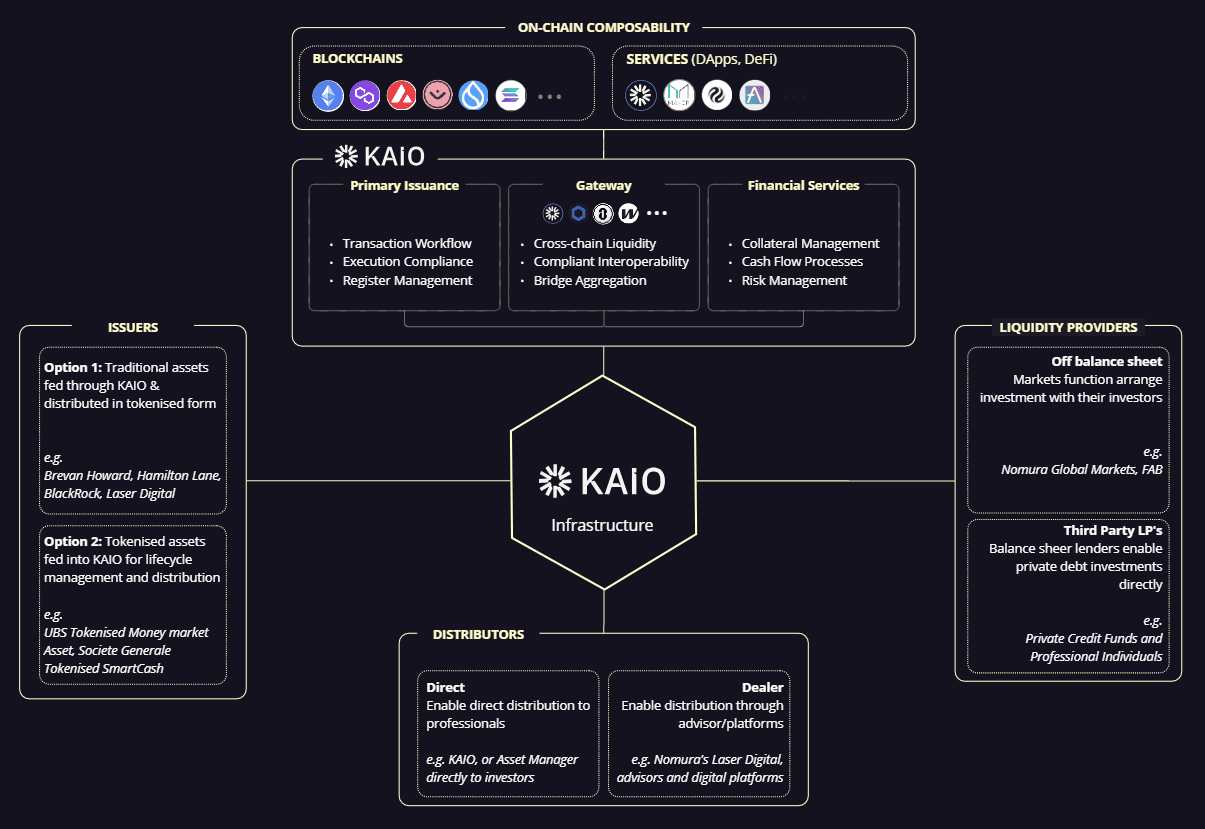
An overview of KAIO's infrastructure | Source: KAIO docs
KAIO operates as a programmable protocol that automates the back-office workflows of fund management. It utilizes a three-tier architecture to ensure security and scalability:
1. The Infrastructure Layer: The AppChain
KAIO utilizes a sovereign AppChain to manage fund issuance, subscriptions, redemptions, and Net Asset Value (NAV) calculations. By moving these processes on-chain, the protocol eliminates the high administrative costs and legacy friction associated with traditional fund distribution.
2. The Compliance Engine
Compliance is hard-coded into the KAIO Protocol. Every transaction is screened against a modular compliance engine. Only whitelisted or verified wallets, those that have passed necessary KYC/AML checks, can hold or trade KAIO-issued tokens. This allows institutions to tap into DeFi liquidity without fearing regulatory breaches.
3. The Product Layer: CASH, SCOPE, VOLT
KAIO hosts a variety of Blue-Chip RWA products:
- CASH: Exposure to the BlackRock ICS US Dollar Liquidity Fund (Money Market).
- SCOPE: Senior secured private credit via Hamilton Lane.
- VOLT: A market-neutral digital asset strategy from Laser Digital.
- KASH (Upcoming): A single-token wrapper designed for retail/native digital users, offering a diversified basket of institutional yields with a target of up to 8% APR.
What Is the $KAIO Token Used For?
The $KAIO token is the native utility and governance engine of the protocol, designed with a fixed supply of 10,000,000,000 (10 billion).
- Governance: Holders vote on protocol upgrades, new asset classes for tokenization, and the allocation of the Community Reserve.
- Access and Staking: Staking $KAIO may provide priority access to new fund launches or lower fee tiers for institutional users.
- Ecosystem Coordination: It serves as the primary unit of account for the AppChain’s security and validator incentives.
What Is KAIO ($KAIO) Tokenomics?
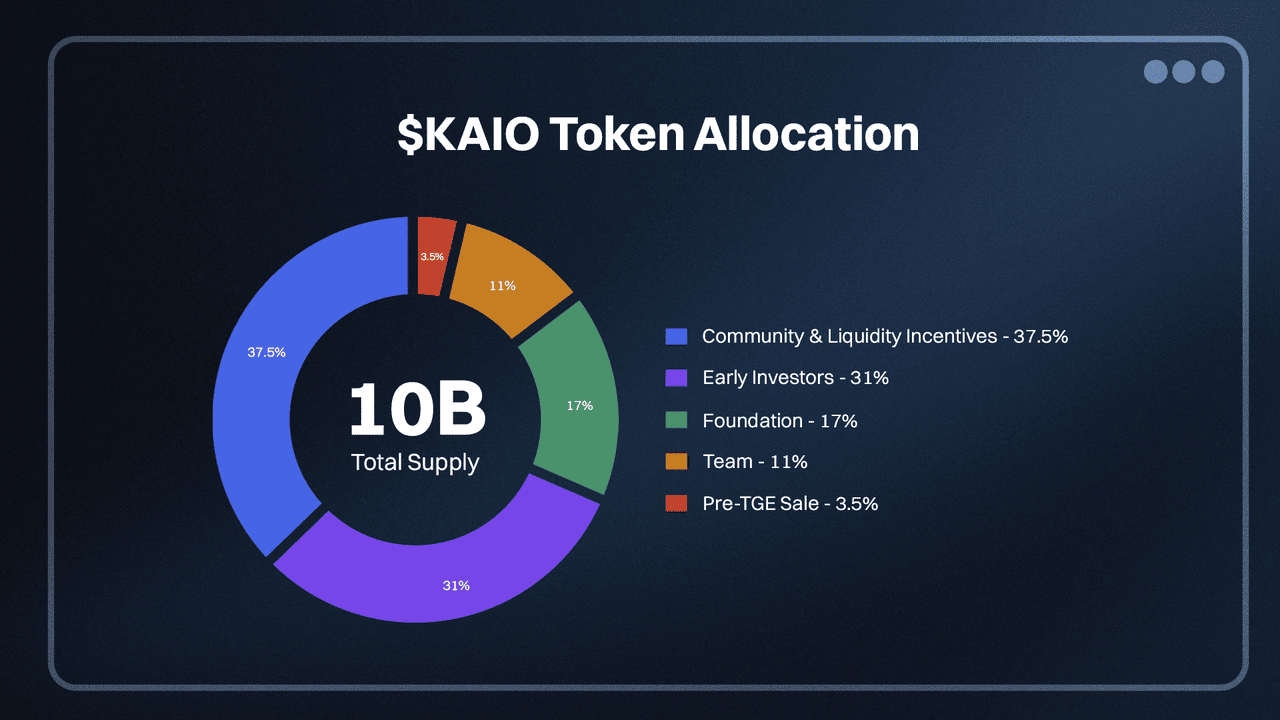
KAIO token allocation | Source: KAIO Community
The distribution of $KAIO is structured to support long-term ecosystem growth and reward early participants who helped build the protocol during its Libre era.
- Community and Liquidity Incentives (37.5%): The largest share, reserved for those providing liquidity and using the protocol. This includes the Phase 1 KAIO Airdrop of 5,000,000 tokens distributed on May 8, 2026, to Mission Board participants and early supporters.
- Ecosystem and Foundation: Managed by the KAIO Foundation to fund R&D, grants, and strategic partnerships with global asset managers.
- Core Contributors and Investors: Subject to strict vesting schedules. To ensure alignment, major backers like Laser Digital and WebN Group follow a 1-year cliff followed by linear monthly unlocks over 24 months.
KAIO vs. Traditional RWA Protocols: Key Differences
|
Feature |
KAIO Protocol |
Standard RWA Projects |
|
Primary Collateral |
Regulated Institutional Funds |
Physical Property / Private Debt |
|
Compliance |
Embedded/Programmable |
Manual Whitelisting |
|
Interoperability |
Native Omnichain (Solana, Sui, etc.) |
Mostly Single-Chain (Ethereum) |
|
Backing |
Nomura (Laser Digital), Brevan Howard |
Venture Capital / Community |
While traditional RWA protocols like Ondo Finance and Centrifuge focus on providing standardized on-chain wrappers for treasuries or decentralized credit marketplaces, KAIO distinguishes itself by operating as a sovereign AppChain specifically for institutional fund lifecycles. Unlike upstream issuers like BlackRock BUIDL, which require a $5 million minimum and offer limited direct DeFi utility, KAIO functions as the distribution layer that fractionalizes these blue-chip assets. It enables accredited investors to enter with as little as $100, while automating complex back-office workflows, such as NAV calculations, subscriptions, and redemptions, directly on-chain through modular smart contracts.
Practically, the differentiator lies in KAIO’s omnichain compliance architecture. While many RWA protocols are siloed on a single network, KAIO-issued tokens like CASH or SCOPE are designed as portable DeFi primitives. They can move across 10+ blockchains, including Ethereum, Solana, and Sui, while maintaining strict regulatory safeguards and investor permissioning. This infrastructure-first approach has allowed KAIO to secure over $95.6 million in TVL and handle $500 million in transactions as of May 2026, positioning it not just as a token issuer, but as the underlying plumbing for the next generation of institutional-grade on-chain capital markets.
How to Trade KAIO (KAIO) on BingX
BingX provides a streamlined experience for those looking to gain exposure to the RWA sector via the $KAIO token, powered by automated insights from BingX AI.
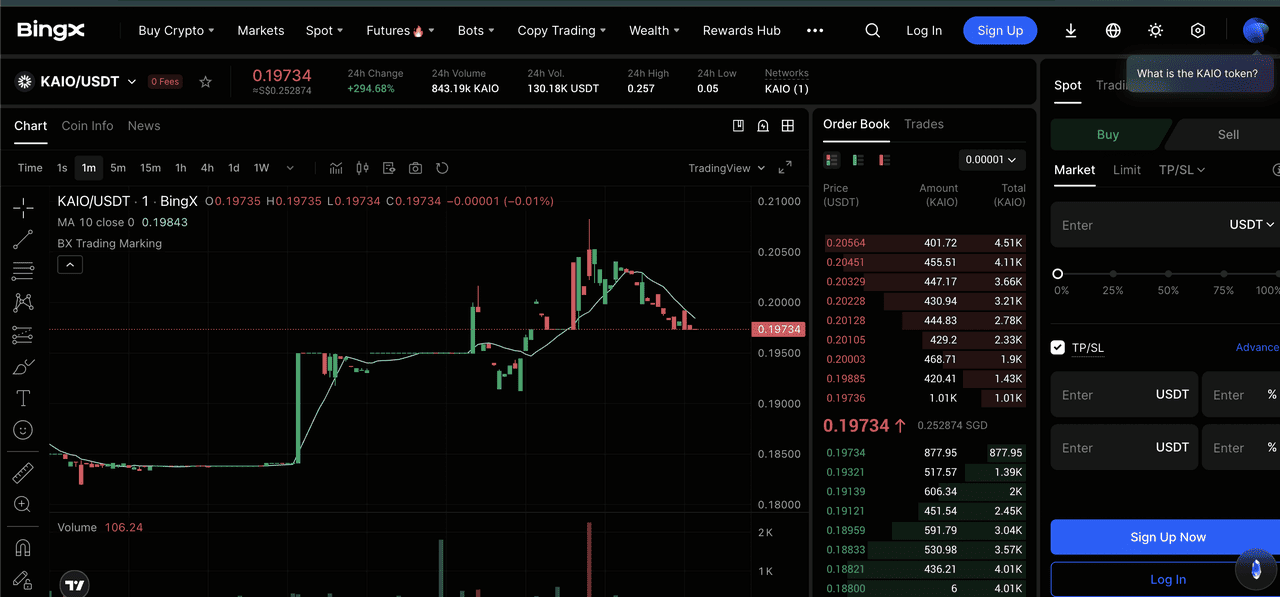
KAIO/USDT trading pair on the BingX spot market
Buy, Sell, or HODL KAIO on the Spot Market
- Search: Navigate to the Spot tab and search for the KAIO/USDT trading pair.
- Order Type: Select a Limit Order to set a specific entry price or a Market Order for instant execution.
- Confirm: Review the transaction and confirm. Your tokens will be visible in your Fund Account.
5 Key Considerations Before Investing in KAIO
Before allocating capital to the $KAIO ecosystem, it is essential to evaluate the structural risks of its fund-backed model and the technical nuances of the protocol's institutional dependencies.
- Regulatory Dependency: As a protocol dealing with regulated funds, KAIO is subject to the evolving legal frameworks of Singapore (MAS) and Abu Dhabi (ADGM).
- Redemption Windows: Unlike standard crypto tokens, the underlying RWA funds may have monthly or daily liquidity windows, e.g., 30-day epochs for private credit.
- Accreditation Requirements: While KASH targets retail, many of the primary funds (CASH, VOLT) remain restricted to Accredited Investors in specific jurisdictions.
- Tether Strategic Alignment: The recent backing from Tether indicates that $USDT will likely become the primary settlement asset for KAIO's global capital flows.
- Technical Security: While audited, the protocol relies on smart contracts to bridge physical legal rights with digital tokens.
Final Thoughts: Is KAIO the Gateway to On-Chain Institutional Yield?
KAIO serves as a functional bridge between the high-compliance environment of global asset management and the liquidity of the digital asset market. As of May 2026, the protocol has successfully shifted the RWA narrative from static collateral to InfraFi, where institutional funds from BlackRock and Brevan Howard operate as programmable, yield-bearing primitives. For users, the practical utility lies in the protocol's ability to lower entry barriers, reducing traditional multi-million dollar minimums to as low as $100, while maintaining the legal protections of a sovereign AppChain. This infrastructure standardizes the movement of regulated capital, potentially making institutional yield a foundational component of on-chain portfolios.
The long-term viability of the KAIO ecosystem depends on its ability to scale its omnichain vision across diverse networks while maintaining its $95.6 million TVL growth trajectory. For strategic participants in the KAIO ecosystem, success requires balancing the benefits of institutional-grade security with the operational realities of TradFi-linked assets, such as specific redemption windows and jurisdictional restrictions. As the protocol expands through its strategic partnership with Tether, it positions $KAIO not merely as a speculative asset, but as a critical utility layer for the $30 trillion alternative investment market.
Risk Reminder: RWA investments involve unique risks, including liquidity constraints and regulatory shifts. Always perform your own research and verify eligibility for specific products on the official KAIO portal.
Related Reading
- What Is Ondo Finance (ONDO), Bringing Tokenized RWAs and Real-Yields On-Chain?
- Top Real-World Asset (RWA) Tokenization Projects of 2026
- Top 10 Blockchains for Real‑World Asset (RWA) Tokenization Projects in 2026
- What Is USDai (CHIP) InfraFi for GPU-Backed Yield and How Does It Work?
- What Is MANTRA (MANTRA) RWA Layer 1 Blockchain and How to Buy the MANTRA Token?
