
intellifi (INTE) is an AI-powered decentralized finance (DeFi) vault platform designed to automate complex investment strategies through autonomous agents. By converting user intents and natural language prompts into on-chain execution, intellifi simplifies yield optimization and asset management for both retail and institutional users.
As of May 2026, the intellifi ecosystem has surpassed $776,000 in testnet volume with over 1,000 active users. With strategic partnerships involving BananaTech for RWA bridges and IQ blockchain for AI-driven education, the protocol is positioning itself as the primary intelligent layer for the multi-chain DeFi landscape.
This article examines the architecture of intellifi's autonomous AI agents, the mechanics of its adaptive vault strategies, the utility of the INTE token, how to navigate the platform's AI-driven ecosystem, and how to trade intellifi (INTE) tokens on BingX.
What Is intellifi (INTE)?
intellifi (INTE) is an Intelligent Onchain Finance protocol that bridges the gap between complex DeFi mechanics and user-friendly automation. Traditionally, DeFi yield farming requires manual rebalancing, gas optimization, and constant monitoring of dozens of protocols like Aave, Uniswap, and Curve. intellifi replaces this manual labor with Autonomous AI Agents.
The platform’s core mission is to provide intent-based execution. Instead of manually swapping tokens and depositing them into pools, users provide a prompt or select a strategy, and the AI handles the underlying smart contract interactions across 50+ protocols. intellifi offers:
- Prompt-to-Execution: Users can use voice or text prompts to trigger on-chain transactions.
- Adaptive Yield Strategies: Machine learning models that rebalance portfolios in real-time based on market volatility and liquidity patterns.
- Non-Custodial Intelligence: While the AI manages the strategy, users maintain 100% custody of their funds with no lock-up periods.
How Does the intellifi Ecosystem Work?
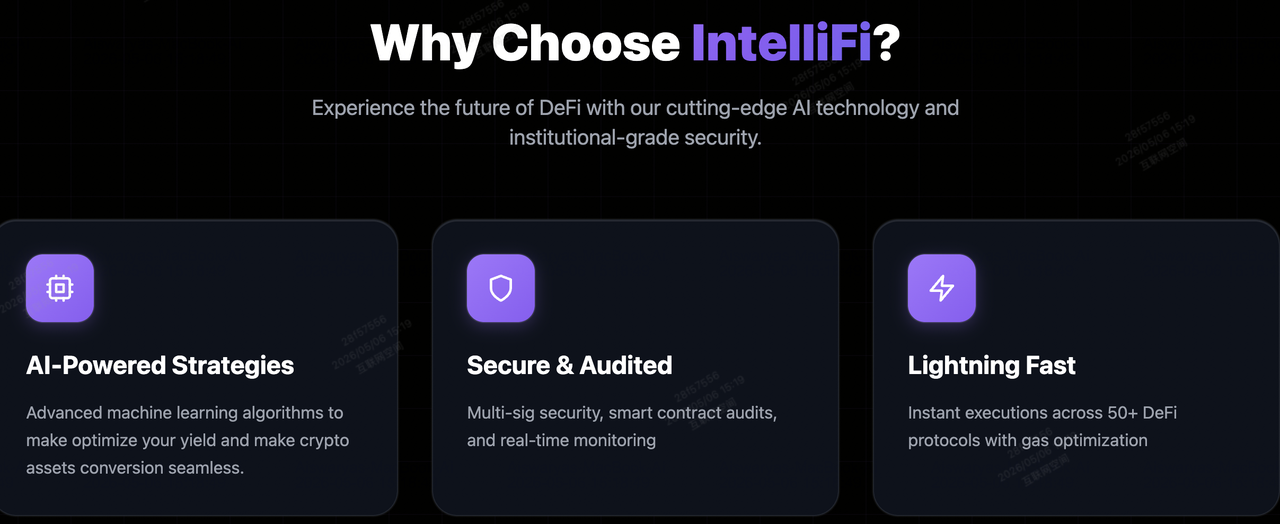
Key benefits of intellifi protocol | Source: intellifi
intellifi operates as a sophisticated aggregator layer that sits on top of existing blockchains like Ethereum and Polygon. Its workflow is divided into three functional layers:
1. AI Vaults: The Strategy Layer
Users deposit assets like ETH, USDC, and WBTC into one of three primary vault archetypes:
- Conservative: Focuses on stablecoin yields and low-risk lending protocols with minimal exposure to volatility.
- Balanced: A hybrid approach using liquidity provision (LP) and blue-chip asset staking.
- Aggressive: High-yield seeking models that utilize leverage, newer protocols, and dynamic arbitrage.
2. Autonomous Agents: The Intelligence Layer
The brain of the protocol consists of machine learning models that analyze hundreds of data points, including:
- Predictive Market Analysis: Forecasting price movements to time entries and exits.
- Gas Optimization: Scheduling executions when network fees are lowest to maximize net APY.
- Risk-Adjusted Rebalancing: Automatically moving capital out of protocols showing signs of liquidity stress or smart contract risk.
3. Multi-Chain Connectivity: The Execution Layer
intellifi uses a bridge-free operations philosophy where possible, aiming for seamless cross-chain yield aggregation. By integrating with 50+ protocols, the AI can find the highest Real Yield without the user needing to manually bridge assets between networks.
What Is the $INTE Token Utility?
The INTE token serves as the backbone of the intellifi ecosystem, facilitating governance, incentivizing performance, and powering the AI infrastructure.
- Governance: INTE holders vote on Protocol Parameter Adjustments, such as which new DeFi protocols to integrate or how to allocate the DAO treasury.
- Performance Fee Sharing: The platform charges a 10% performance fee on profits. A portion of these fees is often redirected to INTE stakers or used for protocol buybacks.
- Tiered Access: Higher tiers of INTE holders may gain access to Institutional Vaults with advanced risk management features and lower latency execution.
- Education and RWA Access: Following the partnership with BananaTech, INTE plays a role in bridging AI strategies with real-world payment infrastructure.
How to Buy intellifi (INTE) on BingX
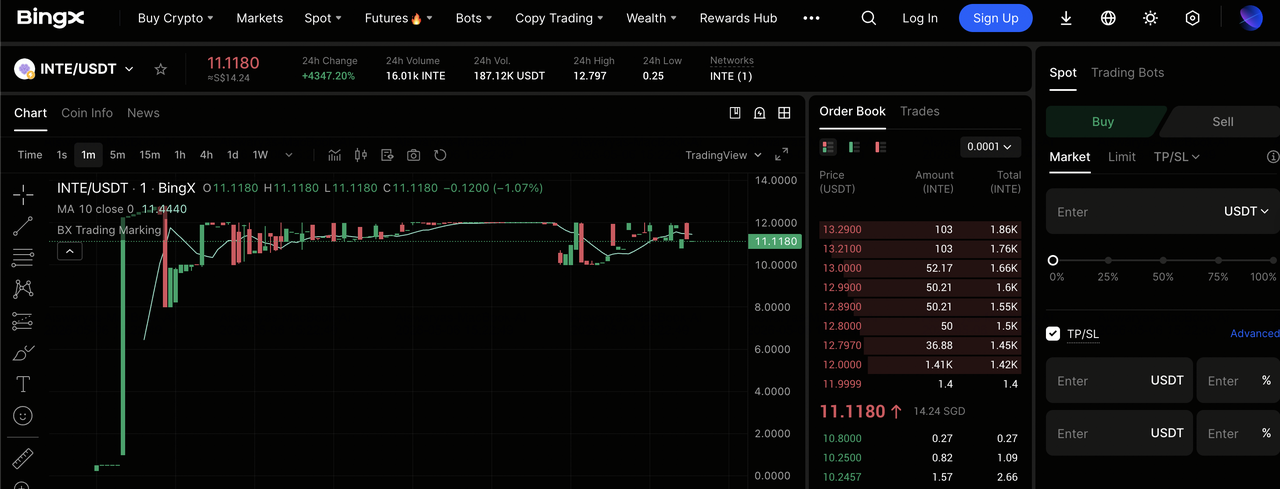
INTE/USDT trading pair on the BingX spot market
To optimize your entry into the AI-DeFi (DeFAI) sector, you can utilize BingX AI to analyze real-time technical indicators and market sentiment for the INTE/USDT pair before executing your trade.
- Access the Spot Market: Log in to your BingX account, navigate to the Spot tab on the top menu, and search for the INTE/USDT trading pair in the search bar.
- Select Your Order Type: Choose a Market Order for instant execution at the current price, or a Limit Order to set a specific entry price where you want the trade to trigger.
- Enter Amount and Confirm: Input the amount of USDT you wish to spend or the quantity of INTE you want to buy, then click Buy INTE to finalize the transaction.
- Manage Your Assets: Once the order is filled, your tokens will appear in your Fund Account where you can hold them or stake them for yield.
intellifi Roadmap and Development
IntelliFi follows a structured, multi-phase deployment strategy to transition from a secure foundational protocol to a globally accessible, AI-managed financial ecosystem.
- Phase 1: Foundation (Q4 2025)
- Establishment of core vault functionality and initial AI strategy implementations.
- Completion of comprehensive smart contract audits and the formation of strategic DeFi protocol partnerships.
- Phase 2: Expansion (Q1 2026)
- Launch of the Testnet Campaign and integration of additional partner protocols for wider liquidity access.
- Introduction of the DAO governance framework and the official community governance launch.
- Phase 3: Innovation (Q2 2026)
- Official Mainnet launch and the release of the native INTE token through presales and public listings.
- Expansion into specialized AI prediction markets to offer new utility for intelligent agents.
- Phase 4: Ecosystem (Q3 2026)
- Deployment of institutional-grade vaults and advanced risk management dashboards.
- Global expansion efforts and the release of the IntelliFi mobile application for on-the-go asset management.
intellifi vs. Traditional DeFi Yield Aggregators: Key Differences
|
Feature |
IntelliFi (INTE) |
Standard Aggregators (Yearn/Beefy) |
|
Decision Making |
Real-time AI Agents |
Static Smart Contract Logic |
|
User Input |
Natural Language/Intents |
Manual Transaction Building |
|
Strategy Updates |
Autonomous & Adaptive |
Governance Proposal/Manual Code Update |
|
Interactivity |
Voice & Local Language Support |
Web3 Dashboard Only |
Unlike traditional yield aggregators like Yearn Finance or Beefy, which rely on static, 'if-then' smart contract logic and periodic manual vault harvests, IntelliFi utilizes Autonomous AI Agents to execute real-time, adaptive rebalancing. While legacy aggregators are often limited to pre-defined strategies that require governance proposals to pivot, IntelliFi’s machine learning models analyze market data and liquidity depth across 50+ protocols to move capital instantly. This shift from reactive to predictive execution allows IntelliFi to mitigate impermanent loss and capture fleeting alpha that traditional, slow-moving vaults typically miss.
From a practical efficiency standpoint, IntelliFi significantly reduces the cost of complexity through automated gas optimization and a performance-based fee structure. Traditional aggregators often require users to manually bridge assets and manage multiple transaction approvals, incurring high cumulative fees and slippage. In contrast, IntelliFi’s intent-based architecture batches operations and executes them during low-congestion windows, net-optimizing the 10% performance fee. By abstracting the technical barriers of multi-chain bridging into a single prompt-to-execution interface, IntelliFi moves DeFi from a manual, high-maintenance activity to a streamlined, institutional-grade automated experience.
5 Key Considerations Before Using intellifi
Before allocating capital to the protocol, it is essential to evaluate the structural nuances of AI-managed vaults and the specific risk parameters inherent in the IntelliFi ecosystem.
- Performance Fees: Remember that IntelliFi takes a 10% cut of profits. If the strategy doesn’t make money, you aren't charged a fee beyond standard network gas.
- Smart Contract & Composable Risk: Despite rigorous audits, interacting with 50+ external protocols introduces composable risk. If an underlying DEX or lending pool fails, it can impact the vault’s performance.
- No Lock-ups: Users maintain 100% custody and can withdraw funds at any time, providing a significant liquidity advantage over traditional institutional products.
- Gas Efficiency & Minimums: The AI batches transactions to minimize overhead; however, while there is no hard minimum, a deposit of at least $100 is recommended to keep gas costs proportionally effective.
- Mainnet Transition: As IntelliFi moves from testnet to mainnet in Q2 2026, keep an eye on the official INTE Token Generation Event (TGE) and the release of new risk-adjusted strategy tiers.
Final Thoughts: Can intellifi Drive the Rise of Agentic Finance?
As of May 2026, IntelliFi serves as a functional benchmark for the Agentic Web, transitioning DeFi from a manual, high-friction activity into an intent-based automated service. By integrating machine learning with non-custodial vaults, the protocol provides a practical solution for users seeking optimized yields without the overhead of constant monitoring across fragmented Layer 1 and Layer 2 networks. The long-term viability of the ecosystem will depend on the AI’s ability to maintain stable risk-adjusted returns as it scales into institutional-grade vaults and expands its cross-chain footprint to Arbitrum and beyond.
For the strategic investor, IntelliFi functions as a foundational tool for on-chain capital management, abstracting complex execution into a single, prompt-to-yield interface. Success within this ecosystem requires a balanced approach: utilizing the AI’s predictive capabilities for efficiency while remaining mindful of the 10% performance fee and the inherent volatility of the protocols the agents interact with. As the platform moves toward its Q2 2026 mainnet launch, it represents a significant shift toward a more accessible and data-driven financial landscape where intelligence, rather than technical expertise, dictates market participation.
Risk Reminder: AI-driven DeFi involves significant market and technical risks. AI models can fail during black swan events, and smart contract vulnerabilities are always a possibility. Conduct thorough research and never invest more than you can afford to lose. BingX is not responsible for any trading losses.
Related Reading
- What Are the Top 7 DeFAI (AI + DeFi) Projects to Watch in 2026?
- What Is USDai (CHIP) InfraFi for GPU-Backed Yield and How Does It Work?
- What Are the Top 10 Base AI Agent Projects to Know in 2026?
- Top 7 AI Agent Tokens on Solana to Watch in 2026 Amid the Rise of the Machine Economy
- What Is UnifAI Network (UAI) Agentic Finance Layer for Autonomous DeFi and How to Buy?
