

Tagger (TAG) is an AI data infrastructure token built around decentralized data collection, labeling, authentication, management, and trading. Instead of following the traditional AI data model, where datasets are sourced, labeled, and controlled by centralized vendors, Tagger uses Web3 crowdsourcing and blockchain-based verification to create a more open data layer for AI developers, contributors, and dataset owners.
As AI models became more powerful and demand for high-quality training data increased, Tagger expanded from a data-labeling narrative into a broader AI data marketplace ecosystem. The ecosystem has several key parts: TAG is the token at the center of task rewards and marketplace activity, Proof-of-Human-Work connects token distribution to completed data processing work, AI Copilot helps contributors label image, voice, text, and video datasets more efficiently, and the data marketplace supports dataset trading, authorization, and monetization. This guide explains what Tagger is, how the network works, how TAG tokenomics function, the main risks to consider, and how to trade TAG on BingX.
What Is Tagger (TAG)?
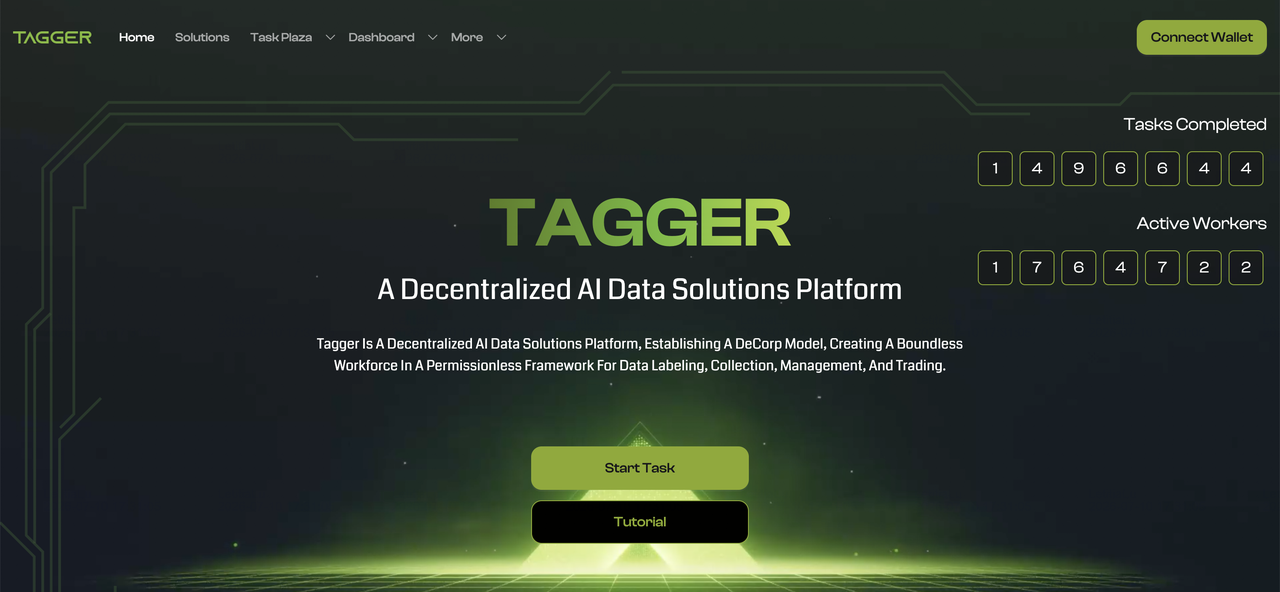
Source: Tagger
Tagger (TAG) is the token connected to Tagger, a decentralized full-stack AI data solutions platform. The ecosystem is built around data collection, data labeling, data authentication, data management, and data trading.
Tagger’s documentation describes the platform as a decentralized full-stack AI data solution covering collection, labeling, management, authentication, trading, and service. The project is designed to solve several problems in the current AI data economy, including data silos, unclear data ownership, unreliable data credibility, difficulty acquiring high-quality datasets, and a shortage of specialized annotators.
The main difference between Tagger and many AI crypto projects is that Tagger focuses on the data layer. Instead of only talking about AI agents or compute, Tagger focuses on the raw material that AI models need: high-quality training data.
Key parts of the Tagger ecosystem include:
- TAG token: The crypto asset connected to the Tagger ecosystem and its AI data infrastructure narrative.
- Data collection: A platform for individuals and institutions to publish and complete data collection tasks.
- Data labeling: Annotation tools for image, text, voice, video, and industry-specific datasets.
- AI Copilot labeling: AI-assisted tools that help contributors produce higher-quality annotations.
- Data authentication: Blockchain-based systems for confirming data ownership, credibility, and authorization.
- Data marketplace: A permissionless platform for dataset trading, licensing, and monetization.
The core idea behind Tagger is that AI data should be easier to collect, verify, and exchange. TAG gives traders exposure to that AI data infrastructure narrative.
Read More: What Are the Top 10 AI Crypto Projects to Watch in 2026?
How Does Tagger Work?
Tagger works by combining AI data workflows with Web3 incentives and blockchain-based verification. Its goal is to connect data contributors, dataset owners, AI developers, and data buyers through one decentralized platform.
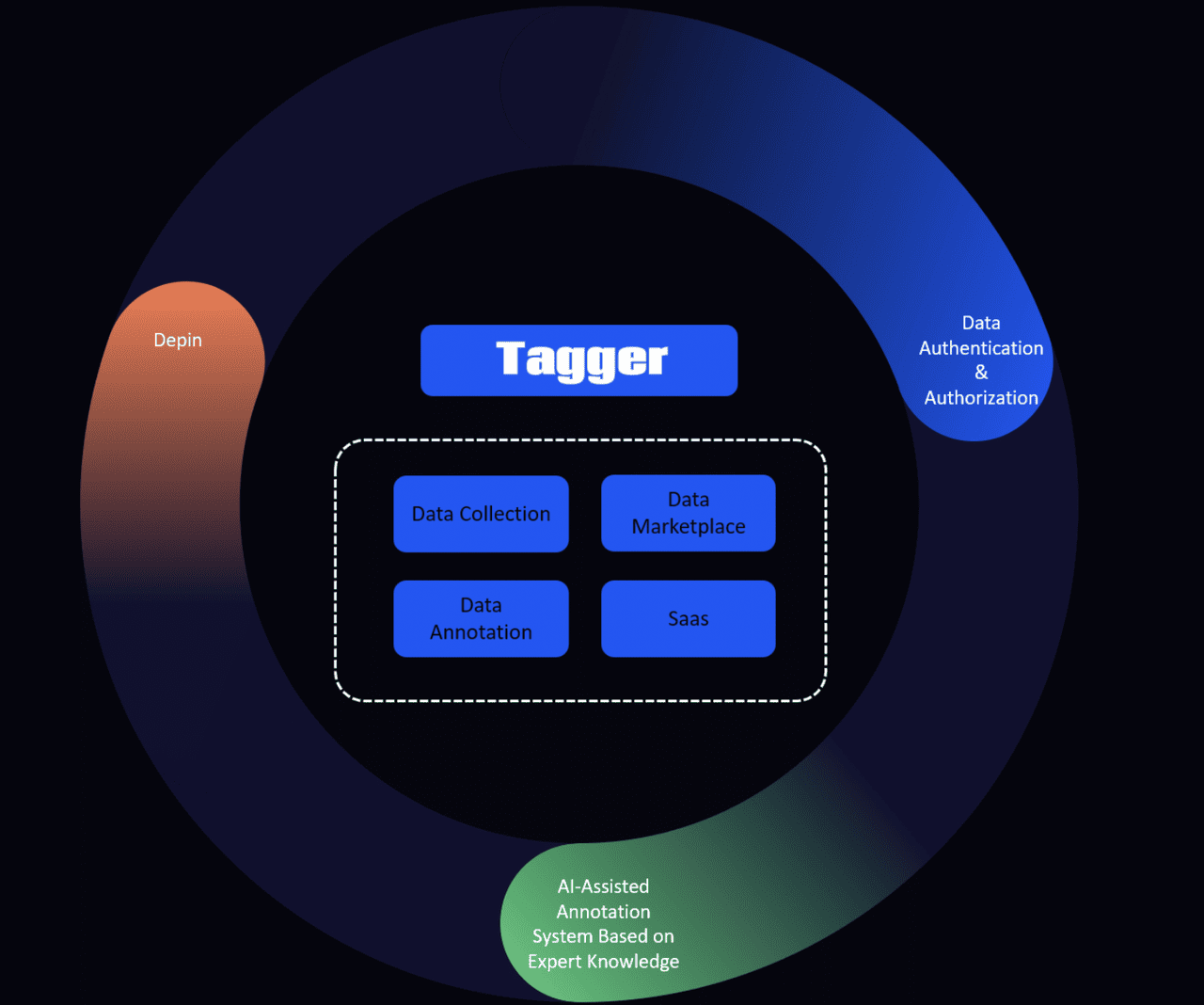
Source: Tagger Documentation
- Data tasks are published: Institutions, developers, or dataset owners can create tasks for data collection, labeling, review, or processing.
- Contributors complete tasks: A wider Web3 contributor network can participate in data work instead of relying only on centralized annotation teams.
- AI Copilot supports labeling: Tagger’s AI-assisted labeling tools help contributors annotate image, voice, text, video, and professional datasets more efficiently.
- Data is cleaned and verified: The platform uses automated systems, blockchain-based authentication, and data rights confirmation to improve dataset quality and ownership clarity.
- Contributors receive rewards: Users who complete valid tasks can receive incentives for their work, creating a crypto-native labor layer for AI data.
- Datasets can enter the marketplace: Verified datasets can be traded, licensed, authorized, or monetized through Tagger’s data marketplace.
Tagger’s long-term thesis is that data should become a more liquid and verifiable asset class. If AI models need better data, then the platforms that collect, clean, label, and verify that data could become important parts of the AI economy.
Read More: What Are the Top 10 AI Agent Crypto Projects of 2026?
Tagger vs. Grass: Key Differences Between AI Data and Decentralized Data Networks
Tagger and Grass are often compared because both sit inside the AI data narrative, but they focus on different parts of the data economy. Tagger is built around data collection, labeling, authentication, management, and trading, while Grass is generally known as a decentralized data network that uses distributed user bandwidth to collect public web data for AI training.
|
Feature |
Tagger (TAG) |
Grass (GRASS) |
|
Core focus |
AI data collection, labeling, authentication, management, and trading |
Decentralized web data collection for AI training |
|
Main data source |
Contributor-created and contributor-processed datasets, including labeling and review tasks |
Public web data gathered through a distributed user network |
|
User role |
Contributors complete data collection, labeling, review, and validation tasks |
Users share unused bandwidth to support data collection |
|
Product angle |
Full-stack AI data workflow platform with AI Copilot labeling and data marketplace ambitions |
Data network focused on turning distributed internet access into AI training data infrastructure |
|
Token narrative |
TAG is tied to AI data work, Proof-of-Human-Work, contributor rewards, and marketplace activity |
GRASS is tied to decentralized web data collection and user-powered data infrastructure |
|
Main risk |
Data quality, contributor reliability, marketplace demand, and token utility |
Data access quality, network scale, privacy concerns, and competition in AI data collection |
The key difference is that Grass is a DePIN project focuses more on collecting public web data, while Tagger focuses more on processing, labeling, verifying, and monetizing data through a broader AI data workflow.
Read More: What Are the Top 10 DePIN Crypto Projects to Know in 2026?
Tagger Ecosystem in 2026: AI Data Demand, Binance Alpha Visibility, and Data Marketplace Growth
Tagger’s 2026 story is built around one of the most important bottlenecks in AI: data. As AI models become more advanced, demand for clean, verified, and specialized datasets continues to grow. Tagger positions itself as a decentralized data infrastructure platform for collecting, labeling, authenticating, managing, and trading AI data.
Unlike meme coins that depend mainly on culture and attention, Tagger’s narrative is more infrastructure-driven. The project focuses on the data layer behind AI development, using Web3 incentives and AI-assisted tools to connect data contributors, dataset owners, and potential buyers.
- AI data becomes a stronger market narrative: As AI models scale, the market is paying more attention to the quality, ownership, and availability of training data. Tagger benefits from this shift because its core product focuses on collecting, labeling, verifying, and trading AI datasets.
- TAG gains visibility through the AI & Big Data category: TAG sits inside the AI & Big Data category, giving the token a clear market category for traders following AI infrastructure assets.
- Binance Alpha tagging increases trader attention: TAG’s Binance Alpha visibility can improve attention among users tracking early-stage or high-attention tokens.
- BNB Smart Chain exposure supports retail liquidity: TAG is connected to BNB Chain, a high-activity retail ecosystem where new AI and infrastructure tokens can attract fast speculative attention.
- AI Copilot labeling gives the project a practical product angle: Tagger’s AI-assisted labeling tool makes the platform easier to understand because it connects the data narrative to a real workflow: helping users label specialized datasets more efficiently.
- Data marketplace model expands the long-term thesis: Tagger is not only about data labeling. Its broader story is about creating a permissionless marketplace where verified datasets can be traded, licensed, and monetized.
Tagger is gaining attention because it gives crypto investors a clear AI data narrative. The upside is that high-quality data remains essential for AI development. The challenge is whether Tagger can build real task demand, maintain data quality, attract contributors, and create meaningful marketplace activity beyond the AI hype cycle.
Read More: Top AI Data Center Stocks to Buy in 2026: Cloud, Servers, and AI Compute Infrastructure
What Are the Tagger (TAG) Tokenomics?
TAG tokenomics center on a large AI data infrastructure supply structure, a decentralized contributor model, and a marketplace thesis built around data collection, labeling, authentication, management, and trading. TAG has a total supply of 405,380,800,000 tokens, with its distribution mainly split across Proof-of-Human-Work, Tag-to-Pump, and Liquidity.
This gives TAG a different tokenomics profile from many VC-heavy AI tokens. The largest allocation is tied to Proof-of-Human-Work, meaning token distribution is designed around data processing work rather than only insider unlocks or passive emissions.
TAG Token Utility and Supply Mechanisms
TAG is the token connected to the Tagger ecosystem. Its long-term value depends on whether Tagger can build real demand across data tasks, contributor rewards, dataset verification, and marketplace activity.
- Data task incentives: TAG may support rewards for contributors who complete data collection, labeling, review, or validation work across the Tagger platform.
- AI data marketplace activity: TAG is tied to Tagger’s broader marketplace thesis, where verified datasets can be traded, licensed, or monetized.
- Proof-of-Human-Work distribution: TAG issuance is connected to data processing work, giving the token a labor-based distribution model rather than a purely narrative-driven launch structure.
- Data authentication and ownership: Tagger uses blockchain-based systems to support data credibility, ownership, and authorization, giving TAG a role inside the platform’s data infrastructure narrative.
- Contributor network alignment: TAG can help align data contributors, dataset owners, and data buyers inside one decentralized workflow.
- AI data infrastructure exposure: For traders, TAG provides market exposure to one of the clearest AI bottlenecks: the need for clean, verified, and specialized training data.
TAG Token Allocation
TAG has a total supply of 405,380,800,000 tokens. According to Tagger’s tokenomics disclosure, the allocation is split across Proof-of-Human-Work, Tag-to-Pump, and Liquidity.
|
Holder Category |
Initial Allocation |
Description |
|
Proof-of-Human-Work |
74.00% |
300,000,000,000 TAG. Tokens are generated through participants’ data processing work, including data labeling and human-in-the-loop review tasks. |
|
Tag-to-Pump |
21.06% |
85,380,800,000 TAG. Launched through four.meme as a DeCorp experiment using a preorder of 106,726 data labeling tasks worth $50,000. Tokens were distributed to participating data labelers. |
|
Liquidity |
4.93% |
20,000,000,000 TAG. Initially paired with $50,000 worth of BNB and deployed to PancakeSwap as liquidity. |
Tagger’s allocation is closer to a proof-of-work-style distribution model for AI data work than a typical insider-heavy token launch. The largest share goes to Proof-of-Human-Work, which connects token distribution to completed data processing tasks. Investors should still monitor how future rewards, marketplace incentives, liquidity depth, and circulating supply evolve as the platform grows.
How to Trade Tagger (TAG) on BingX
BingX offers two practical ways to gain exposure to Tagger, depending on whether the goal is direct ownership or short-term trading. Spot trading is better suited for users who want to buy and hold TAG directly, while futures trading is designed for active traders who want long or short exposure to TAG price movements.
Spot Trading: Buy and Own TAG Directly
Spot trading is the most straightforward way to buy Tagger on BingX. When users buy TAG on the spot market, they own the asset directly and can hold it in the BingX spot account, transfer it, or withdraw it to a BNB Smart Chain-compatible self-custody wallet if withdrawals are supported.
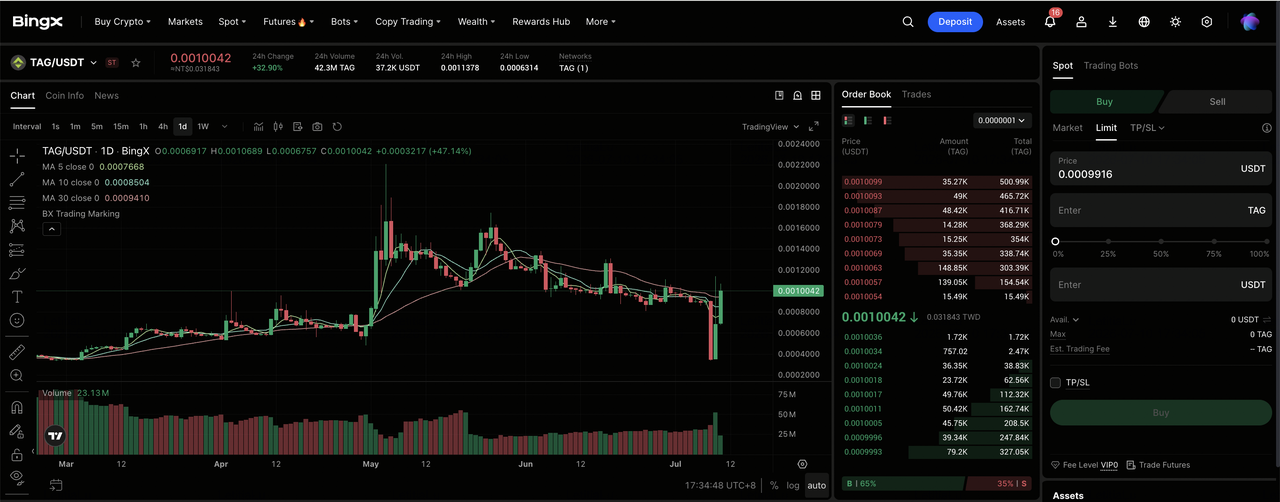
Step 1: Account setup and security. Sign up and log into your BingX account, complete the identity verification (KYC) required in your region, and enable two-factor authentication.
Step 2: Fund your spot account. Deposit USDT or another supported asset into your BingX spot account. Where available, users can also use supported fiat on-ramp options.
Step 3: Navigate to the spot market. Search for the TAG/USDT trading pair.
Step 4: Place your order. Choose a market order to buy TAG immediately at the current price, or use a limit order to set the price you want to pay.
Step 5: Manage your TAG. Once filled, your TAG appears in your spot account. You can keep it on BingX for convenience or withdraw it to a BNB Smart Chain-compatible self-custody wallet if withdrawals are supported.
Futures Trading: Trade TAG Price Movements
For active traders, BingX may offer USDT-margined TAG perpetual futures. Futures allow users to trade TAG price movements without holding the underlying asset, with the flexibility to open long positions if they expect TAG to rise or short positions if they expect TAG to fall.
Because futures involve leverage, they can amplify both gains and losses. This approach is more suitable for traders who already have a clear risk plan and understand liquidation risk, particularly for assets like TAG that is sensitive to AI data narratives, Binance Alpha attention, BNB Smart Chain liquidity, and data marketplace development.
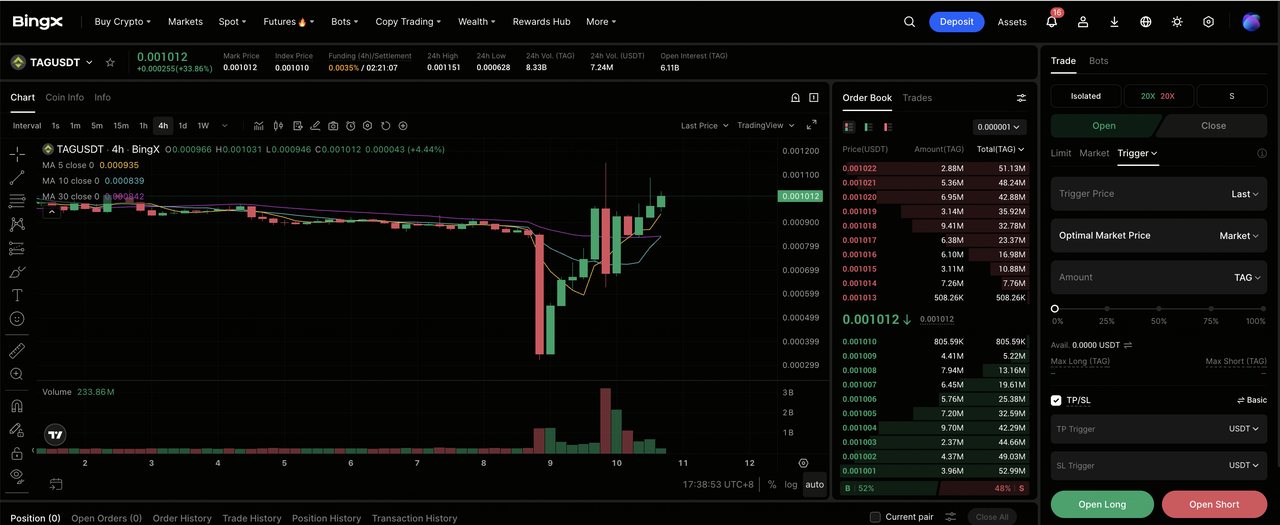
Step 1: Transfer collateral. Move USDT from your spot account into your futures account, where it will serve as margin.
Step 2: Select the contract. Search for the TAG-USDT perpetual contract.
Step 3: Set direction and leverage. Open long if you expect TAG to rise, or open short if you expect TAG to decline. Choose leverage based on your risk tolerance and position size.
Step 4: Execute the trade. Enter the order amount and choose a market or limit order depending on your trading plan.
Step 5: Manage risk. Set stop-loss and take-profit orders before or immediately after entering the position. Profit and loss settle dynamically in USDT.
Risks and Considerations Before Investing in Tagger (TAG)
Tagger has a clear AI data narrative, but it also carries several risks. Data infrastructure is important, but building a working decentralized data marketplace is difficult.
- Execution risk: Tagger needs real task demand, contributor activity, buyer demand, and marketplace volume. Without usage, the token may rely mainly on AI market attention.
- Data quality risk: Crowdsourced data platforms must prevent spam, low-quality submissions, inaccurate labeling, and manipulation.
- Token utility risk: TAG needs a clear role inside the platform. Investors should watch whether the token is used meaningfully in tasks, rewards, staking, marketplace activity, or governance.
- Supply and reward risk: TAG’s distribution is heavily tied to Proof-of-Human-Work, so investors should monitor how rewards, emissions, and circulating supply develop over time.
- Competition risk: Tagger competes with centralized data vendors, AI labeling companies, Web3 data networks, and AI infrastructure projects.
- Privacy and compliance risk: Data collection and marketplace activity can involve sensitive information. Privacy protection, authorization, and compliance standards are important for long-term adoption.
Final Thoughts: Should You Invest in Tagger (TAG) in 2026?
Tagger matters because AI needs data, and the data layer remains one of the hardest parts of the AI economy. Models can become more powerful, but they still need clean, verified, and specialized datasets to improve. Tagger’s thesis is that Web3 can make this process more open, global, and transparent.
The upside is that TAG gives investors and traders exposure to a real AI infrastructure theme: data collection, labeling, authentication, and marketplace activity. The risk is that this market is hard to execute in. Tagger needs to prove that contributors can produce useful data, buyers are willing to pay for it, and the token has a real role inside the platform.
For investors and traders, TAG is best understood as a high-risk AI data infrastructure token. The key metrics to watch are platform usage, task volume, contributor growth, dataset demand, token unlocks, reward distribution, and whether Tagger can build real marketplace liquidity beyond the AI hype cycle.
Related Reading
- What Are the Top 10 AI Crypto Projects to Watch in 2026?
- What Are the Top 10 AI Agent Crypto Projects of 2026?
- What Is Sentient (SENT)? A Beginner’s Guide to Open-Source AGI and Decentralized AI in 2026
- What Is Render (RENDER)? A Beginner’s Guide to Render Network, AI, and GPU Compute in 2026
- Top AI Data Center Stocks to Buy in 2026: Cloud, Servers, and AI Compute Infrastructure
- Top 10 AI Hardware Stocks to Watch in 2026: The Architecture Driving Next-Gen Intelligence
FAQs About Tagger (TAG)
1. What is TAG coin?
TAG is the native token and governance token of the Tagger platform. It is used for data task rewards, task posting, staking, dataset purchases, software subscriptions, AI model customization, and other platform activities.
2. Which chain is TAG on?
TAG is listed with a BscScan explorer link, which means it is on BNB Chain. Users should verify the official token details through trusted sources before transferring funds.
3. What wallets support TAG?
TAG can generally be checked in wallets that support BNB Chain tokens, such as MetaMask, Trust Wallet, Rabby, or supported hardware wallets. Always confirm wallet and exchange support before depositing or withdrawing.
4. When was the TAG airdrop?
TAG does not appear to follow a standard public airdrop model. Tagger’s official docs describe TAG distribution as task-based and contributor-driven through Proof-of-Human-Work and Tag-to-Pump participation.
5. What is Tag-to-Pump?
Tag-to-Pump is part of TAG’s token distribution. According to Tagger’s official docs, it was launched through four.meme as a DeCorp experiment for crowdsourced data-labeling tasks.
