

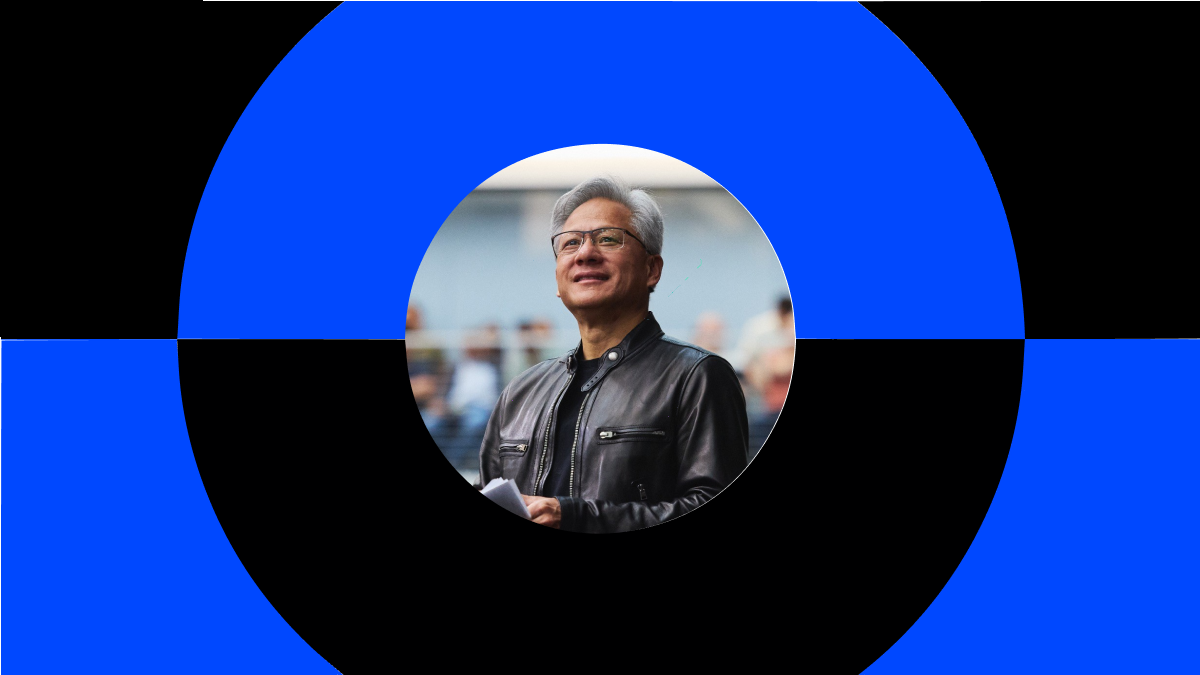
The global technology sector in 2026 is defined by a profound paradigm shift. The industry has decisively moved away from the traditional software-as-a-service (SaaS) model to enter a hyper-capital-intensive infrastructure era. Today, global economic dominance is dictated by physical compute capacity, advanced semiconductor packaging, and highly protected sovereign cloud systems. At the absolute epicenter of this macroeconomic transformation stands Jensen Huang, the co-founder, president, and CEO of Nvidia Corporation.
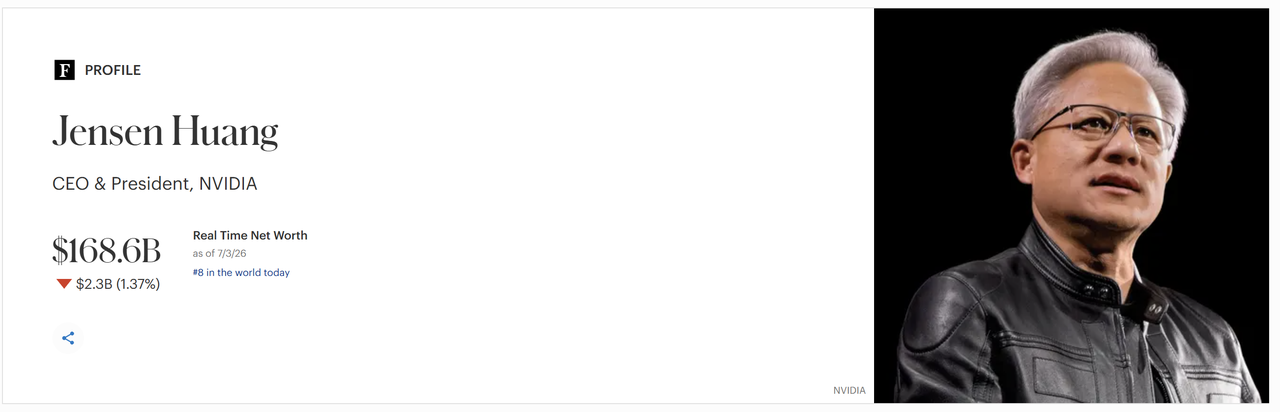
Huang’s personal wealth accumulation over the first half of the 2020s mirrors the unprecedented global rush for graphics processing units (GPUs) and full-stack data-center platforms. Under his strategic guidance, Nvidia achieved an extraordinary milestone, crossing a market capitalization of $5 trillion in October 2025. This historic valuation cemented the corporation’s status as the foundational hardware architect of the machine intelligence era. As a result, Huang's financial profile has transitioned from that of a highly successful Silicon Valley executive into one of the most powerful modern industrial fortunes on earth.
Who Is Jensen Huang?
Source: Jensen Huang LinkedIn
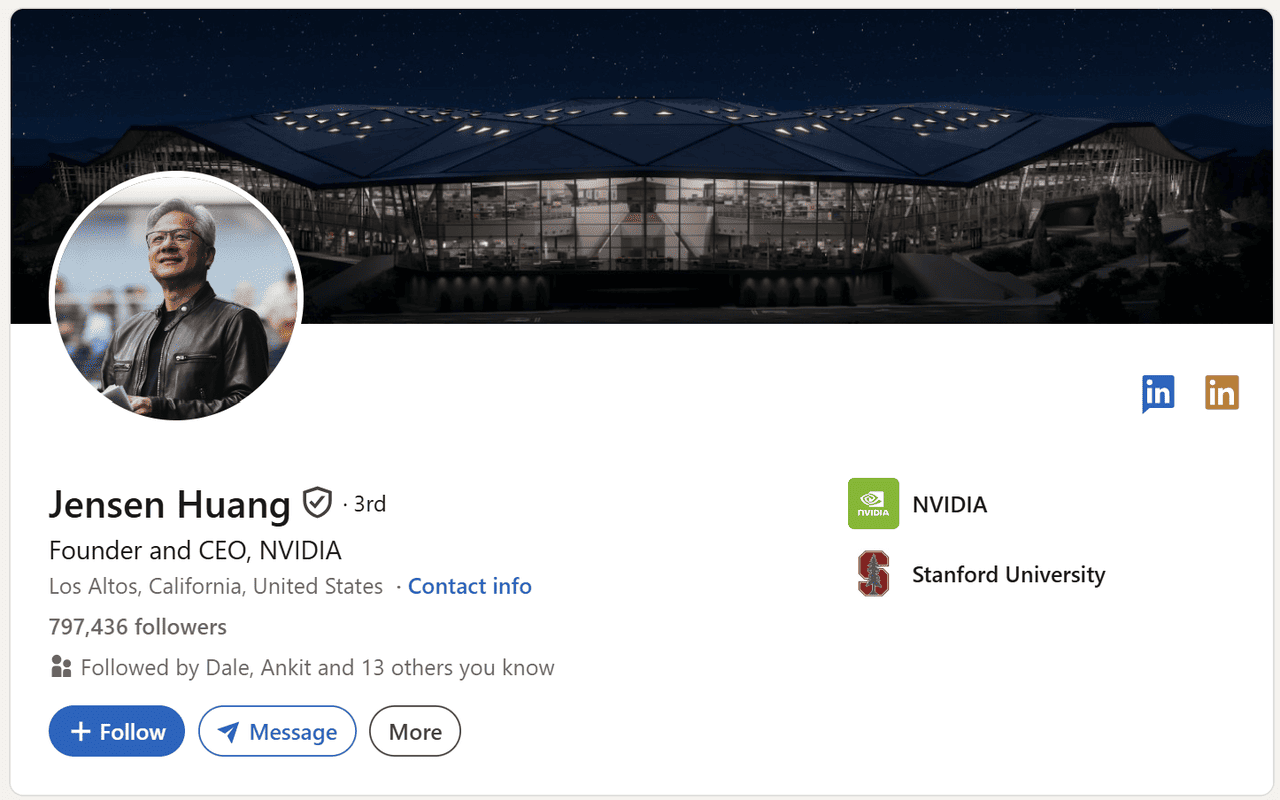
Jensen Huang is a Taiwanese-American electrical engineer, entrepreneur, and executive who has fundamentally altered the trajectory of modern computing. Born in Tainan, Taiwan, Huang moved to the United States as a child, later earning his undergraduate degree in electrical engineering from Oregon State University and a master's degree from Stanford University.
In 1993, alongside co-founders Chris Malachowsky and Curtis Priem, Huang established Nvidia with a core conviction: that the PC would eventually become a commercial consumer device for enjoying games and multimedia, requiring a specialized hardware component known as the graphics processing unit (GPU). For nearly three decades, Huang steered Nvidia through intense silicon competition, transitioning the company from a niche gaming hardware manufacturer into a dominant force in parallel computing.
His masterstroke arrived in 2006 with the introduction of the CUDA computing platform, a proprietary software layer that allowed developers to utilize Nvidia GPUs for general-purpose mathematical processing. This long-term bet laid the structural groundwork for the modern artificial intelligence explosion, transforming Nvidia's hardware into the indispensable backbone of hyper-scale data centers globally and placing Huang at the steering wheel of the global tech economy.
How Did Jensen Huang Build His Wealth?
Unlike traditional technology executives who diversify their assets across vast corporate holdings, real estate empires, and disparate venture capital funds, Huang’s multi-billion-dollar fortune is highly concentrated and structurally linear. His net worth is anchored on three clear strategic pillars:
1. High Equity Concentration
The primary vehicle for Huang’s wealth accumulation is his direct, long-term ownership of Nvidia common stock. Having held onto his founder shares through decades of market cycles, stock splits, and volatile tech corrections, Huang has maintained a highly concentrated position that ensures his net worth scales in lockstep with Nvidia's multi-trillion-dollar market capitalization.
2. Complete Hardware Monopolization
Huang positioned Nvidia not merely as a component vendor, but as a system-level monopoly. By anticipating the computing constraints of generative AI models years before they entered mainstream public awareness, Huang directed massive capital expenditures toward securing global supply chains for specialized components like High Bandwidth Memory (HBM) and advanced silicon packaging. This foresight enabled Nvidia to capture an estimated 75% to 80% of the global AI hardware infrastructure market by 2026.
3. The CUDA Software Moat
An architectural reality of the AI ecosystem is that hardware is only as effective as the software running it. By investing heavily in the CUDA parallel computing ecosystem for two decades, Huang created a massive developer dependency. This software moat prevents hardware competitors from easily eroding Nvidia’s pricing power, allowing the firm to maintain historic gross margins near 80% to 88% and consistently inflating the value of Huang's equity.
Jensen Huang's Net Worth in 2026: Key Estimates
The baseline metric of Jensen Huang's wealth in 2026 positions him firmly within the elite tier of global industrialists. Because his fortune is primarily tied to publicly traded equity, leading financial indexes track his net worth in real-time, reflecting day-to-day changes in market demand for AI infrastructure.
Jensen Huang Financial Status Registry (2026)
|
Wealth Metric |
2026 Financial Status |
Qualitative Influence & Analytical Context |
|
Baseline Assessment |
$154 Billion – $162.5 Billion |
Early 2026 baseline registry ranking across institutional wealth monitors. |
|
Bloomberg Billionaires Index |
$178 Billion |
Documented as of May 10, 2026, driven by intense corporate demand for next-gen chip architectures. |
|
Forbes Real-Time Peak |
$191.5 Billion |
Achieved in mid-May 2026, briefly ranking him as the 7th wealthiest individual globally. |
|
Mid-2026 Macro Estimate |
Over $200 Billion |
Consolidated Forbes projection evaluating sustained performance of the Blackwell and Rubin hardware rollouts. |
|
Nvidia Equity Control |
3.3% – 3.6% |
Total proportional ownership of outstanding common stock via personal and family trust vehicles. |
|
FY2026 Annual Compensation |
$36.6 Million |
Annual cash and equity executive award package, representing a 27% administrative reduction. |
Jensen Huang's Wealth vs. Nvidia's Corporate Revenue (2020–2026)
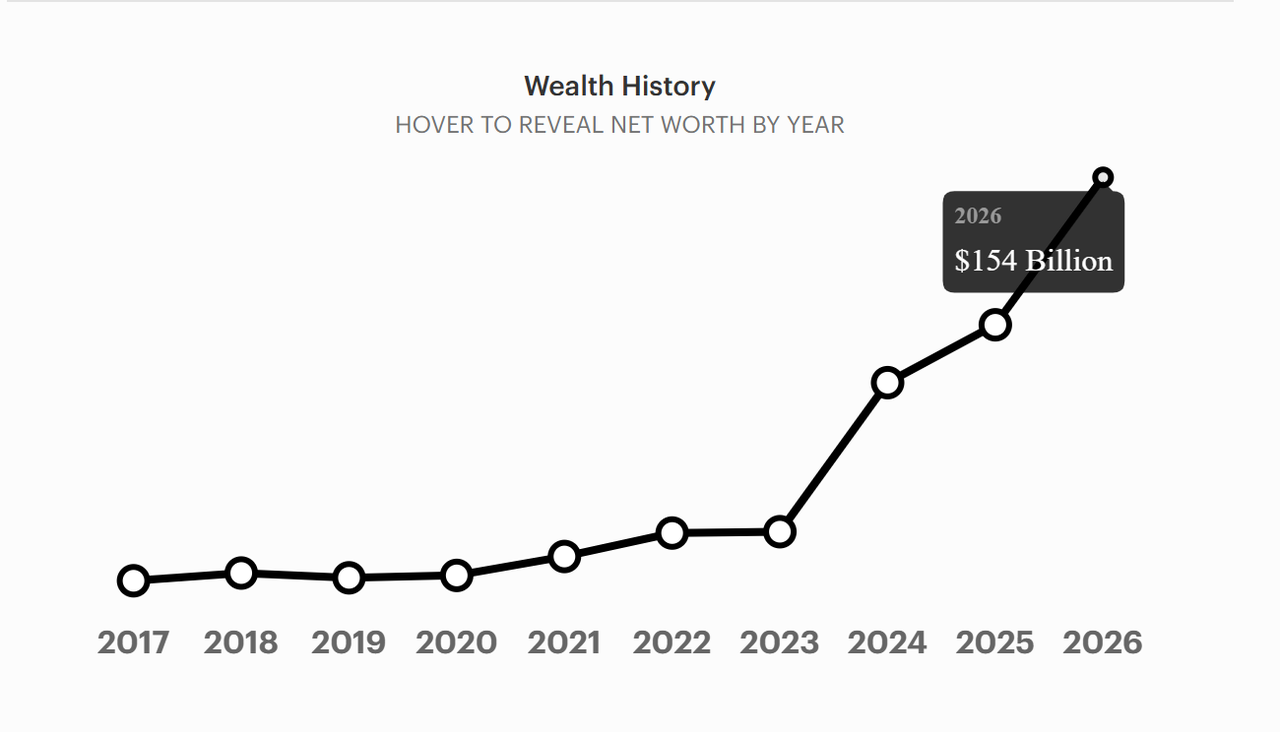
To understand the velocity of Huang's financial ascent, his net worth must be evaluated alongside Nvidia’s full-year corporate revenue expansions.
|
Calendar Year |
Huang's Estimated Net Worth ($B) |
Primary Growth Drivers |
Nvidia Full-Year Revenue ($B) |
Global Billionaire Ranking |
|
2020 |
$4.8 |
Early AI frameworks and premium gaming GPU demand |
$10.9 (FY2020) |
Outside Top 50 |
|
2022 |
$35.9 |
Enterprise machine learning and cloud infrastructure scaling |
$26.9 (FY2022) |
Top 30 |
|
2024 |
$121.0 |
Hyper-scale generative AI infrastructure buildout |
$47.5 (FY2024) |
Top 15 |
|
2025 |
$176.0 |
Historic $5 trillion corporate market cap achievement |
$115.2 (FY2025) |
Top 10 |
|
2026 |
$178.0 – $200.0+ |
Commercial Blackwell and Rubin platform deployment |
$215.9 (FY2026) |
Top 7 |
Market Domination, Software Moats, and AI Industry Impact
Nvidia dominates the generative AI hardware layer. In fiscal year 2026, data center business revenue hit $193.7 billion (over 90% of total corporate sales). This momentum surged into early fiscal year 2027, with record Q1 revenue of $81.6 billion, anchored by a $75.2 billion quarter from the data center wing alone.
To stave off rivals, Huang has evolved Nvidia from selling individual chips to deploying full-stack computing platforms.
Nvidia's Key 2026 Market Dynamics
- The "Vera" CPU Launch (May 2026): Engineered specifically to eliminate data bottlenecks in large-scale LLM inference, Vera runs twice as efficiently and 50% faster than traditional server microprocessors. Early enterprise launch partners include Meta, Oracle, Dell, and CoreWeave.
- The CUDA Moat: Nvidia’s proprietary computing platform is backed by over 4 million developers. It ensures Nvidia GPUs achieve 70% to 85% real-world efficiency, whereas competitors using less mature software stacks often throttle down to 45% efficiency due to software translation overhead.
- AI Compute Partner Program (July 1, 2026): Leveraging $96 billion in FY2026 free cash flow, Nvidia offers buyback guarantees on unused GPU capacity for smaller cloud providers like CoreWeave. This aggressively mitigates financial risk for boutique clouds and expands Nvidia's reach beyond hyperscalers building custom internal silicon.
The Competitive Silicon Landscape (2026 Estimates)
|
Platform |
2026 Market Share |
Core Hardware |
Gross Margins |
Software & Interconnect Ecosystem |
|
Nvidia |
75% – 80% |
H100, B200, GB200, Vera CPU |
79.2% – 88.1% |
CUDA platform, NVLink 6.0, InfiniBand |
|
Broadcom |
12% – 15% |
Custom TPUs / Hyperscaler ASICs |
Industry Baseline |
Merchant optical routing fabrics |
|
AMD |
7% – 10% |
Instinct MI300X, MI350X, MI355X |
64.7% – 68.0% |
ROCm open-source software stack |
|
Google TPU |
5% – 7% |
TPU v5p, Trillium |
Internal Focus |
Google Cloud Platform native software |
|
AWS Trainium |
3% – 5% |
Trainium 2, Inferentia |
Internal Focus |
AWS Bedrock deployment integration |
NVDA Stock Performance: Direct Impact on Jensen Huang's Net Worth
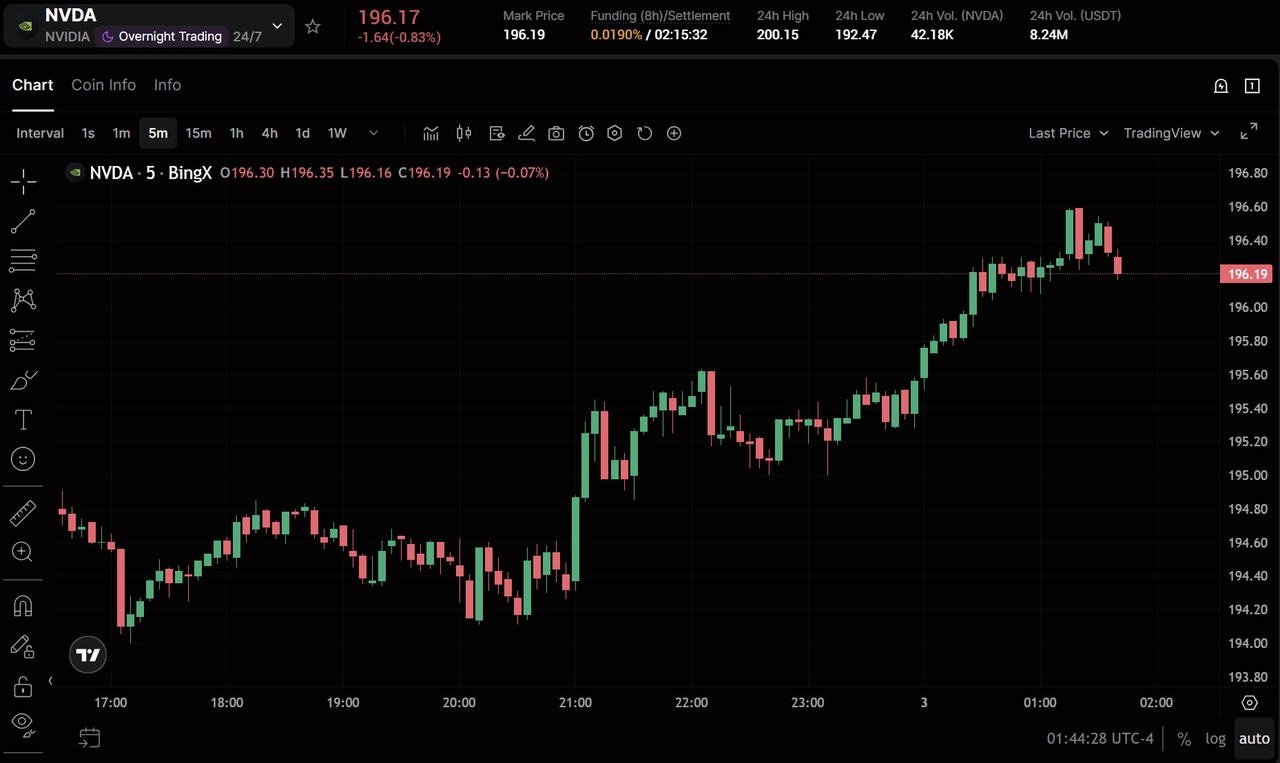
Because Jensen Huang’s net worth is inextricably linked to Nvidia's public equity performance, his real-time wealth remains highly sensitive to daily stock market fluctuations. In July 2026, NVDA shares have stabilized at approximately $194.83 to $197.58, down slightly from a parabolic spring peak that saw a 52-week high of $236.54. This recent pullback represents an 8% to 9% profit-taking rotation across the semiconductor sector, which briefly slid Nvidia's total market capitalization below its historic $5 trillion threshold to a still-massive $4.71 trillion.
The mechanics of this correlation are straightforward: with roughly 3.3% to 3.6% of outstanding common stock locked in his personal estate and family trust vehicles, every $10 macro swing in NVDA’s share price shifts Huang’s personal paper wealth by roughly $3.5 billion to $4 billion.
Despite this short-term cooling period, Nvidia's underlying fundamentals are exceptionally strong. The firm recorded Q1 FY2027 revenue of $81.61 billion (an 85% year-over-year surge) and has issued robust Q2 guidance of $91 billion. With institutional price targets from firms like Bank of America projecting an upside back toward the $245 to $320 range over the next twelve months, supported by an $119 billion backlog of hardware supply commitments, any major rebound in the stock price is positioned to instantly catapult Huang's net worth well past the $220 billion mark.
How Does Jensen Huang's Wealth Compare to Other Tech Leaders?
Evaluating Jensen Huang’s net worth, equity layout, and overall industry influence alongside other prominent technology leaders reveals distinct approaches to wealth accumulation and corporate governance in the AI era.
Peer Wealth and Organizational Governance Matrix (2026)
|
Tech Leader |
Associated Organization |
Estimated 2026 Net Worth |
Equity Control Mechanism |
Core AI Integration Role |
|
Elon Musk |
Tesla / SpaceX / xAI |
$1.053 Trillion |
20% of Tesla equity; 42% of private SpaceX equity |
Colossus training clusters, autonomous FSD systems |
|
Mark Zuckerberg |
Meta Platforms |
$195.3B – $222.0B |
High-leverage dual-class voting shares |
Open-source LLaMA model distribution, compute accumulation |
|
Jensen Huang |
Nvidia |
$178.0B – $200.0B+ |
$$\approx 3.3\% - 3.6\$$ direct and family trust equity holdings |
Primary supplier of global high-performance GPU hardware |
|
Dario Amodei |
Anthropic |
$7.0 Billion |
$$\approx 1.8\$$ fully diluted equity via dual-class voting structure |
Claude LLM developer, Claude Code agentic tools |
|
Sam Altman |
OpenAI |
$2.0B – $3.3B |
0% direct equity; wealth held via independent VC funds |
Creator of ChatGPT, pioneer of AI Sovereign Wealth Funds |
|
Satya Nadella |
Microsoft |
$1.3B – $1.56B |
$$\approx 0.01\$$ of Microsoft; performance-linked stock grants |
Azure AI platform cloud scaling, primary OpenAI investor |
Jensen Huang vs. Elon Musk: The Trillionaire Era
In June 2026, Elon Musk became the world's first dollar trillionaire, driven by the public listing of SpaceX on the Nasdaq at an initial $1.8 trillion valuation. His post-IPO net worth peaked at $1.45 trillion on June 16, 2026, before macro tech sell-offs and Tesla pay-package litigation briefly dragged it to $957 billion. Musk reclaimed his status by June 30, 2026, ending the month at an estimated $1.053 trillion. Within the AI ecosystem, Musk’s xAI Colossus data center hosts over 220,000 Nvidia GPUs, positioning him as both a premier customer of Jensen Huang and a primary competitor in frontier model training.
Mark Zuckerberg: Open-Source Scaling and Compute Accumulation
Mark Zuckerberg’s 2026 net worth fluctuated between $195.3 billion and $222 billion, impacted by infrastructure adjustments and legal rulings. Zuckerberg’s core AI strategy hinges on distributing Meta's LLaMA model family as open-source software to commoditize the industry's software layer. While lowering barriers for developers, this move intentionally accelerates the demand for underlying physical hardware. Consequently, Meta remains one of the largest global buyers of Nvidia GPUs, with its teams actively collaborating with Nvidia to integrate the newly launched Vera CPU into its high-performance clusters.
Sam Altman: Capital Realignment and Sovereign Partnerships
Sam Altman’s 2026 net worth sits between $2.0 billion and $3.3 billion, derived entirely from early-stage venture stakes (e.g., Reddit, Uber, Airbnb) rather than direct OpenAI equity (which remains at 0%). Under his leadership, OpenAI transitioned to a Public Benefit Corporation (PBC) and filed a confidential $1 trillion IPO intent in June 2026.
To fund massive physical infrastructure needs, Altman proposed a global "AI Sovereign Wealth Fund." This initiative includes a discussion to grant the US Government a 5% equity stake in OpenAI (worth $42.6 billion based on a private market valuation of $852 billion), alongside an aggressive ecosystem expansion program launched in May 2026 that exchanges $2 million in API compute tokens for direct equity in early-stage startups.
Dario Amodei: Private Value and Safety-First Governance
Dario Amodei’s early 2026 net worth is estimated at $7 billion, anchored on a 1.8% fully diluted founder stake in Anthropic. Driven by enterprise adoption of the Claude model family and Claude Code, Anthropic's annualized revenue run rate surged from $30 billion in April to $47 billion in May 2026.
To secure raw computing power, Amodei executed a landmark deal with Elon Musk's xAI, agreeing to pay $1.25 billion per month through May 2029 to lease capacity on the Colossus cluster, accessing over 220,000 Nvidia GPUs. Despite raising capital at a projected $900 billion valuation (which would push his personal wealth past $15 billion), Amodei retains firm governance through a dual-class share voting structure and committed via a January 2026 public pledge to donate 80% of his personal wealth.
Satya Nadella: Executive Execution at Scale
Unlike his founder peers, Satya Nadella represents the modern "employee billionaire" model, with a 2026 net worth of $1.3 billion to $1.56 billion. His wealth is built purely on performance-linked executive stock awards and compensation grants. Nadella directly holds approximately 0.01% of Microsoft (worth over $348 million), supplemented by more than $700 million in cumulative historical stock liquidations. His wealth structure showcases how a professional manager can capture elite industrial value by leading a legacy tech giant through a high-stakes computing transition.
Conclusion
Jensen Huang’s net worth in 2026 stands as a definitive case study in modern technological industrialization. At an estimated $178 billion to over $200 billion, Huang has constructed a fortune that is uniquely correlated with the physical foundation of the digital age. By refusing to diversify out of his core creation, his personal net worth acts as a high-beta financial reflection of global AI infrastructure demand.
Whether the technology sector encounters future regulatory firewalls, shifting trade lanes, or cooling software valuations, Huang has anchored his estate inside the actual computing hardware required to run the modern world. In doing so, he has ensured that as long as humanity requires raw processing power, his position among the wealthiest individuals on earth remains firmly secured.
Related Reading
- Nvidia (NVDA) Stock Price Outlook for 2026: Can Blackwell and Vera Rubin Take NVDA Back to $300?
- How to Buy Nvidia (NVDA) Stock in 2026: Complete Guide for Beginners
- Top AI Tokenized Stocks to Watch in 2026
- How to Trade Forex, Commodities, Stocks, and Indices With BingX TradFi: A Beginner's Guide (2026)
- Oracle (ORCL) Stock Outlook for 2026: Can the AI Cloud Infrastructure Buildout Take ORCL to $300?
- Alphabet (GOOGL) Stock Outlook 2026: Can Gemini and Google Cloud AI Drive GOOGL Cross $420?
- What Is Sam Altman’s Net Worth in 2026?
- What Is Elon Musk's Net Worth in 2026?
FAQs on Jensen Huang’s Net Worth
1. How much is Jensen Huang worth in 2026?
As of mid-2026, Jensen Huang’s net worth is estimated between $178 billion and over $200 billion, according to tracking from the Bloomberg Billionaires Index and Forbes Real-Time Registry. This places him around the 7th or 8th position among the wealthiest individuals globally.
2. What percentage of Nvidia does Jensen Huang own?
Jensen Huang directly and indirectly controls approximately 3.3% to 3.6% of Nvidia’s outstanding common stock. This exposure is managed through personal brokerage holdings and long-term family-trust vehicles.
3. What is a 10b5-1 trading plan, and how does Jensen Huang use it?
A 10b5-1 plan is a pre-scheduled trading framework that automatically executes stock sales based on predefined criteria, such as date, price, or volume. Huang uses these plans to systematically liquidate fractions of his Nvidia shares, such as an automated plan in 2025 that generated roughly $865 million, without triggering concerns regarding insider trading.
4. Why did Jensen Huang’s executive compensation decrease in fiscal year 2026?
Jensen Huang’s total compensation package fell by 27% to $36.6 million in fiscal year 2026. This was an administrative market adjustment tied directly to a brief, temporary performance decline in Nvidia stock during the prior year, when investors reacted to potential AI market bubbles.
5. How does the CUDA software platform protect Jensen Huang's wealth?
CUDA is Nvidia's proprietary software computing layer. Because it is utilized by over four million developers globally and delivers up to 85% real-world chip efficiency, it creates a developer dependency that prevents corporate clients from switching to rival chips, protecting Nvidia's high profit margins and elevating Huang's paper net worth.
