
Minting FXRP in 2026 represents a paradigm shift for long-term XRP holders. Historically, XRP on the XRP Ledger (XRPL) remained a non-smart-contract asset, severely limiting its utility in decentralized finance (DeFi). The launch of the FAssets protocol on the Flare Network bridges this functional gap, allowing users to wrap their native assets 1:1 into an EVM-compatible token.
With over 155 million FXRP already minted and integrated across Flare's fast-growing DeFi space, learning how to safely maneuver through the minting and redemption cycles is crucial for optimizing capital efficiency. Whether you utilize automated direct minting portals or optimize yield via next-generation ERC-4626 infrastructure like Firelight, navigating the underlying mechanics safely ensures your assets maintain robust liquidity.
An Introduction to the Flare Network
The Flare Network is a specialized Layer-1 blockchain engineered to provide secure, decentralized, and high-integrity data directly from external blockchains and the internet. Rather than relying on centralized third-party bridges, Flare incorporates built-in data acquisition layers, specifically the Flare Data Connector (FDC) and the Flare Time Series Oracle (FTSO).
In the 2026 Web3 architecture, Flare functions as the computational and programmable layer for legacy blockchains. By marrying EVM compatibility with robust cross-chain state verification, the network allows traditionally static assets to float seamlessly into open-market finance applications without altering the core rules of their native chains.
Read more: What Is Flare Network? The Institutional Guide to XRPFi
What Are FAssets and How Do They Work?
An FAsset implementation on Flare Network is a trust-minimized, over-collateralized digital representation of a non-smart-contract token on the Flare network. FAssets bring assets like XRP, Bitcoin (BTC), and Dogecoin (DOGE) into programmable ecosystems by wrapping them via strict, code-enforced, and mathematically verifiable rules.
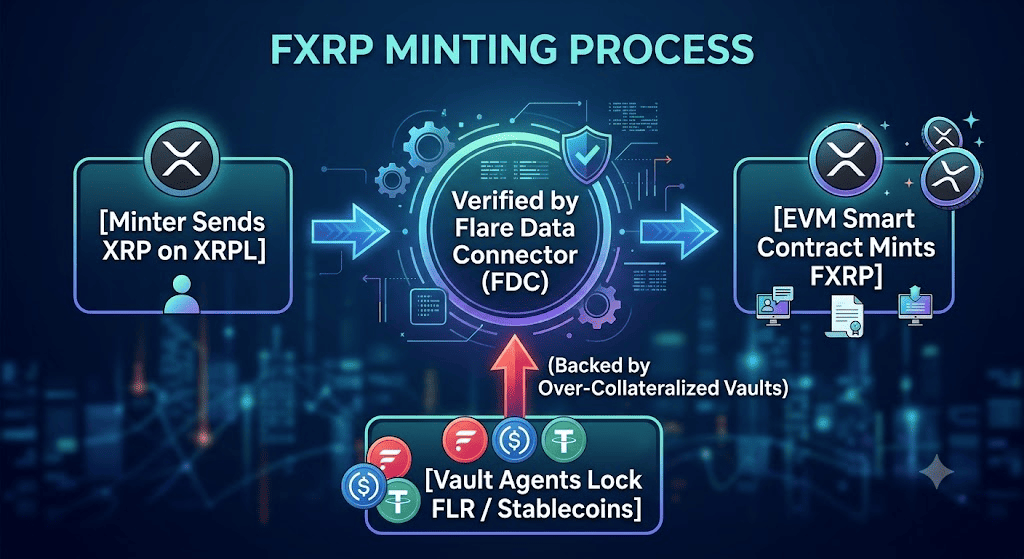
The system coordinates structural token minting by relying on decentralized Vault Agents. To facilitate safety, these agents must lock collateral, such as native FLR or stablecoins, into the FAssets smart contracts. This collateral acts as an insurance policy, ensuring that every single FAsset minted on Flare is perpetually backed by real economic value. If an agent misbehaves or fails a redemption request, the protocol automatically penalizes the agent's collateral to compensate the user.
What Is FXRP and Why Use It?
FXRP is the first fully operational FAsset, representing native XRP on Flare at a strict 1:1 ratio. It exists as an ERC-20 token, rendering it universally compatible with EVM-based wallets, decentralized exchanges (DEXs), lending desks, and automated yield aggregators.
XRP holders utilize FXRP primarily to access XRPFi, the specialized financial stack expanding across the Flare ecosystem. Instead of letting tokens sit idle in cold storage, users swap or mint into FXRP to deploy assets across diverse DeFi utilities:
- Yield Farming: Injecting asset pairs into decentralized automated market makers (AMMs) like SparkDEX.
- On-Chain Staking & Vaulting: Flowing wrapped tokens directly into interest-bearing money markets.
- Trustless Portability: Enjoying native LayerZero integration as an Omnichain Fungible Token (OFT) for swift cross-chain portability.
The 2026 FXRP Minting Cap Status
When navigating the FAssets infrastructure, observing the current governance limits is essential for a smooth onboarding process. The protocol manages risk systematically using explicit constraints. A primary metric to monitor is the Flare Network XRP minting cap, which regulates total system exposure during rollout phases.
Following the successful FAssets v1.3 mainnet launch in mid-2026, the governance layer relies on dynamic risk bounds rather than static hard caps. The platform limits sudden system spikes using a combination of hourly mint limits, daily mint limits, and large-mint thresholds.
System Rule: If a user attempts to execute a transaction that exceeds these short-term thresholds, the protocol will emit a DirectMintingDelayed event rather than a standard failure. This places the transaction into a secure buffer queue, stamping it with an executionAllowedAt timestamp indicating exactly when the fast path will finalize the mint safely.
How to Mint FXRP via Flare Portal: Step-by-Step Guide
The modern FAssets ecosystem offers two major pathways: Standard Portal Minting, using decentralized agents via a Collateral Reservation Fee, and Direct Minting (introduced in v1.3, utilizing automated smart accounts and destination tags).
Method 1: FXRP Minting via the Standard Agent Portal Flow
To mint manually via consumer interfaces, you can interact with official portals like the AU Portal (fassets.au.cc) or the Oracle Daemon Portal.
- Connect Dual Wallets: Access the portal and link your EVM wallet like MetaMask to manage the Flare side, alongside your XRPL wallet, e.g., Xaman, to handle the underlying XRP.
- Reserve Collateral: Choose a public agent from the directory based on their performance fees. Initiate a Collateral Reservation Transaction (CRT). This locks the agent's vault capacity and requires a small Collateral Reservation Fee (CRF) paid in native FLR.
- Obtain Payment Reference: The contract returns an event containing the agent's specific XRPL address and a unique 32-byte payment reference number.
- Execute XRPL Payment: Open your XRPL wallet and send the target amount of XRP to the agent's address. You must include the 32-byte payment reference inside the memo field. This prevents other actors from claiming your deposit.
- Finalize on Flare: The Flare Data Connector automatically fetches the transaction proof within 3–10 minutes. Once proved, the smart contracts execute the final mint, depositing the newly created FXRP straight into your EVM wallet.
Method 2: High-Volume Automated Direct Minting for FXRP (FAssets v1.3)
For programmatic users, developers, or repeat minters, the v1.3 upgrade allows you to bypass manual agent assignment completely using a Minting Tag Manager.
- Reserve a Reusable Tag: Call the reserve() function on the MintingTagManager smart contract by paying a baseline native token fee. The contract mints a unique destination tag as an ERC-721 NFT.
- Bind Your Recipient Address: Call setMintingRecipient(tag, your_flare_address). This permanently maps that specific destination tag to your EVM account.
- Send Simple Payments: From that point forward, you can route standard XRP payments directly to Flare’s Core Vault address on the XRPL. As long as the transaction carries your reserved Destination Tag, the system automatically interprets it, routes the funds through the FDC, and mints FXRP straight to your mapped address, no individual memos required.
How to Use FXRP in Kinetic and Firelight to Earn Yield
Once you hold FXRP, your assets transition into productive capital. The two main components driving yield generation on Flare are Firelight and Upshift Vaults.
1. Firelight ERC-4626 Yield Vaults
Firelight provides specialized, tokenized yield-generating vaults built natively around the standard ERC-4626 implementation.
- Deposit and Mint: Users deposit raw FXRP into the vault via deposit(assets) to immediately receive corresponding vault shares representing their percentage ownership of the pool's yield.
- Epoch Processing: The vault aggregates the underlying tokens and deploys them directly into automated market strategies.
- Requested Redemptions: To exit, users trigger a withdrawal request during the current active period, which burns the vault shares. Once the designated period concludes, calling claimWithdraw() pulls the principal plus accrued compounding rewards directly back to the wallet.
2. Upshift Strategy-Driven Vaults
Upshift abstracts operational risk management by sorting assets through automated, on-chain DeFi pipelines.
|
How to Redeem FXRP on Flare Network
Redemption reverses the structural process, melting your FXRP back into native, tradable XRP on the XRPL.
- Initiate the Request: Call the redeemAmount or redeemWithTag method on the AssetManagerFXRP contract, specifying your desired asset volume and your target destination XRPL address.
- Queue Processing: The system matches your request against the front of a first-in, first-out (FIFO) Redemption Ticket queue, selecting an active agent to settle the debt. Your FXRP is instantly burned on Flare.
- Agent Settlement Window: The selected agent is assigned a hard deadline measured in both XRPL blocks and timestamps. The agent must send native XRP to your designated XRPL address, including the unique payment reference in the memo.
- Verification or Default Protection:
- Normal Path: The agent uploads the FDC payment proof, finalizing the protocol loop and releasing their locked vault collateral.
- Default Path: If the agent fails to pay before the expiration deadline, you or an appointed executor bot submit a payment non-existence proof. The system automatically penalizes the agent, paying you out directly in native FLR collateral at market price plus a premium to cover your underlying losses.
How to Trade XRP (XRP) and Flare Network (FLR) on BingX
For users looking to capitalize on price volatility or efficiently balance their collateral profiles between XRP and FLR, BingX offers a deep-liquidity, zero-latency environment.
Step 1: Deposit Assets to BingX
Navigate to your BingX Asset Overview page. Select either XRP or FLR, generate your unique deposit address, and transfer tokens from your web3 wallet.
Critical Notice: When depositing XRP to BingX from an external wallet, you must include both the deposit address and the required Destination Tag/Memo. Leaving out the destination tag will cause your funds to become stuck in the exchange's main custody contract.
Read more: How to Send XRP to a Centralized Exchange
Step 2: Swap via the Spot Market or Conversion Engine
- For Instant Swaps: Use the BingX Convert tool to execute direct pairings between XRP and stablecoins like USDT with zero trading slippage.
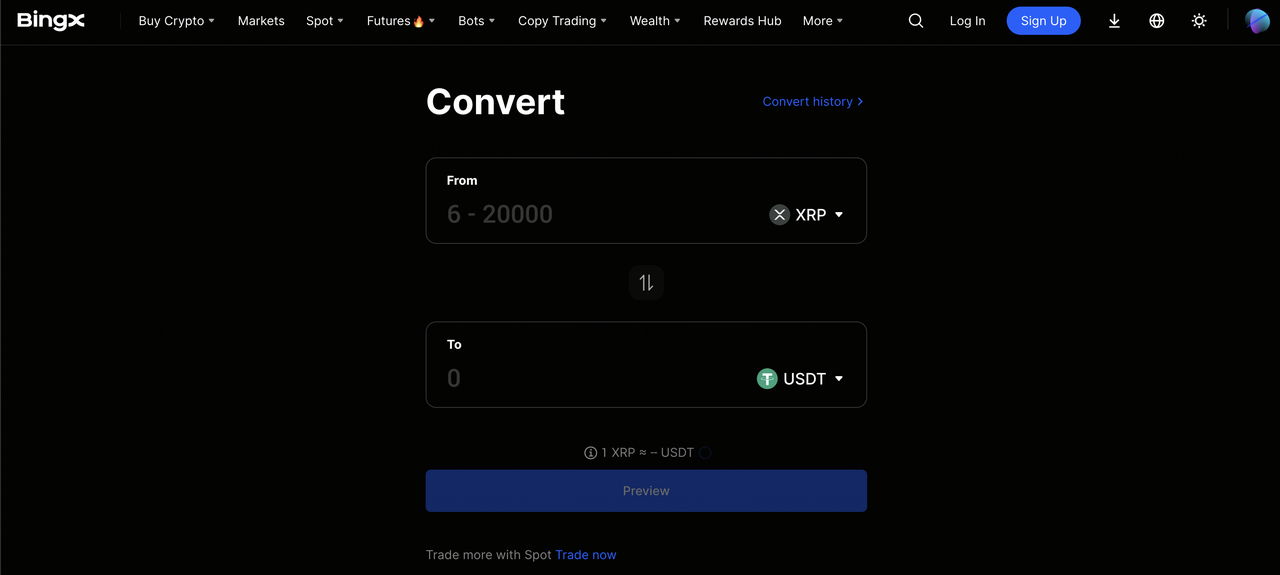
Swap XRP for USDT on BingX Convert
- For Advanced Execution: Navigate to the Spot Trading terminal and load the XRP/USDT or FLR/USDT order books. Use Limit or Market orders to manage your targets precisely.
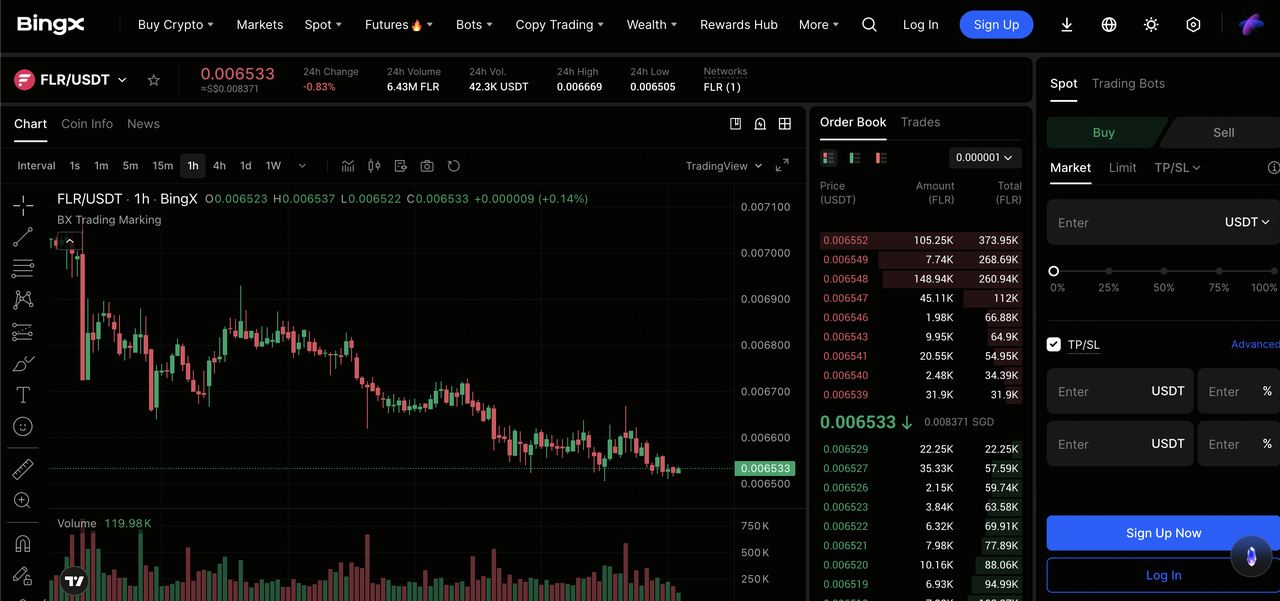
FLR/USDT trading pair on BingX spot market
Step 3: Off-Ramp to Fiat
If you are realizing profits, move your trading balances into your Fund Account. Utilizing the integrated Convert Fiat interface backed by Legend Trading allows you to off-ramp your digital balances straight into traditional banking rails via regional instant networks like SEPA Instant or high-speed USD clearing accounts.
Key Considerations When Minting and Redeeming FXRP FAsset on Flare Network
Before committing your capital to cross-chain bridges, it is crucial to analyze the underlying structural factors, such as liquidity locks, network slippage, and safety timelines, that directly dictate your transaction efficiency on the Flare Network.
- Total Surcharge Leakage: Always account for the combination of the Collateral Reservation Fee (CRF), the underlying Agent Minting/Redemption fees, and the network gas costs on both chains.
- Dust Accumulation: Fractional operations below full lot sizes, e.g., fractional fees minted to the pool, create dust. Dust is held safely by the protocol until it accumulates to a full lot, which then auto-generates a standard redemption ticket. Alternatively, you can clear minor fractions anytime using the self-closingfunction.
- 14-Day Proof Window: FDC attestation proofs remain available for creation for 14 days. If both the minter and agent neglect to present their transaction proofs within this two-week window, the normal pipeline freezes. The agent must then trigger a manual fallback recovery recovery by burning an equivalent amount of native FLR collateral to unlock their vault.
Final Thoughts: Should You Mint FXRP for XRPFi on Flare Network?
Minting FXRP on the Flare Network represents the next evolutionary step for XRPFi, breaking down the historic silos separating traditional ledger assets from modern decentralized yield protocols. By understanding how the FAssets v1.3 mechanisms govern mint limits, tag management, and collateral fallback rules, you can safely navigate the ecosystem to generate sustainable on-chain revenue.
Risk Reminder: Cross-chain operations carry intrinsic smart contract and volatility risks. Always double-check your payment references and destination tags on both Flare and BingX before completing high-value transactions.
Related Reading
- What Is Flare Network? The Institutional Guide to XRPFi
- Bitcoin vs. XRP: What’s a Better Investment in 2026?
- XRP vs. Ethereum: What’s a Better Investment in 2026?
- What Are the Top 10 Ways to Earn Passive Income from Crypto in 2026?
FAQs on Minting and Redeeming FXRP
1. What happens if the agent fails to send my XRP during a redemption?
If the agent misses the protocol-defined block deadline, the redemption enters a default state. You submit a payment non-existence proof through the Flare Data Connector and receive compensation directly from the agent's vault in native FLR tokens valued at market rate plus an additional insurance premium.
2. Can I mint an arbitrary amount of FXRP?
Standard portal minting requires you to transact in positive integers of lots to prevent high network fee leakage relative to the trade value. However, direct minting tools and self-closing options can accommodate fractional values and smaller balances.
3. Do I need native FLR tokens to complete a basic mint?
Yes. You require native FLR tokens to settle the initial Collateral Reservation Fee (CRF) when setting up standard portal entries, alongside standard gas allocations required to interact with Flare smart contracts.
