
In early May 2026, Heating Oil (HO) sits at a high-stakes geopolitical crossroads. After a volatile Q1 that saw prices touch a record $4.60 in March, the fuel is currently trading near $3.90 per gallon. While the market is structurally braced for a supply surplus later this year, immediate physical tightness driven by military strikes in the Middle East is overriding traditional seasonal dips. Investors are now weighing a projected 13.6 million b/d of resilient U.S. Crude production against the risk of a total shipping freeze in the Strait of Hormuz.
As the energy transition accelerates, the volatility of 2026 is pushing European and UK consumers toward electric heat pumps for price stability. However, with the Hormuz Risk Premium entering a critical phase, the entire distillate complex is coiling for its next breakout. This guide breaks down the Heating Oil price prediction for 2026 using data from the EIA, J.P. Morgan, Goldman Sachs, and Reuters.
You will also discover how to trade Heating Oil futures with USDT through BingX TradFi.
Top 5 Things for Heating Oil Traders to Know in 2026
As Heating Oil navigates a high-stakes environment of war-risk premiums and green energy shifts, traders must monitor these five market-moving factors.
- The Hormuz Chokepoint: Roughly 20% of global oil flows through the Strait of Hormuz. With ongoing conflict involving Iran, any physical blockade could immediately send prices toward the $5.00 psychological barrier.
- Decoupling from Seasonality: Traditionally, prices drop in summer. In 2026, high demand for jet fuel (chemically similar to kerosene/heating oil) and geopolitical fear are keeping prices elevated during the off-season.
- The Supply Surplus Forecast: Outside of the conflict zones, global supply is growing. The EIA and J.P. Morgan project that production from the U.S., Brazil, and Guyana will eventually outpace demand, targeting a mean reversion toward $60 Brent.
- Currency and Import Costs: Heating oil is traded in USD. For UK and EU traders, a weaker Pound or Euro in 2026 has acted as a silent thief, raising the effective cost of imported kerosene even when global crude remains flat.
- Refining Cracks: Reduced domestic refining capacity in the UK and parts of Europe means markets are more sensitive to crack spreads - the difference between crude oil prices and the price of the refined heating oil.
What Is Heating Oil (HO)?
Heating Oil, often referred to as No. 2 fuel oil or kerosene in domestic contexts, is a low-viscosity liquid petroleum product used in furnaces and boilers. In 2026, it remains a critical energy source for over 1.5 million off-grid households in the UK and millions more in the U.S. Northeast.
As of May 2026, the market is defined by inelastic demand during cold snaps but increasing substitution risk from electric alternatives. Unlike gasoline, heating oil prices are heavily influenced by the global middle distillate market, which includes diesel and jet fuel. On the BingX TradFi platform, traders can speculate on these price movements through Heating Oil (HO) CFDs, allowing for both long and short positions.
Trading heating oil in 2026 utilizes NYMEX Heating Oil futures (HO) as the global benchmark. Investors can also gain exposure via energy ETFs like UHN or major integrated oil equities. BingX TradFi lets you trade Heating Oil futures with Tether (USDT).
A Look at Heating Oil's Performance in Early 2026
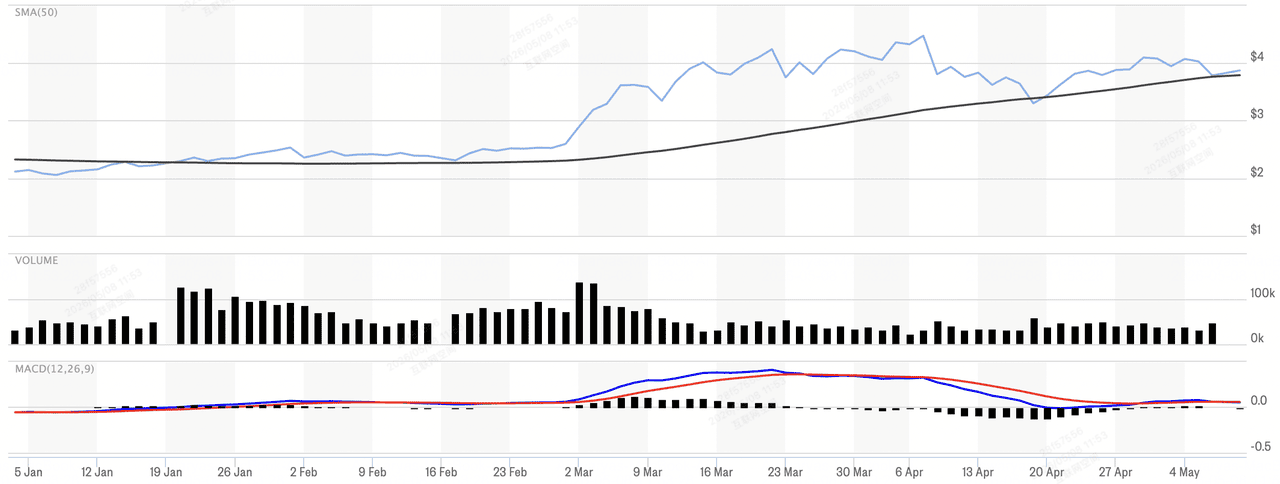
Heating oil prices in 2026 | Source: MarketWatch
The first half of 2026 has been a perfect storm. Following a period of stability in 2025, the January-March period saw a 61% monthly surge as military actions escalated in the Gulf. Physical damage to refineries in oil-producing regions has created a lag in supply that cannot be fixed by diplomatic resolutions alone. By May 2026, the market has entered a distribution phase, with prices consolidating between $3.60 and $4.00 as traders await the next geopolitical catalyst.
Heating Oil 2026 Strategy: How to Navigate Energy Volatility
- The $3.20 Floor: Technical analysts identify the $3.15–$3.20 zone for December 2026 contracts as the critical support level. If conflict eases, this is the primary target for a mean reversion.
- The Jet Fuel Correlation: Monitor aviation data. If summer travel hits record highs, the competition for distillates will prevent heating oil from seeing its usual summer discount.
- Inventory Draws: Watch the weekly EIA storage reports. In 2026, panic stockpiling by countries like China has kept inventories tighter than the production data suggests.
Heating Oil 2026 Investment Outlook: $5.00 Spike vs. $3.00 Mean Reversion
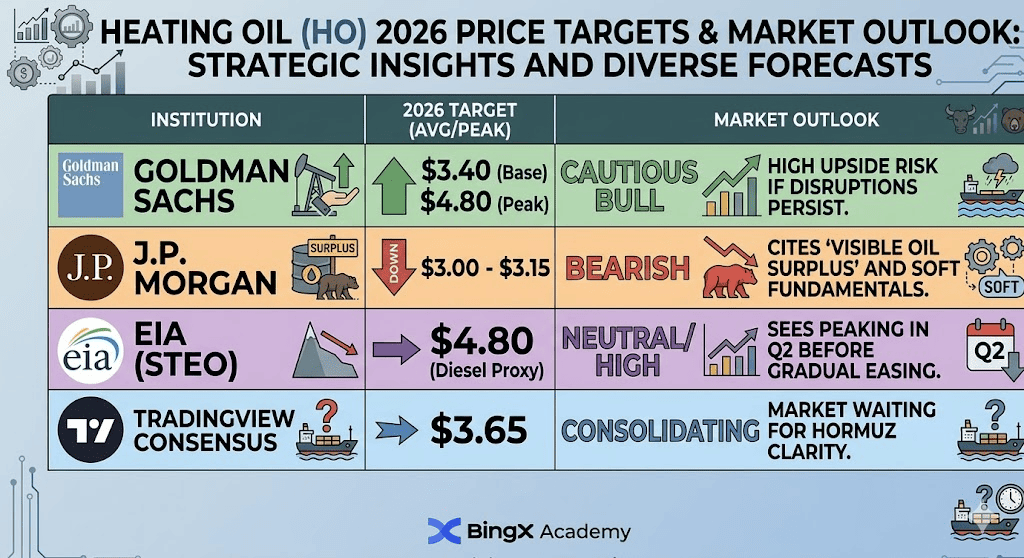
Heating oil prediction for 2026 by Wall Street analysts
Navigating the heating oil market in 2026 requires balancing short-term geopolitical catalysts against a looming structural supply surplus.
The Bull Case: Heating Oil's $5.00 Geopolitical Spike
The bullish narrative centers on a Protracted Disruption scenario where the Strait of Hormuz remains contested or closed for over 90 days. Goldman Sachs analysts warn that a total blockade could propel Brent crude toward $115/bbl, creating a parabolic move in distillates. This environment would likely drive NYMEX heating oil futures past their March record of $4.60, targeting a $4.80–$5.00/gallon range as the fear premium decouples from physical inventory levels.
Practically, this scenario is fueled by a feedback loop of emergency industrial stockpiling and military insurance surcharges. Traders should watch for a sustained break above $4.20, which would signal the transition from a standard rally to a short squeeze event. In this high-alpha environment, heating oil becomes a primary hedge against broader market inflation, though it carries the risk of sharp flash crashes if diplomatic breakthroughs occur.
The Base Case: $3.40 – $3.80 Consolidation for Heating Oil Prices in 2026
The base case envisions a High Volatility Range where geopolitical tension provides a hard floor, but record U.S. output of 13.6 million b/d acts as a firm ceiling. The EIA suggests that while the $4.00 level may be tested during supply hiccups, the seasonal transition into the summer months will eventually cool the rally. Expect prices to oscillate in a wide, choppy band between $3.40 and $3.80, influenced heavily by fluctuating refining margins and the high cost of rerouting tankers around conflict zones.
For investors, this is a range-trader’s market where technical levels at $3.25 (support) and $4.10 (resistance) define the playground. Success in this scenario depends on monitoring crack spreads, the difference between crude prices and refined product value. As long as the Middle East situation remains a cold conflict, the market will likely digest the Q1 shock without reaching new highs, providing a stable but elevated cost environment for consumers.
The Bear Case: The $3.00 Demand Destruction Trap
The bearish scenario, championed by J.P. Morgan, is triggered by a Supply Glut coinciding with a global economic slowdown. If diplomatic efforts successfully normalize Iranian exports, the market will suddenly face the sizable surpluses projected by Natasha Kaneva’s strategy team. When combined with a hard-landing recession that slashes industrial diesel and jet fuel consumption, the speculative length built up during the Q1 crisis would likely face a rapid, forced liquidation.
Technically, the bear case is confirmed by a decisive close below the $3.20 line in the sand. A breach here would open the door for a rapid retest of the $3.00–$3.10 support zone by Q4 2026 as the geopolitical war tax is fully erased. In this environment, the market shifts from a supply-deficit focus to a demand-surplus reality, making short positions the dominant strategy as the 2026 commodity shock premiums evaporate.
Heating Oil Price Forecasts for 2026 by Leading Analysts
|
Institution |
2026 Target (Avg/Peak) |
Market Outlook |
|
Goldman Sachs |
$3.40 (Base) / $4.80 (Peak) |
Cautious Bull: High upside risk if disruptions persist. |
|
J.P. Morgan |
$3.00 - $3.15 |
Bearish: Cites "visible oil surplus" and soft fundamentals. |
|
EIA (STEO) |
$4.80 (Diesel Proxy) |
Neutral/High: Sees peaking in Q2 before gradual easing. |
|
TradingView Consensus |
$3.65 |
Consolidating: Market waiting for Hormuz clarity. |
How to Trade Heating Oil (HO) Futures on BingX TradFi
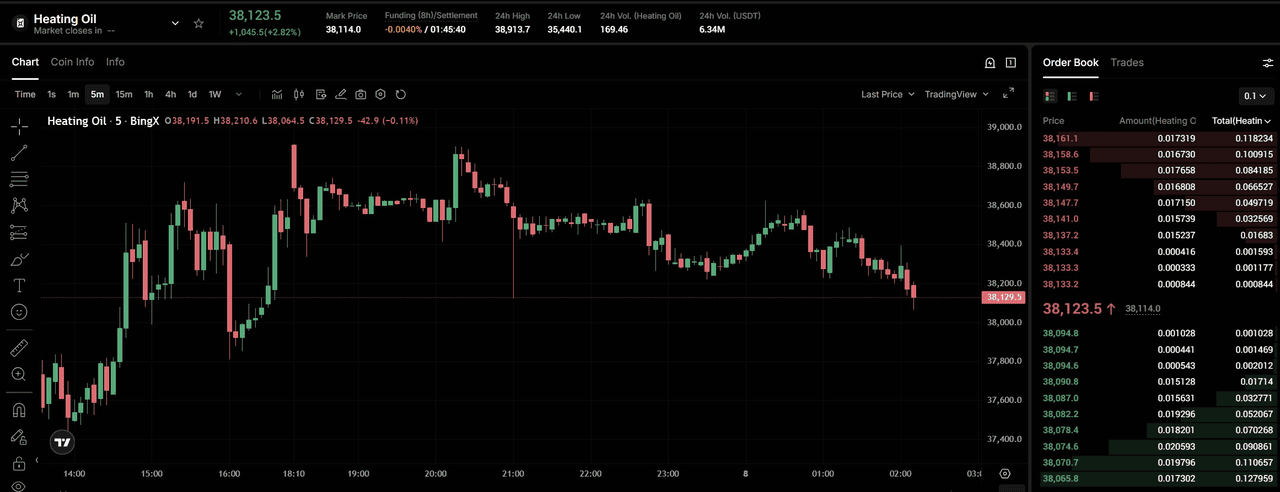
Heating oil perpetuals on BingX futures market
Capitalize on energy volatility using BingX TradFi. Whether you are hedging your home heating costs or betting on a geopolitical de-escalation, BingX provides the tools to trade the world's most vital distillates, including automated insights from BingX AI.
- Access BingX TradFi: Navigate to the Commodities section.
- Select Heating Oil (HO): Choose the Heating-Oil-USDT contract.
- Choose Your Direction: Open Long if you anticipate further Middle East escalations, or Open Short if you believe the supply glut will drive prices lower
- Manage Risk: Use TP/SL (Take Profit/Stop Loss) tools to protect against flash crashes common in the 2026 energy market.
Top 5 Risks to Watch for Heating Oil Traders in 2026
While the fundamental landscape for middle distillates remains historically tight, traders must navigate a high-stakes environment of shifting policy, unexpected supply surges, and technical volatility that could derail the current bullish trend.
- The Peace Dividend: A sudden diplomatic breakthrough in the Middle East could erase the $0.50/gallon risk premium overnight.
- Refining Resilience: If new refineries in the Middle East and Asia come online faster than expected, the crack spread will narrow, lowering HO prices even if crude is high.
- Weather Anomalies: A La Niña event leading to an exceptionally cold late 2026 would trigger a massive demand spike when inventories are already low.
- Policy Shifts: Government subsidies for heat pump installations in the UK/EU could lead to faster-than-expected demand destruction.
- Liquidity Crushes: During periods of extreme volatility, the gap between bid and ask prices can widen, making entries and exits more expensive.
Final Thoughts: Is Heating Oil a Buy at $3.90 in 2026?
As of May 2026, Heating Oil has transitioned from a standard utility into a high-alpha geopolitical proxy. At the $3.90 level, the market is currently pricing in a significant war tax due to the ongoing instability in the Strait of Hormuz. For tactical traders, the confluence of physical supply threats and the catch-up demand from a surging aviation sector suggests that while the $4.60 peak may offer technical resistance, a return to the cheap oil era of $2.50 is fundamentally unsupported for the remainder of the year.
Practical positioning at these levels requires a disciplined approach to the $3.20 support and $4.20 resistance zones. Long-term portfolios may view current consolidation as a floor formed by the marginal cost of production, whereas short-term traders should prioritize liquidity and monitor real-time inventory drawdowns. Utilizing BingX AI to track USD strength and middle-distillate crack spreads will be essential for timing entries in a market where the seasonal calendar has been replaced by geopolitical headlines.
Risk Reminder: Trading energy commodities involves extreme capital risk due to high price volatility and geopolitical sensitivity. Heating oil’s smaller market size relative to crude oil can lead to rapid price swings and reduced liquidity during sudden economic shifts. Always implement strict stop-loss orders and never trade with capital you cannot afford to lose.
Related Reading
- Gasoline Price Prediction 2026: $4.50 Geopolitical Peak or $3.00 Supply Normalization?
- Natural Gas Price Prediction 2026: $15 Global Energy Shock or U.S. Glut Trap?
- Crude Oil Price Forecast 2026: $140 War Premium or $60 Surplus Baseline?
- Occidental Petroleum (OXY) Price Prediction 2026: $115 Net-Zero Alpha or $55 Commodity Trap?
- Exxon Mobil (XOM) Price Prediction 2026: $180 Energy Alpha or Geopolitical Value Trap?
- XOP S&P Oil & Gas ETF Prediction 2026: $210 Geopolitical Moonshot or $130 Hedge Trap?
