
Cloud mining lets you mine Bitcoin and other proof-of-work (PoW) coins without purchasing or managing specialized physical hardware. Instead of running noisy, heat-intensive ASIC miners at home, you rent raw computing power (hashrate) from professional, industrial-scale data centers, and your corresponding share of the mining rewards is deposited into your wallet or exchange account.
However, the cloud mining landscape in mid-2026 is highly specialized and heavily saturated with risk. Following the 2024 halving and subsequent spikes in global mining difficulty, the sector has seen a sharp divide: unverified platforms promising "guaranteed high daily returns" have increasingly unraveled as advance-fee scams, while institutional, publicly traded, or exchange-backed operators have consolidated the market by building hybrid infrastructure that blends cryptocurrency mining with AI cloud computing.
This comprehensive guide explains the mechanics of cloud mining in 2026, evaluates the most reliable operational cloud mining apps, breaks down true post-halving profitability, and details how to seamlessly move your mined rewards to BingX to trade or hedge.
What Is Cloud Mining and How Does It Work?
Cloud mining is a service model where users purchase a fraction of hashing power from remote data centers. The provider handles the complex logistics, sourcing hardware, maintaining optimal cooling, securing cheap industrial electricity, and connecting to institutional mining pools, while the user monitors the output through a digital dashboard.
The operational lifecycle generally follows these distinct stages:
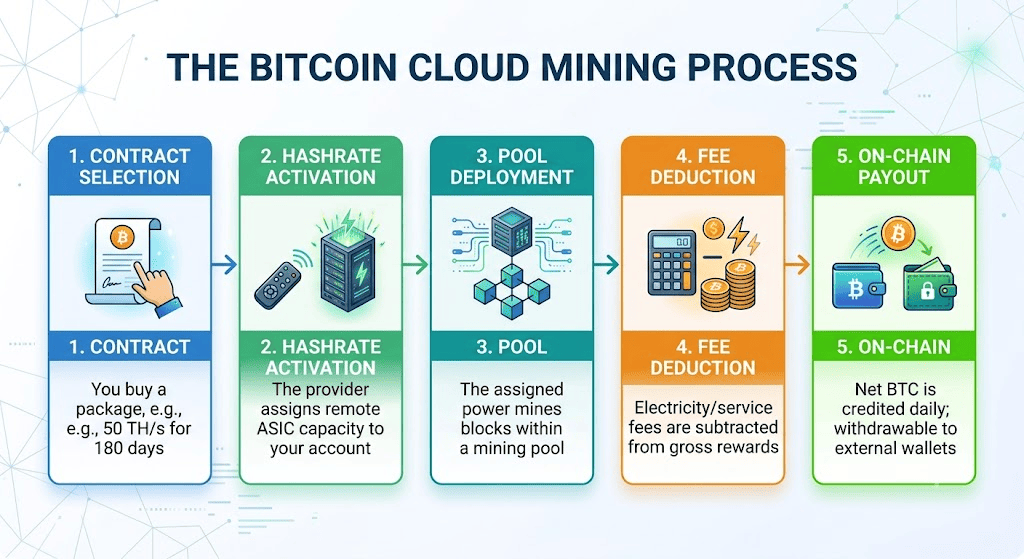
How Bitcoin cloud mining works
By abstracting away hardware management, cloud mining presents a low barrier to entry for beginners. However, it changes the nature of the investment: instead of purchasing a tangible asset with residual hardware liquidation value, you are buying a time-bound service contract whose yield fluctuates dynamically based on network state and market pricing.
Bitcoin Cloud Mining vs. Hardware Mining: Key Differences
|
Attribute |
Cloud Mining (Renting Hashrate) |
Hardware Mining (Home/Hosted ASICs) |
|
Upfront Investment |
Low entry barrier (frequently starting from $10 to $100). |
High (ASICs cost $2,000–$6,000+ per unit plus infrastructure setup). |
|
Operational Control |
None. The platform dictates the hardware configuration and mining pool. |
Full control over hardware firmware, optimization settings, and pool choices. |
|
Transparency |
Low. Restricted to what the platform's user dashboard displays. |
High. Real-time diagnostic access to physical hardware performance. |
|
Resale/Residual Value |
Zero. Contracts expire completely at the end of the term. |
Liquid. Hardware retains residual market value and can be resold. |
|
Risk Exposures |
Extreme counterparty and platform exit-scam risks. |
Operational risks (hardware failure, local power rate increases). |
The choice between cloud mining and hardware mining centers on a fundamental trade-off between capital efficiency and operational sovereignty. Cloud mining minimizes initial friction with a low entry barrier of $10 to $100, entirely bypassing the $2,000 to $6,000+ per-unit capital expenditures required to purchase modern ASIC hardware. However, this accessibility comes at the expense of total structural exposure; cloud mining yields zero residual value upon contract expiration, leaving investors entirely dependent on a platform’s digital dashboard with no control over pool routing or hardware optimization.
Conversely, hardware mining functions as a physical asset play. While home or hosted configurations demand heavy upfront infrastructure costs, high power management, and exposure to local utility rate hikes, they provide full firmware control and real-time diagnostic transparency. Crucially, physical ASICs remain liquid assets that retain measurable resale value on secondary markets. For a practical deployment strategy, cloud contracts should be treated strictly as short-term, speculative hedges against difficulty spikes, whereas physical or hosted hardware ownership remains the only viable path for institutional exposure with a concrete asset backstop.
Read more: The Shift to ASICs: Why You Can’t Mine Bitcoin with a GPU in 2026
Is Cloud Mining BTC Still Profitable in 2026?
Cloud mining can be profitable in 2026, but the margin profile is razor-thin. Following the 2024 Bitcoin halving, which cut block rewards down to 3.125 BTC, and a consecutive 12-month run of historic highs in global network difficulty, data centers must achieve hyper-efficient power rates under 0.05 to 0.06 per kWh to stay viable.
For retail consumers, profitability is governed by a highly sensitive multi-variable relationship:
Net Revenue = (Gross Global Block Rewards × Allocated Hashrate Share) − (Electricity Fees + Maintenance Deductions)
Critical Warning on Contract Fees: Many private platforms charge ongoing daily maintenance fees of around $0.03–$0.07 per TH/day. If the market price of Bitcoin drops or network difficulty rises beyond a certain threshold, these operational deductions can completely consume your gross mining yields, rendering the contract net-negative. Always inspect the contract’s Force Majeure or automatic termination clauses, which frequently allow platforms to dissolve contracts if they remain unprofitable for a consecutive period, e.g., 10 to 20 days.
Historically, extensive data analysis reveals that in sideways or bearish market environments, simply buying Bitcoin directly on the spot market or investing in spot Bitcoin ETFs consistently outperforms cloud mining contracts due to the absence of difficulty adjustments and operational fee drag.
Read more: Is Bitcoin Mining Still Profitable in 2026: How to Calculate BTC Mining Profitability?
What Are the Most Reputable Cloud Mining Platforms for 2026?
The following platforms represent the most visible, transparent, and operationally established options in mid-2026. This list focuses strictly on providers featuring public corporate filings, exchange backing, or verifiable physical infrastructure.
1. Bitdeer (NASDAQ: BTDR)
Bitdeer is a vertically integrated market leader that controls its entire infrastructure stack, from proprietary ASIC chip R&D in the Sealminer series to global data center operations.
- Infrastructure and Power Matrix: Operates multi-megawatt computing facilities across Texas (USA), Norway, and Bhutan, utilizing highly optimized, grid-verifiable sustainable energy matrices.
- Pricing Mechanics: Offers entry packages starting from approximately $1.00 to $26.00 depending on promotional availability, with hash rate fees sitting at roughly $0.0029–$0.0033/T/D and electricity overhead mapped at $0.0531/T/D.
- Operational Execution: Features Classic Mode where users keep 100% of the contract's total cryptocurrency output, alongside an Accelerator Mode designed for faster principal recovery via an upfront profit-sharing threshold.
- Regulatory Status: Publicly traded on the NASDAQ, ensuring fully audited financial disclosure statements, SEC oversight, and concrete legal accountability.
2. BitFuFu (NASDAQ: FUFU)
BitFuFu operates a massive cloud computing footprint heavily backed by an institutional partnership with major hardware manufacturer Bitmain, ensuring priority access to top-tier ASIC technology.
- Computing Scale: Reports an active fleet capacity of approximately 26 EH/s as of early 2026.
- Contract Dynamics: Provides retail hashrate plans and advanced enterprise-grade hosting services; uses a non-custodial architecture that routes daily mining rewards directly to external user wallets.
- Financial Profile: Fully listed on the NASDAQ, offering SEC-level balance sheet transparency; however, historical consumer reviews cite occasional delays in customer support resolutions.
- Strategic Advantage: Maintains a preferential purchase arrangement for up to 80,000 S-series Antminers, keeping its hardware fleet highly efficient post-halving.
3. NiceHash
NiceHash avoids traditional fixed corporate contracts entirely, operating as an open, peer-to-peer computing marketplace connecting hashpower buyers with a global network of independent miners.
- Financial and Entry Minimums: Operates a pay-as-you-go model with a very low minimum entry threshold of approximately $10.
- Operational Control: Buyers select specific mining algorithms, such as SHA-256 for Bitcoin or Scrypt for Litecoin/Dogecoin, and set custom real-time bid limits, directly controlling their duration, costs, and destination pools.
- Payout and Settlement: Features automated daily clearing cycles with all payouts processed and denominated directly in Bitcoin.
- Risk Profile: EU-registered, GDPR, and AML compliant; buyers must actively monitor pool difficulty changes and volatile marketplace pricing to maintain a net-positive margin.
Read more: How to Mine Litecoin (LTC) in 2026: A Beginner’s Guide
4. Binance Cloud Mining / Binance Pool
Binance Cloud Mining seamlessly integrates computing contracts into the ecosystem of the world's largest digital asset exchange, prioritizing user-friendliness and immediate liquidity off-ramps.
- Contract Lifecycle: Provides pre-packaged hashrate contracts with flexible durations typically ranging from 30 to 360 days.
- Cost & Payout Structure: Features a low-barrier investment threshold with daily mining distributions credited directly to the user's exchange funding wallet.
- Transactional Efficiency: Bypasses external blockchain network transaction fees entirely for internal account credits, maximizing net micro-payout retention.
- Institutional Security: Backed directly by Binance’s cold-storage protocols, insurance backstops, and multi-jurisdictional compliance architectures.
5. ECOS
ECOS is an all-in-one digital asset ecosystem operating legally inside a government-backed Free Economic Zone (FEZ) in Hrazdan, Armenia, offering a blend of cloud mining and physical equipment hosting.
- Contract Configurations: Offers long-term customizable contracts spanning 6 to 50 months, with pricing starting at a minimum threshold of approximately $99 to $150.
- Hardware Sourcing: Connects contracts directly to verifiable physical hardware capacity, including high-efficiency rigs like the Antminer S21 Pro (245 TH/s, 15 J/TH).
- Jurisdictional Protection: Benefits from structural tax exemptions and direct power line infrastructure linked to local thermal power plants within the economic zone.
- Platform Integration: Features a comprehensive mobile wallet and application interface equipped with difficulty-adjusted profitability calculators to map multiple growth scenarios.
6. Hashmart
Hashmart is a focused cloud mining utility tailored for users who prefer structured, medium-term contracts without navigating highly complex marketplace parameters.
- Contract Limitations: Focuses strictly on an active 12-month Bitcoin mining plan; legacy open-ended Bitcoin and Ethereum contracts have been completely discontinued.
- Financial Parameters: Entry tiers start at approximately $50 for a baseline allocation of 500 GH/s on the 12-month BTC plan.
- Operational Maintenance: Features a transparent, fixed-fee deduction structure that explicitly outlines maintenance and electricity costs prior to contract confirmation.
- Usability: Strips out auxiliary crypto trading features to provide a clean, dashboard-driven user experience centered strictly on tracking contract hash delivery.
7. Compass Mining
Compass Mining represents the institutional hosted mining alternative to traditional cloud contracts, giving users actual legal ownership over physical machinery.
- Investment Threshold: Higher retail entry requirements, requiring a minimum upfront capital commitment of approximately $2,000+ to purchase a complete ASIC unit.
- Power and Facilities: Hosts user-owned ASICs across over 20 verified institutional data centers globally, boasting a combined operational capacity of 160+ MW with power costs optimized at 7.5 to 9.5 cents per kWh.
- Operational Mechanics: Users pay ongoing monthly hosting and power fees to the facility while enjoying full control over destination pool configurations and keeping 100% of the raw block rewards.
- Historical Note: Stabilized its management and infrastructure footprint following a 2022 legal severance from Russian hosting facilities due to international sanctions, making it a robust option for long-term retail miners who want to own physical assets.
How to Choose a Reliable Provider and Avoid Cloud Mining Scams
The cloud mining space attracts an exceptionally high volume of fraudulent actors. Protect your capital by enforcing this strict verification process before deploying any funds:
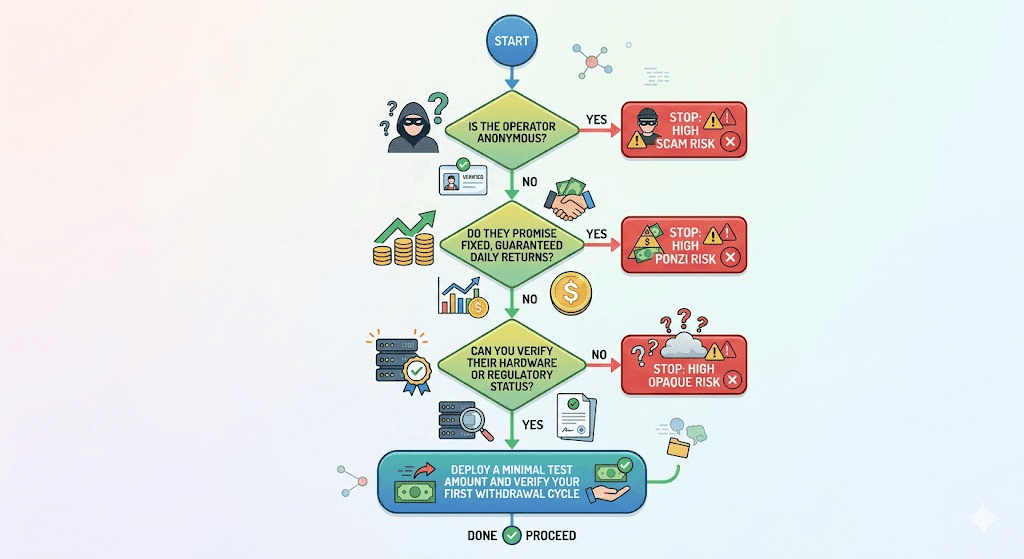
1. Identify the Core Red Flags
Immediate warning signs of a fraudulent cloud mining structure include:
- Guaranteed Yields: No legitimate operator can promise a fixed percentage return because Bitcoin price and network difficulty fluctuate constantly.
- Advance-Fee Traps: If a platform demands an additional payment, often masked as a network tax, security deposit, or withdrawal fee, before releasing your accumulated earnings, it is a definitive scam.
- Anonymous Teams: Avoid websites that lack clear, verifiable parent corporate entities, physical office addresses, or registered business jurisdictions. Historical cases like the 575 million HashFlare Ponzi collapse prove that fake dashboards can easily mask non-existent hardware.
2. Run the Direct Purchase Comparison Test
Always calculate the cost-efficiency of the contract against a raw spot asset purchase. If spending $500 on a cloud mining contract is projected to yield an estimated 0.005 BTC over 12 months under static conditions, check how much raw BTC that same $500 can buy immediately on the spot market.
If direct accumulation yields more asset weight without the added operational and counterparty risks, skip the contract entirely.
How to Trade and Manage Your Mined BTC Coins on BingX
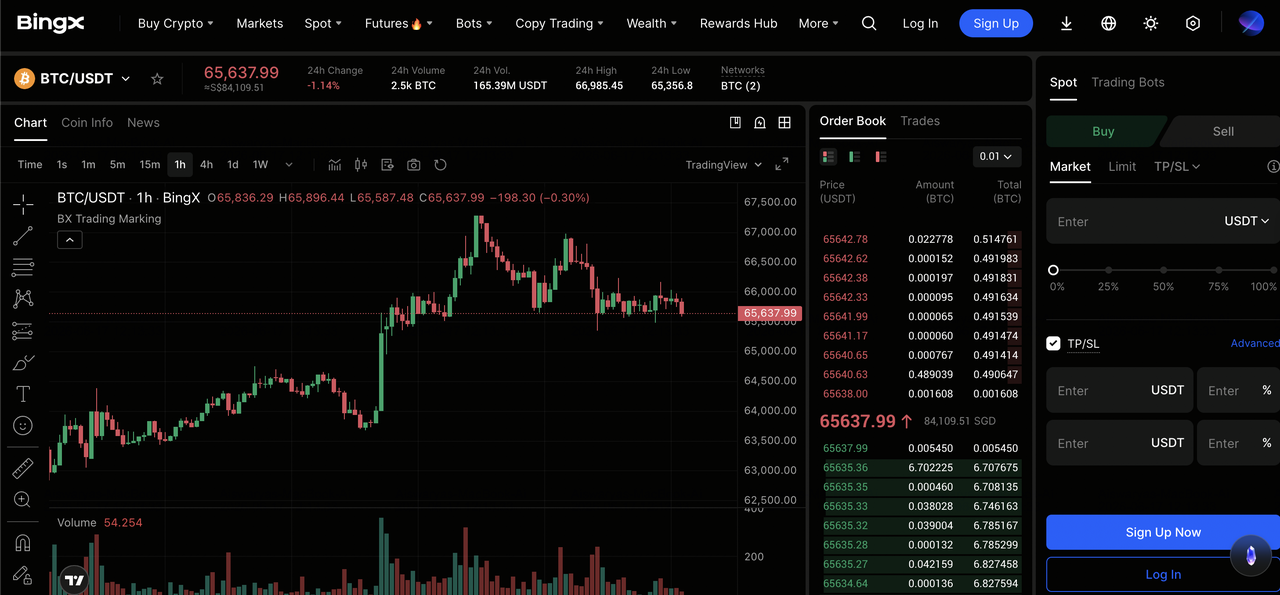
BTC/USDT trading pair on BingX spot market
Once your chosen cloud mining provider processes your daily distribution and you cross their minimum withdrawal threshold, it is critical to move your coins off the mining platform to mitigate platform custody risks.
- Retrieve Your BingX Deposit Address: Log into your BingX account, navigate to Asset and Deposit, select your mined asset, e.g., Bitcoin, and choose the correct network, e.g., BTC/Bitcoin network. Copy your unique alphanumeric deposit address.
- Execute Platform Withdrawal: Paste this address into the withdrawal configuration field of your cloud mining platform. Always double-check the characters to prevent clipboard hijacking errors.
- Confirm Network Settlement: Monitor the transaction via a blockchain explorer. Once the required network confirmations are met, the balance will settle directly into your BingX Funding account.
- Execute Spot Exchanges or Strategic Hedges: Navigate to the BingX Spot Market to sell your BTC for stablecoins like USDT or reallocate capital into alternative high-utility assets. Advanced users can use BingX Futures to open strategic short positions, effectively hedging their pending cloud contract mining yields against sudden downside market volatility.
Final Thoughts: Should You Use a Cloud Mining Platform to Mine Bitcoin in 2026?
Cloud mining in 2026 remains a highly specialized financial instrument. While it completely eliminates the overhead of managing hardware, it introduces substantial platform counterparty risk and fee structures that can heavily penalize net performance if the broader market consolidates.
If you decide to engage with cloud mining, do so strictly with capital you treat as speculative or experimental. Rely exclusively on platforms with verifiable corporate footprints, such as publicly listed entities, run highly conservative profitability calculations, and withdraw your distributions routinely to your secure wallets or your BingX trading account to maintain maximum control over your wealth.
Related Reading
- How to Mine Bitcoin (BTC) in 2026: A Beginner's Guide
- What Are the Top Proof-of-Work (PoW) Coins to Mine in 2026?
- The Shift to ASICs: Why You Can’t Mine Bitcoin with a GPU in 2026
- Top Bitcoin Wallets: Best Ways to Store BTC in 2026
- What Are the Top Bitcoin Hardware Wallets to Use in 2026?
- Is Bitcoin Mining Still Profitable in 2026: How to Calculate BTC Mining Profitability?
FAQs on Bitcoin Cloud Mining
1. Are there legitimate free Bitcoin cloud mining sites?
No. Genuine proof-of-work mining demands real physical hardware infrastructure and significant power expenditure. Platforms offering "unlimited free mining" are typically simulated marketing funnels or data-harvesting sites designed to incentivize users into upgrading to paid tiers. Genuine promotional trials, such as temporary sign-up hashrate bonuses, are strictly capped and ahighly restricted.
2. Can I mine multiple cryptocurrencies simultaneously via cloud mining apps?
Certain specialized platforms utilize merged mining configurations, allowing their underlying script architectures to secure multiple networks simultaneously, such as mining Litecoin and Dogecoin together via Scrypt algorithms. This allows operators to optimize their diversified yield streams, though retail cloud contracts often liquidate these auxiliary assets internally and pay the user out in a single asset like BTC or USDT.
3. How do mining rewards handle local tax obligations?
In many leading financial jurisdictions, digital assets accumulated via mining are classified as taxable income at their fair market valuation at the exact time of receipt. Subsequent conversions, spot sales, or asset swaps on exchanges like BingX may also trigger capital gains liabilities. It is vital to maintain precise accounting records detailing receipt timestamps, asset quantities, and historical price points. Always consult with a certified tax professional regarding local compliance mandates.
