
Between July 2024 and June 2025, Brazil processed US$318.8 billion in crypto assets, according to Chainalysis data, representing a 109.9% increase compared to the previous period. At this scale, even small price discrepancies between platforms stop being minor details and become real financial losses. In the P2P market, where each seller sets their own price, this variation can easily exceed 3% to 5% for the same Bitcoin at the exact same moment, depending on the exchange, payment method, and trading hours.
Quick Answer: Comparing Bitcoin prices in real time across P2P exchanges means simultaneously checking the market (spot) price, the seller’s quoted P2P price, and the embedded spread. To do this: (1) access the P2P dashboard of each exchange, (2) filter by payment method and desired amount, (3) calculate the percentage spread relative to the spot reference price, and (4) include fees and settlement time before deciding where to buy.
What Is the Bitcoin P2P Price and Why It Differs Across Exchanges
In the peer-to-peer market, you are not purchasing Bitcoin directly from an exchange as you would in a conventional spot trade. Instead, you are trading with another user selling their position. That seller sets the price based on the market quotation plus a personal spread, which covers market risk during the trading window, platform fees, and in some cases, the convenience of the accepted payment method.
It is similar to buying USD at an airport exchange booth versus a bank: the asset is the same, but the price can differ significantly.
This spread exists in every P2P transaction and tends to be smaller on platforms with deeper liquidity, a higher number of active sellers, and faster average settlement times. Platforms with fewer advertisers force buyers to accept wider spreads because competition between sellers is lower.
Positive and Negative Spreads in the P2P Market
The spread can work in both directions. A positive spread occurs when the seller lists above the market price, which is the standard scenario. A negative spread, which is less common, appears when a seller needs to liquidate quickly and accepts a discount relative to the spot price, creating a genuine opportunity to buy below market value.
Knowing how to identify both situations is the difference between executing efficiently and overpaying unnecessarily.
How to Calculate the P2P Spread in Practice
Before entering any P2P trade, it is important to calculate the actual spread of the offer relative to the market price. The formula is straightforward:
Spread (%) = ((P2P Price - Spot Price) / Spot Price) × 100
Practical example using real numbers:
Imagine Bitcoin is trading at R$620,000 on the spot market (you can verify this directly on the BingX live price page, which displays real-time quotations). You find a P2P seller offering Bitcoin at R$637,400.
Spread = ((637,400 - 620,000) / 620,000) × 100
Spread = (17,400 / 620,000) × 100
Spread = 2.81%
On a R$5,000 purchase, this spread represents an additional R$140. On R$50,000, it becomes R$1,400 in hidden cost. Multiplied by the trading frequency of an active trader, this amount can materially impact annual performance.
What Should Be Included in the Total P2P Cost Calculation
The spread is not the only cost component. To compare platforms accurately, the complete calculation should include:
- Seller spread relative to the reference spot price
- Platform transaction fees (often zero for P2P trades)
- Average payment release time, which affects users locked into the quoted price during the settlement window
- Accepted payment methods, since sellers accepting PIX usually charge tighter spreads than those requiring traditional bank transfers
Best Platforms to Compare Bitcoin P2P Prices in Brazil
BingX P2P
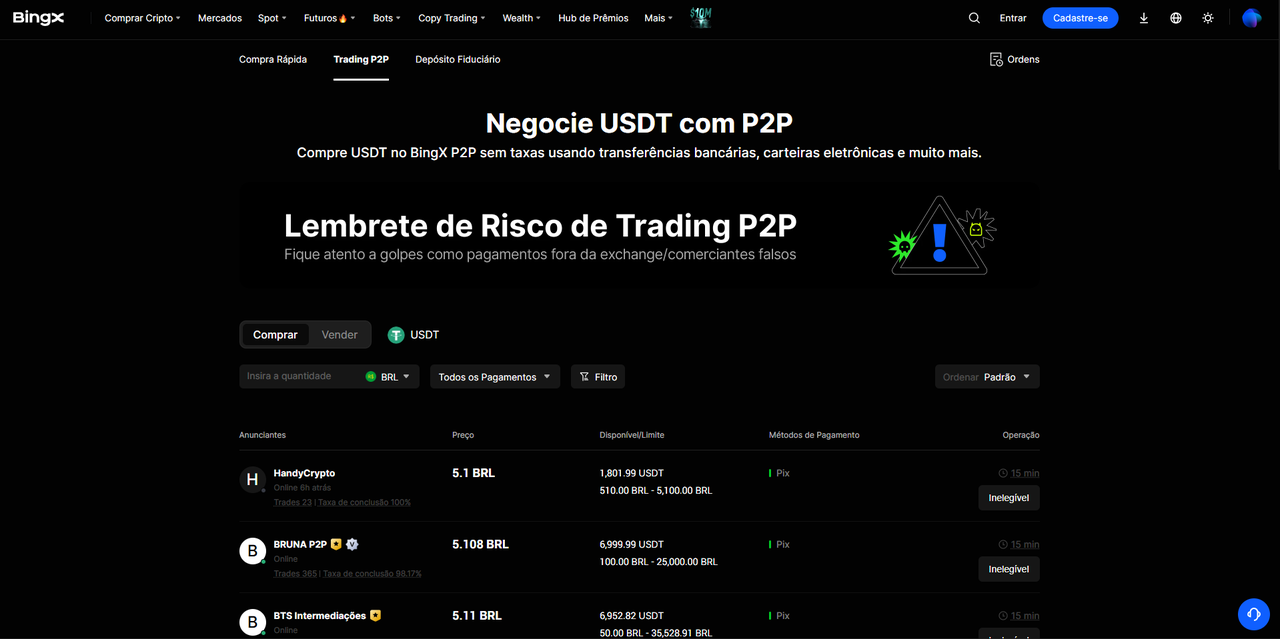
Founded in 2018, BingX supports more than 820 digital assets, making it one of the most comprehensive platforms for Brazilian traders looking to compare prices and identify the best real-time P2P offers. In practice, BingX stands out in three key areas for price comparison:
First, the platform displays the spot reference price directly within the P2P interface, allowing users to calculate the spread of any offer without switching tabs or relying on external tools. Second, its advanced filtering system enables users to sort offers by price, payment method (including PIX), minimum and maximum transaction amounts, and the seller’s average completion time. Third, the public trading history of each seller — including completion rate, total trades, and average response time — allows buyers to evaluate not only pricing but also counterparty reliability before entering a transaction.
Buyer fees on BingX P2P transactions are zero, eliminating an additional cost layer that can impact comparisons on competing platforms.
For Brazilian traders using PIX as their primary payment method, BingX maintains a strong base of verified merchants supporting instant transfers, reducing average settlement times and consequently lowering the risk of price fluctuations during the trading window. Learn more in the BingX PIX deposit tutorial.
Binance P2P
The interface allows users to compare offers side by side using filters for fiat currency, payment method, and transaction range. The key consideration is that its high trading volume attracts both reputable merchants and advertisers with heavily inflated spreads mixed among competitive offers, requiring buyers to filter listings carefully.
OKX P2P
For price comparison, the platform provides a consolidated overview of active offers alongside market reference pricing, although the interface is less intuitive for beginners compared to BingX or Binance.
The platform charges zero fees on user-to-user P2P transactions, leaving the seller spread as the primary cost component.
Bybit P2P
Bybit has been expanding its P2P presence in Brazil with support for PIX and more than 60 fiat currencies. According to internal platform data, transactions are typically completed in under five minutes on average, reducing the risk of price volatility during settlement.
One important consideration is the platform’s February 2025 security incident, which reinforces the importance of using external wallets for long-term asset storage and using the platform primarily for transaction execution.
External Tools for Real-Time P2P Price Comparison
In addition to the native interfaces of each exchange, several external tools help traders build a broader comparative view:
CoinGecko and CoinMarketCap serve as spot price references. Before accessing any P2P platform, checking the reference price on these tools helps calibrate the actual spread of each available offer. You can also use the BingX real-time BTC/USD converter as a quick benchmark before entering any P2P trade.
LocalBitcoins was historically the leading Bitcoin-exclusive P2P platform in Brazil but lost relevance following regulatory changes in 2023. It still exists as a market reference, although with significantly reduced volume.
Bisq is a decentralized alternative for users seeking non-custodial transactions without exchange-controlled custody. Price comparison is more manual, but the non-custodial model removes institutional counterparty risk. After purchasing assets, consider using compatible hardware wallets for maximum security.
For most Brazilian traders, the most efficient comparison process is still performed directly through the P2P interfaces of centralized exchanges, with BingX and Binance covering the majority of common use cases.
CEX vs. P2P: How Pricing Behaves Differently in Each Model
|
Criteria |
Spot Market (CEX) |
P2P Market |
|
Price Formation |
Centralized order book |
Each seller sets their own price |
|
Spread Transparency |
Embedded within trading fees |
Seller spread + platform fee |
|
Execution Speed |
Instant |
Depends on seller confirmation |
|
Payment Methods |
Limited (crypto, cards) |
Broad (PIX, bank transfer, PayPal) |
|
Privacy |
Varies by platform |
|
|
Liquidity |
High |
Varies depending on platform and trading hours |
The P2P market generally trades at slightly higher prices than the spot market due to the seller’s spread. The trade-off is greater payment flexibility and, in some cases, the ability to transact directly without dealing with order book spreads in low-liquidity pairs. For trades executed on the BingX BTC/USDT spot market, spreads are typically much tighter than those found in P2P markets under normal market conditions.
How to Filter P2P Offers to Find the Best Price
In practice, the comparison process on a platform like BingX follows this logic:
Step 1 - Check the Spot Reference Price
Before opening the P2P module, check the current Bitcoin price on the BingX live quotation page or through a platform such as CoinGecko.
Step 2 - Filter by Payment Method
Select the payment method you intend to use (such as PIX) and define the amount you plan to trade. This immediately removes sellers who do not match your trading profile.
Step 3 - Sort by Price
After applying the filters, sort the offers from lowest to highest price. Calculate the spread of the top three offers using the formula presented earlier.
Step 4 - Analyze the Seller Profile
A low spread from a seller without trading history is not necessarily a good deal. Check the completion rate (above 95% is generally considered strong), total number of completed trades, and average response time.
Step 5 - Consider Trading Hours
Spreads are usually tighter during periods of higher market activity, typically between 9 AM and 6 PM Brasília time. During late-night hours and weekends, the number of active sellers declines and spreads tend to widen.
Strategies to Reduce Total Costs When Buying Bitcoin via P2P
Use a Price Limit as a Mental Benchmark
Define a maximum acceptable spread before searching for offers. A spread above 2% already deserves closer evaluation: it may be worth waiting for a better offer or migrating to the spot market if BTC/BRL liquidity can support your desired trade size. You can also use BingX AI to monitor market trends and identify more favorable entry opportunities.
Prioritize Sellers with High Volume and Strong Reputation
Sellers with a large number of completed transactions typically operate with tighter spreads because they rely on trading volume for profitability. Newer merchants often charge wider spreads to compensate for the risk associated with smaller contracts.
Monitor Peak Liquidity Hours
In Brazil, P2P spreads are generally lower during business hours when more sellers are actively competing for buyers. Outside these hours, reduced competition tends to favor higher spreads. Automated trading bots can help monitor pricing opportunities around the clock.
Consider Splitting Large Purchases into Smaller Batches
For purchases above R$20,000, splitting the order into two or three smaller transactions throughout the day can sometimes help capture different pricing windows and reduce the average entry cost. Always apply proper risk management practices to avoid unnecessary exposure to sudden market movements during execution.
FAQ: Frequently Asked Questions About Bitcoin P2P Price Comparison in Brazil
1. Is the Bitcoin P2P price always higher than the spot price?
In most cases, yes. P2P sellers incorporate a spread to cover price fluctuation risk during the settlement period and to compensate for their trading operation. This spread typically ranges from 0.5% to 5%, depending on the platform, seller, and market conditions. During periods of low liquidity, spreads can become even wider.
2. How can I tell if a P2P offer is fairly priced?
The most direct approach is to calculate the spread relative to the spot price. Use the real-time quotation from BingX or CoinGecko as a benchmark and apply the formula: ((P2P price - spot price) / spot price) × 100. Spreads below 1.5% are generally considered competitive in the Brazilian market.
3. Do P2P platforms charge fees to buyers?
Most major P2P platforms, including BingX, Binance, and OKX, do not charge direct fees to buyers for P2P transactions. The primary cost for buyers is the spread embedded in the seller’s quoted price.
4. What is the best time to buy Bitcoin via P2P in Brazil?
Peak trading hours between 9 AM and 6 PM Brasília time on weekdays generally offer tighter spreads due to increased competition among sellers. Overnight hours and weekends usually experience wider spreads.
5. Is it safe to buy Bitcoin through P2P platforms in Brazil?
Platforms with escrow systems ensure that Bitcoin remains locked until payment confirmation is completed, protecting both buyers and sellers. The greater risk usually exists on decentralized non-custodial platforms. In most situations, combining escrow-enabled platforms with reputable sellers provides sufficient operational security. Always enable 2FA on your account before initiating any P2P transaction.
6. Which tool should I use to compare P2P prices across multiple exchanges simultaneously?
There is currently no single consolidated platform for comparing P2P offers across multiple exchanges simultaneously in Brazil. In practice, traders manually review filtered offers on each platform and compare the calculated spreads.
7. Does the payment method affect the P2P price?
Yes, directly. Sellers who accept PIX usually charge slightly lower spreads because PIX settles instantly, reducing exposure to market risk. Payment methods with longer settlement times (such as traditional bank transfers or boleto payments) tend to carry wider spreads to compensate for the additional risk window. Learn how to make a PIX deposit on BingX to start trading without additional conversion costs.
Summary: What You Need to Know
- Bitcoin P2P prices vary across platforms because each seller sets their own pricing based on the spot market plus a personal spread
- The spread formula is ((P2P price - spot price) / spot price) × 100, and spreads below 1.5% are considered competitive in Brazil
- BingX displays the reference spot price directly within the P2P interface and charges zero fees for buyers, making real-time comparison easier
- Business hours (9 AM–6 PM on weekdays) generally offer tighter spreads because of stronger seller competition
- Always evaluate the seller profile, not just the price, because a low spread from an unverified seller may become more expensive than expected. After purchasing, store your USDT or BTC in secure wallets and verify whether the chosen exchange regularly publishes Proof of Reserves reports
Related Reading
- Crypto Fees and Spreads: Real Exchange Comparison for Brazilian Traders
- CEX, DEX, or P2P: How to Buy Crypto in Brazil in 2026
- How to Buy Bitcoin and Crypto with P2P on BingX
- CEX, DEX, or P2P: How to Buy Crypto in Brazil in 2026
- How to Understand Fees and Slippage in the BingX Spot Market and Maximize Your Profits
