

Buying Stellar (XLM) with a credit card in 2026 has become the go-to method for investors looking to capture rapid market momentum. Driven by a historic institutional partnership with Wall Street’s Depository Trust & Clearing Corporation (DTCC) to tokenize securities on-chain, XLM has broken out of long-standing technical resistance, causing a massive surge in trading volume. When a breakout occurs, waiting 3–5 business days for a standard bank transfer means missing the entry point.
Centralized exchanges like BingX offer near-instant credit and debit card settlement via optimized payment gateways, while platforms like Bitget and Coinbase provide alternative direct on-ramps. However, card purchases carry a premium. To maximize your capital, you must navigate the trade-offs between processing fees, market spreads, and mandatory security checks like 3D Secure (3DS) and KYC.
This guide details the fastest and most cost-effective ways to buy Stellar with a credit card in 2026, breaking down fee structures and explaining how to safely withdraw your assets to a non-custodial Stellar wallet.
Why Does Buying XLM with Credit Card Require Fee and Spread Planning?
While credit and debit cards offer unmatched speed, they are the most expensive entry points into the digital asset ecosystem. Card issuers and third-party payment processors, such as Mercuryo, Banxa, or MoonPay, charge convenience fees that can quickly eat into your purchasing power.
Furthermore, during periods of high volatility, such as the trading volume surge surrounding Stellar’s recent real-world asset (RWA) expansion, hidden costs like market slippage and wide order-book spreads can act as silent profit killers. Securing the best rate requires choosing an exchange that combines low card-processing margins with deep spot market liquidity.
What Is Stellar (XLM) and How Does It Work?
Stellar (XLM) is an open-source, decentralized Layer-1 blockchain network designed primarily for fast, low-cost cross-border payments, asset issuance, and RWA tokenization. Founded in 2014 by Jed McCaleb, the network acts as a highly efficient, neutral financial rail connecting traditional banks, payment processors, and digital assets.
Unlike traditional cryptocurrencies, Stellar operates using a unique consensus framework rather than energy-intensive mining or capital-heavy staking:
- Stellar Consensus Protocol (SCP): Based on the Federated Byzantine Agreement (FBA), SCP relies on a network of trusted validators. Instead of waiting for a global network consensus, nodes select overlapping subsets of other trusted nodes called quorum slices. This allows transactions to settle and achieve absolute finality in just 3 to 5 seconds.
- Near-Zero Operational Friction: Stellar is architected for micro-transactions. The network fee is mathematically minimized to a standard baseline of 0.00001 XLM per transaction, rendering cross-border settlement virtually free.
- Native Path Payments: The ledger features a built-in Decentralized Exchange (DEX) with an automated market maker (AMM) engine. It automatically routes multi-currency exchanges in a single atomic transaction, e.g., converting USD → XLM → EUR, finding the cheapest liquidity path instantly.
Stellar Ecosystem Tokenomics
The native asset of the network is the Lumen (XLM). It does not function as a traditional gas token or staking asset; rather, it acts as a structural utility asset. XLM is required to pay network transaction fees and fulfill anti-spam requirements, such as the mandatory 1 XLM base reserve per account. The asset features a fixed max supply of 50 billion XLM, with roughly 33.6 billion currently circulating.
Recent Developments in the Stellar Ecosystem in 2026
The year 2026 has marked a fundamental shift for Stellar, transitioning it from a payment network to the premier public infrastructure for institutional RWA tokenization.
- The DTCC Breakthrough (May 2026): In a landmark move for financial markets, the Depository Trust & Clearing Corporation (DTCC), the backbone of U.S. financial settlement, announced an integration with Stellar. This multi-chain strategy aims to host tokenized stocks, ETFs, and U.S. Treasuries on Stellar's public ledger by H1 2027, unlocking massive liquidity.
- Bermuda On-Chain Expansion: On May 12, 2026, the government of Bermuda announced it selected the Stellar network to power its strategic campaign to build the world’s first fully on-chain sovereign economy.
- Interoperability and Yield Upgrades: Circle’s Cross-Chain Transfer Protocol (CCTP) launched natively on Stellar, dramatically smoothing stablecoin rails. Concurrently, Protocol 26 or Yardstick successfully hit testnets, enhancing smart contract efficiency on Stellar’s Soroban platform.
Why BingX Is the Premier Platform to Buy Stellar (XLM) Instantly with Credit Card
In 2026, navigating the highly competitive fiat-to-crypto infrastructure requires looking past simple headlines. Choosing the right direct on-ramp depends on optimizing three critical vectors: card processor fees, base trading spreads, and underlying liquidity. While several global platforms support instant card purchases, BingX establishes itself as the most cost-effective and secure ecosystem for capturing fast-moving Stellar momentum.
The Lowest Total Leakage for Credit and Debit Card On-Ramps
BingX leads the 2026 digital asset market by systematically minimizing the operational costs embedded in card checkouts. Supporting both Visa and Mastercard, BingX features an incredibly low entry barrier with a minimum purchase requirement of just $10, protecting retail capital from heavy fixed fee minimums.
The structural advantage of BingX lies in its Dual-Efficiency Execution Strategy:
- The USDT-Convert Workflow: Users can purchase stable USDT instantly via the optimized Quick Buy gateway and route it directly into the deep XLM/USDT spot market. With a baseline trading fee of just 0.10%, which drops further for tiered VIP volume accounts, this method bypasses the bloated conversion premiums typically charged by legacy retail applications.
- Deep Order Book Liquidity: Backed by world-class market depth and institutional-grade liquidity providers, BingX minimizes market slippage. When high-impact news hits the wire, such as the recent DTCC real-world asset integration, buy orders on BingX are filled immediately with zero latency, ensuring you capture the actual spot price on your screen.
- Institutional Asset Integrity: Security on BingX extends beyond the transaction. The platform enforces a transparent, real-time audited 100% Proof-of-Reserves (PoR) architecture. Your funds are backed to the cent by verified on-chain assets, held securely in cold storage until you decide to trade or initiate self-custody.
How to Buy XLM with Credit Card on BingX: Step-by-Step Guide
Purchasing Stellar (XLM) using a credit or debit card can be completed in minutes. On BingX, you can choose between two main routes: buying XLM directly through the Quick Buy option, or using your card to fund your account with USDT first and then trading it for XLM on the spot market for maximum price efficiency.
Below is the step-by-step operational workflow utilizing the optimized BingX interface.
Step 1: Account Creation and Security Setup
Navigate to the BingX platform and register an account using a secure email address or phone number. Before exposing your account to any fiat funding, fully activate your security perimeter. Enable Google Two-Factor Authentication (2FA), set up a biometric passkey, and configure an anti-phishing code to prevent malicious actors from intercepting your account communications.
Step 2: Access the Crypto Purchase Gateway
Log in to your verified account, navigate to the header, select Buy Crypto from the main navigation menu, and then click on Quick Buy.
Step 3: Choose Your Funding Strategy
Depending on your preference for direct convenience or lower overall fee leakage, select one of the following paths:
- Direct Purchase: Select your local fiat currency, e.g., USD, EUR, GBP, search for XLM (Stellar Lumens) as your target asset, and enter the specific amount of fiat you wish to spend.
- Spot Market Optimization: Select your local fiat currency to purchase USDT (Tether) instantly with your card. Funding your account with USDT first allows you to manually control your entry price using the deep liquidity of the spot market later.
Step 4: Select Payment Method and Authorize
Choose Credit/Debit Card (Visa/Mastercard) as your primary payment rail. Review the real-time quote provided by the platform, which explicitly breaks down the current market rate, applicable card processing fees, and the net amount of crypto you will receive. Confirm the order to trigger the secure 3D Secure (3DS) banking gateway.
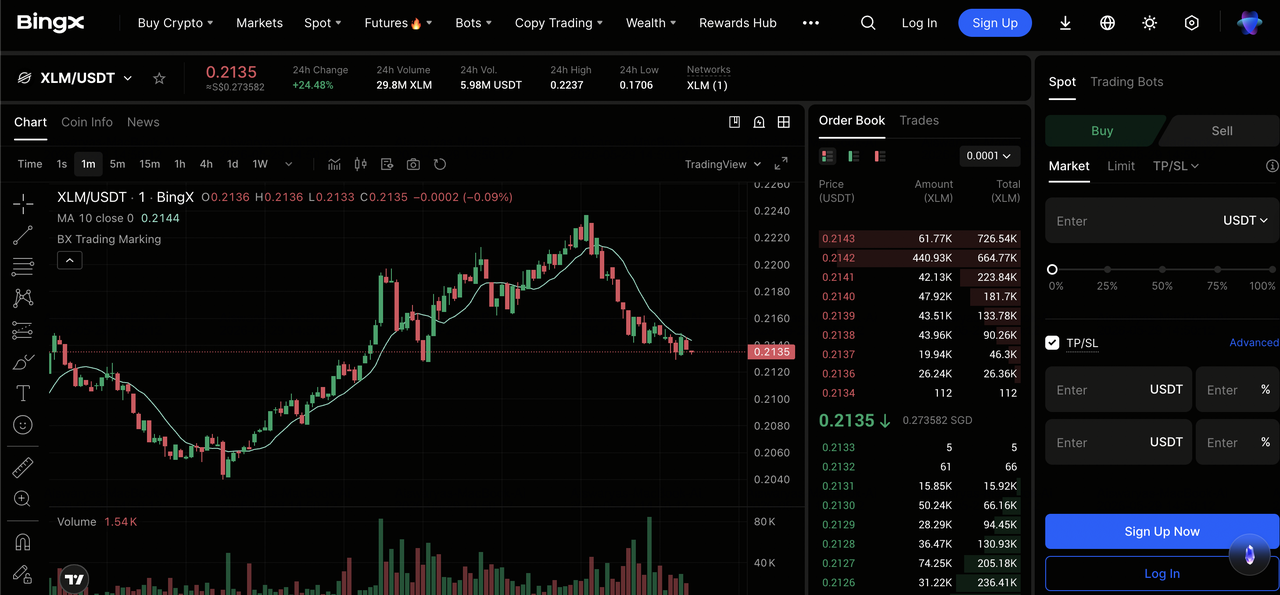
XLM/USDT trading pair on the BingX spot market
Step 5: Execute Spot Trade
If you chose to fund your account with USDT, head over to the spot trading terminal once the card transaction settles. Search for the XLM/USDT trading pair. Enter the amount of USDT you wish to allocate and execute either a Market Order for instant fulfillment or a Limit Order to capture a specific technical support level.
Step 6: Confirm Spot Delivery
Once completed, your assets will reside securely in your BingX Spot Account. You can view your updated token balance, trade history, and portfolio distribution in real time via your personal asset dashboard.
Security Check: Verifying 3D Secure and KYC
In the 2026 regulatory landscape, buying crypto anonymously with traditional banking rails is no longer possible. Every reputable tier-1 exchange enforces strict compliance protocols to eliminate fraud and money laundering.
- Mandatory KYC (Know Your Customer): To unlock fiat on-ramps, you must complete identity verification. This requires uploading a government-issued ID like passport or driver's license and completing a real-time biometric facial scan. Unverified accounts are strictly blocked from interacting with card processing networks.
- 3D Secure (3DS) Compliance: To protect against unauthorized card use, your card issuer must support 3D Secure protocol. During check-out, you will be automatically redirected to your bank’s secure portal to verify the transaction via a one-time SMS password, push notification, or biometric authorization inside your mobile banking app.
How to Transfer XLM to a Stellar Wallet for Self-Custody
Centralized exchanges are excellent for trading and liquidity management, but true asset ownership requires moving your funds to a non-custodial wallet. This ensures that you control the private cryptographic keys to your Stellar assets.
Understanding the Stellar Network Rules
The Stellar network operates on a unique structural framework designed to prevent blockchain spam. When executing a transfer, you must adhere to two critical components:
- The Base Reserve Requirement: Every active account on the Stellar ledger must maintain a minimum structural balance of 1 XLM. This baseline balance is locked by the network protocol to keep the ledger active. If you open a brand-new self-custody wallet, your very first transfer must be at least 1–2 XLM simply to initialize the account on-chain.
- The MEMO Field: Unlike Bitcoin or Ethereum, where a destination address is sufficient, centralized exchanges utilize a shared omnibus wallet architecture to hold customer XLM. When sending XLM back to an exchange, you must include a unique MEMO ID (text or ID string) provided by the platform. Forgetting the MEMO when depositing to an exchange will result in lost funds, as the exchange will not know which individual account to credit.
Note: Sending from an exchange to your private, non-custodial wallet typically does not require a memo, but you should always double-check your wallet's specific documentation.
How to Withdraw XLM Tokens From Exchange to Wallet
- Step 1: Download and set up a verified, secure Stellar ecosystem wallet, such as L稳定, Solar Wallet, or a hardware cold storage device like a Ledger or Trezor. Securely back up your 12-to-24 word recovery seed phrase offline.
- Step 2: Open your wallet application and locate your public Stellar receive address; this always begins with the letter G. Copy the address to your clipboard.
- Step 3: Navigate to your exchange account asset portal and click Withdraw. Select XLM and paste your private wallet address into the destination field.
- Step 4: Select the native Stellar Network rail. If sending to your own private wallet, you can typically leave the Memo field blank or enter a placeholder like "Self", unless your specific wallet software indicates otherwise.
- Step 5: Enter the amount of XLM you wish to transfer, pass your secondary security layers (Email + Google 2FA codes), and submit the transaction. Because the Stellar Consensus Protocol (SCP) processes transactions in just 3–5 seconds, your funds will arrive in your wallet almost instantly, carrying network transaction fees that cost a tiny fraction of a cent (0.00001 XLM).
Final Thoughts: Navigating the 2026 Stellar Ecosystem with BingX
Buying Stellar with a credit card is the most efficient method to transition fiat currency into the ecosystem instantly. By utilizing high-speed direct on-ramps like BingX, you clear the technical hurdles of traditional banking delays and position your portfolio to react to the growing wave of enterprise RWA tokenization.
To maximize efficiency, always cross-reference card processing percentages against exchange spreads, verify your identity via secure 3DS systems, and protect your long-term capital by practicing diligent self-custody on a dedicated hardware wallet.
Risk Reminder: Digital asset markets are subject to high market risk and severe price volatility. Past performance is not a reliable indicator of future results. Always protect your capital and conduct thorough independent research before buying or trading volatile crypto assets.
FAQs on Using Credit Cards to Buy Stellar (XLM)
1. Can I buy XLM with a credit card without completing KYC?
No. In 2026, all compliant and secure fiat payment networks require identity verification to process credit or debit cards. Unverified accounts are limited exclusively to crypto-to-crypto trading rails.
2. What happens if I forget to enter the MEMO when depositing XLM to an exchange?
If you transfer XLM to a centralized platform without the designated MEMO ID, the funds will arrive safely in the exchange’s main storage wallet, but the platform will fail to credit your specific user account. You will need to contact customer support with your on-chain transaction hash to manually recover the assets.
3. Is there a maintenance fee for holding XLM in a private wallet?
The network does not charge recurring upkeep fees, but the protocol enforces a permanent base reserve of 1 XLM per account to combat ledger bloat. This locked balance can be freed only if the account is completely merged and closed on-chain.
