
Most Brazilian traders focus only on trading fees and overlook the spread. This oversight can be costly. According to data from Portal do Bitcoin in January 2026, a difference of just 0.05% in the total cost of a trade can result in up to a 15% variation in annualized net profit for high-frequency traders. In Brazil, where crypto trading volume has grown significantly following the Crypto Legal Framework, understanding the true cost of each trade is no longer a minor detail—it is a matter of financial survival.
Quick answer: Fees are explicit charges imposed by the exchange for each transaction, directly deducted from your balance. Spread is the difference between the buy and sell price of an asset, embedded within the quoted price itself. To reduce total costs: use limit orders, trade high-liquidity pairs such as BTC/USDT, choose exchanges with deep order books, and consider volume-based VIP programs.
What Are Crypto Trading Fees
When you execute an order on a centralized exchange, the platform charges a percentage of the traded value. This fee appears clearly in your transaction history, is calculated transparently, and you know exactly how much you paid.
Most exchanges use the maker-taker model. The logic is straightforward: traders who provide liquidity to the order book (makers) benefit from lower fees because they contribute to market efficiency. Traders who consume liquidity immediately (takers) pay slightly higher fees for this convenience.
Think of it this way: at a bakery, customers who pre-order bread receive a discount. Those who walk in and buy what is already available pay full price. Exchanges follow the same principle.
- Maker: places a limit order that sits in the order book awaiting execution. Adds liquidity.
- Taker: places a market order that executes immediately against existing orders. Consumes liquidity.
Trading fees are calculated as follows:
Fee = Order Value × Fee Rate
Practical example: a trader buys R$ 5,000 worth of Bitcoin via a market order on an exchange with a 0.10% taker fee. The cost is R$ 5,000 × 0.0010 = R$ 5.00. It may seem small, but if this trader executes 20 trades per month, the monthly cost reaches R$ 100 in fees alone, excluding spread.
What Is Spread in Crypto
Spread is the hidden cost. It does not appear as a line item in your transaction history, but it is embedded in every quoted price you see on an exchange.
Technically, spread is defined as the difference between the best bid (buy price) and the best ask (sell price) of an asset in the order book.
Spread = Ask Price - Bid Price
Spread (%) = (Ask - Bid) / Bid × 100
Example: Bitcoin quoted with a bid of R$ 520,000 and an ask of R$ 520,800. The absolute spread is R$ 800, representing 0.15% of the price. If you buy and then sell without any price movement, you have already lost 0.15% purely due to the spread, excluding any explicit fees.
On high-volume exchanges with deep order books, such as pairs BTC/USDT and ETH/USDT, spreads tend to be tighter. However, in lower-liquidity altcoins or during off-peak trading hours, spreads can range from 0.5% to 2%, making trades significantly more expensive than they appear.
The Formula for the Real Cost of a Trade
The most common mistake among beginner traders is comparing only fee percentages across exchanges while ignoring spread. The real cost of a trade has two components:
Total Cost (%) = Trading Fee + Spread
For a round-trip trade (buy and sell of the same asset), the cost doubles:
Total Cost (Round Trip) = (Maker or Taker Fee × 2) + (Spread × 2)
Example with real numbers:
A trader executes a R$ 10,000 BTC/USDT trade on BingX under the following conditions:
- Spot taker fee: 0.10%
- Average BTC/USDT spread: 0.05%
Entry cost: R$ 10,000 × (0.10% + 0.05%) = R$ 15.00
Exit cost: R$ 10,000 × (0.10% + 0.05%) = R$ 15.00
Total trading cost: R$ 30.00
If the same trader operates on an exchange with a 0.25% taker fee and a 0.20% spread (common in low-liquidity platforms):
Total trading cost: R$ 10,000 × (0.45% × 2) = R$ 90.00
The R$ 60.00 difference per trade, multiplied by 20 monthly trades, results in an additional R$ 1,200 in monthly costs—simply due to choosing the wrong platform.
Real Comparison of Fees and Spreads Across Major Exchanges in 2026
International Exchanges Operating in Brazil
BingX
BingX applies a standard 0.10% fee for both maker and taker orders in the spot market, aligned with the industry average. In the perpetual futures market, fees are 0.02% for makers and 0.05% for takers, both below the global average. The VIP program reduces fees progressively: upon reaching US$ 15 million in 30-day volume, spot fees drop to 0.014% maker and 0.04% taker. For high-volume futures traders, the Supreme VIP tier offers 0% maker fees and 0.028% taker fees. The platform maintains a US$ 150 million Shield Fund and audited proof-of-reserves with 100% coverage.
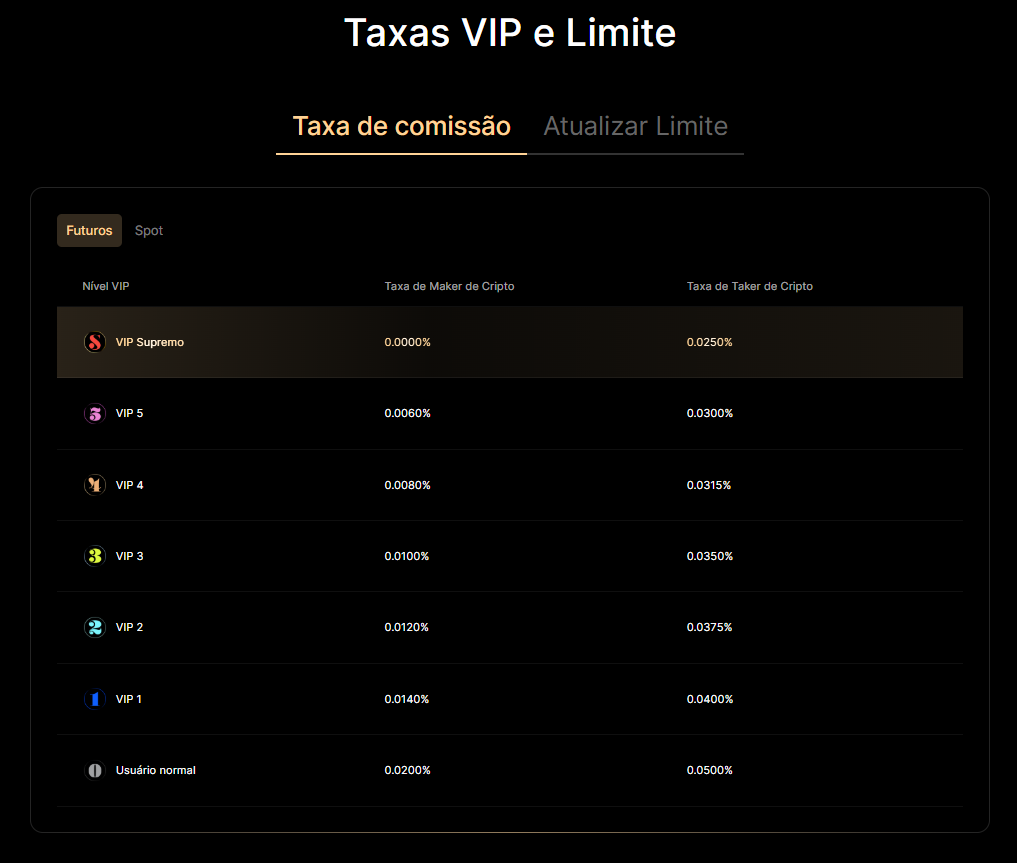
BingX VIP Program
For the P2P market, BingX charges 0% fees for both maker and taker, offering a tangible advantage for users looking to convert USDT into Brazilian reais without additional trading costs.
The spread on the BTC/USDT pair on BingX is typically tight due to strong trading volume and deep order book liquidity, especially during peak trading hours. High-liquidity pairs such as BTC/USDT and ETH/USDT offer the most competitive spreads, according to platform market data updated in early 2026.
Binance
Binance holds the largest global trading volume. In Brazil, access to BRL spot markets remains somewhat limited.
Kraken
Spreads are generally competitive for high-liquidity pairs, but the standard fee structure is above the industry average for lower-volume traders.
Coinbase
Coinbase Advanced Trade offers fees closer to competitors, but still above average for Brazilian retail traders. The embedded spread in the basic interface is one of the platform’s most common criticisms.
Brazilian Exchanges
Mercado Bitcoin
Deposits and withdrawals in BRL are fee-free. The downside lies in higher trading fees compared to international competitors. The advantage is regulatory compliance with VASP standards.
Foxbit
A Brazilian exchange founded in 2014, focused on simplicity and Portuguese-language customer support. It operates with trading fees and embedded FX spread in BRL transactions. Suitable for users prioritizing local support, but not the most cost-efficient for active traders.
Cost Comparison Table
|
Exchange |
Spot Maker Fee |
Spot Taker Fee |
Futures Maker Fee |
Futures Taker Fee |
BTC/USDT Spread* |
|
BingX |
0.10% |
0.10% |
0.02% |
0.05% |
Tight (high liquidity) |
|
Binance |
0.10% |
0.10% |
0.02% |
0.05% |
Tight |
|
Kraken |
0.16% |
0.26% |
0.02% |
0.05% |
Tight |
|
Coinbase Advanced |
0.06% |
0.10% |
N/A |
N/A |
Moderate |
|
Mercado Bitcoin |
Variable |
Variable |
N/A |
N/A |
Embedded BRL spread |
Estimate based on publicly available market data in 2026. Actual spread varies depending on real-time liquidity and trading hours.
When Spread Matters More Than Fees
There are situations where the spread has a greater impact than any explicit fee. Traders need to understand these conditions to avoid unexpected costs.
Trading Low-Liquidity Altcoins
The lower an asset’s trading volume, the wider its spread tends to be. A coin with US$ 500,000 in daily volume may have spreads ranging from 0.5% to 2%, making a 0.10% fee look almost irrelevant compared with the real cost of the trade.
Market Orders During High Volatility
During sharp price movements, the order book becomes thinner. Traders entering with market orders may face wider spreads as well as slippage. The combination of a wide spread and slippage is especially damaging for those trading perpetual futures with leverage. Applying solid risk management practices, including stop-loss and take-profit orders, is essential in these conditions.
Platforms That Charge Spread Instead of Fees
Some platforms, such as certain CFD brokers, do not charge a fixed fee. Instead, they generate revenue by artificially widening the spread between buy and sell prices. The cost does not disappear; it simply changes form. To an inattentive trader, it may look free. To someone who understands the structure, it can sometimes be more expensive than paying a direct fee.
CEX vs DEX: How Costs Behave Differently
On a centralized exchange (CEX), such as BingX, Binance, or Mercado Bitcoin, trading costs are predictable: a percentage fee on trading volume plus the spread from the order book.
On a decentralized exchange (DEX), such as Uniswap or PancakeSwap, the structure is different. There is no order book: prices are determined by an AMM (Automated Market Maker) using liquidity pools. The cost of a trade on a DEX includes:
- Protocol fee, usually from 0.01% to 1% depending on the pool
- Price impact, meaning the larger the order relative to the pool, the greater the deviation
- Gas fee, the blockchain network fee required to process the transaction
For Brazilian traders who mainly trade BTC and ETH in smaller volumes, CEXs usually provide lower total costs and more predictable execution. DEXs make more sense for users who want access to newly launched tokens before they are listed on major exchanges. To store these tokens securely, use compatible Web3 wallets.
How to Reduce the Real Cost of Your Trades
Understanding the cost structure is half the battle. The other half is acting on it.
Use limit orders whenever possible. By placing a limit order instead of a market order, you pay the maker fee, which is lower than the taker fee, while also controlling the execution price and eliminating slippage.
Trade high-liquidity pairs. BTC/USDT and ETH/USDT have the tightest spreads on any exchange with meaningful trading volume. For altcoins, assess the spread before entering a position. Tools such as BingX AI help identify better entry and exit opportunities.
Source: BingX AI
Consider the volume-based VIP program. BingX offers discount tiers based on 30-day trading volume. For active traders, concentrating volume on a single platform may be worthwhile to unlock lower fees.
Monitor your trading hours. Spreads tend to be lower during periods of higher global liquidity, generally during the overlap between Asian and European markets, from 4 a.m. to 8 a.m. Brasília time. Traders using automated trading bots can take advantage of these windows without needing to stay in front of the screen.
Evaluate deposit and withdrawal costs. A platform with competitive trading fees but high withdrawal fees can end up costing more overall. BingX, for example, does not charge fees for crypto deposits, but applies a fixed withdrawal fee that varies by asset and selected network. Choosing lower-cost networks such as TRC-20 (TRON) for USDT transfers can significantly reduce this cost.
Use the demo account to estimate costs before trading. BingX offers a demo account with virtual USDT (VST), where you can simulate trades and calculate the real impact of fees and spreads on your strategy before committing real capital. Access the account verification tutorial to unlock all platform features.
FAQ
1. What are maker and taker fees in crypto?
A maker fee is charged to traders who place an order in the order book and wait for execution, usually through a limit order. A taker fee is charged to traders who execute immediately against an existing order, usually through a market order. Makers pay less because they add liquidity to the market; takers pay more because they consume that liquidity.
2. What is the impact of spread on a trader’s profit?
Spread is applied every time a trader enters and exits a position. In a round-trip trade with a 0.15% spread, the trader starts 0.30% below breakeven before accounting for any fees. For frequent traders, accumulated spread costs can exceed explicit trading fees.
3. Are zero-fee exchanges really free?
Not necessarily. Some platforms that advertise “zero fees” generate revenue by widening the spread between buy and sell prices. The cost has not been eliminated; it has simply become less visible. Use the BingX direct conversion tool to compare the real cost across different options before trading.
4. How do you calculate the real cost of a crypto trade?
Use the formula: Total Cost = (Trading Fee + Spread) × Order Value. For a complete trade, meaning entry and exit, multiply the result by 2. Also add any withdrawal fees and gas fees for DEX transactions.
5. Is it worth moving up to a VIP tier on exchanges?
It depends on monthly trading volume. On BingX, for example, reaching US$ 15 million in 30-day volume reduces the spot maker fee from 0.10% to 0.014%. For high-volume traders, the savings can be substantial.
6. What is the difference between spread on a CEX and price impact on a DEX?
On a CEX, spread is the difference between the best bid and ask prices in the order book. On a DEX, the equivalent cost is “price impact”: how much a large order moves the price within a liquidity pool. In DEXs with shallow pools, a single order can move the price by 1% or more, making DEXs inefficient for large volumes.
7. Does BingX offer Portuguese support for Brazilian traders?
Yes. The platform offers an interface and support in Portuguese, as well as educational videos and articles designed for Portuguese-speaking users. Mobile app access is also available in Portuguese. To set up your account security from the start, follow the 2FA activation tutorial.
8. What is the difference between a trading fee and a crypto withdrawal fee?
A trading fee is charged on each buy or sell transaction inside the platform. A withdrawal fee is charged when you move crypto from the exchange to an external wallet. These are separate costs: the first affects frequent traders, while the second impacts users who move assets between platforms or into self-custody.
Key Takeaways
- Fees are explicit and appear in your transaction history. Spread is embedded in the price and often goes unnoticed
- The real cost of a trade is always fee plus spread. Looking only at fees leads to incomplete comparisons
- For futures, the funding rate is a third cost component that can exceed fees and spread combined when positions are held for several days
- BingX charges 0.10% spot fees and 0.02%/0.05% on perpetual futures, below the industry average for futures, with a VIP program that can progressively reduce these rates
- Limit orders reduce two costs at once: they pay maker fees, which are lower, and eliminate slippage
- High-liquidity pairs such as BTC/USDT have tighter spreads on any major exchange
- The choice of withdrawal network, such as TRC-20, Solana, or Ethereum, can make a major difference in the cost of moving USDT between platforms. Use wallets compatible with multiple networks to keep your assets secure outside exchanges
