
In early May 2026, Nickel (XNI) is the center of a high-stakes tug-of-war between structural oversupply and a geopolitical supply squeeze. After touching near two-year highs of $19,350 in April, the base metal is currently consolidating as traders digest a 30% cut in Indonesian mining quotas. While the broader market remains in a technical surplus of approximately 324,000 tonnes, the Sulfur Crisis, triggered by conflict in the Middle East and the closure of the Strait of Hormuz, has crippled the production of battery-grade Mixed Hydroxide Precipitate (MHP).
As Indonesia consolidates its OPEC-style control over 60% of the global nickel market, nickel's investment thesis is shifting. No longer just a stainless steel input, it is now a strategic battlefield for EV supply chain security. This guide breaks down the Nickel price prediction for 2026 using data from Goldman Sachs, BMI (Fitch Solutions), the International Nickel Study Group (INSG), and S&P Global.
You will also discover how to trade Nickel futures with USDT through BingX TradFi.
Top 5 Things for Nickel Traders to Know in 2026
As Nickel navigates an environment of resource nationalism and chemical shortages, traders must monitor these five market-moving factors.
- The Indonesian ONEC Pivot: Indonesia has transitioned from a 'growth-at-all-costs' disruptor to a price guardian. By slashing 2026 mining quotas (RKAB) to 260–270 million tonnes, Jakarta is actively defending a price floor.
- The Sulfur Bottleneck: Nickel refining (HPAL) requires massive sulfur imports. With Middle Eastern supply routes disrupted, Indonesian processors have faced 10% output cuts, tightening the supply of battery-grade materials.
- LFP vs. NMC Chemistry: High nickel prices are accelerating the shift toward Lithium Iron Phosphate (LFP) batteries, which contain zero nickel. This serves as a long-term demand ceiling for the metal.
- Rising Cost Floors: Diminishing ore grades in Indonesia dropping from 1.8% to 1.4% and a new price-linked royalty regime mean that global marginal costs have risen to nearly $17,000/t.
- Exchange Inventory Divergence: While LME stocks have risen toward 280,000 tonnes, shadow inventories in Asia are tightening, creating a disconnect between paper prices and physical availability.
What Is Nickel (XNI)?
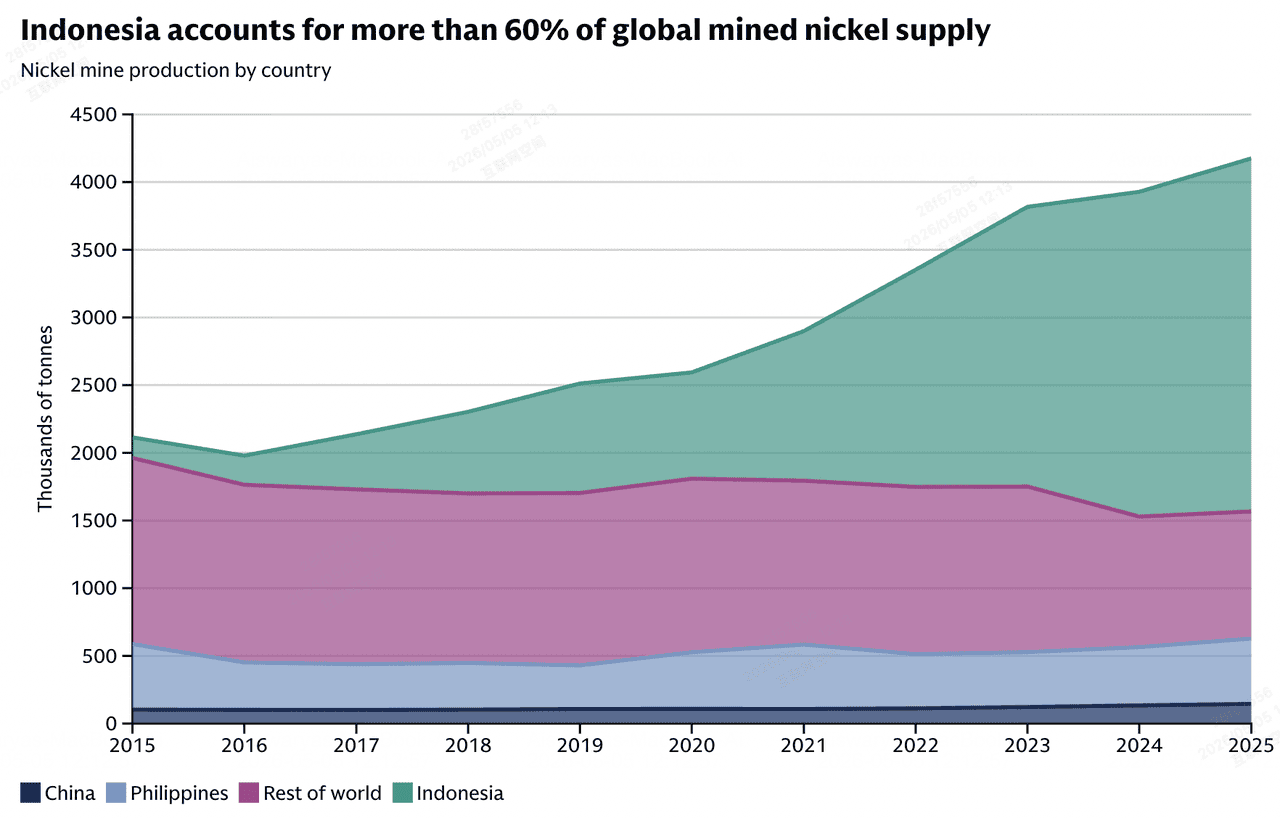
Indonesia is the world's largest nickel producer | Source: Goldman Sachs
Nickel is a versatile, corrosion-resistant transition metal. While historically dominated by the stainless steel sector (70% of demand), its 2026 valuation is increasingly driven by its role in high-energy-density EV batteries. Nickel allows for longer driving ranges, making it essential for premium automotive performance.
As of May 2026, the nickel market is defined by a bipolar structure: an abundance of low-grade Nickel Pig Iron (NPI) versus a tightening supply of high-purity Class 1 nickel and battery intermediates. On the BingX TradFi platform, traders can capitalize on these spreads through Nickel (NI) CFDs, enabling exposure to global price trends without the logistical burden of physical ore.
Trading nickel in 2026 involves tracking the benchmark LME Nickel 3-Month Futures and the SHFE Nickel contracts. Investors can also gain exposure via major mining equities like Vale (VALE), Eramet (ERA), or junior developers like Alaska Energy Metals (AEMC), which is advancing a strategic U.S. domestic supply at the Nikolai Project.
How Did Nickel Perform in 2025: A Review
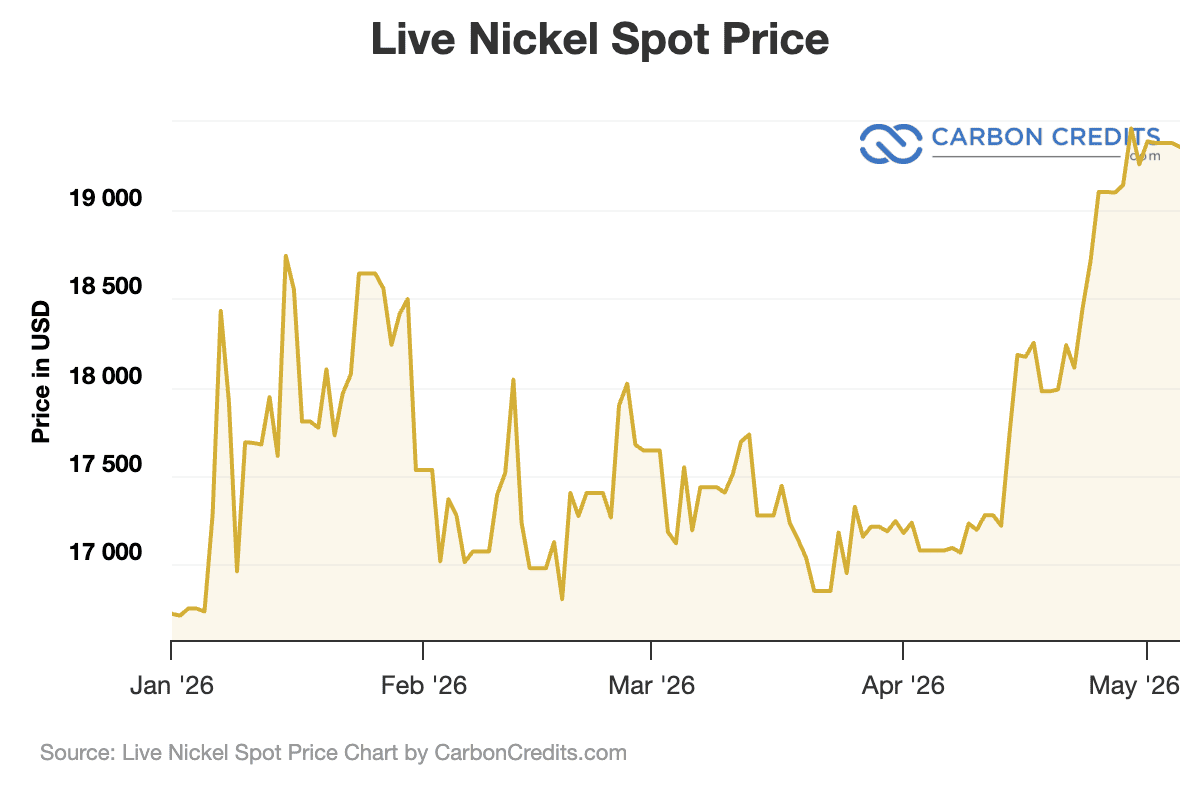
Nickel's YTD performance as of May 2026 | Source: Carbon Credits
2025 was a year of 'The Great Reset.' Prices spent much of the year suppressed by a flood of Indonesian supply and a slow recovery in Chinese real estate. LME nickel opened 2025 near $15,365 and drifted toward lows of $13,815 in April 2025 as the global surplus widened.
However, the tide turned in December 2025 when Indonesia signaled a 34% output reduction for the coming year. This sparked a 20% rally in just 12 trading sessions, carrying the metal into 2026 with renewed bullish momentum and shifting the narrative from a perpetual glut to policy-driven scarcity.
Nickel 2026 Investment Outlook: $25,000 Breakout vs. $16,000 Mean Reversion
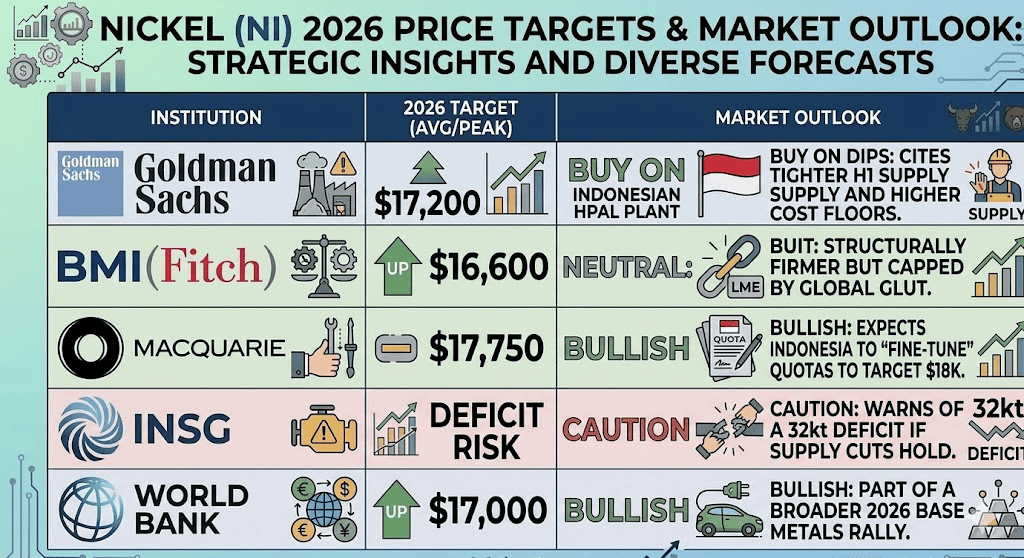
Nickel price forecasts for 2026 by leading analysts
Navigating the 2026 nickel market requires balancing a fundamental surplus against immediate geopolitical flashpoints.
The Bull Case: The $25,000 Structural Shock
The bullish narrative centers on a Supply-Chain Perfect Storm where the perceived global surplus is exposed as a statistical illusion. While approved RKAB quotas totaled 364 million tonnes in 2025, actual production utilization hovered at a staggering 55%, meaning paper nickel never reached the physical market. If Jakarta maintains the 2026 cap at 260–270 million WMT while the Strait of Hormuz remains closed, the inability to import sulfur for Indonesian HPAL plants will choke the production of battery-grade Mixed Hydroxide Precipitate (MHP), tipping the market from a 300kt surplus into an acute physical deficit.
For traders, the technical trigger is a sustained break above the $21,000 resistance level. Such a move would likely ignite a massive short squeeze as institutional investors realize that Western Sulphide projects, like Alaska Energy Metals’ Nikolai Project, cannot reach production fast enough to offset the Indonesian shortfall. In this scenario, price becomes inelastic; Western automakers, desperate to satisfy Inflation Reduction Act (IRA) domestic sourcing requirements, will pay a premium for any non-Chinese controlled supply, driving spot prices toward the $25,000 psychological target.
The Base Case: Nickel Trades in a $17,000 – $19,500 Volatile Range
The base case envisions a High-Floor, Heavy-Lid environment defined by active supply management. Indonesia’s transition to a price-linked royalty system, taxing sales up to 19% at higher tiers, effectively incentivizes Jakarta to defend a $17,000 support floor, which aligns with the current marginal cost of production for high-cost producers. While geopolitical tensions keep the sulfur risk premium alive, the market is restrained by a 324,000-tonne surplus and high LME inventories, which act as a cooling mechanism against runaway rallies.
Practically, this results in a range-bound market where nickel averages $17,200 per tonne. Investors should expect range-trading opportunities between the $17,500 support and $19,200 resistance zones. Momentum will be dictated by incremental data points: monthly Chinese stainless steel utilization and the pace of destocking in LME warehouses. In this phase, nickel remains a neutral asset, balancing the tailwinds of the green energy transition against the headwinds of a cooling Chinese real estate sector and the steady adoption of nickel-free LFP batteries.
The Bear Case: Nickel's $15,500 Demand Destruction
The bearish scenario, or the Reversion Trap, is triggered by a sudden de-escalation of regional conflicts and a policy retreat in Jakarta. If Indonesian regulators, facing pressure from domestic smelters operating at only 70–75% utilization, raise the 2026 RKAB quotas back above 300 million tonnes, the scarcity narrative will evaporate instantly. A reopening of the Strait of Hormuz would normalize sulfur flows, slashing HPAL operating costs and allowing a flood of high-pressure acid leach output to saturate the battery-grade market just as demand growth slows.
On the demand side, a Hard Landing for the global EV sector would see LFP (Lithium Iron Phosphate) batteries exceeding 70% market share, effectively decoupling the EV revolution from nickel consumption. If the Chinese housing recovery remains stagnant, reducing the demand for 300-series stainless steel, the market will face a mean reversion toward the $15,500 level. Technically, a daily close below the $16,800 line in the sand would signal the start of a bearish trend, liquidating speculative long positions and forcing the market to price in a long-term structural oversupply.
Nickel Price Forecasts for 2026 by Leading Analysts
|
Institution |
2026 Target (Avg/Peak) |
Market Outlook |
|
Goldman Sachs |
$17,200 |
Buy on Dips: Cites tighter H1 supply and higher cost floors. |
|
BMI (Fitch) |
$16,600 |
Neutral: Structurally firmer but capped by global glut. |
|
Macquarie |
$17,750 |
Bullish: Expects Indonesia to "fine-tune" quotas to target $18k. |
|
INSG |
Deficit Risk |
Caution: Warns of a 32kt deficit if supply cuts hold. |
|
World Bank |
$17,000 |
Bullish: Part of a broader 2026 base metals rally. |
How to Trade Nickel (NI) Futures on BingX TradFi
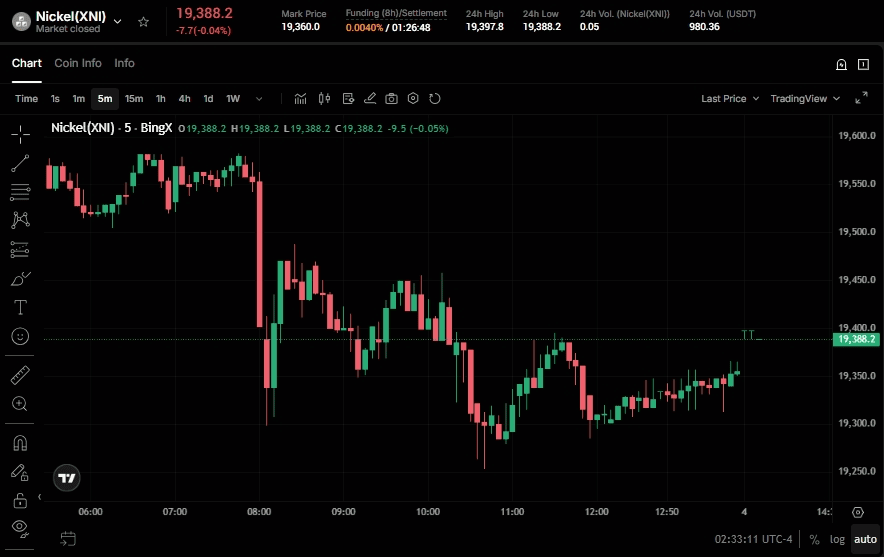
Nickel perpetual futures on BingX TradFi
Utilize the volatility of the ONEC era with BingX TradFi and BingX AI's automated insights. Whether hedging against industrial cost increases or speculating on geopolitical supply shocks, BingX offers the tools to trade Nickel with precision.
- Access BingX TradFi: Go to the Commodities section.
- Select Nickel (NI): Choose the NICKEL(XNI)-USDT perpetual contract.
- Analyze Sentiment: Use the BingX AI tool to track Indonesian RKAB news and Strait of Hormuz shipping data.
- Set Your Position: Open Long to bet on the $25,000 breakout or Open Short to trade the $16,000 surplus floor.
- Protect Capital: Use Stop-Loss orders to navigate the 20% price swings common in the 2026 nickel market.
Top 5 Risks to Watch for Nickel Traders in 2026
While the fundamental outlook for nickel remains historically volatile, traders must navigate a complex landscape of geopolitical shifts and technological pivots that could disrupt the current price floor.
- Quota Backpedaling: If Indonesia raises mining quotas back to over 300 million tonnes, the price rally will likely collapse.
- LFP Market Share: If LFP batteries exceed 70% of the EV market, the nickel premium will vanish.
- The Paper Glut: High LME inventory levels can dampen physical price spikes through speculative shorting.
- Ceasefire Risk: A Middle East peace deal would immediately lower sulfur costs and processing premiums.
- Recycling Growth: As more EVs reach end-of-life, secondary nickel supply could surprise the market.
Final Thoughts: Should You Buy Nickel in 2026?
As of May 2026, Nickel has evolved from a simple industrial base metal into a high-stakes geopolitical lever. At the current $18,000–$19,000 range, the market is pricing in a substantial risk premium driven by Indonesian quota restrictions and Middle Eastern logistics. For tactical traders, the Sulfur Shock creates a compelling environment for long-bias strategies, particularly as the $17,000 floor, anchored by rising marginal production costs and Jakarta’s price-linked royalty regime, appears technically and fundamentally robust.
However, the persistent global surplus of over 300,000 tonnes serves as a stark reminder that physical availability remains high. Successful navigation of this market requires a disciplined, data-driven approach: entries should ideally be timed around successful retests of support levels rather than chasing price spikes fueled by geopolitical headlines. Monitoring the pace of LME inventory drawdowns and the frequency of Indonesian RKAB revisions will be essential for determining whether the current rally has the structural legs to target $25,000 or if it is destined for a range-bound consolidation.
Risk Reminder: Nickel is one of the most volatile base metals. Geopolitical shifts in Jakarta or the Middle East can trigger limit-up or limit-down moves in minutes. Always use strict risk management when trading nickel.
Related Reading
- Platinum (PL) Price Prediction 2026: $2,500 Industrial Breakout or Speculative Retrace?
- Palladium Price Prediction 2026: $2,900 Tariff Squeeze or Structural Bear Trap?
- Zinc (XZN) Price Prediction 2026: $3,500 Supply Breakout or $2,950 Demand Trap?
- Is Copper (XCU) a Good Investment in 2026?
- Crude Oil Price Forecast 2026: $140 War Premium or $60 Surplus Baseline?
