ZEROBASE (ZBT) is a high-performance decentralized network designed to solve the trust gap in global finance through real-time Zero-Knowledge (ZK) proof generation. By utilizing a unique architecture of HUB and Prover nodes, ZEROBASE generates cryptographic proofs in milliseconds for less than 1 cent each. This allows developers to build verifiable applications, ranging from private logins (zkLogin) to compliant dark pools (zkDarkpool) and institutional-grade staking (zkStaking).
As of April 2026, the project has gained significant traction following its successful $5M funding round and the launch of its Super Strategy, a quantitative yield engine that requires users to burn ZBT tokens for access. With a fixed supply of 1 billion tokens and a deflationary burn-to-access mechanism, ZBT serves as the utility backbone for a network that bridges the gap between Web3's transparency and the privacy requirements of traditional finance.
This article examines the technical architecture of the ZEROBASE Prover Network, the mechanics of its risk-neutral staking products, and the utility of the ZBT token on BingX.
What Is the ZEROBASE (ZBT) Network?
ZEROBASE is a foundational infrastructure layer for verifiable off-chain computation. While standard blockchains struggle with the computational heavy lifting required for complex ZK proofs, ZEROBASE offloads this work to a decentralized network of high-performance hardware. Backed by investors like Binance Labs and Dao5, the platform focuses on three core pillars:
- Real-Time Speed: Proof generation occurs in milliseconds, making it suitable for high-frequency financial auditing and instant user authentication.
- Hardware-Level Privacy: By using Trusted Execution Environments (TEE), the network ensures that sensitive data processed by provers is never exposed to the node operators themselves.
- Regulatory Alignment: Unlike black box privacy protocols, ZEROBASE supports decryptable circuits, allowing for optional compliance layers that satisfy institutional audit requirements.
The platform's flagship consumer product, zkFi, offers the first ZK-powered stablecoin staking mechanism that delivers risk-neutral returns through autonomous arbitrage, all verified on-chain in real-time.
How Does the ZEROBASE Ecosystem Work?
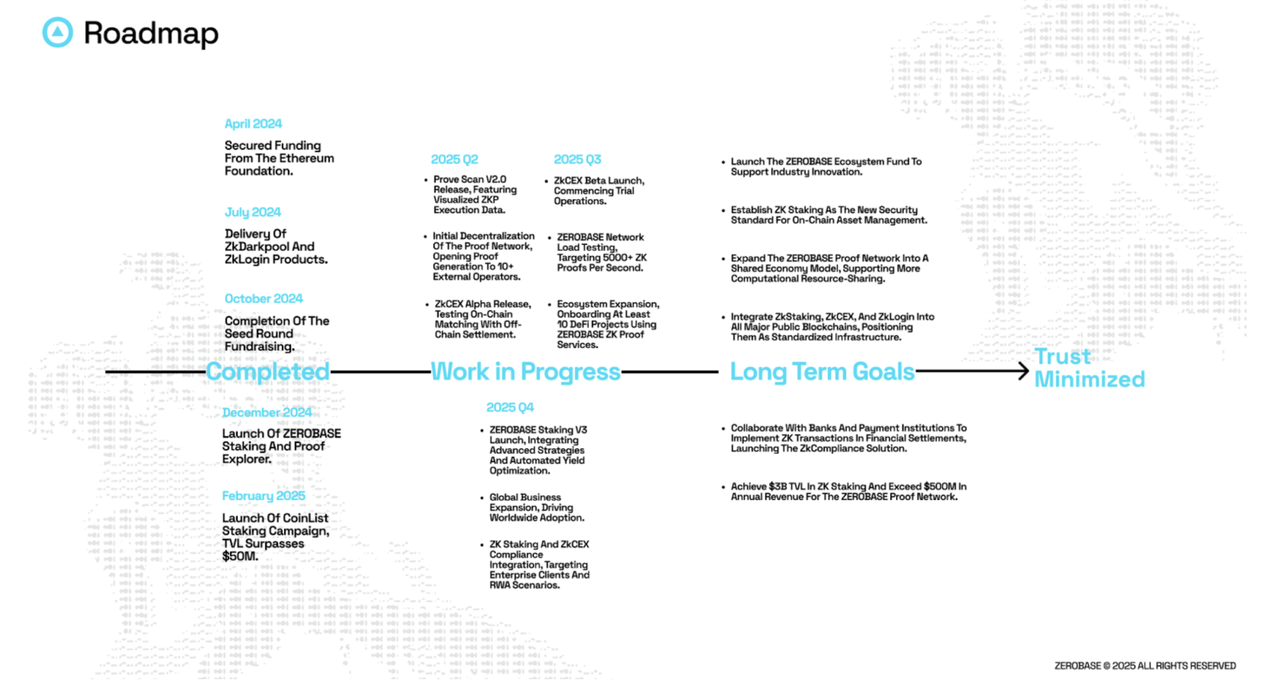
ZEROBASE roadmap | Source: ZEROBASE docs
The ZEROBASE architecture is built on a high-efficiency HUB-Prover coordination model:
- HUB Nodes (The Routers): These nodes serve as the network’s traffic controllers. They receive proof requests from users and use a consistent hashing algorithm to intelligently dispatch tasks to the most suitable Proving Nodes. HUB nodes earn ZBT emissions for providing bandwidth and maintaining high uptime.
- Prover Nodes (The Workers): These are high-performance nodes responsible for the actual cryptographic computation. To ensure skin in the game, Prover nodes must stake a minimum of $1,000,000 in stablecoins. They earn rewards in ZBT and stablecoins based on their performance and the volume of proofs generated.
- Virtual Node Mechanism: To prevent data skew where one HUB gets overwhelmed, ZEROBASE uses virtual nodes to balance the load across the entire network, ensuring that even under heavy traffic, proof generation remains 'fast, faster, fastest.'
- The Super Strategy: This is a multi-strategy quantitative framework (statistical arbitrage and options) that operates within the ZEROBASE vault. It uses ZK Interval Proofs to prove to stakers that the fund managers are staying within risk limits, e.g., Net Leverage ≤ 6%, without revealing the secret trading algorithms.
What Is the ZBT Token Used For?
The ZBT token is the native utility and coordination layer of the ZEROBASE network. Its functions include:
- Network Fees: Users and dApps pay in ZBT to request proof generation or access specialized circuits.
- Node Incentives: Rewards for HUB and Prover nodes are denominated in ZBT, ensuring the decentralized hardware remains active.
- Strategy Access (The Burn Mechanism): To participate in the Super Strategy which targets 3%–7% monthly gains, users must mint Tickets (NFTs) using ZBT. For example, a Diamond Ticket costs 50,000 ZBT, which is permanently burned upon use.
- Governance: ZBT holders vote on DAO parameters, including the 20% revenue allocation to the ZEROBASE Foundation and potential buyback-and-burn programs.
What Is ZBT Tokenomics?
ZEROBASE features a fixed total supply of 1,000,000,000 (1 billion) ZBT tokens. The distribution is heavily weighted toward the decentralized infrastructure providers.
ZBT Token Allocation and Vesting Schedule
- Node Staking and Rewards (43.75%): Linear release starting one month post-TGE.
- Team and Advisors (20.00%): 1-year cliff, followed by 48-month linear vesting.
- Ecological Fund (15.00%): Fully unlocked at TGE.
- Investors (11.25%): 1-year cliff, followed by 24-month linear vesting.
- Airdrop and Early Mining (8.00%): 5% unlocked at TGE, with the remaining 3% released in the second month.
- Liquidity (2.00%): Fully unlocked at TGE.
ZEROBASE (ZBT) vs. Traditional ZK Infrastructure
|
Feature |
ZEROBASE (ZBT) |
Standard ZK (e.g., RISC Zero) |
|
Primary Focus |
Real-time Finance & Compliance |
General Purpose Computation |
|
Security Layer |
ZK + TEE (Hardware Security) |
Pure Cryptographic (Software) |
|
Proof Cost |
Under $0.01 per proof |
Varies (Often higher for complex tasks) |
|
Yield Component |
Native zkStaking & Arbitrage |
Infrastructure only |
|
Access Model |
Token Burn (Ticket-based) |
Pay-per-use / Gas |
While traditional ZK infrastructure like RISC Zero or Succinct focuses on general-purpose verifiable computing through software-based zkVMs, ZEROBASE (ZBT) is vertically integrated for high-frequency financial applications. It achieves sub-second proof generation, often clocking in at under 25ms, by combining Zero-Knowledge Proofs with Trusted Execution Environments (TEE). This hybrid approach slashes costs to less than $0.01 per proof, whereas traditional on-chain verification can fluctuate significantly based on network congestion and circuit complexity. By offloading the heavy lifting to a decentralized HUB-Prover network using consistent hashing for load balancing, ZEROBASE maintains a high-throughput environment capable of auditing trillions of dollars in real-time transactions without the latency bottlenecks of pure-software ZK systems.
Practically, the distinction lies in verifiable utility versus pure infrastructure. Traditional ZK tools provide the building blocks for developers, but ZEROBASE delivers an out-of-the-box financial layer where risk is cryptographically provable. For instance, its Super Strategy uses ZK Interval Proofs to enforce a Net Leverage Ratio (NLR) ≤ 6% and Gross Leverage Ratio (GLR) ≤ 2, providing stakers with a real-time risk-neutral status bar. This shifts the paradigm from 'Trust me, I'm a fund manager' to 'Verify me via the Prover Network.' For investors, this means ZBT functions as a commodity-utility token where access to institutional-grade yields is gated by a deflationary burn mechanism, e.g., burning 50,000 ZBT for a Diamond Ticket, creating a direct correlation between network usage and token scarcity that is absent in most general-purpose ZK infrastructure.
How ZEROBASE Differs From Other ZK-Proof Protocols
While standard ZK protocols focus on general-purpose verifiable computing, ZEROBASE is vertically integrated for finance. It doesn't just generate proofs; it uses those proofs to validate the risk-neutrality of investment funds, allowing retail users to see a blue progress bar when their staked funds are safe and a red bar if risk limits are breached.
How to Trade ZEROBASE (ZBT) on BingX
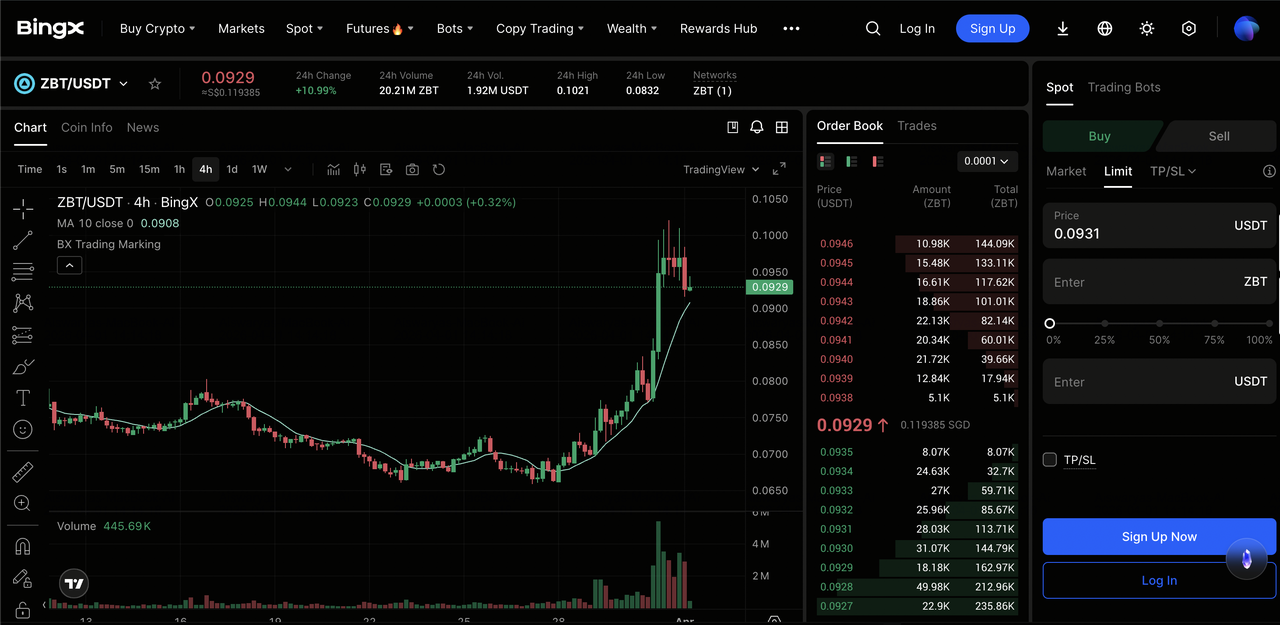
ZBT/USDT trading pair on the BingX spot market
Maximize your trading efficiency by using BingX AI to analyze real-time market sentiment and technical indicators for $ZBT during high-volatility phases driven by new Super Strategy ticket cycles. BingX provides a streamlined environment for trading ZBT, ensuring institutional-grade liquidity and advanced risk management tools for both spot and futures markets.
- Access the Spot Market: Go to the Market tab on the BingX app and search for ZBT/USDT trading pair.
- Analyze with BingX AI: Use the built-in AI tools to monitor ZBT's burn rate and on-chain proof volume, which often correlate with price action.
- Execute Your Trade: Use Limit Orders to capture specific entry points or Grid Trading to profit from the volatility inherent in infrastructure tokens.
5 Key Considerations Before Investing in ZEROBASE (ZBT)
Before allocating capital to the $ZBT ecosystem, it is essential to evaluate the structural risks of its node-collateral model and the utility-driven demand cycles of its Super Strategy.
- Utility-Driven Deflation: The price of ZBT is heavily influenced by the demand for Super Strategy tickets. High demand for yields leads to more ZBT being burned.
- Node Collateral Risk: Prover nodes stake $1 million in stablecoins. While this secures the network, a major slashing event or technical failure at the node level could impact network confidence.
- Institutional Adoption: ZEROBASE’s decryptable circuits are built for institutions. Monitor partnerships with RWA (Real World Asset) projects as a growth indicator.
- Vesting Schedule: Watch for the 1-year cliff in late 2026 when team and investor tokens begin their linear unlock.
- Hardware Dependency: Unlike pure software protocols, ZEROBASE relies on TEE-enabled hardware like Intel SGX or NVIDIA H100s. Shifts in hardware availability could affect network scaling.
Final Thoughts: Is ZEROBASE the Future of Verifiable Finance?
As of April 2026, ZEROBASE has transitioned from a theoretical framework into a functional Proof-as-a-Service layer that bridges the gap between institutional privacy and on-chain transparency. By integrating TEE-based hardware security with real-time ZK verification, the network provides a scalable solution for high-frequency financial auditing and risk-neutral yield generation. The utility-driven burn-to-access model for the Super Strategy effectively shifts ZBT from a speculative governance token to a mandatory commodity for capital-efficient staking, creating a direct correlation between ecosystem adoption and token scarcity.
For the practical investor, the long-term value of ZEROBASE depends on its ability to maintain its $20 million+ ARR and expand its Super Strategy capacity without breaching its own risk-control boundaries, such as the 15% Maximum Drawdown (MDD) limit. Success in this ecosystem requires a dual-focus approach: monitoring the on-chain Blue/Red risk neutrality indicators for yield stability while tracking the burn rate of ZBT-denominated tickets as a proxy for organic demand.
Risk Reminder: Digital asset investments, particularly in high-performance infrastructure like ZBT, carry significant technical and market risks. While the Super Strategy is designed for risk neutrality, it does not eliminate smart contract vulnerabilities, exchange-level liquidation risks, or the potential for extreme price volatility following the TGE and subsequent unlock phases. Always perform your own research and never trade capital you cannot afford to lose.
