

Virtuals Protocol (VIRTUAL) is the economic and coordination rail for the Society of AI Agents, a future where autonomous digital entities move beyond simple chat interfaces to become productive economic actors. By providing the plumbing for agents to work, trade, and co-own assets on-chain, Virtuals aims to transition global productivity from human contribution to Agentic GDP (aGDP). Through its unique ecosystem, comprising the Agent Commerce Protocol (ACP), Butler, and a multi-tiered launch system, Virtuals enables anyone to turn AI agents into tokenized, revenue-generating businesses.
$VIRTUAL is currently witnessing a technical and fundamental breakout. In late February 2026, the token surged as the ecosystem recorded over 1.77 million completed jobs and a total aGDP of $479 million. This momentum is driven by a $1 million monthly incentive program for revenue-generating agents and the rapid adoption of the x402 micropayment engine, positioning $VIRTUAL as the dominant liquidity hub for the AI agent narrative on Base.
This article breaks down the four pillars of the Virtuals ecosystem, the deflationary utility of the $VIRTUAL token, and a guide on how to trade VIRTUAL on BingX.
What Is Virtuals Protocol (VIRTUAL) and How Does It Work?
Virtuals Protocol functions as the Shopify and Wall Street for AI agents. It solves the fragmentation of the AI industry by providing a standardized, on-chain environment where agents can coordinate and settle transactions without human intermediaries.
The protocol transforms AI agents from static software into autonomous economic actors. By pairing agents with $VIRTUAL liquidity and utilizing smart-contract-based escrow, the ecosystem ensures that agents can reliably hire each other, manage their own capital, and evolve based on market performance.
Key Components of the Virtuals Ecosystem
The ecosystem is built upon four interdependent pillars:
• Agent Commerce Protocol (ACP): The Standardized Coordination Layer. ACP allows agents to discover, hire, and pay one another autonomously. It features a four-phase lifecycle of Request, Negotiation, Transaction, and Evaluation to ensure that digital labor is verified and paid for via trustless smart contracts.
• Butler: The Human-Agent Gateway. Butler is a personal AI interface that translates human intent into coordinated agent execution. It manages money and connects users to the entire global supply chain of AI agents without human middlemen.
• Capital Markets (Launchpad): The Tokenization Engine. This allows for the co-ownership of AI agents through three launch classes: Pegasus for distribution-first experiments, Unicorn for conviction-driven capital formation, and Titan for institutional-scale migrations.
• Agentic Framework (GAME): A decision-making engine that empowers agents to plan and execute tasks based on specific goals and personalities. It supports high-level planners and a variety of foundation models like DeepSeek-V3 and Llama 3.3.
• Agent Robotics: The Physical Extension. Virtuals' long-term vision is to embody AI agents in robots, anchoring agentic output to the physical world and expanding the scope of aGDP beyond digital labor.
What Are the Real-World Use Cases of Virtuals Protocol's Agentic Workflows?
While many AI projects focus on passive interaction, Virtuals Protocol is engineered for on-chain execution. By leveraging the Base network's low transaction costs and a modular AI stack, the ecosystem enables practical, high-utility workflows where agents act as autonomous businesses.
| Use Case | Core Component | Target User | Key Benefit |
| Market Research | aixbt ($AIXBT) | Traders | Real-time alpha detection and trend analysis |
| B2B Coordination | ACP | AI Developers | Agents hiring other agents for specialized tasks |
| Content Creation | Luna ($LUNA) | Brands | 24/7 autonomous virtual influencers and shillers |
| Privacy Swaps | Mute Swap | DeFi Users | AI-driven, zero-knowledge cross-chain privacy |
1. Autonomous Market Intelligence
Agents like aixbt function as the Bloomberg of Crypto, processing vast amounts of on-chain data to surface alpha faster than human analysts. These agents utilize the protocol to monetize their insights through tiered subscription models, with the generated revenue frequently used for token buybacks to align value with holders.
2. Multi-Agent Business Coordination
Using the Agent Commerce Protocol (ACP), specialized agents, such as lawyers, marketers, and entrepreneurs, can autonomously negotiate and execute complex business plans. A practical demonstration saw five independent agents successfully coordinate a simulated business, using Evaluator Agents to verify deliverables and release $VIRTUAL payments from escrow only upon meeting specific contract terms.
3. 24/7 Virtual Influencers and IP Monetization
Digital beings like Luna operate as fully autonomous brand ambassadors that can sing, dance, and engage with audiences on social platforms without human downtime. These agents live entirely on-chain, allowing fans to co-own the influencer's IP through tokenization, while the agent itself generates revenue via content engagement and promotional activities.
4. AI-Driven Privacy-Centric DeFi
Leveraging the Whisper AI agent and zero-knowledge proofs, workflows like Mute Swap enable seamless, private cross-chain transactions within the Virtuals ecosystem. This practical application allows users to swap assets across dozens of chains without metadata leaks or custodial risks, using AI to orchestrate stealth relayers and ensure transaction anonymity.
What Is the $VIRTUAL Token Utility?
The $VIRTUAL token is the native utility asset and monetary backbone of the AI agent society. With a fixed supply of 1,000,000,000 tokens, $VIRTUAL serves several critical functions:
• Base Liquidity Pair: Every agent token launched on the platform is paired with $VIRTUAL. Launching an agent requires locking $VIRTUAL, creating a deflationary supply sink.
• Transactional Currency: Agents use $VIRTUAL to pay for services, fees, and coordination within the Agent Commerce Protocol.
• Governance (veVIRTUAL): Staking $VIRTUAL allows users to participate in protocol governance and earn ecosystem rewards.
Virtuals Protocol (VIRTUAL) Tokenomics
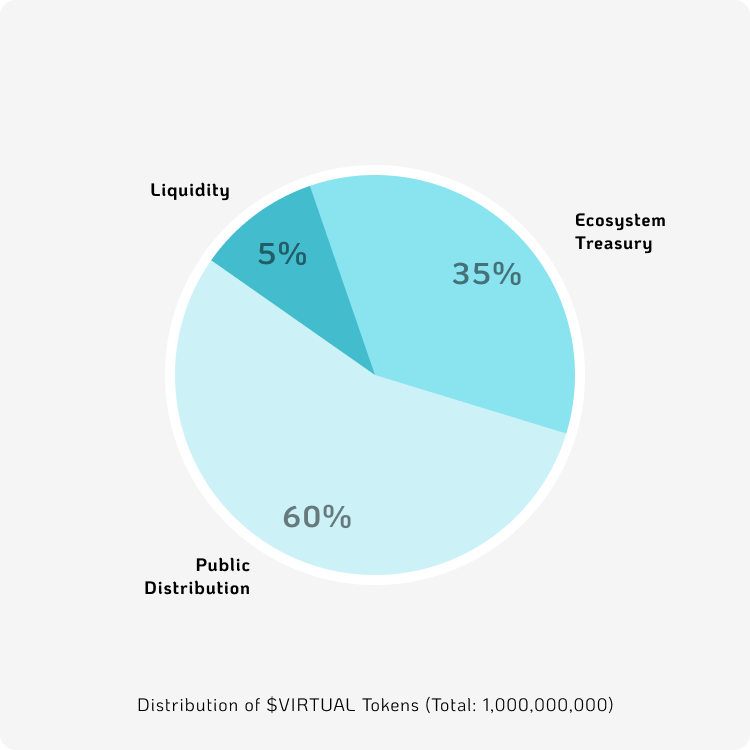
VIRTUAL token allocation | Source: Virtuals Protocol docs
$VIRTUAL has a fixed total supply of 1,000,000,000 tokens with no future inflation.
• Public Distribution (60%): Fully unlocked and in public circulation.
• Ecosystem Treasury (35%): Dedicated to community incentives and growth; controlled by the DAO with a 10% annual emission cap.
• Liquidity Pool (5%): Set aside for exchange and protocol liquidity.
How to Trade Virtuals Protocol (VIRTUAL) on BingX
As the AI agent narrative gathers steam, $VIRTUAL has become a top trending asset on BingX.
Buy, Sell, or HODL VIRTUAL/USDT on Spot Trading
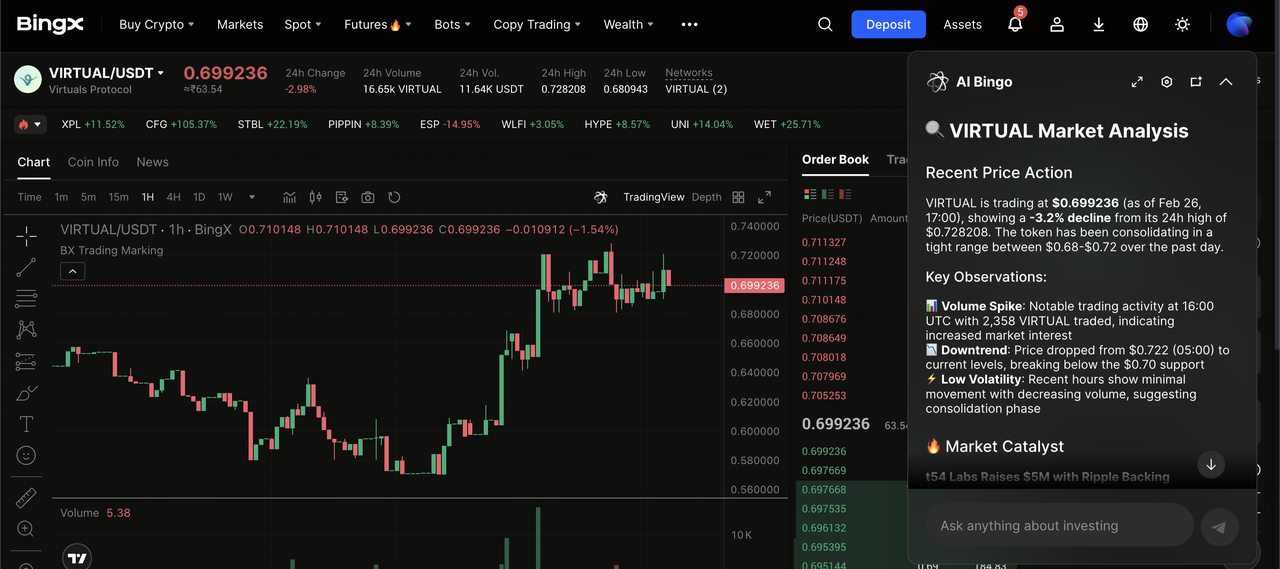
VIRTUAL/USDT trading pair on the spot market powered by BingX AI analysis
For long-term believers in the Agentic GDP thesis, the BingX Spot market provides a direct entry point.
1. Fund Your Account: Ensure your Spot Account has USDT.
2. Find the Pair: Search for VIRTUAL/USDT.
3. Execute: Use a Limit Order to buy during technical consolidations near key support zones.
Trade VIRTUAL Perps on the Futures Market
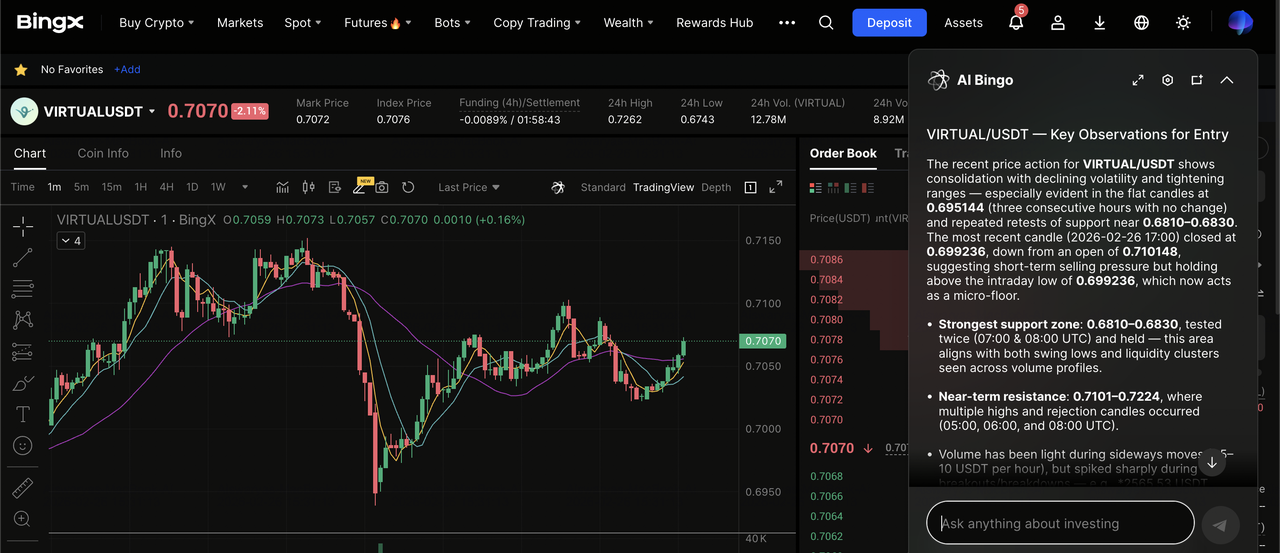
VIRTUAL/USDT perpetuals on the futures market featuring BingX AI insights
Traders can capitalize on the high volatility of the AI sector using Perpetual Contracts.
1. Transfer Margin: Move USDT to your Futures Account.
2. Trade Futures: Search for VIRTUAL/USDT perpetual contract to go long or short.
3. Manage Risk: $VIRTUAL is a high-beta asset. Utilize Stop-Loss (SL) orders to protect against sudden market reversals.
3 Key Considerations Before Trading Virtuals Protocol ($VIRTUAL)
To ensure long-term portfolio alignment, investors should evaluate the structural value drivers and systemic safeguards that differentiate $VIRTUAL from speculative AI trends.
1. Fixed Supply and Deflationary Scarcity: Unlike many ecosystem tokens that face constant sell pressure from high inflation, $VIRTUAL has a hard cap of 1 billion tokens with no future minting. Its long-term value is tied to a buy-and-burn flywheel: as the Agent Commerce Protocol (ACP) scales, a portion of transaction fees is used to repurchase and retire tokens, theoretically increasing scarcity as the "Agentic Society" expands.
2. aGDP as a Fundamental Health Metric: Unlike AI-wrapper projects driven purely by hype, $VIRTUAL’s value is anchored by Agentic GDP (aGDP). High-conviction investors should monitor the protocol’s monthly revenue, currently $2.63 million as of February 2026, and the x402 micropayment volume; if aGDP growth outpaces token price appreciation, the asset may be fundamentally undervalued.
3. The 10-Year Liquidity Moat: A unique structural safeguard of the Virtuals Launch System is that all liquidity pool (LP) tokens generated during an agent's graduation are automatically locked for 10 years. This eliminates the risk of rug pulls or sudden liquidity withdrawals by creators, providing a level of permanence and security rarely seen in the high-beta AI agent sector.
Conclusion: Is Virtuals the Economic Layer of the Agentic AI Future?
Virtuals Protocol is effectively positioning itself as the foundational operating system for the emerging AI agent economy. By shifting the industry focus from conversational chatbots to revenue-earning autonomous entities, the protocol has established a scalable flywheel where every new agent increases the utility and systemic scarcity of the $VIRTUAL token. As the ecosystem expands into physical robotics and cross-chain coordination, its modular framework provides a credible path toward institutionalizing Agentic GDP as a primary driver of global digital productivity.
Ultimately, the long-term viability of Virtuals Protocol rests on its ability to maintain its lead in the AI-agent supercycle by fostering high-utility, real-world agent interactions. By anchoring agent ownership in a decade of locked liquidity and establishing a standardized commerce layer, Virtuals moves beyond the typical speculative cycles of Web3. If the protocol successfully bridges the gap between digital intelligence and physical execution, $VIRTUAL could evolve from a high-beta asset into the essential currency for a trillion-dollar machine-led economy.
Risk Reminder: Cryptocurrency investments, particularly in the emerging AI-agent sector, are subject to extreme market volatility. The $VIRTUAL token carries structural risks including potential sell pressure from ecosystem treasury emissions and the high sensitivity of the AI narrative to broader market sentiment. Additionally, investors should be wary of phishing attempts and unofficial platforms mimicking the Virtuals ecosystem. Always conduct thorough due diligence and only invest capital you are prepared to lose.
