

The global movement of institutional capital remains trapped in an archaic web of legacy correspondent banking networks, trapping over $2 trillion in idle liquidity and costing businesses up to $120 billion annually in transactional friction. While traditional settlement systems require days to clear international transfers, Stellar (XLM) processes and settles transactions within 5.3 seconds for an average cost of just $0.0007. This unparalleled cost-efficiency has propelled the network from a nimble remittance channel into a financial juggernaut, hosting over $2.83 billion in tokenized Real-World Assets (RWAs) and managing over 10.1 billion total network operations through a globally distributed ecosystem spanning 180+ countries.
Governed by the non-profit Stellar Development Foundation (SDF), the network serves as a specialized, compliance-friendly settlement layer designed to issue, trade, and exchange digital representations of value seamlessly. By forging direct technical integrations with the world's largest clearinghouses and traditional financial protocols, Stellar is rapidly scaling a bridge between institutional banking infrastructure and public blockchain technology, enabling trillions of dollars in traditional financial market value to move instantly on-chain.
What Is Stellar (XLM)?
Stellar is an open-source, decentralized Layer-1 blockchain network optimized for asset issuance and borderless payment infrastructure. Unlike general-purpose blockchains designed for speculative dApps, Stellar is fundamentally built as an interoperability layer that translates traditional fiat currencies, securities, and commodities into liquid digital assets called tokens. Its structural core includes a native decentralized exchange (DEX) and automated order-matching capabilities, allowing disparate financial assets, such as a tokenized U.S. dollar and a Euro stablecoin, to exchange directly on-chain within a single ledger entry.
The native utility asset of the network is Lumens (XLM), a digital commodity with a fixed supply of approximately 50 billion tokens. XLM is not structured as a highly speculative execution token; instead, it provides operational utility by denominating transaction fees, fulfilling anti-spam ledger requirements, and acting as a highly liquid bridge currency during complex, multi-asset conversions. This practical, settlement-centric design allows fintechs, neobanks, and blue-chip asset managers to implement enterprise-grade payment rails without taking on the severe congestion and volatile gas fee liabilities found on other public chains.
Beyond Payments: XLM as a Regulatory-Compliant Commodity
Stellar's core architecture differs sharply from speculative, general-purpose smart contract networks. From inception, its structural design has favored integration with regulated anchors, banks and financial firms that issue stablecoins, tokenized fiat currencies, and yield-bearing instruments backed 1:1 by real reserves. This compliance-first approach has recently achieved a monumental legal milestone, providing deep structural clarity for market participants.
What Is the March 2026 SEC/CFTC Ruling and How Does It Affect Stellar (XLM)?
In March 2026, the regulatory status of Stellar's native token Lumens (XLM) was definitively cleared. United States regulators - the SEC and CFTC, formally designated XLM as a digital commodity. This landmark classification immediately separated Stellar from ongoing industry disputes regarding unregistered security classification.
For institutional allocators, banks, and custodians, this ruling eliminates compliance gray areas, opening the door for secure long-term custody solutions and specialized financial products, including CME XLM futures.
How Does Stellar Work?
The network functions through a specialized three-layer framework that handles identity, consensus, and programmable execution, optimizing every transaction for immediate finality.
1. The Anchored Asset Framework
Stellar links to the physical financial world via Anchors. These are licensed fintech platforms, stablecoin issuers like Circle providing native USDC, or tier-one banks that accept local currency deposits and issue corresponding tokenized assets on the network. These digital wrappers can be moved globally instantly.
2. The Stellar Consensus Protocol (SCP)
Unlike Proof-of-Work (PoW) or Proof-of-Stake (PoS), Stellar uses a Proof-of-Agreement (PoA) architecture driven by the Stellar Consensus Protocol. Nodes do not use high-energy mining or compete via financial staking pools. Instead, validators choose trusted groups of overlapping participants, known as Quorum Slices.
When these connected groups reach consensus via lightning-fast message sequences, the transaction is permanently committed to the ledger. This design delivers absolute transaction finality in 3 to 5 seconds with negligible carbon output.
3. Path Payments and the On-Chain DEX
Stellar features a native, decentralized order book built directly into its core protocol. This enables a unique feature called Path Payments, which allows a sender to send one currency, e.g., USD stablecoins, and have the recipient receive another, e.g., Euros or local fiat, automatically. The network calculates the most efficient route across the order book, using XLM as a highly liquid bridge asset whenever direct pairs are illiquid.
Lumens (XLM) Token Utility: The Stellar Network's Lubricant
Rather than mimicking the inflationary app token models common across the broader Web3 economy, XLM functions strictly as the core mechanical lubricant of the Stellar ledger. Token demand is structurally driven by inventory requirements, network safety rules, and direct transactional utility.
Aside from its friction-reducing properties, XLM provides critical liquidity routing by acting as an always-on intermediary asset. This structural function allows the network's built-in order book to pair otherwise illiquid financial assets automatically during cross-border transfers.
What Is the Role of XLM in the Soroban Smart Contract Era?
While Stellar excelled at basic value transfer for years, the deployment of Soroban, a developer-friendly, Rust-based smart contract execution engine, fundamentally expanded the network's programmable capabilities. Soroban introduces WebAssembly (Wasm) safety standards, scalable fee models, and advanced state-bloat prevention tools to handle high-velocity decentralized finance (DeFi) without sacrificing speed.
Gas Fees vs. Anti-Spam: How Lumens Fuel the Network
On traditional smart contract chains, gas fees fluctuate wildly depending on network congestion, frequently pricing out everyday utility. On Stellar, the XLM native token plays a highly specialized anti-spam role rather than serving as a highly speculative computational rent asset:
- The Minimum Account Reserve: To keep the ledger clean from arbitrary data storage and spam, every active Stellar account must hold a base reserve of exactly 1 XLM.
- Predictable Transaction Costs: Transactions require a minimal baseline cost of just 0.00001 XLM, keeping typical interactions well below a small fraction of a single penny at an average of around $0.0007.
As the codebase advances through major updates, this model remains highly efficient. For example, the Protocol 23 Whisk upgrade added parallel execution to process multiple contract interactions simultaneously, ensuring fees remain remarkably flat even as dApp usage climbs.
What Is Stellar (XLM) Tokenomics?
The tokenomics of Stellar are structurally distinct from inflationary or mining-dependent digital assets. At inception, 100 billion tokens were minted, accompanied by a 1% annual inflation mechanism. However, following a decisive community vote in October 2019, the ecosystem permanently disabled the inflation schedule and executed a massive supply reduction, burning over 55 billion tokens.
This hardcapped the absolute total supply of Lumens at approximately 50 billion XLM, with roughly 33.8 billion XLM currently circulating on the open market. The remaining token supply is held by the Stellar Development Foundation (SDF) under strict mandates to be progressively distributed over downstream years to fund technical grants, strategic enterprise infrastructure investments, and global ecosystem expansion.
Stellar vs. General-Purpose Layer 1 Blockchains: Key Differences
|
Feature |
Stellar (XLM / Soroban) |
General-Purpose L1s (e.g., Ethereum) |
|
Consensus Mechanism |
Proof-of-Agreement (SCP) |
Proof-of-Stake / Proof-of-Work |
|
Avg. Transaction Cost |
~$0.0007 |
Variable ($1.00 – $50.00+) |
|
Time to Finality |
3 – 5 Seconds |
Minutes to Hours |
|
Native Asset Feature |
Built-in DEX & Path Payments |
Requires custom smart contracts |
|
Regulatory Status |
Designated Commodity (March 2026) |
Varies by network / jurisdiction |
The fundamental divergence between Stellar and general-purpose Layer-1 networks lies in architectural optimization: general-purpose chains prioritize computational complexity, whereas Stellar is hyper-engineered for execution throughput and deterministic settlement. By employing the Stellar Consensus Protocol (SCP) instead of resource-heavy PoS models, the network settles transactions with absolute finality in 3 to 5 seconds, completely bypassing the prolonged block confirmation delays and MEV (Maximal Extractable Value) front-running vulnerabilities inherent to standard virtual machine architectures. Furthermore, whereas general-purpose chains require complex, gas-guzzling smart contracts to handle basic asset tracking and swaps, Stellar embeds a high-performance decentralized exchange (DEX) and automated path-payment routing directly into its core protocol layer.
This specialized design yields radical, practical cost advantages for institutional allocators and high-velocity fintech applications. Stellar maintains an average transactional cost of just $0.0007, isolating users from the volatile, congestion-driven fee spikes where general-purpose network gas fees can surge from $1.00 to over $50.00 during peak market volatility. Combined with the March 2026 SEC/CFTC digital commodity ruling, this structural cost predictability removes both the economic and regulatory compliance liabilities that typically stymie corporate deployment. Enterprise platforms can launch tokenized assets, distribute corporate payroll, or route international remittances without the risk of fluctuating overhead or legal reclassification.
Why 2026 Is the Institutional Pivot for Stellar Network
For years, blockchain tokenization occurred on the fringes of traditional finance. However, 2026 marks the definitive moment institutional adoption shifted into hyper-drive on Stellar, anchored by real capital commitments and infrastructure upgrades.
The Landmark DTCC Integration
The ultimate catalyst for Stellar's institutional pivot is its historic partnership with the Depository Trust & Clearing Corporation (DTCC). In mid-2026, the DTCC confirmed the integration of its institutional tokenization service natively on the Stellar blockchain, marking its very first public blockchain deployment.
A closed testnet launched in July 2026 to pilot the tokenization of trillions of dollars in traditional equities, such as the Russell 1000, ETFs, and U.S. Treasuries, targeting a full commercial rollout in the first half of 2027. This ecosystem momentum pushed tokenized RWAs on Stellar to a record valuation of $2.83 billion.
Stellar's Technical Evolution: Protocol 27 and the Quantum Frontier
Stellar's roadmap is moving rapidly to secure its position as an enterprise settlement layer. Validators are set to vote on the Protocol 27 Zipper Mainnet Upgrade on July 8, 2026. This vital update introduces advanced account abstraction features, including delegated authentication (CAP-0071-01) and address-bound credentials, which enable wallets to securely batch transactions, deploy modular multi-signature schemes, and dramatically simplify user onboarding.
Concurrently, the network has introduced its Quantum Preparedness Plan (QPP) to integrate post-quantum cryptographic primitives (ML-DSA signatures) by 2027. This proactive security roadmap directly ensures that enterprise asset managers can protect tokenized sovereign debt and stock portfolios against future computational decryption risks.
How to Trade Stellar (XLM) on BingX
BingX provides a secure, institutional-grade trading ecosystem to monitor and trade XLM tokens with advanced charts and execution features.
Buy, Sell, or HODL XLM in the Spot Market
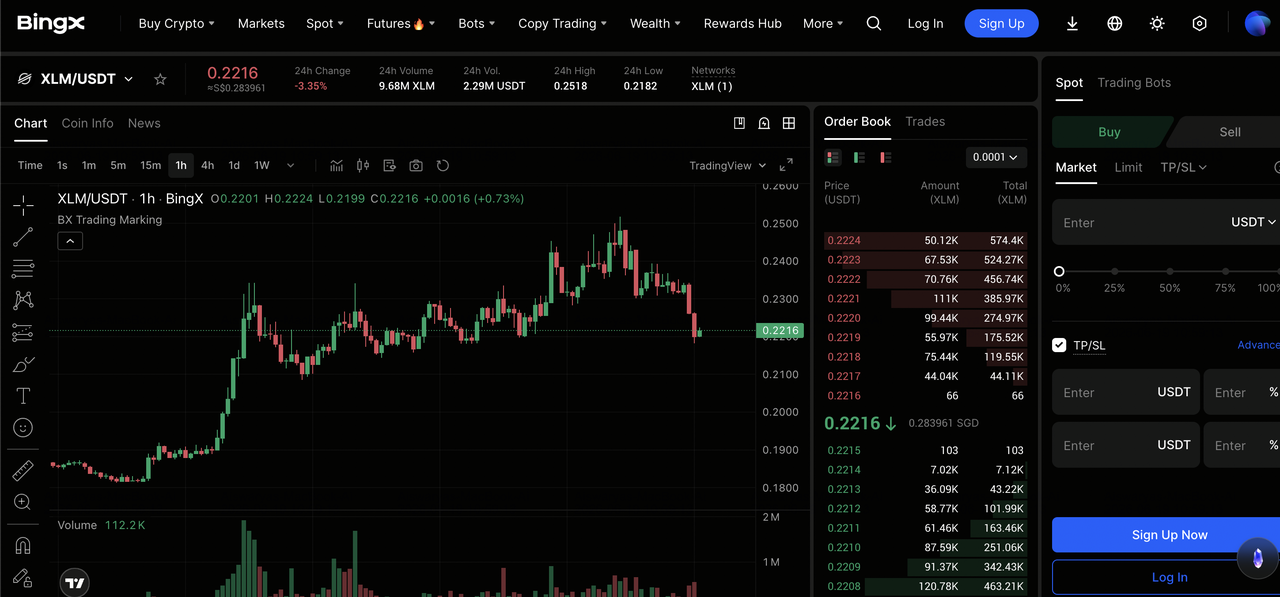
XLM/USDT trading pair on BingX spot market
- Access Spot Market: Navigate to the Spot drop-down menu on the BingX platform and select Spot Trading.
- Search for Pairs: Enter XLM in the asset search bar and select the XLM/USDT pair.
- Configure Your Order: Choose a Market Order for instant execution at current market prices, or a Limit Order to specify your preferred entry price.
- Execute Trade: Input the amount of USDT you want to allocate, review the order variables, and click Buy XLM to route the tokens to your spot wallet.
Long or Short XLM Perpetuals with Leverage in the Futures Market
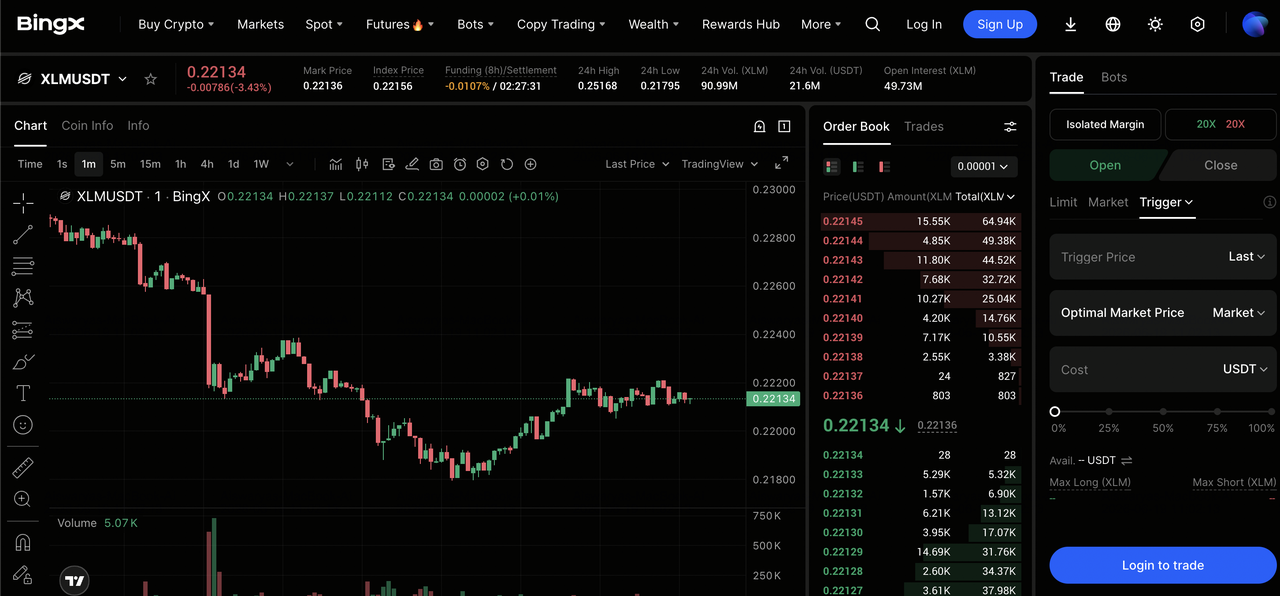
XLM/USDT perpetual contract on BingX futures market
- Access Futures Dashboard: Navigate to the Futures drop-down menu and select Perpetual Futures, then locate the XLM/USDT perpetual contract or the XLM/USDC perpetual contract.
- Select Margin Mode: Choose Isolated Margin to lock your risk parameters to a single position, or Cross Margin to utilize your entire available futures balance as collateral.
- Calibrate Leverage: Adjust the leverage slider to match your strict risk profile, keeping in mind that leverage amplifies both potential profits and liquidation risks.
- Open Position: Submit an Open Long order if your analysis points toward fundamental price appreciation, or an Open Short order to benefit from market downside or hedge spot asset allocations.
Key Risks and Considerations Before Buying Stellar (XLM)
Before committing capital to the Stellar ecosystem, carefully evaluate these critical market, technical, and execution risks:
- Circulating Supply Dilution: While the absolute total supply is hardcapped at 50 billion XLM, the Stellar Development Foundation (SDF) retains roughly 30% of all tokens. The progressive release of these assets into the open market to fund technical grants and ecosystem expansion could create structural sell pressure.
- Fierce Institutional Competition: Stellar operates in a highly crowded institutional sector. It faces direct competition from both alternative payment-centric blockchains and private, centralized enterprise networks, such as Ripple or banking-consortium ledgers, vying for the same market share.
- Execution and Testnet Timeline Dependencies: A massive portion of XLM's 2026 bullish momentum relies on the commercial success of the DTCC partnership. Any delayed milestones, unfavorable closed testnet results in July 2026, or regulatory bottlenecks regarding the live H1 2027 rollout could severely hit market sentiment.
- Overbought Near-Term Technicals: Following major institutional announcements, XLM has historically experienced explosive surges that push its short-term Relative Strength Index (RSI) deep into overbought territory. Traders should be cautious of chasing peak momentum, as overextended technicals increase the probability of severe corrective pullbacks down to key support levels.
Final Thoughts: Stellar Is Evolving Into the Settlement Layer for Real-World Value
Stellar has successfully transitioned from a specialized cross-border remittance corridor into an enterprise-grade settlement layer for tokenized global finance. By combining an energy-efficient consensus model with native regulatory clarity, robust Rust-based smart contracts, and deep institutional partnerships like the DTCC framework, the platform offers an efficient solution for bringing internet capital markets on-chain.
Risk Reminder: Investing in digital assets involves smart contract, technical roadmap execution, and market volatility risks. Always conduct thorough research, track governance votes, and never risk more capital than you can afford to lose. BingX assumes no responsibility for external trading allocations.
Related Reading
- How to Buy Stellar (XLM) with Credit Card: 2026 Direct On-Ramps
- What Are the Top Layer-1 (L1) Blockchains to Know in 2026?
- Top 10 Blockchains for Real‑World Asset (RWA) Tokenization Projects in 20264
- Top Real-World Asset (RWA) Tokenization Projects of 2026
- Top Payment Finance (PayFi) Crypto Projects to Watch in 2026
