

Re Protocol (RE) is one of the most technologically unique and structurally resilient infrastructure platforms in the digital asset market celebrated for its revolutionary approach to protocol governance and ecosystem expansion. Conceived as an open-source decentralized internet capital market for insurance risk, Re Protocol (RE) was engineered to connect on-chain crypto-native capital with the $1 trillion real-world reinsurance industry. It bridges decentralized finance (DeFi) with real-world assets (RWAs) by allowing users to pool stablecoin liquidity and capture institutional-grade returns backed by actual insurance premiums.
As of 2026, Re Protocol (RE) stands out as a highly efficient layer 1-grade tokenized execution ecosystem widely respected for its institutional-grade security framework, full-stack tooling, and massive structural adoption. Moving past speculative crypto token emissions, Re Protocol (RE) has evolved into an essential infrastructure pillar for high-value insurance utility, decentralized risk management, and real-world Web3 integrations. Powered by its community-centric architecture and strategic backing from Coinbase Ventures, Re Protocol (RE) ensures a secure, user-governed environment making it a premier choice for the global expansion of the Web3 economy.
Read more: What Is OpenEden (EDEN)? RWA Yield-Bearing Treasury and How to Trade It On BingX
Key Takeaways
- Full-Stack RWA Infrastructure Provider: Re Protocol (RE) builds foundational decentralized applications for the insurance industry, incubating major real-world asset protocols and specialized yield-bearing primitives.
- On-Chain Solvency Scalability: Operating across networks like Base Layer 2 and Ethereum, the network functions as an EVM-compatible execution layer tailored for high-volume capital matching and daily on-chain oracle attestations.
- Uncorrelated Premium Realism: The protocol redirects stablecoins into fully collateralized quota-share agreements, yielding returns insulated from traditional digital asset volatility.
- Layered Capital Tranching: Users can access tokenized insurance alpha based on their specific risk tolerances, picking between senior principal-protected layers and high-yield junior capital tranches.
- Top Trading Venue: BingX stands as the premier choice for trading Re Protocol (RE) spot and Re Protocol (RE) futures with deep market liquidity, low trading fees, and robust security features.
What Is Re Protocol (RE)?

Source: re.xyz
Re Protocol (RE) is an open-source decentralized blockchain network designed to act as a flexible smart contract platform, enabling friction-free peer-to-peer value transfer and secure decentralized application deployment. Engineered to help Web3 protocols overcome code vulnerability and governance deadlocks, Re Protocol (RE) removes structural innovation barriers by implementing a comprehensive suite of consumer tools and underwriting primitives built right into the ledger's base rules.
In 2026 Re Protocol (RE) continues to serve as an indispensable, highly adaptive infrastructure environment within the global crypto space. The platform has distinguished itself by continually onboarding advanced technical capabilities, such as multi-chain liquidity composability across Curve, Pendle, and Morpho, without ever breaking application backward-compatibility or dividing its ecosystem. Backed by strategic partnerships with regulated carriers like Re Protocol (RE) bridges the gap between secure enterprise software design and user-centric network control.
How Re Protocol Works
Re Protocol (RE) achieves its rapid transaction speeds and structural finality by utilizing a specialized Proof of Stake consensus mechanism and an interconnected product layer. Instead of exposing users to unstable network fee models or sudden consensus splits, Re Protocol (RE) organizes its core execution framework through several vital ecosystem components:
Insurance Capital Layers (ICLs)
The primary consumer-facing application powered by the network channels stablecoin capital into fully collateralized reinsurance contracts. Users deposit stablecoins (such as USDC, AUSD, or Ethena’s sUSDe) into specialized Insurance Capital Layers. Instead of using an automated market maker system where users provide liquidity for others to trade against, these on-chain pools act as institutional collateral to absorb real-world risk, moving through secure Fireblocks custody vaults to back real underwriting policies.
Two Ways to Participate (reUSD & reUSDe)
The protocol issues customizable, smart contract-based yield assets that give participants simple, liquid exposure to reinsurance-backed returns. They act as distinct tranches within the protocol’s capital stack:
- Basis-Plus (reUSD): The senior, principal-protected tranche. It earns a stable blended yield (SOFR + sUSDe weighted average) plus a 250 bps spread. It features instant redemption access when capacity allows and is shielded by all layers below it.
- Insurance Alpha (reUSDe): The junior tranche designed for professional risk appetites. It absorbs structural losses right after the reinsurer’s corporate equity is exhausted but yields a massive variable return powered by a premium spread of 850 bps.
Transparent Oracle Verifications
The associated execution-layer framework addresses many of the transparency challenges of legacy insurance markets. Every dollar of backing collateral, earned premiums, and reserve movements is reported on-chain daily via third-party oracle integrations like Chainlink. The underlying network itself remains fully auditable, using the native utility asset to coordinate validation parameters and sustain network integrity.
Key Trends and Utility of RE Protocol in 2026
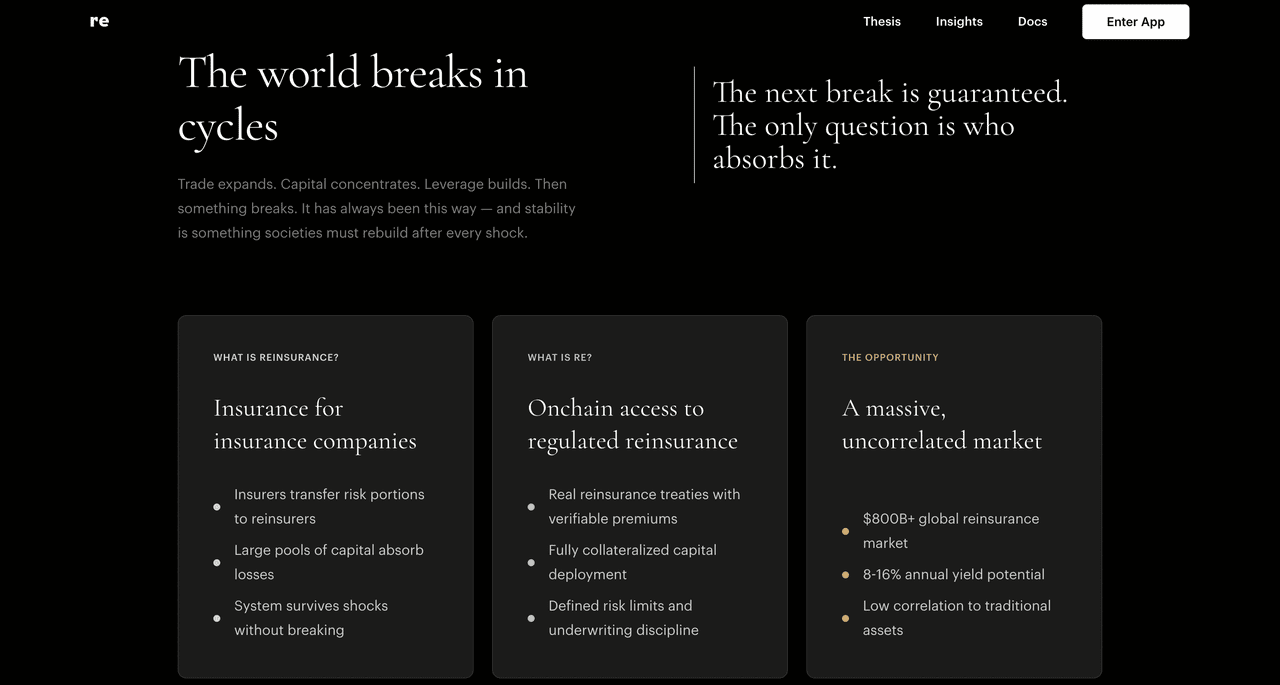
Source: re.xyz
Re Protocol (RE) exhibits impressive technological evolution and structural adoption in 2026. The network has successfully expanded its real-world asset footprint across a $409M diversified insurance portfolio, bridging Web3 assets with traditional premiums spanning commercial auto, workers' compensation, small business commercial, and homeowners insurance. This system enables users to capture real-world returns globally across diverse lines of business without inflating gas expenses or exposing themselves to systemic crypto correlations.
Re Protocol (RE) has also carved out a dominant niche in decentralized insurance coordination and real-world asset deployment where mathematical certainty is paramount. The native token, RE, remains heavily utilized across the entire ecosystem. It serves as the primary coordination layer for network validation, the required asset needed to vote on structural policy parameters, and the financial foundation backing ecosystem growth initiatives across millions of active global wallets.
Benefits and Advantages of RE Protocol

Re Protocol (RE) presents several core operational advantages that keep it at the forefront of the smart contract and decentralized application sector:
- Incubated Application Ecosystem: Native access to premium RWA tranches provides the ultimate foundational stack for tokenized insurance architecture.
- Uncorrelated Yield Primitives: Tailored real-world cashflows shield users from systemic crypto market drawdowns and speculative token inflation.
- Institutional-Grade Platform Safety: Partnering with licensed Cayman-based carriers ensures rigorous regulatory compliance, policy discipline, and audit controls.
- Predictable Staking and Costs: Running transactions via low-latency fee parameters on optimized Layer 2 engines isolates users from volatile mainnet network spikes.
- Extreme Capital Efficiency: The tranching architecture utilizes a fraction of the capital lock-up periods demanded by legacy reinsurance markets, delivering a thoroughly liquid environment.
- Ecosystem Underwriting Alignment: The network balances protocol expansion using strict risk limits and a low-volatility, "catastrophe-light" posture to guarantee long-term protocol resilience.
What are the Tokenomics of RE Token?
Re Protocol (RE) uses an industry-tailored, utility-focused Proof of stake (PoS) model. Following major community-approved tokenomic overhauls, the network utilizes a highly controlled supply model to align validators, underwriters, and everyday stakers.
Key Supply and Tokenomics Data
- Circulating Supply: Growing alongside on-chain total value locked (TVL) and premium distributions to accommodate institutional inflows.
- Maximum Supply Cap: Fixed at exactly 1B Re Protocol (RE) tokens with programmatic constraints designed to maintain structural ecosystem equilibrium.
- Initial Distribution: Allocated across foundational platform contributors, strategic risk management partners, and public distribution pipelines to establish deep liquidity foundations across global insurance networks.
How RE Economics Work
- Network Security and Staking: In order to participate in the transaction validation process and secure the Insurance Capital Layers, nodes must deposit an established allocation of the native asset. Stakers earn validation yields for processing blocks and maintaining ledger integrity.
- Governance Weight: Holding Re Protocol (RE) acts as the baseline layer for orchestrating the platform's rules. While yield tokens settle capital tranches, the native RE token utilizes a weighted system where greater token concentrations command proportional influence over technical upgrades and policy additions.
- Ecosystem Integration: Re Protocol (RE) plays a functional role in broader projects under the RWA umbrella, where holding varying amounts of RE can influence the distribution of incentives, ecosystem growth initiatives, and counterparty approvals.
- Protection from Volatility: While RE acts as the underlying governance and security layer, the protocol’s deposit tranches (reUSD and reUSDe) are tied directly to institutional premium performance, protecting the base chain asset from unpredictable insurance cycles or isolated market events.
Inflation Distribution
The tokens minted through the annual inflation are distributed to key network stakeholders to ensure security and continued development:
- 65%: Allocated to network validators for maintaining security and network management.
- 25%: Allocated to ecosystem projects and developmental grants.
- 10%: Allocated to community vaults and liquidity pools.
Understanding RE Protocol's Treasury Backing
Over time, the ecosystem treasury has retained substantial asset positions, managed through secure smart contracts to fund long-term development, strategic risk expansions, and regional market onboarding. Together, the validation requirements and weighted governance participation encourage investors to lock up their Re Protocol (RE) as opposed to liquidating them on the secondary market, helping reduce market volatility and driving sustainable utility for existing tokens in circulation.
How to Buy Re Protocol (RE) on BingX
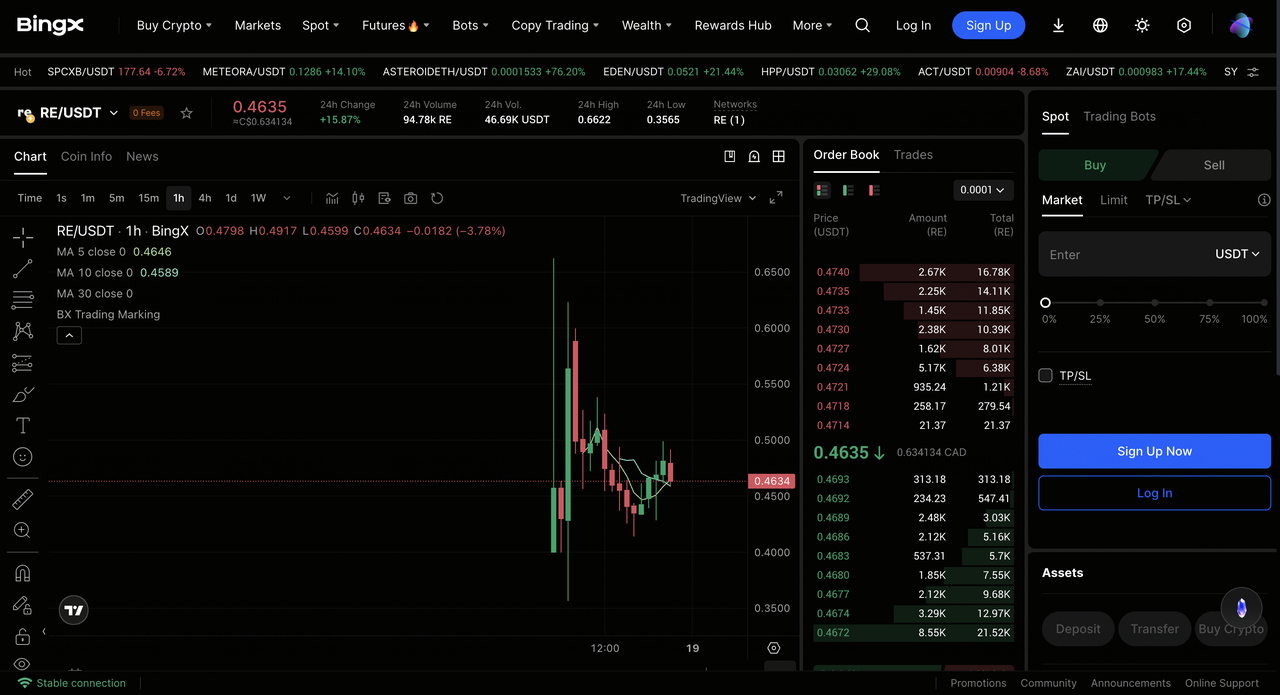
Before you can capture yields from real-world insurance premiums, you can utilize BingX AI, the platform’s intelligent trading assistant, to analyze real-time market trends and identify the most optimal entry points for your purchase. Follow these steps to secure your tokens on the RE/USDT trading pair on the spot market:
- Fund Your Account: Navigate to the Buy Crypto section to purchase USDT using a credit/debit card, Apple Pay, or bank transfer.
- Access the Spot Market: Go to the Spot tab and search for the RE/USDT trading pair.
- Execute Your Trade: Select Market Order for an instant purchase at the current price, enter the amount of RE you wish to buy, and click Buy RE.
- Confirm Holdings: Once the trade is complete, your tokens will appear in your Spot Account, ready to be utilized for DAO governance decisions or long-term ecosystem storage.
Trade Re Protocol Futures with Leverage
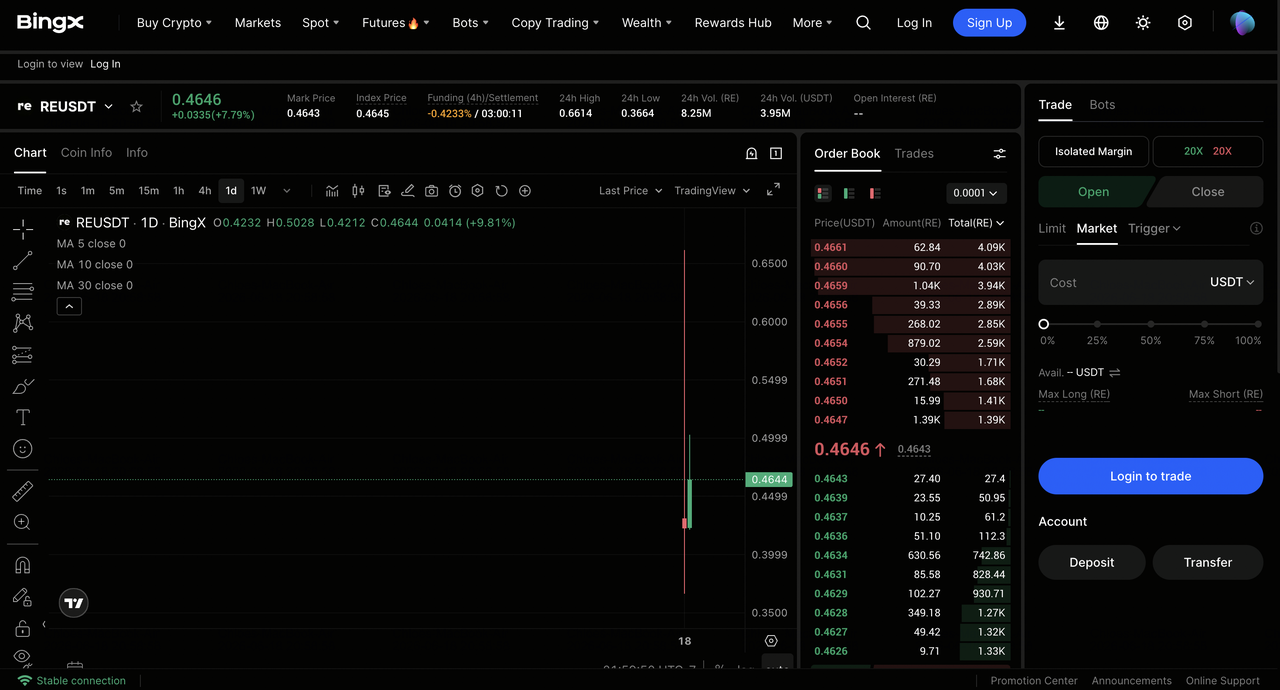
RE/USDT perpetuals on the futures market
- Transfer USDT to your Futures account and select the RE/USDT Perpetual contract.
- Choose your leverage and apply automated Stop-Loss and Take-Profit tools to manage volatility while capturing RE’s price movements.
Conclusion: Why You Should Trade Re Protocol on BingX
Re Protocol (RE) continues to prove its immense structural value in 2026 through its strict cryptographic privacy, ecosystem predictability, capped token issuance, and community-driven development. As global developers and financial institutions demand Web3 environments that combine rigorous transaction security with real-world assets and optimized decentralized exchange (DEX) routing, Re Protocol (RE) remains an exceptionally reliable choice for modern digital infrastructure.
BingX stands out as the ultimate exchange hub for trading Re Protocol (RE), providing excellent liquidity depth, minimal trading fee tiers, and rapid execution speeds for spot holders. Whether you are trading Re Protocol (RE) to exploit short-term market movements, accumulating assets for long-term network validation utility, or interacting with institutional-grade DeFi applications, BingX lets you process and manage your Re Protocol holdings safely and effectively.
As public and developer demand for user-custodial asset tokenization and real-world event frameworks continues to accelerate, trading Re Protocol (RE) on a platform like BingX ensures users have the tools and structural reliability needed to confidently navigate the Web3 landscape.
Related Reading
- Top Real-World Asset (RWA) Tokenization Projects of 2026
- Top 10 Blockchains for Real‑World Asset (RWA) Tokenization Projects in 2026
- What Is Canton Network (CC) RWA Layer-1 Blockchain and How Does It Work?
- Best RWA Cryptocurrencies to Invest in 2026
- What Is Pharos (PROS) RealFi RWA Layer-1 Blockchain and How Does It Work?
