

Polkadot (DOT) is a foundational Layer-0 blockchain protocol designed to address one of crypto’s most persistent structural problems, fragmented and isolated blockchains. Created by Ethereum co-founder Gavin Wood, Polkadot introduces a decentralized cross-chain framework that allows independent blockchains to communicate, transfer assets, and share data without compromising security or decentralization.
$DOT has emerged as a strong performer within the interoperability and Layer-0 infrastructure narrative. The DOT token has surged more than 26%, significantly outperforming the broader market. This rally was driven by three major catalysts converging at once, including an upcoming network inflation halving event, speculation around a potential institutional ETF filing, and a broader altcoin rotation fueled by improving macro sentiment.
In this article, we break down how Polkadot’s multi-chain architecture works, examine the utility of the $DOT token, and provide a step-by-step guide to trading DOT on BingX
What Is Polkadot (DOT) and How Does It Work?

Polkadot operates as a blockchain of blockchains, designed to eliminate information silos between major networks such as Ethereum, Bitcoin, and Solana. Instead of forcing all applications onto a single chain, Polkadot uses a layered multi-chain architecture. A central Relay Chain coordinates consensus and security for multiple parallel blockchains known as parachains. This structure allows transactions to be processed simultaneously across chains, significantly increasing throughput while avoiding the congestion typical of monolithic networks.
The protocol is built on four core technical pillars:
1. Relay Chain: The Relay Chain is the backbone of the ecosystem. It manages shared consensus, finality, and cross-chain messaging through XCM. It does not execute smart contracts, which keeps it minimal and secure. All parachains inherit security from the Relay Chain’s pooled DOT staking, meaning even new chains benefit from network-wide economic backing.
2. Parachains: Parachains are independent, application-specific blockchains that connect to the Relay Chain through slot auctions. Each parachain can customize its design for specific use cases such as DeFi, privacy, gaming, or NFTs, while still sharing the Relay Chain’s security. This removes the need for each chain to build its own validator set from scratch.
3. Cross-Consensus Message Passing (XCM): XCM is Polkadot’s native interoperability framework. It allows parachains to transfer tokens, data, and contract instructions directly between one another without relying on external bridges. This integrated approach reduces counterparty risk and strengthens cross-chain security.
4. Nominated Proof-of-Stake (NPoS): Polkadot uses NPoS, where nominators stake DOT to support trusted validators. Misbehavior results in slashing a portion of the validator’s stake. Because security is backed by the total value staked across the network, attacking the Relay Chain becomes economically prohibitive.
Who Founded Polkadot?
Polkadot was founded by Gavin Wood, a co-founder of Ethereum and author of the Ethereum Yellow Paper. In 2016, Wood published the Polkadot whitepaper, proposing a multi-chain architecture to address scalability and interoperability limits of single-chain networks.
In 2017, the Web3 Foundation was formed to steward development, raising over $145 million through an ICO. Core engineering has been led by Parity Technologies.
Polkadot’s mainnet launched in May 2020, with parachain slot auctions beginning in late 2021. Early projects such as Acala, Moonbeam, and Astar Network helped establish the ecosystem. The network has since implemented multiple on-chain runtime upgrades without hard forks.
Polkadot Surged 22% in February 2026: The Key Catalysts Behind the $DOT Rally
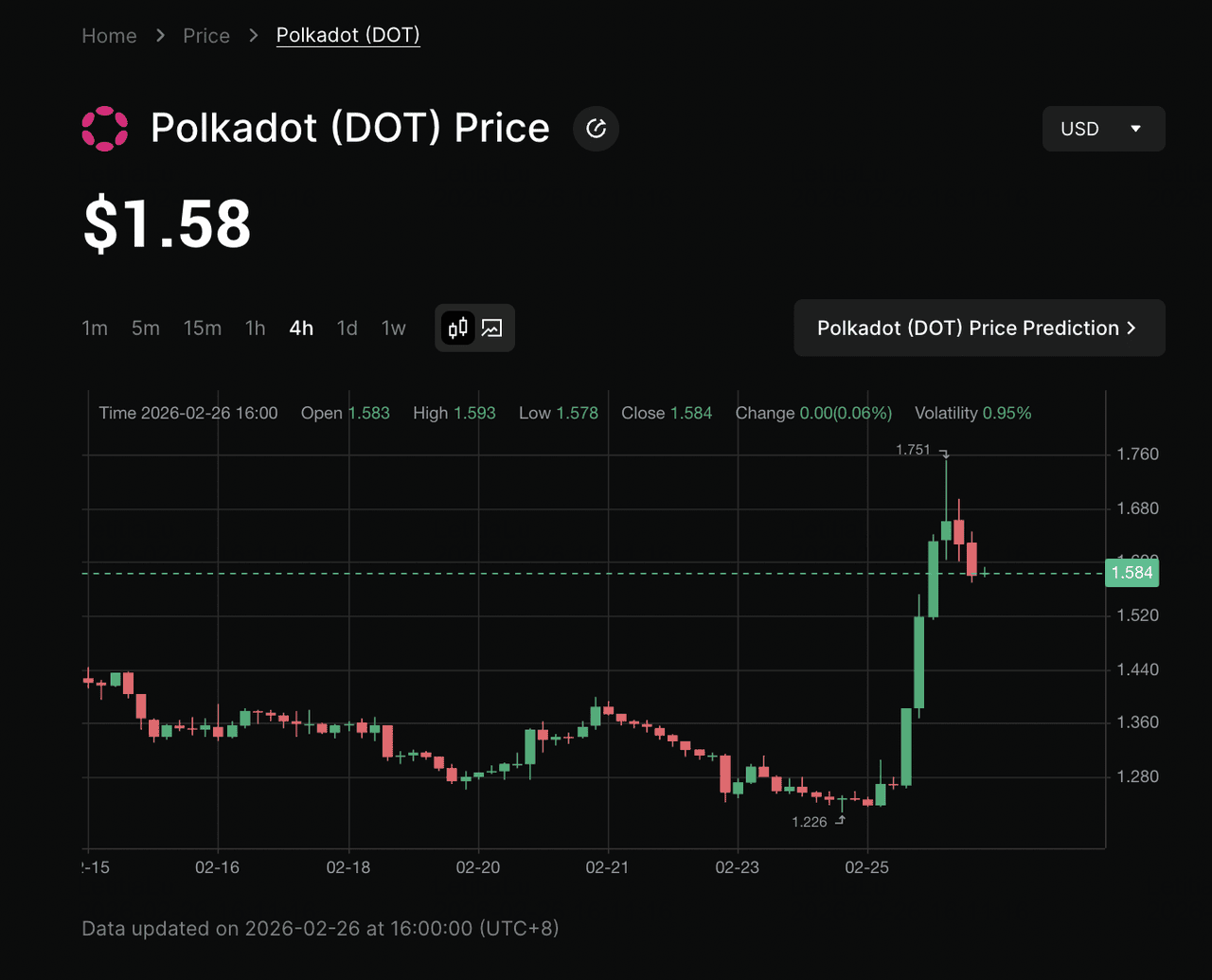
In February 2026, Polkadot’s native token $DOT surged more than 22%, clearly outperforming the broader crypto market. The rally was driven by a combination of structural tokenomics changes, institutional speculation, improving macro sentiment, and a decisive technical breakout.
1. Polkadot DOT 50% Inflation Halving Reduces Token Supply on March 14, 2026
Polkadot is preparing to cut its annual token issuance by 50%, marking its first major monetary policy shift. The reduction in new DOT supply has strengthened the scarcity narrative, prompting traders to position ahead of the March implementation date. As seen in other supply-adjustment cycles, markets often reprice assets in anticipation rather than after the event occurs.
2. Spot Polkadot DOT ETF Speculation Gains Traction
Reports circulated that Grayscale and 21Shares may be exploring a spot Polkadot ETF. While unconfirmed, ETF-related narratives have repeatedly acted as valuation catalysts in crypto markets, particularly following the institutional acceptance of Bitcoin spot ETFs.
3. Capital Rotation Into Polkadot During Altcoin Rally
Bitcoin reclaiming $69,000 restored a risk-on tone across digital assets. At the same time, positioning ahead of Nvidia earnings strengthened broader market sentiment. Capital rotated from large-cap assets into established mid-tier tokens, with Polkadot emerging as a key beneficiary.
4. $DOT Breaks Out With Expanding Trading Volume
DOT broke out of a multi-month consolidation range, signaling a shift in momentum. Spot and perpetual futures volumes climbed to multi-month highs, confirming broad trader participation and reinforcing the strength of the 22% move.
Read more: Polkadot (DOT) Surges 26%+ Amid Halving Hype and Altcoin Rotation: Traders Eye Further Gains
What Is the $DOT Token Utility?
According to the official Polkadot Wiki, $DOT is the native token of the Polkadot network and plays three interconnected roles that secure the ecosystem and drive participation.
• Governance: DOT holders participate in on-chain governance through OpenGov. They can propose and vote on network upgrades, fee adjustments, inflation parameters, and runtime changes. Approved proposals are executed automatically on-chain without requiring hard forks. A portion of DOT issuance is allocated to the Treasury, which funds ecosystem development through governance-approved referenda.
• Staking: DOT secures the Relay Chain through Nominated Proof of Stake. Token holders can lock DOT to nominate validators and earn staking rewards. This staking mechanism provides economic security, as the cost of attacking the network scales with the total value of DOT staked.
• Access to Secure Computation and Coretime: DOT is used to purchase Coretime, which grants projects access to Polkadot’s secure block space and interoperability infrastructure. Projects can also reserve parachain identifiers for their rollups using DOT. This newer Coretime model replaces traditional slot auctions with a more flexible allocation system, directly linking demand for network resources to demand for DOT.
What Is Polkadot ($DOT) Tokenomics?
$DOT operates under a fixed annual issuance model designed to balance staking incentives, treasury funding, and long-term supply predictability. The network issues 120,000,000 DOT per year, a framework introduced in November 2024 when Polkadot transitioned from percentage-based inflation to linear supply growth. Instead of expanding at a constant inflation rate, issuance is now fixed in absolute terms, meaning the effective inflation rate declines gradually as total supply increases.
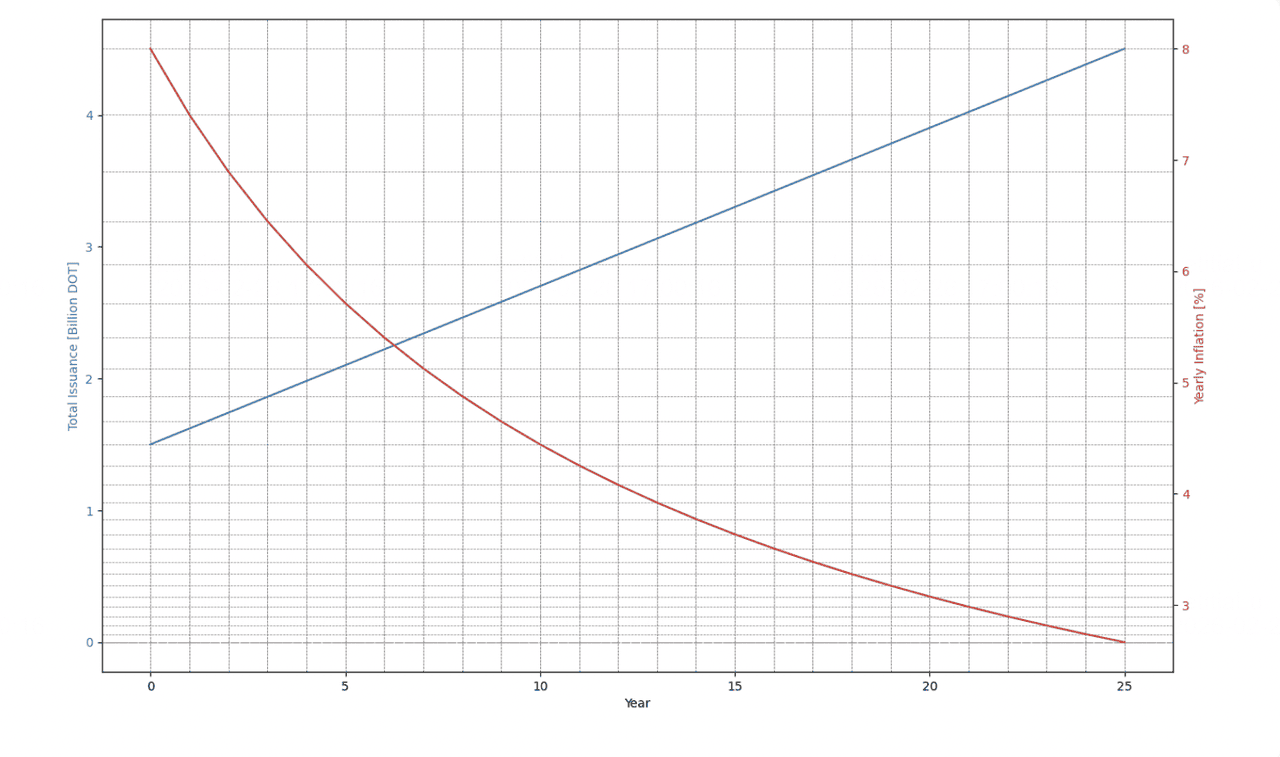
Source: Polkadot (DOT) Tokenomics
The annual issuance is allocated as follows:
• 85% distributed to stakers who secure the network
• 15% allocated to the on-chain Treasury to fund ecosystem development
Importantly, net DOT inflation is lower than the gross 120 million figure due to two built-in deflationary offsets. Unused Treasury funds can be partially burned through governance decisions, and a portion of revenue generated from Coretime sales is permanently removed from circulation. In simple terms, net inflation equals fixed annual issuance minus DOT burned from Treasury and Coretime mechanisms.
Polkadot’s First-Ever Inflation Halving Will Reduce Annual DOT Issuance by 50% on March 14, 2026
The most significant upcoming supply-side event is Polkadot’s first-ever inflation halving, scheduled for March 14, 2026. This change will reduce annual DOT issuance by 50%, marking the largest monetary policy adjustment in the network’s history. The event is widely viewed as a major structural catalyst behind recent DOT price momentum.
Polkadot Layer 0 vs. Layer 1 Blockchains: What’s the Difference?
Layer 1 blockchains such as Ethereum operate as standalone networks that handle execution, consensus, and security within a single chain. Polkadot, by contrast, is designed as a Layer 0 protocol that provides shared security and interoperability infrastructure for multiple connected blockchains.
| Metric | Layer 1 (e.g., Ethereum) | Polkadot Layer 0 |
| Core Role | Executes smart contracts and processes transactions directly | Provides shared security and cross-chain infrastructure for multiple chains |
| Architecture | Monolithic, single-chain execution | Modular, separates consensus (Relay Chain) from execution (parachains) |
| Scalability | Limited by single-chain throughput | Scales horizontally via parallel parachains |
| Interoperability | Requires external bridges to connect to other chains | Native cross-chain messaging through XCM |
| Security Model | Each chain secures itself independently | Shared security across all connected parachains |
| Application Deployment | Apps deploy directly on the main chain | Projects can launch independent Layer 1 parachains |
| Upgrade Mechanism | May require complex coordination or forks | On-chain governance with runtime upgrades |
| Token Utility | Secures and governs a single chain | Secures and governs an entire multi-chain ecosystem |
How to Trade Polkadot (DOT) on BingX
Leverage BingX AI trend analysis tools to navigate DOT’s volatility with greater precision. By tracking real-time volume expansion, funding rates, RSI divergence, and trend strength indicators, BingX AI helps traders interpret market momentum across the interoperability sector and make more informed entry and exit decisions.
Buy or Sell DOT/USDT on Spot Trading
For investors positioning ahead of Polkadot’s first-ever 50% inflation halving and long-term Layer-0 adoption growth, the BingX Spot market provides direct exposure without leverage risk.
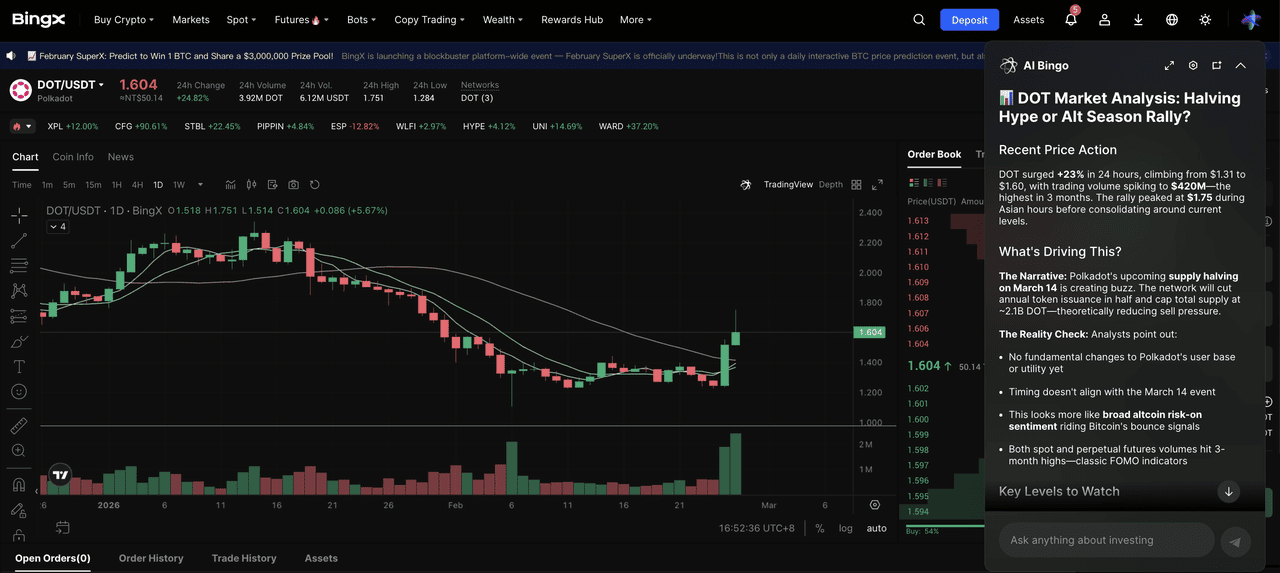
1. Fund Your Account: Ensure your Spot Account is funded with USDT.
2. Find the Pair: Search for DOT/USDT in the Spot market.
3. Execute Your Strategy: Use a Limit Order to accumulate during macro pullbacks or a Market Order to capture breakout momentum ahead of key catalyst dates.
Trade DOT Perps in the Futures Market for Volatility
Traders seeking to capitalize on volatility surrounding the inflation halving, ETF speculation, or Bitcoin-led market moves can use DOT/USDT Perpetual Contracts.
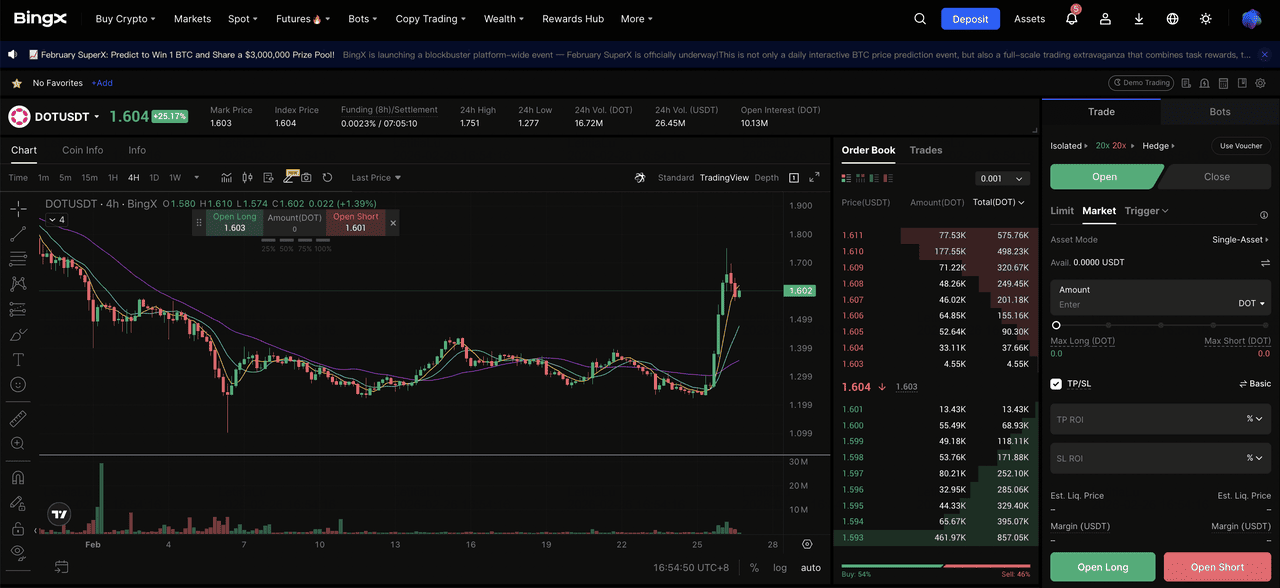
1. Transfer Margin: Move USDT to your Futures Account.
2. Trade DOT Futures: Search for the DOT/USDT perpetual contract and open a long or short position.
3. Monitor Catalysts: Track halving countdown dynamics, ETF filing developments, funding rate shifts, and Bitcoin price action as leading indicators.
4. Manage Risk: Use leverage cautiously. DOT can amplify Bitcoin’s moves during risk-on phases and retrace sharply during macro pullbacks. Always apply Stop-Loss (SL) and Take-Profit (TP) orders to control downside exposure.
3 Key Considerations Before Trading Polkatdot (DOT)
Before trading DOT, it is important to understand several core factors that can significantly impact pricing dynamics, timing, and overall trading risk in fast-moving crypto markets.
1. The Double-Edged Nature of the Halving Narrative: While the March 14, 2026 inflation halving remains the dominant bullish catalyst in the current cycle, markets often exhibit “buy the rumor, sell the news” behavior around scheduled supply events. Once the halving is executed, the narrative premium may fade. Traders should monitor on-chain flows and volume trends before and after the event to gauge whether momentum is sustaining or shifting into profit-taking.
2. Parachain Ecosystem Growth and Demand: DOT’s long-term value is directly linked to the strength of the Polkadot parachain ecosystem. Key indicators include active parachain participation, cross-chain message activity, and DeFi usage across the network. Sustained ecosystem expansion supports structural demand for DOT, while stagnation could weaken the investment thesis.
3. Parachain Lease Expiry and Supply Unlock Risk: Unlike traditional vesting schedules, Polkadot’s supply risk stems from parachain bond expirations. When lease periods end, bonded DOT is returned to contributors, potentially increasing circulating supply. Tracking upcoming lease expirations is essential for anticipating periods of structured selling pressure.
Conclusion: Is Polkadot (DOT) a Good Investment in 2026?
For investors evaluating DOT in 2026, the case combines clear near-term catalysts with a longer-term structural thesis. The March 14 inflation halving reduces annual issuance by 50%, introducing a meaningful supply shift, while ETF speculation adds a potential institutional demand narrative. At the same time, broader altcoin rotation and improving macro sentiment have supported DOT’s recovery and short-term momentum.
Long term, Polkadot’s value depends on its role as a Layer-0 infrastructure protocol. Its shared security model, native cross-chain communication, and Coretime-based resource allocation position DOT as the token securing and powering a multi-chain ecosystem. However, ETF rumors remain unconfirmed, and post-halving volatility is possible. Ultimately, sustained parachain adoption and developer activity will determine whether DOT’s structural thesis translates into durable value.
