
By utilizing a Pre-IPO tokenization model, BingX enables retail investors to speculate on OpenAI’s valuation, currently targeted at up to $1 trillion, without the traditional barriers of private equity markets, which typically require accredited investor status.
On June 8, 2026, AI pioneer OpenAI officially announced its confidential submission of a draft Form S-1 registration statement with the U.S. Securities and Exchange Commission (SEC) for an Initial Public Offering (IPO). Coming just one week after its chief rival Anthropic submitted its own filing, OpenAI's move intensifies an unprecedented public market liquidity race. Through the OpenAI (Pre-IPO) futures contract on BingX, traders can now access the explosive growth of the ChatGPT ecosystem 24/7 on-chain.
This article examines the mechanics of OpenAI pre-IPO futures and how you can trade the OPENAI(Pre-IPO)-USDT contract to gain early exposure to one of the largest tech listings in financial history.
What Is OpenAI and Why Does the OpenAI IPO Matter?
Founded in 2015 and dramatically restructured into a commercial powerhouse, OpenAI has transformed from an esoteric research nonprofit into the foundational engine of the generative AI revolution. The company’s flagship product, ChatGPT, commands over 900 million weekly active users and more than 50 million paying consumer subscribers, generating a staggering $2 billion in monthly recurring revenue (MRR) as of early 2026. By scaling its custom silicon pipelines, expanding its enterprise ecosystem via Codex, and pioneering localized neural processing models, OpenAI has evolved from a simple chatbot provider into a structural utility layer for the global digital economy.
|
OpenAI Metric / Indicator |
Operational & Financial Baseline |
|
Target IPO Valuation Range |
Up to $1.00 Trillion |
|
Last Private Post-Money Valuation |
$852 Billion (March 2026 Funding Round) |
|
Monthly Recurring Revenue (MRR) |
$2.00 Billion (As of March 2026) |
|
Weekly Active Users (WAU) |
900+ Million |
|
Premium Paid Subscribers |
50+ Million |
|
Projected Path to Profitability |
Estimated 2030 |
OpenAI's key financial metrics in the S-1 filing
OpenAI’s confidential S-1 filing represents a watershed moment for global capital markets, firing the starting gun on a historic $1 trillion public market liquidity race. Alongside near-simultaneous listings from Anthropic and SpaceX, this wave will serve as the ultimate, multi-trillion-dollar test of Wall Street’s true appetite for capital-intensive, high-compute technology. For market participants, this listing transitions artificial intelligence out of the speculative sandbox of private venture funding and forces it into the strict, data-driven validation arena of public corporate balance sheets, fundamentally altering tech sector equity allocations for the next decade.
When Will OpenAI Go Public?
OpenAI has officially initiated the IPO process following its confidential Form S-1 submission to the SEC, with Wall Street underwriter syndicates led by Goldman Sachs and Morgan Stanley pointing toward a public debut window as early as September 2026.
Because the draft prospectus is under confidential review to allow the company to navigate complicated strategic tradeoffs, the exact timing remains flexible. The definitive launch window depends on how quickly regulators evaluate OpenAI's financials, including its massive $2 billion in monthly revenue and $24 billion annualized run rate (ARR) recorded as of March 2026, and how it balances its projected path to profitability by 2030 against ongoing infrastructure expenditures.
What Are OpenAI Pre-IPO Futures ($OPENAI)?
OpenAI pre-IPO futures function as a specialized derivative asset class that bridges the liquidity of digital asset markets with the private valuation of Sam Altman’s artificial intelligence firm. Unlike traditional equities, these pre-IPO contracts are structured as specialized tracking derivatives that mirror the economic performance, private funding rounds, and market sentiment surrounding the underlying private firm.
With OpenAI targeting a valuation of up to $1 trillion for its public debut, up from its last private funding round of $110 billion at an $840 billion valuation in early 2026, this futures contract allows retail traders to bypass the multi-million-dollar entry barriers of private secondary markets. Practically, this means a user can open fractional positions of OpenAI exposure 24/7, capturing the price action driven by a weekly active user base that recently crossed 900 million. It is important to note that these contracts carry counterparty risk and do not grant legal voting rights or direct equity ownership in the underlying company.
How Does the OpenAI Pre-IPO Futures Contract Work?
At its core, the pre-IPO contract is an application of advanced futures market design that optimizes the User Intent for private artificial intelligence equity exposure:
- Synthetic Exposure: The contract does not grant direct voting rights or legal ownership of OpenAI's upcoming Public Benefit Corporation common stock. Instead, it mirrors the price action of OpenAI’s private valuation and public listing expectations.
- The "Third Phase" Infrastructure Pivot: The contract's long-term value is heavily anchored to OpenAI's operational execution. As the firm transitions from a consumer product company into infrastructure automation, it is scaling high-margin enterprise software, its web browser ecosystem, and its advanced coding assistant Codex to compete directly with alternative models.
- Hyperscaler Diversification: OpenAI's updated corporate structure has allowed it to diversify its computing architecture. While Microsoft remains its largest public proxy via a cumulative $13 billion investment, OpenAI has forged independent data partnerships with Amazon and Alphabet's Google to fuel its capital-intensive training cycles.
OpenAI IPO vs. Pre-IPO Futures: What Is the Difference?
|
Feature |
OpenAI Private / IPO Shares |
OpenAI Pre-IPO Futures ($OPENAI) |
|
Accessibility |
Institutional & Accredited Investors Only |
Open to All (BingX Users) |
|
Trading Hours |
Restricted Traditional Market Hours |
24/7 On-Chain |
|
Minimum Buy-in |
High Institutional Thresholds |
As low as 10 USDT |
|
Governance |
Voting Rights Included |
No Voting/Governance |
|
Liquidity |
Low (Lock-up periods apply) |
High (Instant Order Execution) |
The primary distinction between an OpenAI IPO and pre-IPO futures lies in legal ownership versus synthetic derivative exposure. A formal IPO issues common stock that represents direct equity, granting holders structural shareholder rights. In contrast, pre-IPO futures are blockchain-based derivatives that mirror price fluctuations based on market demand without granting underlying ownership. While the official IPO must navigate strict SEC S-1 disclosures before revealing exact gross margins, futures contracts rely on the liquidity design of the trading platform and can trade at a premium or discount based on immediate market demand.
Participating in the initial public offering requires a traditional brokerage account and favors major Wall Street institutions. Pre-IPO futures, however, democratize access by lowering the entry barrier to as little as 10 USDT, allowing for fractional exposure to a company approaching a $1 trillion valuation.
For active traders, futures contracts offer 24/7 market access and instant settlement, making them an excellent tool for speculating on immediate tech catalysts, such as the rollout of advanced contextual ad structures or next-generation GPT models, whereas IPO shares are subject to traditional exchange hours and standard 180-day lock-up periods that restrict selling for months after the debut.
How to Trade OpenAI Pre-IPO Futures on BingX
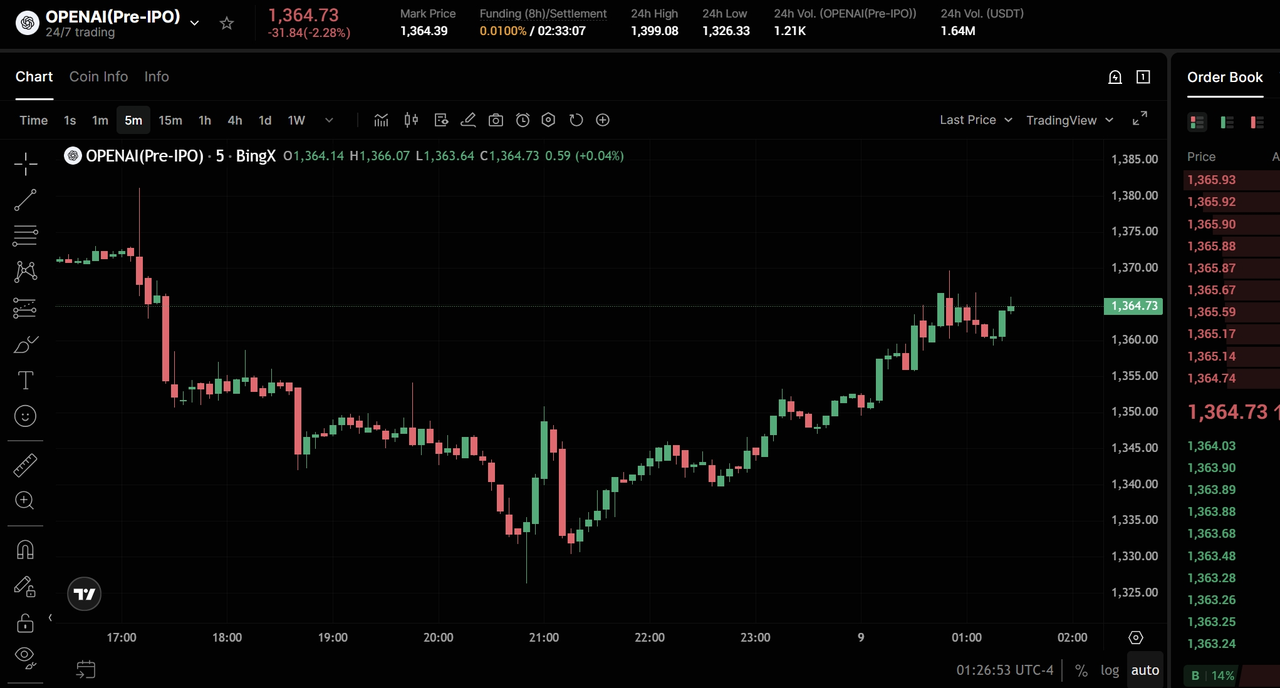
OpenAI pre-IPO on BingX futures market
The BingX Pre-IPO Trading Zone is a specialized market segment dedicated to pre-listing derivatives. BingX democratizes access by listing tracking derivatives on its advanced perpetual futures interface.
For traders looking to use leverage, the Pre-IPO Trading Zone offers synthetic contracts that track OpenAI's valuation momentum.
- Enter the Futures Interface: Tap the Futures tab on the BingX app or web terminal.
- Locate the Pre-IPO Pair: Search for OPENAI to locate the OPENAI(Pre-IPO)-USDT Perpetual Futures market.
- Transfer Margin: Ensure you have USDT in your Futures account. Use the Transfer button to move funds from your Fund account if necessary.
- Configure Leverage and Margin Mode:
- Isolated Margin: Limits your maximum risk to a single position.
- Cross Margin: Uses your entire available balance to defend against liquidation.
- Note: Select a conservative leverage level that strictly aligns with your specific risk tolerance.
- Place Your Order:
- Long: If you anticipate OpenAI’s valuation will rise past its private market baseline as the September 2026 public listing approaches.
- Short: To hedge against a potential valuation shakeout, high cash-burn concerns, or broader tech market volatility.
- Manage Your Position: Set Take-Profit (TP) and Stop-Loss (SL) orders immediately. Pre-IPO futures are highly speculative and can move independently of broader crypto trends based on private equity updates and SEC regulatory movements.
OpenAI vs. Anthropic vs. SpaceX IPO: What's the Best Tech IPO of 2026?
The summer of 2026 has brought an unprecedented convergence of generational tech listings. With SpaceX (SPCX) launching its historic debut this week, and both Anthropic and OpenAI pushing confidential S-1 filings through the SEC review pipeline, investors face a high-stakes capital allocation puzzle.
Mega-Cap AI Tech IPO Comparison Matrix
|
Metric / Indicator |
OpenAI |
Anthropic |
SpaceX (SPCX) |
|
Target / IPO Valuation |
Up to $1.00 Trillion |
$965 Billion |
$1.75 Trillion |
|
Annualized Revenue Run Rate |
$24 Billion ($2B/month) |
Over $44 Billion |
$60 Billion+ |
|
Core Monetization Engine |
Consumer ChatGPT + Ads + B2B |
Enterprise Claude Code + B2B |
Starlink Broadband + Heavy Launch |
|
Enterprise Market Share |
32.30% |
34.40% |
Near-Monopoly Space Infrastructure |
|
Projected Profitability |
Estimated 2030 |
Estimated 2028 |
Profitable (Driven by Starlink Cash) |
|
Lead Underwriters |
Goldman Sachs, Morgan Stanley |
J.P. Morgan, Bank of America |
Morgan Stanley, Goldman Sachs |
Should You Invest in OpenAI IPO or Anthropic and SpaceX IPOs?
For investors prioritizing pure-play software growth and immediate developer mindshare, Anthropic currently presents a structurally superior financial footprint to OpenAI. Driven by its dominant enterprise adoption and popular programming assistant, Claude Code, Anthropic’s annualized revenue run rate exploded fivefold over the past year to surpass $44 billion, outpacing OpenAI's $24 billion run rate.
More importantly, Anthropic is pacing toward structural profitability by 2028, whereas OpenAI is struggling with a significantly larger consumer infrastructure cost burden and does not forecast true profitability until 2030. Speculating on OpenAI or Anthropic at near-trillion-dollar valuations relies heavily on a high price-to-sales multiple, making them highly sensitive to near-term software margins and model obsolescence cycles.
Conversely, for institutional and risk-conscious allocators seeking a structural baseline, SpaceX (SPCX) stands out as the premium asset in the 2026 line-up. At a valuation of $1.75 trillion, SpaceX is not just a speculative bet on generative AI code lines; it is an omnipresent infrastructure monopoly.
By keeping its highly profitable Starlink global satellite internet framework integrated within the listing, which simultaneously serves as the orbital compute backbone for xAI’s Grok engine, SpaceX balances massive physical assets and recurring subscription revenue with zero exposure to traditional software obsolescence. While OpenAI and Anthropic fight an expensive, capital-intensive war over raw frontier models, SpaceX serves as the heavy-asset toll collector of both global connectivity and the orbital compute era.
5 Key Considerations Before Trading OpenAI Pre-IPO Futures
Before allocating capital to pre-IPO futures contracts, it is essential to evaluate the unique risks involved:
- Counterparty and Product Risk: Since pre-IPO contracts are derivative instruments, their value depends on the structural liquidity and tracking accuracy of the platform relative to private market evaluations.
- IPO Timelines: While initial underwriter reports point toward a September 2026 debut window, OpenAI has emphasized that it may remain private longer to execute specific product goals, meaning any delay can cause sharp volatility in futures contract prices.
- No Direct Ownership: Remember that you are trading a digital contract that tracks OpenAI's growth narrative; you do not hold physical stock certificates or equity inside OpenAI's Public Benefit Corporation.
- Crypto Market Sentiment: Pre-IPO futures can temporarily diverge from actual private share values due to crypto-specific leverage spikes, platform-wide liquidations, or speculative retail hype.
- The High Cash-Burn Era: Training frontier models is estimated to cost well over $100 million per single run. Monitor how OpenAI balances its target path to 2030 profitability against its intense infrastructure and chip expenditures.
Final Thoughts: Should You Trade OpenAI Pre-IPO Futures?
As of June 2026, OpenAI has solidified its status as an elite titan of the AI revolution. By commanding a massive consumer footprint with over 900 million weekly active users, implementing dynamic programmatic ad revenue streams, and moving past legacy legal overhangs, the company is actively pacing toward a historic $1 trillion public listing.
For the strategic investor, trading the pre-IPO contract on BingX is a direct play on the expanding algorithmic economy. While Wall Street waits for OpenAI's S-1 prospectus disclosures to go public, the BingX Pre-IPO Trading Zone provides the tools to hedge, speculate, and establish early positioning before the institutional floodgates officially open.
Risk Reminder: Pre-IPO futures are high-risk speculative assets. The contract price may fluctuate significantly based on IPO rumors, regulatory filings, technological model releases, and general market conditions. Always perform your own research, maintain strict risk management parameters, and only trade capital you can afford to lose. BingX is not responsible for any trading losses.
Related Reading
- OpenAI IPO Incoming? Inside OpenAI’s S-1 Filing and the Trillion-Dollar AI Triumvirate Liquidity Race
- What Is Anthropic Pre-IPO and How to Trade It on BingX?
- How to Trade SpaceX Pre-IPO on BingX Pre-IPO: SPACEX (VNTL), SPACEX (PreStocks), and SPCX
- Should You Participate in SpaceX IPO: Pros and Cons
FAQs: Everything You Need to Know About Trading OpenAI Pre-IPO Futures
1. Can retail investors buy OpenAI shares before the official IPO?
Directly, no. Access to private OpenAI shares via traditional secondary channels is restricted to venture capital funds, institutional backers, and accredited investors with massive capital minimums. However, through the BingX Pre-IPO Trading Zone, retail investors can gain synthetic exposure to OpenAI's market momentum via futures contracts using USDT, bypassing geographic and accreditation barriers.
2. When is the expected OpenAI IPO date and what is its valuation?
OpenAI submitted its confidential draft S-1 prospectus with the SEC recently, with sources hinting at a potential launch as early as September 2026. While the company's last private funding round valued it at $852 billion, it is targeting a valuation of up to $1 trillion for its public debut.
3. What are the core financial metrics driving OpenAI's valuation?
OpenAI's growth is characterized by heavy commercial acceleration, generating $2 billion in monthly revenue as of March 2026. This top-line expansion is supported by over 50 million premium consumer subscribers, alongside scaling enterprise solutions and programmatic ad deployments.
