The global artificial intelligence landscape in 2026 is undergoing a profound structural realignment. The speculative, high-flying phase of early generative AI deployment has given way to an era of strict capital discipline, infrastructure optimization, and aggressive platform monetization. In this macroeconomic climate, corporate value is no longer measured solely by raw frontier model capabilities, but by the efficiency of cloud ecosystems, localized data center scaling, and institutional platform control. At the absolute apex of this foundational enterprise transition stands Jeffrey P. Bezos, the founder and Executive Chairman of Amazon.com, Inc.
Who Is Jeff Bezos?
Jeffrey Preston Bezos is an American computer scientist, technology entrepreneur, and commercial space pioneer who revolutionized global commerce and cloud computing as the founder and Executive Chairman of Amazon.com, Inc.. Born in New Mexico, he graduated summa cum laude from Princeton University in 1986 with degrees in electrical engineering and computer science. After becoming the youngest Senior Vice President at Wall Street quantitative firm D.E. Shaw & Co., Bezos left his financial career in 1994 to launch Amazon out of his Seattle garage, transforming an online bookstore into a multi-trillion-dollar e-commerce and AWS cloud infrastructure giant.
After stepping down as Amazon CEO in 2021 to become Executive Chairman, Bezos pivoted his primary operational focus toward his private aerospace firm Blue Origin and his vertical industrial AI startup, Project Prometheus. Today, operating as a "Founder-Sovereign," his multi-hundred-billion-dollar capital allocation strategy focuses on scaling physical-AI automation, orbital data centers, and planetary-scale philanthropic commitments.
Jeff Bezos's Net Worth in 2026: Key Estimates
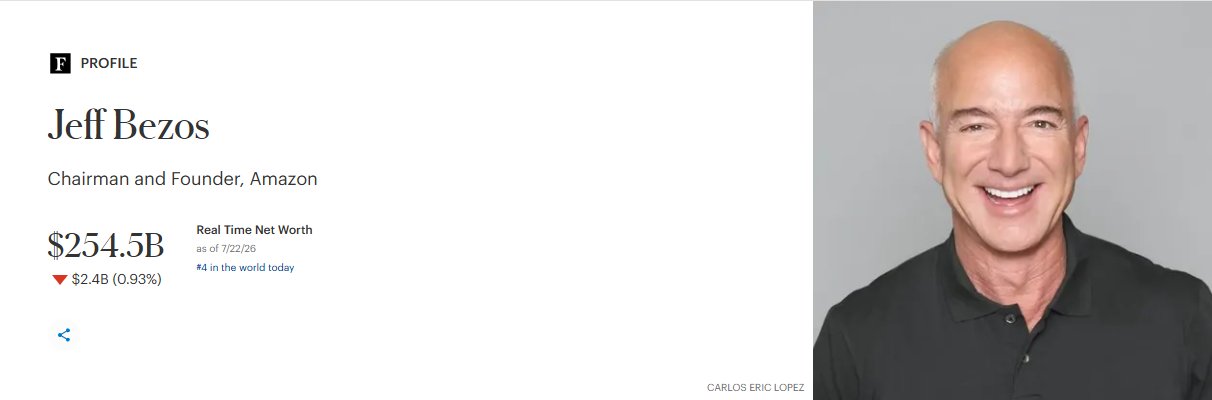
The baseline metrics of Jeff Bezos's personal wealth in 2026 establish him firmly among the four wealthiest individuals on Earth. Because his net worth is fundamentally anchored by his massive equity holdings alongside high-growth private ventures, top-tier global wealth trackers evaluate his financial standing through real-time public market filings and private venture valuations.
Jeff Bezos Financial Status Registry (2026)
|
Holding Metric |
Value / Asset Count |
Reporting Date / Context |
|
Forbes Real-Time Billionaires Index |
~$256.6 Billion |
Real-Time Mid-2026 Registry Index |
|
Bloomberg Billionaires Index |
~$252.6 Billion |
Verified Mid-Year Evaluation Index |
|
Forbes 2026 Annual List Ranking |
Position #4 Globally |
40th Annual World's Billionaires List |
|
Daily Trading Volatility Band |
$224 Billion – $266 Billion |
Market Band Sensitivity Range |
|
Direct Amazon Share Ownership |
~881 Million Shares (~8.2% Stake) |
Primary Public Equity Driver |
|
Implied Value of Direct Stake |
~$212 Billion – $235 Billion |
Calculated at $247–$266 Stock Price |
|
Cumulative Share Sales (IPO to Date) |
Over $49 Billion |
Realized Historical Cash Liquidity |
On the 40th annual Forbes World's Billionaires list published in March 2026, Bezos was positioned at No. 4 globally with an annual baseline of $227.1 billion. By July 2026, real-time market recoveries in tech equities pushed his personal wealth upward to ~$256.6 billion. Depending on daily trading volatility, his net worth shifts within a wide band of $224 billion to $266 billion, marking a massive recovery from the 2023 market drawdown where his recorded fortune bottomed at $114 billion.
Deconstructing Jeff Bezos’s Fortune: Public Equity vs. Private Assets
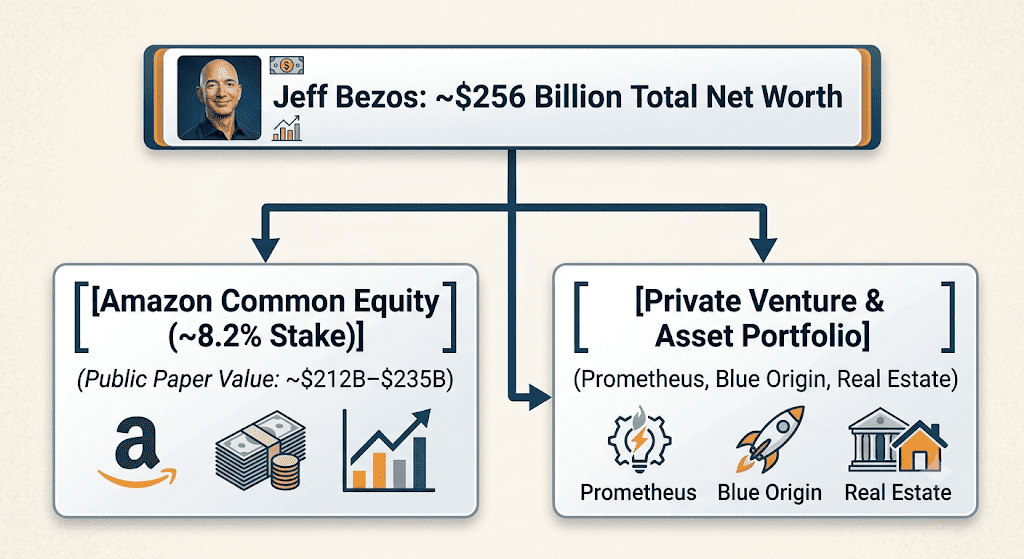
To understand Jeff Bezos's actual financial standing in 2026, we have to look at the explicit separation between his liquid public equity in Amazon and his hyper-scale private asset holdings.
Deconstructing Jeff Bezos’s Asset Portfolio (Mid-2026)
|
Asset Class / Venture |
Ownership / Stake Details |
Estimated Value (Mid-2026) |
Strategic Operational Role |
|
Amazon (NASDAQ: AMZN) |
~881 million shares (~8.2% stake) |
~$212.0B – $235.0B |
Executive Chairman & Largest Shareholder |
|
Project Prometheus |
Co-lead founder; primary investor |
~$41.0 Billion (Series B) |
Operational Co-Chief Executive Officer |
|
Blue Origin |
Near-wholly owned private firm |
~$50.0B – $100.0B |
Founder & Primary Financial Backer |
|
Sovereign Real Estate |
Miami, Seattle, and regional estates |
~$700 Million |
Private Residential Compound Holdings |
|
The Washington Post |
Wholly owned (acquired 2013) |
~$250M – $500M |
Sole Media Proprietor |
|
Private Luxury Assets |
Custom superyacht (Koru) |
~$500 Million |
Private Maritime Asset |
Jeff Bezos’s Amazon Equity and Rule 10b5-1 Stock Sales
The underlying structural engine of Bezos's wealth remains his direct equity stake in Amazon. As the largest individual shareholder, holding roughly 881 million shares (~8.2% of total outstanding common stock), every $10 movement in Amazon's share price shifts his personal paper net worth by over $8.8 billion.
To fund his capital-intensive private initiatives without triggering market panic, Bezos utilizes automated Rule 10b5-1 trading plans. Since Amazon’s 1997 IPO, he has systematically liquidated more than $49 billion in stock. These liquidations accelerated significantly, providing him with tens of billions in liquid cash reserves to fund private aerospace, artificial intelligence, and real estate acquisitions.
How Amazon’s Strategy Drives Bezos’s Wealth
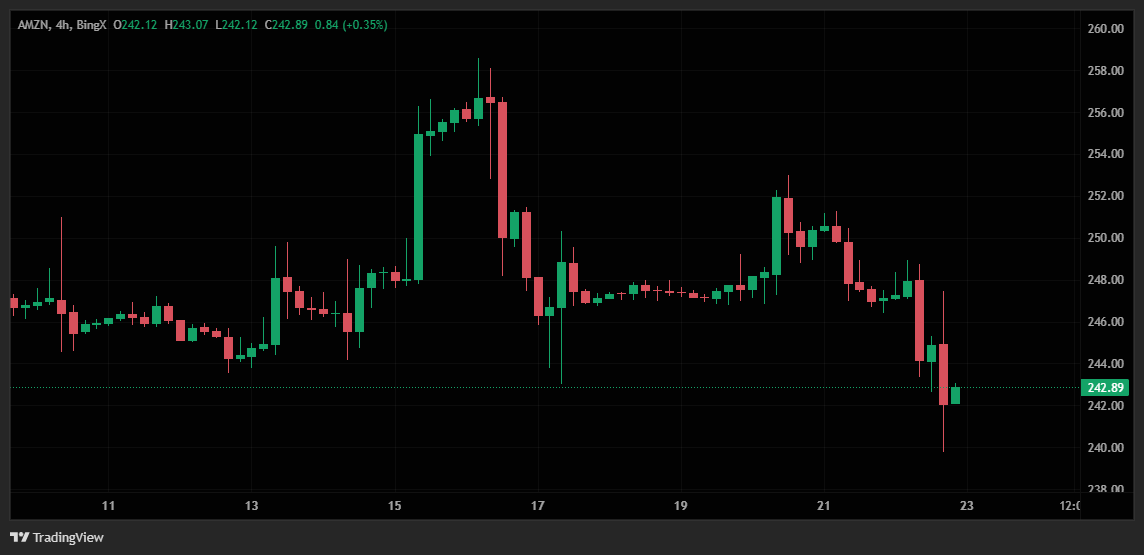
Because Jeff Bezos remains Amazon’s largest individual shareholder, holding approximately 881 million common shares, or about 8.2% of total outstanding equity, his paper fortune moves directly with Amazon’s share price.
To put his stock sensitivity into perspective:
- The $10 Price Delta: Every $10 move in Amazon’s share price adds or subtracts more than $8.8 billion from Jeff Bezos’s net worth, based on 881 million shares.
- The $200 Billion Capex Moat: Wall Street’s re-rating of Amazon stock, which supports roughly $212 billion to $235 billion of Bezos’s wealth, is tied to CEO Andy Jassy’s plan to invest about $200 billion in fiscal 2026 across AI data centers, power infrastructure, and custom silicon.
- AWS & Anthropic Windfalls: AWS reached a $150 billion annualized run rate, with quarterly revenue of $37.6 billion, up 28% year over year, and operating income of $14.16 billion in Q1 2026. Amazon’s stake in Anthropic also generated a $16.8 billion pre-tax paper gain after its latest Series H round, helping reinforce the valuation base behind Bezos’s fortune of more than $250 billion.
Bezos’s Project Prometheus and Industrial AI Strategy
Project Prometheus marks Bezos’s direct return to operational technology leadership. The physical AI startup raised $12 billion at a $41 billion valuation, with Bezos serving as co-CEO alongside MIT-trained physicist Vik Bajaj. The company is focused on applying AI to complex industrial and engineering workflows rather than competing in the consumer chatbot market.
Prometheus is designed to handle tasks such as jet engine development, materials research, and semiconductor lithography. By turning these physical engineering problems into machine learning systems, the platform aims to compress design and testing cycles that can take years into much shorter digital workflows.
Jeff Bezos’s Blue Origin and Project Sunrise Space Data Centers
Blue Origin’s Project Sunrise, also known as TeraWave, proposes a network of up to 51,600 solar-powered satellites operating as interconnected compute nodes through optical laser links. The system would function as a distributed orbital data center capable of supporting large-scale computing workloads.
By moving AI training, simulations, and other energy-intensive tasks into orbit, Bezos aims to reduce pressure on terrestrial power grids and water supplies. The project could also position Blue Origin as a future provider of space-based computing infrastructure for governments, enterprises, and other large-scale users.
How Does Jeff Bezos's Wealth Compare to Other Tech Leaders?
To contextualize Jeff Bezos’s wealth and operational influence within the global technology ecosystem, his assets and structural control mechanisms must be compared with other leading industry executives in mid-2026.
|
Tech / AI Leader |
Primary Corporate Affiliation |
Estimated 2026 Net Worth |
Core Equity Control Mechanism |
AI & Infrastructure Positioning |
|
Elon Musk |
Tesla, SpaceX, xAI |
$839B – $997.1B |
~20% Tesla; 42% private SpaceX equity |
Megawatt compute clusters (Colossus), FSD neural nets. |
|
Larry Page |
Alphabet (Google) |
$257B – $284.3B |
Dual-class super-voting stock block |
Search infrastructure & foundational Gemini models. |
|
Jeff Bezos |
Amazon / Prometheus |
$224B – $256.6B |
8.2% Amazon; majority private Prometheus |
AWS cloud moat, Anthropic models, physical AI (Prometheus). |
|
Mark Zuckerberg |
Meta Platforms, Inc. |
$222B – $237B |
~13% economic; 61% voting control |
Open-source foundation models (Muse), data center scale. |
|
Jensen Huang |
Nvidia Corporation |
$154B – $175.4B |
3.3% – 3.6% direct & family trusts |
Universal hardware silicon provider; GPU dominance. |
|
Dario Amodei |
Anthropic PBC |
$7.0B – $15.5B |
1.8% fully diluted; Class B shares |
Safety-aligned enterprise conversational models (Claude). |
|
Sam Altman |
OpenAI, Helion Energy |
$3.4B – $4.0B |
0% direct equity in OpenAI; VC funds |
Consumer application ecosystems; sovereign compute funds. |
|
Satya Nadella |
Microsoft Corporation |
$1.3B – $1.56B |
~0.01% equity; performance grants |
Cloud ecosystem expansion; Azure partner integration. |
1. Pure-Play Private AI Equity vs. Public Industrial Holdings
Unlike legacy tech billionaires like Elon Musk and Mark Zuckerberg, whose fortunes are highly liquid and traded daily on public stock exchanges, Jeff Bezos’s multi-hundred-billion-dollar net worth sits in a hybrid category. While his baseline paper wealth remains mathematically anchored to Amazon’s public market cap, his active capital deployments are heavily concentrated in illiquid, private physical assets like Blue Origin and Prometheus. This setup allows him to shield billions in private equity from public market volatility, easily outscaling professional corporate managers like Microsoft CEO Satya Nadella whose fortunes are bound to public grant schedules.
2. The Sam Altman Paradox
While Sam Altman wields massive geopolitical and market influence as the CEO of OpenAI (valued between $730B and $852B), he famously holds 0% direct equity in the company. Altman’s estimated $3.4 billion net worth is instead derived entirely from independent venture capital investments in external startups like Helion Energy, Reddit, and Stripe. In stark contrast, Jeff Bezos operates as a true "Founder-Sovereign," retaining direct equity ownership in Amazon (~8.2%) alongside majority operational control and lead-investor equity in his private ventures. This structural difference ties Bezos's personal balance sheet directly to the long-term industrial performance of his own platforms.
3. Structural Dilution in Private AI Labs
The comparative matrix highlights a severe capital friction point for private AI founders like Anthropic’s Dario Amodei ($8.0B–$15.5B) and DeepSeek’s Liang Wenfeng ($36.0B). To fund the immense physical compute infrastructure required to train frontier models, private founders are routinely forced to dilute their equity or personally inject billions in cash to protect their ownership percentages. Bezos completely bypasses these personal dilution dynamics. By controlling the underlying physical host infrastructure through AWS, he captures the processing spend of rival AI labs using corporate balance sheets, de-risking his own personal wealth.
4. Professional Operators vs. Founder-Sovereigns
Professional corporate executives like Satya Nadella and Andy Jassy manage multi-trillion-dollar hyperscale balance sheets, yet their personal fortunes remain under $2 billion. Their compensation is strictly structured around performance-linked grants and public stock options, leaving their personal wealth transparent but structurally capped. Founders like Bezos, Musk, and Zuckerberg operate under an entirely different wealth model: their fortunes are driven by concentrated equity blocks accumulated from inception, granting them total financial autonomy and insulating them from short-term public board oversight.
Related Reading
- Top AI Data Center Stocks to Buy in 2026: Cloud, Servers, and AI Compute Infrastructure
- Top AI Hyperscaler Stocks to Watch in 2026: The $700 Billion Cloud Infrastructure Race
- What Is Amazon CEO Andy Jassy's Net Worth in 2026?
- What Is Meta CEO Mark Zuckerberg's Net Worth in 2026?
- What is Microsoft CEO Satya Nadella's Net Worth in 2026?
FAQs on Jeff Bezos’s Net Worth
1. How much is Jeff Bezos worth in 2026?
As of mid-2026, Jeff Bezos’s personal net worth is estimated between $224 billion and $256.6 billion, placing him securely at Position #4 globally on major billionaire registries. His wealth is primarily tied to his Amazon equity stake and private venture holdings.
2. What percentage of Amazon stock does Jeff Bezos own?
Jeff Bezos remains Amazon's largest individual shareholder, holding approximately 881 million shares, representing roughly 8.2% of the company's total outstanding common stock.
3. How much cash has Jeff Bezos realized from selling Amazon stock?
Since Amazon's 1997 IPO, Jeff Bezos has systematically sold more than $49 billion worth of Amazon stock through structured Rule 10b5-1 trading plans. These liquidations provide the cash reserves used to fund Blue Origin and his private AI ventures.
4. What is Project Prometheus?
Project Prometheus is Jeff Bezos’s vertical physical-AI startup focused on building an "artificial general engineer" for industrial manufacturing. In June 2026, the company closed a $12 billion Series B funding round that valued the entity at $41 billion, marking Bezos’s first hands-on executive CEO role since stepping down from Amazon in 2021.
5. What is Blue Origin's Project Sunrise?
Project Sunrise (TeraWave) is a proposal submitted by Blue Origin to the FCC to launch 51,600 solar-powered satellites into low Earth orbit. The constellation aims to function as a distributed orbital data center network, routing massive AI computing workloads in space to reduce pressure on terrestrial energy grids.
6. Does Jeff Bezos hold Bitcoin or other cryptocurrencies?
No. Jeff Bezos has never confirmed personal ownership of Bitcoin, Ethereum, or other digital assets. His multi-hundred-billion-dollar fortune is driven strictly by traditional public equities, private venture holdings, and physical aerospace infrastructure.
