
ETHGas is a foundational primitive designed for the Realtime Ethereum era, moving beyond the 12-second latency of standard block times to create a high-frequency execution environment. Launched to eliminate the gas anxiety that hinders institutional and retail adoption, ETHGas provides the tools for developers to build gasless applications and for traders to secure guaranteed block inclusion through decentralized, programmable rails.
$GWEI is currently a breakout performer in the Infrastructure and Ethereum Beta narrative. In February 2026, following its listing on major exchanges, the token saw a significant 28% monthly gain in price and a 21%+ surge in daily trading volume, outperforming broader market indices. While the macro environment shows a high correlation with traditional equities, GWEI has maintained strong bullish momentum, testing critical resistance levels as liquidity flows into speed-as-a-service protocols.
This article breaks down the mechanics of the Blockspace Marketplace, the utility of the $GWEI token, and a guide on how to trade GWEI tokens on BingX.
What Is ETHGas (GWEI) and How Does It Work?
ETHGas operates as a high-performance Blockspace Logistics Layer, transitioning Ethereum from a best-effort auction model to a guaranteed delivery network. By decoupling transaction sequencing from the standard 12-second block time, it allows protocols to achieve Web2-speed UX on decentralized rails.
The protocol functions through three high-utility technical pillars:
1. Institutional Blockspace Marketplace: Unlike the chaotic public mempool, this is a Forward Market for gas. Validators sell standardized Sequencing Rights as liquid assets. This allows institutional traders to purchase Whole Block Commitments or Inclusion Guarantees in advance, locking in execution costs and eliminating Priority Gas Auctions (PGAs) that cause fee spikes.
2. Realtime Execution Engine (50ms Latency): ETHGas utilizes a specialized Realtime Builder sidecar that breaks a single Ethereum slot into hundreds of micro-intervals. It broadcasts Preconfirmations, preliminary state updates with economic guarantees, every 50–100ms. This enables Synthetic Realtime for DeFi, allowing DEX positions and price feeds to update 240x faster than the L1 12-second finality.
3. Open Gas (Gasless Abstraction): This is a zero-code Loyalty Layer for dApps. Protocols deposit ETH into a vault to sponsor user actions. When a user transacts, the protocol handles the hidden tax of gas in the background. Users receive 100% automated rebates via a claimable dashboard, effectively removing the $2–$5 friction barrier for onboarding new retail users.
By integrating reth-based nodes and WebSocket proxies, ETHGas provides a Priority Boarding experience. For developers, this means building Gasless dApps where the complexity of the blockchain is abstracted away, leaving only the speed and security of a realtime global settlement layer.
What Is the $GWEI Token Utility?
The $GWEI token is the native governance asset that fuels the Realtime Ethereum ecosystem. It serves as the steering wheel for the protocol’s decentralized stewardship:
• Staking for Governance ($veGWEI): Holders lock $GWEI to receive $veGWEI, granting voting rights on protocol parameters, fee structures, and treasury allocations.
• Commitment-Based Weighting: Voting power is amplified by the duration of the stake, protecting the protocol from short-term speculators and rewarding long-term believers.
• Treasury Stewardship: The community decides how to allocate grants for developers and strategic partnerships to expand the Gasless Future roadmap.
• Protocol Upgrades: $veGWEI holders act as the final authority on smart contract migrations and new integration approvals.
What Is ETHGas ($GWEI) Tokenomics?
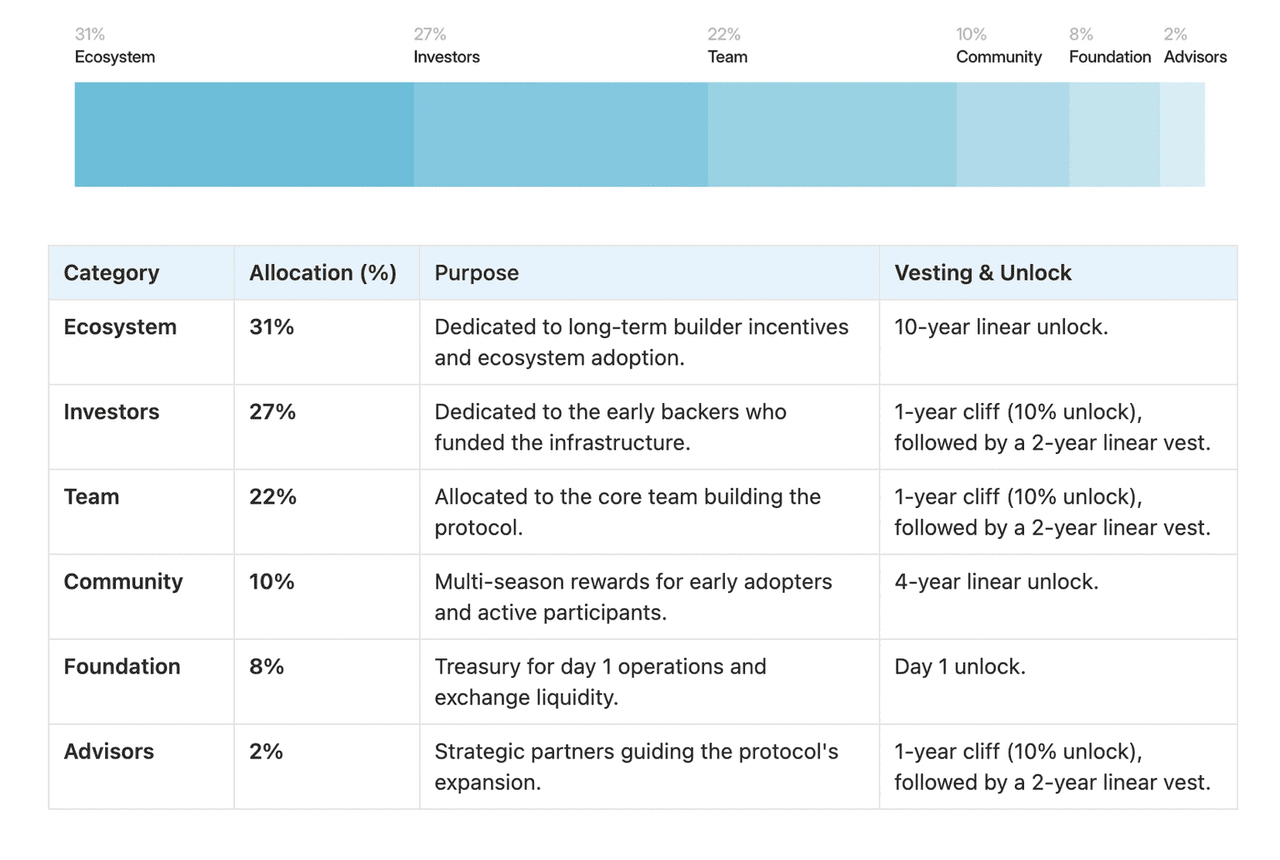
GWEI token allocation | Source: ETHGas docs
The $GWEI token is an ERC-20 token with a fixed total supply of 10 billion. The distribution is designed for long-term sustainability, with a significant portion of the supply dedicated to ecosystem growth and community rewards.
• Ecosystem (31%): Dedicated to long-term builder incentives and ecosystem adoption, subject to a 10-year linear unlock.
• Investors (27%): Allocated to early backers with a 1-year cliff, followed by an immediate 10% unlock and a 2-year linear vest.
• Team (22%): Allocated to core contributors building the protocol, following the same 1-year cliff and 2-year linear vesting schedule as investors.
• Community (10%): Multi-season rewards for early adopters and participants, released over a 4-year linear unlock.
• Foundation (8%): Treasury for Day 1 operations and exchange liquidity; these tokens were fully unlocked at launch.
• Advisors (2%): Strategic partners guiding expansion, subject to a 1-year cliff and 2-year linear vesting.
ETHGas vs. Traditional Ethereum Execution: Key Differences
| Metric | Standard Ethereum (L1) | ETHGas Infrastructure |
| Settlement Time | Around 12 Seconds | 50ms – 100ms (240x Faster) |
| Throughput Logic | Reactive (Mempool) | Proactive (Forward Market) |
| Gas Fee Experience | Volatile and Anxious | Gasless via Open Gas Rebates |
| Market Structure | Real-time Auction | Forward Commodity Market |
| Block Access | Public Mempool | Whole Block Sequencing Rights |
| Validator Income | Variable MEV/Tips | Predictable, Superior Yield |
Standard Ethereum execution operates on a best-effort model with a fixed 12-second heartbeat, where users compete in a blind, real-time auction (the mempool) to have their transactions included. This creates a high-latency environment where gas anxiety is the norm; if you don't bid high enough, your transaction hangs. ETHGas replaces this reactive chaos with a proactive logistics network, standardizing blockspace into a tradable commodity. Instead of waiting for a block to be minted, users can secure Forward Commitments, guaranteeing their transaction's placement before the block is even built.
The most significant shift is the transition from High-Latency Finality to Realtime Preconfirmations. While traditional execution requires a 12-second wait for state updates, ETHGas utilizes a Realtime Builder that streams preliminary state changes every 50–100ms. This 240x increase in speed allows decentralized applications to feel as responsive as centralized web servers. By moving the economic burden of gas from the end-user to the protocol via the Open Gas Initiative, ETHGas transforms gas from a volatile user tax into a predictable, back-end operational expense for developers.
ETHGas vs. Traditional MEV
Traditional Maximal Extractable Value (MEV) is often predatory, relying on searchers and builders to front-run or sandwich user trades within the dark corners of the mempool, leading to slippage and poor execution for retail. ETHGas flips this dynamic by commoditizing sequencing rights. Instead of builders capturing value through hidden extraction, ETHGas allows Validators to sell those rights transparently in an open market. This shifts the value from invisible exploitation to programmable yield, where traders pay for guaranteed execution outcomes rather than being at the mercy of MEV bots.
How to Trade ETHGas (GWEI) on BingX
Leverage BingX’s advanced trading tools to navigate the high-growth infrastructure sector with precision.
Buy or Sell GWEI/USDT on Spot Trading
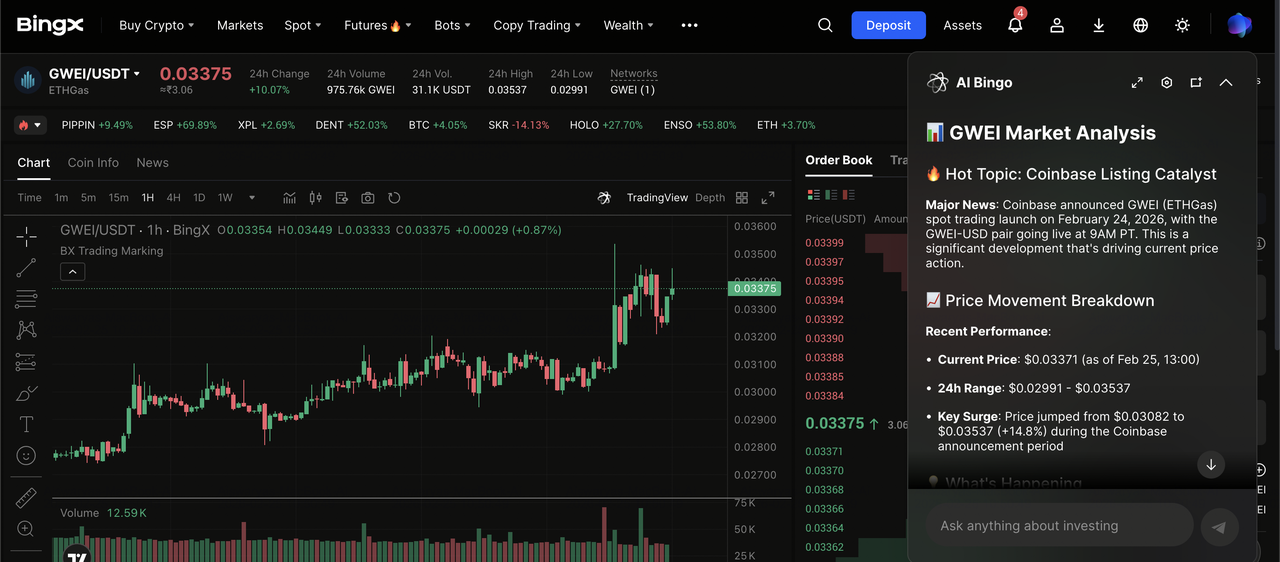
GWEI/USDT trading pair on the spot market featuring BingX AI insights
For investors betting on the long-term adoption of real-time blockspace, the BingX Spot market provides a secure entry point.
2. Find the Pair: Search for GWEI/USDT in the Spot market.
3. Execute: Use a Limit Order to accumulate near key support levels or a Market Order to capture immediate momentum.
Trade GWEI Perps in the Futures Market for Volatility
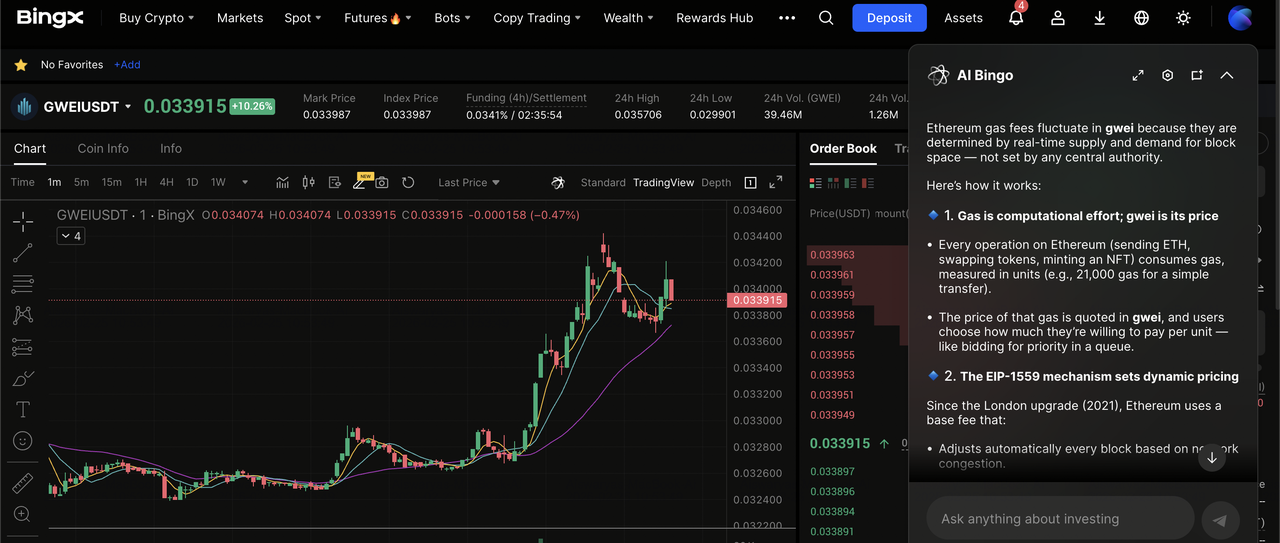
GWEI/USDT perpetuals on the futures market featuring BingX AI insights
Traders looking to capitalize on GWEI’s high-beta moves or hedge against macro-driven pullbacks can utilize perpetual contracts.
1. Transfer Margin: Move USDT into your Futures Account and search for the GWEI/USDT perpetual contract.
2. Analyze Trends: Watch the BTC/ETH price action; as an Ethereum Beta play, GWEI often amplifies ETH's upward moves.
3. Risk Management: Utilize Take-Profit/Stop-Loss orders to navigate the 10-year vesting schedule and potential sell pressure from early backers.
3 Key Considerations Before Trading GWEI
Before trading GWEI, it’s important to understand a few core factors that can significantly impact pricing, execution costs, and overall trading risk in fast-moving crypto markets.
1. High Correlation to Macro Markets: As of February 2026, GWEI currently maintains a 0.95 correlation with the S&P 500. Traders should monitor global equity sentiment, as GWEI often acts as a high-leverage proxy for broader market risk-on environments.
2. Vesting and Supply Inflation: While the exchange listing has driven short-term pumps, early backers have a low cost-basis. Monitor the 1-year cliff and subsequent 2-year linear vesting for team and investors to anticipate potential supply absorption.
3. Ecosystem Adoption Metrics: The long-term value of $GWEI is tied to the Gasless Flywheel. Watch for the number of protocols joining the Open Gas Initiative and the volume of blockspace sold on the marketplace. Stagnation in validator participation is a primary red flag for fundamental value.
Conclusion: Is ETHGas the End of Gas Anxiety?
ETHGas (GWEI) represents a strategic shift from the legacy best-effort execution model toward a structured, high-speed logistics network for Ethereum blockspace. By commoditizing gas and enabling sub-100ms preconfirmations, the protocol provides the foundational infrastructure necessary for high-frequency DeFi and seamless retail adoption. Through the Open Gas Initiative, it successfully abstracts the technical and financial friction of gas fees, repositioning them as a back-end operational cost for protocols rather than a barrier for end-users.
While ETHGas offers a robust solution to Ethereum’s latency and fee volatility, its long-term success depends on broad validator integration and sustained protocol participation. Investors should remain cognizant of the inherent risks associated with early-stage infrastructure projects, including high correlation with macro-market trends and potential sell pressure from scheduled token unlocks. As with any emerging crypto-asset, thorough due diligence is essential, as the protocol's fundamental value is intrinsically tied to the actual adoption of its real-time execution engine.
