

Lorenzo Protocol (BANK) is an institutional-grade on-chain asset management platform that packages complex yield strategies into tokenized products called On-Chain Traded Funds (OTFs). Instead of asking users to manage staking positions, quantitative strategies, and real-world asset exposure separately, Lorenzo bundles these into single, tradable tokens that mirror how traditional asset managers structure funds. The project describes its long-term goal as building "Wall Street on-chain," bringing fund structuring, net asset value calculation, and settlement into smart contracts.
Lorenzo launched its native BANK token in April 2025 on the BNB Smart Chain and has since expanded across the Bitcoin finance (BTCFi) and real-world asset (RWA) narratives that defined the 2025 and 2026 crypto cycles. The ecosystem has several key parts: BANK is the governance and utility token at the center of the protocol, veBANK is the vote-escrowed version created by locking BANK, USD1+ is the flagship yield OTF, and liquid Bitcoin products such as stBTC and enzoBTC extend the platform into Bitcoin yield. This guide explains what Lorenzo is, how the protocol works, how BANK tokenomics function, the main risks to consider, and how to trade BANK on BingX.
What Is Lorenzo Protocol (BANK)?
Source: Lorenzo Protocol
Lorenzo Protocol (BANK) is a decentralized finance platform built to bridge institutional-grade asset management and the on-chain economy. Its core innovation is the On-Chain Traded Fund model, which lets users invest in a single tokenized asset that represents a diversified basket of yield strategies. These strategies can include quantitative trading, DeFi yield, and exposure to tokenized real-world assets. The protocol automates parts of the operational process, including net asset value calculation and on-chain settlement, while some strategy execution and rebalancing may involve approved off-chain managers or custodial infrastructure. This allows investors to retain exposure through a composable token while gaining access to strategies they would otherwise struggle to access directly.
BANK is the governance and utility token of this system. Deployed on BNB Smart Chain, BANK can be locked to generate veBANK, a vote-escrowed token that grants greater voting power the longer it is locked. This design rewards long-term participants rather than short-term speculators. Lorenzo is backed by YZi Labs and positions itself around two of the strongest current narratives in Web3: real-world asset tokenization and Bitcoin yield innovation.
The core idea behind Lorenzo is simple: sophisticated asset management should be programmable, transparent, and accessible. BANK is the coordination asset that ties governance, incentives, and product access together across the platform.
Key components of the Lorenzo ecosystem include:
- BANK token: The governance and utility token on BNB Smart Chain, used for voting, staking, and access to protocol features.
- veBANK: The vote-escrowed token created by locking BANK, granting boosted voting power and influence over incentive distribution.
- USD1+ OTF: The flagship On-Chain Traded Fund that combines real-world asset yield, DeFi strategies, and quantitative trading into one token.
- Financial Abstraction Layer (FAL): The technical infrastructure that enables the creation and management of OTFs.
- stBTC and enzoBTC: Liquid Bitcoin products that let BTC holders earn yield while keeping their assets usable across DeFi.
How Does Lorenzo Protocol Work?
Lorenzo works as an on-chain asset management layer whose products, governance, and incentives are coordinated by the BANK token and a modular fund infrastructure connected to real yield sources.
- OTFs package strategies into single tokens: When a user invests in an On-Chain Traded Fund, their capital is allocated to specific yield strategies managed by smart contracts, approved managers, or a combination of on-chain and off-chain infrastructure. The protocol periodically reports net asset value, although an OTF token’s market price may not always reflect its underlying NAV in real time.
- The Financial Abstraction Layer manages funds: Lorenzo's FAL handles the creation, deployment, and settlement of OTFs, abstracting away the operational complexity of running tokenized funds.
- BTCFi unlocks Bitcoin liquidity: Through products like stBTC and enzoBTC, Bitcoin holders can earn yield and use tokenized representations of BTC across supported DeFi applications. Lorenzo has reported that stBTC is integrated with more than 30 protocols across over 20 blockchain ecosystems, although availability varies by product and network.
- veBANK aligns long-term governance: Locking BANK produces veBANK, giving holders voting power over product configurations, fee structures, ecosystem fund allocation, and emission adjustments. The exact voting power, lock periods, and benefits depend on Lorenzo’s current governance rules.
- Protocol revenue supports incentives: Lorenzo states that part of the revenue generated by its products may support ecosystem reward pools and incentive programs. However, holding BANK or veBANK does not necessarily provide an automatic or guaranteed claim on protocol fees.
What Is USD1+?
USD1+ is Lorenzo Protocol’s flagship On-Chain Traded Fund designed to generate yield from a combination of real-world asset income, DeFi strategies, and quantitative trading. Users receive a tokenized position representing exposure to the underlying strategy, while net asset value is reported periodically. Because some strategy execution may involve custodians, professional managers, or centralized trading infrastructure, USD1+ also carries counterparty, operational, liquidity, and settlement risks in addition to smart contract risk.
Lorenzo vs. Traditional DeFi Yield: What Are the Differences?
Lorenzo is often compared to standard DeFi yield platforms because both let users earn returns on deposited assets, but they approach the problem differently. Typical DeFi yield relies on lending pools or liquidity mining, while Lorenzo structures yield into fund-like products with periodic net asset value reporting, professional strategy design, and institutional framing.
|
Comparison |
Lorenzo Protocol |
Traditional DeFi Yield |
|
Core model |
On-chain asset management layer |
Individual lending, staking, or liquidity protocols |
|
Strategy structure |
Multiple strategies packaged into a single tokenized product |
Direct exposure to one primary yield mechanism |
|
Yield sources |
Quantitative trading, DeFi yield, and tokenized real-world assets |
Lending interest, staking rewards, or liquidity mining fees |
|
Product management |
Professionally structured strategies with periodic NAV reporting |
Users select and manage individual protocol positions |
|
Main advantage |
Diversified exposure with a lower operational burden |
Direct and transparent exposure to a specific yield source |
|
Main risk |
Additional strategy, custody, counterparty, and smart contract complexity |
Protocol, smart contract, liquidity, and market risk |
The main difference is that Lorenzo was designed as an asset management layer rather than a single-strategy protocol. For investors, the comparison comes down to positioning: standard DeFi yield suits users who want direct, transparent exposure to one mechanism such as lending or staking, while Lorenzo suits users who want diversified, professionally structured strategies wrapped into a single composable token. This structure can lower the operational burden for treasuries, DAOs, and retail users, but it also adds a layer of strategy and smart contract complexity to evaluate.
Read More: What Are the Top BTCFi (Bitcoin DeFi) Projects in 2026?
What Are the Lorenzo Protocol (BANK) Tokenomics?
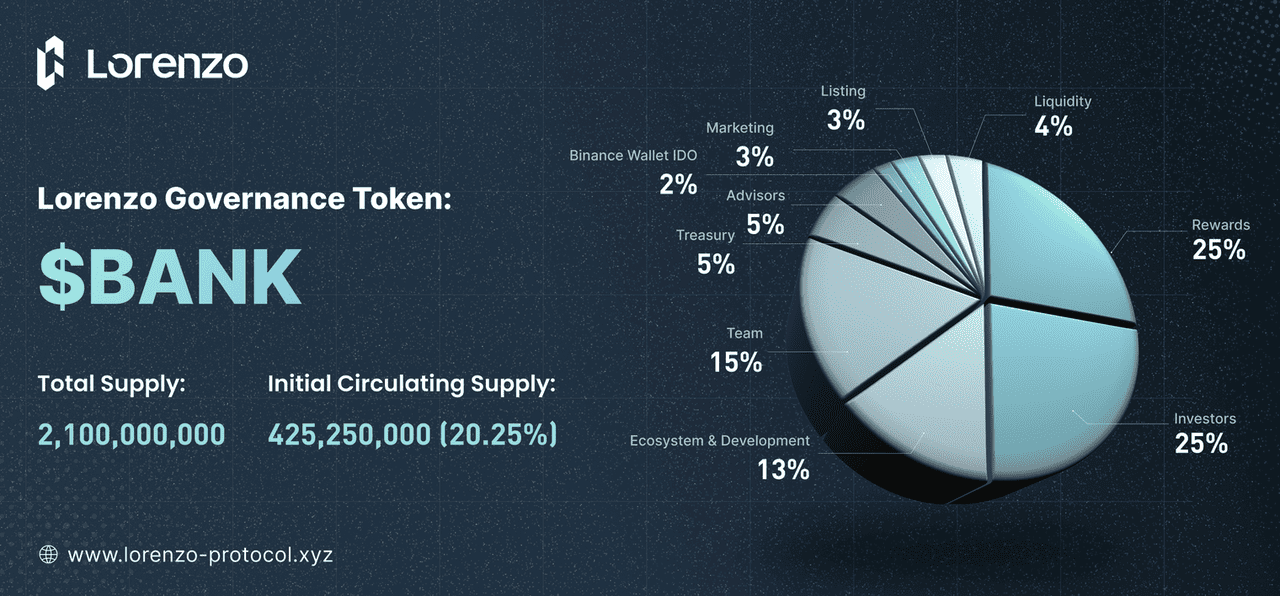
BANK tokenomics center on a fixed maximum supply, a vote-escrow governance model, and a gradual unlock schedule. BANK has a maximum supply of 2.1 billion tokens, with an initial circulating supply of 425.25 million BANK, equal to 20.25% of the maximum supply. Circulating supply expands over time as tokens allocated to rewards, investors, the team, ecosystem development, and other categories are distributed. This makes BANK different from fully circulating tokens, because future unlocks can add supply to the market
BANK Token Utility and Supply Mechanisms
BANK is the utility and governance asset of the Lorenzo ecosystem. Its utility spreads across governance, staking, incentives, and product coordination.
- Governance: BANK holders can lock tokens for veBANK to vote on product configurations, fee structures, ecosystem fund allocation, and emission adjustments.
- Staking and veBANK: Locking BANK produces veBANK, giving holders governance rights and influence over incentive distribution. The exact voting power, lock periods, and benefits depend on Lorenzo’s current governance rules.
- Rewards and incentives: A portion of protocol revenue may be used to sustain ecosystem reward pools and incentive programs. However, BANK or veBANK ownership does not necessarily create an automatic or guaranteed claim on protocol revenue.
- Product coordination: BANK acts as the coordination layer across USD1+, stBTC, enzoBTC, and future structured vaults, linking token demand to ecosystem activity.
- Ecosystem alignment: BANK ties together users, liquidity providers, developers, and institutional participants around the protocol’s long-term development.
BANK Token Distribution
Source: Lorenzo Protocol Docs
- Rewards: 25%, or 525 million BANK. This allocation supports user rewards, incentive programs, liquidity campaigns, and broader ecosystem participation.
- Investors: 25%, or 525 million BANK. This allocation belongs to early investors and represents a significant share of the maximum supply, making its vesting and unlock schedule important for future market supply.
- Team and Advisors: 20%, or 420 million BANK. This combines the team allocation of 15%, or 315 million BANK, and the advisor allocation of 5%, or 105 million BANK. These tokens are intended to align core contributors and advisors with Lorenzo’s long-term development.
- Ecosystem, Development, and Treasury: 18%, or 378 million BANK. This combines ecosystem and development at 13%, or 273 million BANK, with the treasury at 5%, or 105 million BANK. These tokens support product development, integrations, partnerships, protocol operations, and future governance-approved initiatives.
- Liquidity, Marketing, Listing, and Binance Wallet IDO: 12%, or 252 million BANK. This combines liquidity at 4%, or 84 million BANK, marketing at 3%, or 63 million BANK, listing at 3%, or 63 million BANK, and the Binance Wallet IDO at 2%, or 42 million BANK. These allocations support market liquidity, exchange access, token distribution, and promotional activities.
These percentages describe BANK’s maximum supply allocation and do not mean that all tokens were circulating immediately after launch. Investors should monitor official vesting schedules, reward emissions, treasury distributions, and token unlock announcements.
How to Trade Lorenzo Protocol (BANK) on BingX
BingX offers BANK through its futures market, letting active traders take long or short exposure to BANK price movements without holding the underlying token. If you want to buy and hold BANK directly instead, you can acquire USDT on BingX and swap it for BANK on a supported decentralized exchange on BNB Smart Chain.
Futures Trading: Trade BANK Price Movements
For active traders, BingX offers USDT-margined BANK perpetual futures. Futures allow users to trade BANK price movements without holding the underlying asset, with the flexibility to open long positions if they expect BANK to rise or short positions if they expect BANK to fall.
Because futures involve leverage, they can amplify both gains and losses. This approach is more suitable for traders who already have a clear risk plan and understand liquidation risk, particularly for an asset like BANK that is sensitive to token unlock events, BTCFi and RWA sentiment, and product adoption headlines.
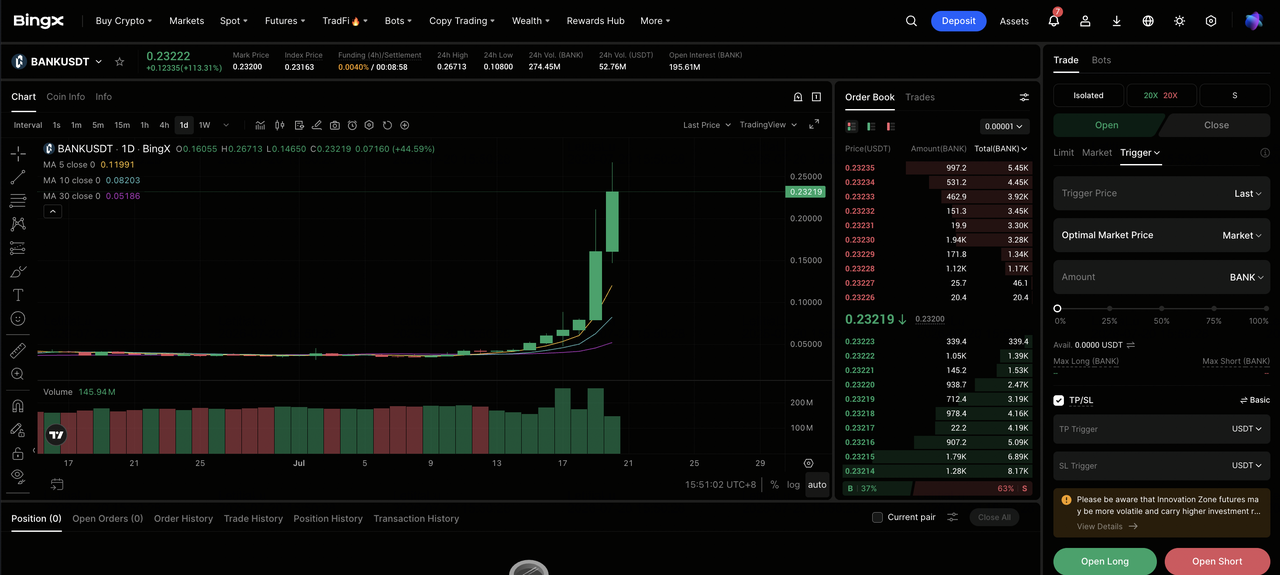
Step 1: Account setup and security. Sign up and log into your BingX account, complete the identity verification (KYC) required in your region, and enable two-factor authentication.
Step 2: Transfer collateral. Move USDT from your spot account into your futures account, where it will serve as margin.
Step 3: Select the contract. Search for the BANK-USDT perpetual contract.
Step 4: Set direction and leverage. Open long if you expect BANK to rise, or open short if you expect BANK to decline. Choose leverage based on your risk tolerance and position size.
Step 5: Execute the trade. Enter the order amount and choose a market or limit order depending on your trading plan.
Step 6: Manage risk. Set stop-loss and take-profit orders before or immediately after entering the position. Profit and loss settle dynamically in USDT.
Risks and Considerations Before Investing in Lorenzo Protocol (BANK)
Lorenzo has real products, institutional framing, and exposure to two strong narratives in BTCFi and RWA. However, BANK still carries risks tied to token supply, strategy complexity, market volatility, and execution.
- Token unlocks can pressure price: With circulating supply well below the 2.1 billion maximum, scheduled or accelerated vesting can add meaningful supply, and a 2026 proposal to shorten vesting highlighted how quickly liquid supply can grow.
- Whale concentration is high: A small number of wallets hold a large share of supply, which can amplify sharp price moves in either direction and increase volatility.
- Strategy and smart contract risk: OTFs bundle quantitative trading, DeFi, and RWA exposure, so users take on the combined risks of those strategies plus smart contract risk, even though the protocol has pursued audits.
- Adoption dependency: BANK's long-term value depends heavily on the growth of USD1+ and other products; if adoption stalls, demand may not offset supply expansion.
- Market volatility: Like most mid-cap DeFi tokens, BANK has shown large swings, including sharp rallies and deep drawdowns, and past performance does not guarantee future results.
Final Thoughts: Should You Invest in Lorenzo Protocol (BANK) in 2026?
Lorenzo Protocol is one of the more structured on-chain asset management projects, combining tokenized fund products, a vote-escrow governance model, and exposure to the BTCFi and RWA narratives. Its 2026 story is anchored by the growth of USD1+, expansion of Bitcoin yield products, and its positioning as an institutional-grade platform backed by named investors.
The key question for 2026 is whether Lorenzo can grow product adoption fast enough to absorb token supply expansion while maintaining trust in its strategies. Its fund infrastructure, governance design, and institutional framing set it apart from single-strategy yield protocols, but BANK is still exposed to unlock-driven supply pressure and broader market sentiment. For investors and traders, the most important metrics to watch are USD1+ adoption, protocol revenue, BTCFi product growth, unlock schedules, and governance decisions.
Related Reading
- What Are the Top BTCFi (Bitcoin DeFi) Projects in 2026?
- What Are the Top 10 DeFi Lending Protocols to Watch in 2026?
- What Is Liquidity Mining? A Guide to Earning Passive Income as a Liquidity Provider
- What is Babylon Protocol? A Complete Guide to Bitcoin Staking and the BABY Token Airdrop
- What Is Zest Protocol (ZEST) BTCFi Platform and How Does It Transform Bitcoin Into Collateral?
- Top 4 Yield Farming Strategies in DeFi to Watch in 2026
FAQs About Lorenzo Protocol (BANK)
1. What makes Lorenzo Protocol different from other DeFi projects?
Lorenzo packages complex yield strategies into single tokenized products called On-Chain Traded Funds, with real-time net asset value and institutional framing. It focuses on asset management infrastructure rather than a single lending or staking mechanism, and uses a veBANK governance model to align long-term participants.
2. What blockchain is BANK built on?
BANK is deployed on the BNB Smart Chain and follows the BEP-20 standard. Lorenzo has also expanded its products to additional networks such as Sui, and its Bitcoin products are accessible across multiple chains.
3. What is veBANK?
veBANK is the vote-escrowed version of BANK, created by locking BANK tokens. Holders receive governance rights and influence over protocol parameters and incentive distribution. The exact voting power, lock periods, and benefits depend on Lorenzo’s current governance rules.
4. Which wallets support BANK?
BANK can be stored in any BNB Smart Chain-compatible wallet, including MetaMask and other BEP-20 wallets. Users should always confirm they are using the correct network before transferring BANK to avoid loss of funds.
