

As the global internet transitions into an AI-driven, agentic era, the vulnerabilities of centralized data infrastructure have reached a breaking point. Megacorporations exercise total control over the world's data, walling off knowledge and exposing users to systemic security breaches, data monetization without consent, and arbitrary censorship. Even existing decentralized alternatives rely on rigid, contract-based blockchain architectures that struggle to scale and require continuous maintenance. Autonomi solves these structural issues by introducing a self-organizing, autonomous Layer 0 data fabric that treats storage as a native resource of the internet itself.
Conceived and built by MaidSafe, a pioneering deep-tech network provider researching peer-to-peer (P2P) systems since 2006, Autonomi turns the idle hard drive capacity of everyday connected devices into a global crowd-storage resource. By cutting out all middlemen, server administrators, and ongoing subscriptions, Autonomi shifts data ownership entirely back to the individual.
What Is Autonomi (ANT)?
Autonomi is a hyper-secure, serverless data platform that provides permanent storage and communication networks without human gatekeepers. At its core, the project addresses three fundamental challenges plaguing the modern web:
- Data Insecurity and Exploitation: Centralized clouds index, track, and expose user files; Autonomi implements local client-side encryption so that the network itself can never see what is stored.
- The Subscription Trap: Traditional cloud providers charge on a recurring gigabyte-per-month basis, leading to escalating costs and data loss if payments lapse; Autonomi introduces permanent storage for a single, one-time upload fee.
- Blockchain Scaling Bottlenecks: On-chain data storage is prohibitively expensive and slow; Autonomi uses a specialized Decentralized Ledger Technology (DLT) that operates completely without a blockchain, meaning the network grows faster and more efficient as more nodes join.
How Does Autonomi Work?
The protocol completely dismantles the standard client-server model. Instead of storing data on a centralized machine, Autonomi runs on a highly structured, self-healing architecture driven by simple, distributed rules.
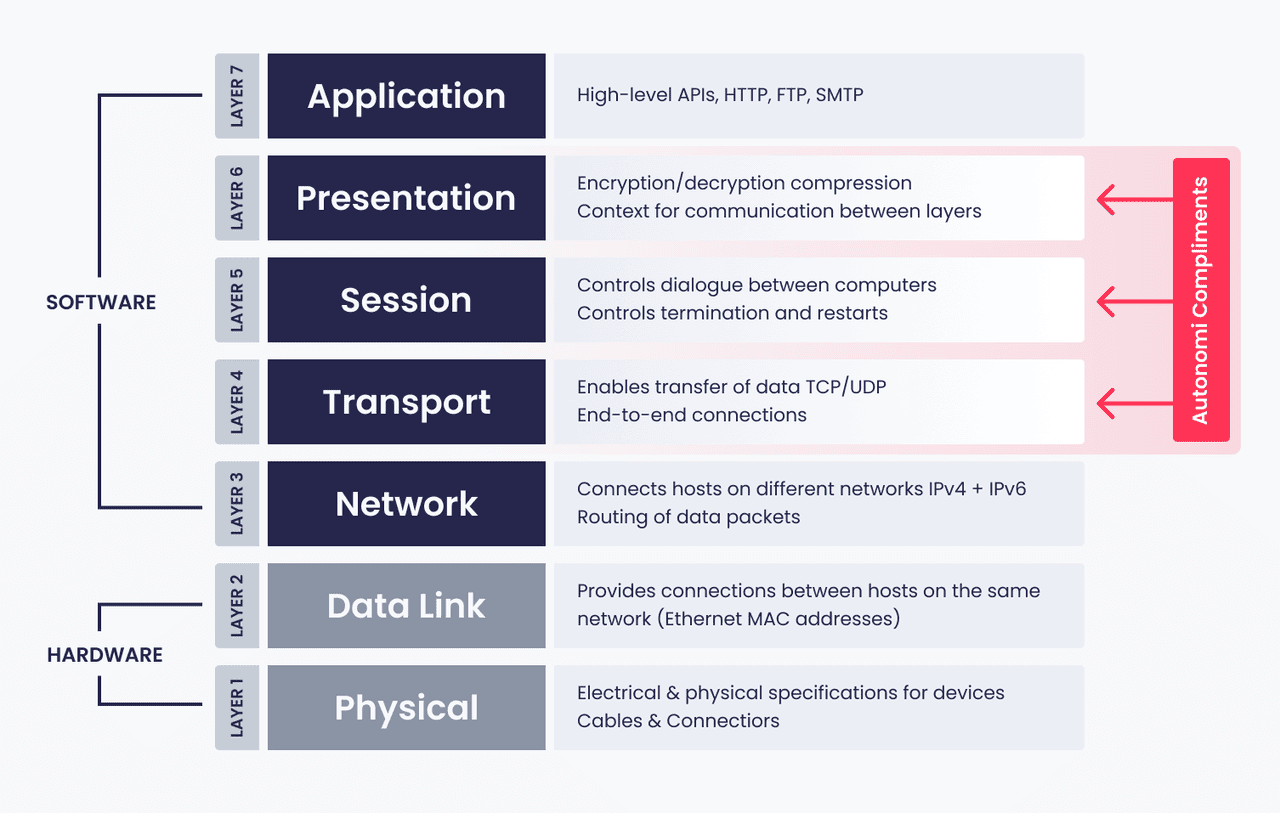
Technical architecture of Autonomi | Source: Autonomi docs
The Local Self-Encryption Primitive
Before a file ever touches the internet, it undergoes a local process known as Self-Encryption. The client-side software splits files into immutable chunks of max 4MB size. Each chunk is encrypted using a unique process where it is secured by its own cryptographic hash as well as the hashes of the preceding and succeeding chunks.
Concurrently, a private Data Map is created on the user's local device. This map acts as the single decryption key and spatial layout required to reassemble the fragments back into a readable file. Because the credentials never leave the device, passwords cannot be hacked, and data at rest is entirely zero-knowledge.
XOR Addressing and Kademlia DHT Routing
Once chunks are encrypted, they are hashed again to derive a unique 256-bit XOR network address. Autonomi utilizes a Kademlia-based Distributed Hash Table (DHT) framework built on the libp2p library.
Every node (a device supplying storage to the network) is also assigned a random XOR address. Chunks are automatically routed and stored on a small cluster of nodes closest in proximity to the chunk's address, known as a Close Group.
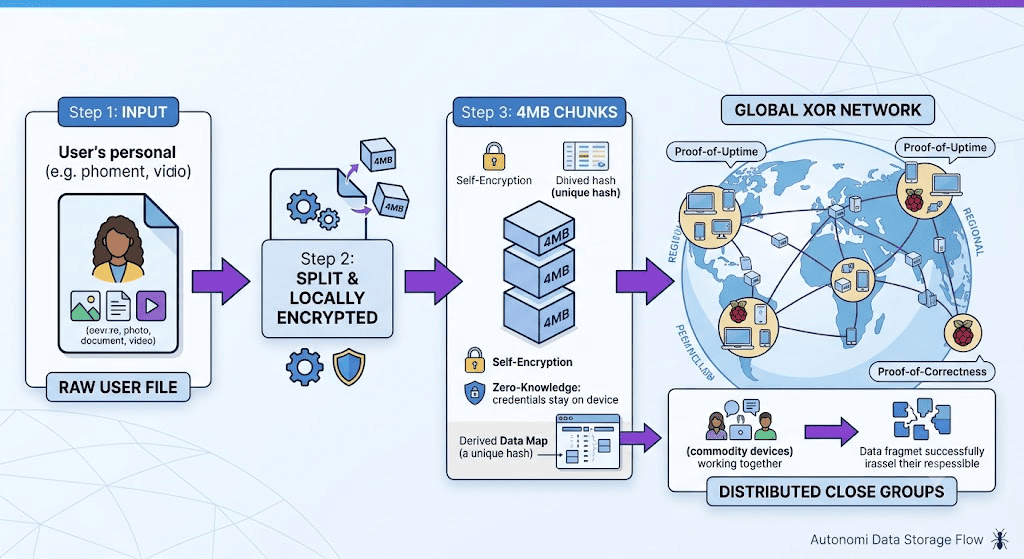
Close Group Autonomous Coordination
Autonomi operates like a biological self-organizing system, drawing heavy inspiration from the decentralized cooperation of ant colonies. Nodes within a Close Group monitor each other's uptime and validity without central oversight:
- Redundant Replication: To ensure high availability, the Close Group automatically replicates copies of each chunk across multiple geographic regions to protect against single points of failure.
- Proof-of-Uptime and Correctness: Nodes must actively prove they hold their designated data fragments. Malicious, unresponsive, or faulty nodes are instantly dropped by neighboring peers and replaced via automated data shuffling.
- Opportunistic Caching: When a file becomes highly popular, the network automatically caches extra copies across intermediate routing nodes, accelerating download speeds as demand rises, similar to BitTorrent seeders.
The Autonomi 2.0 Post-Quantum Stack
Launched in early 2026, Autonomi 2.0 represents a complete architectural evolution, separating the network into a modular, five-layer stack designed for a post-quantum threat model:
- Developer Interfaces: Driven by ant-client and ant-sdk with REST/gRPC endpoints supporting 15 programming languages.
- saorsa-transport: A custom transport layer featuring native QUIC NAT traversal, allowing standard home routers to host nodes seamlessly with zero configuration.
- saorsa-core: The foundation for Kademlia routing, trust mechanics, and EigenTrust reputation scoring.
- saorsa-pqc: An explicit post-quantum cryptographic layer protecting node identities and handshakes via NIST-standardized primitives: ML-KEM-768 for secure key exchanges and ML-DSA-65 for digital signatures, leaving zero classical fallback.
- The x0x Network: A parallel, post-quantum gossip network running alongside the storage layer, custom-built for machine-to-machine skill sharing, agent discovery, and real-time collaboration.
Autonomi vs. Alternative Data Infrastructure: Key Differences
|
Feature |
Autonomi (2.0) |
Filecoin / Storj |
Arweave |
AWS S3 Cloud |
|
Architecture |
Blockchain-less DLT |
Blockchain + Smart Contracts |
Blockweave |
Centralized Servers |
|
Coordination |
Fully Autonomous |
Intermediary Consensus |
PoW Mining |
Centralized Admin |
|
Pricing Model |
One-Time Fee Forever |
Dynamic Leasing Contracts |
Upfront Endowments |
Recurring Subscription |
|
Egress Fees |
Zero ($0.00) |
Variable |
Zero |
High Bandwidth Costs |
|
Node Hardware |
Commodity (64GB Limit) |
Enterprise / High Capital |
Heavy Compute / Storage |
Proprietary Data Centers |
|
Quantum Resistance |
Native Layer 0 (ML-KEM) |
None |
None |
None |
While competitor protocols utilize smart contracts to negotiate storage leases between buyers and sellers, they introduce transaction fees, complex renewals, and severe scaling overhead. Autonomi operates entirely without contracts or data-tracking ledgers, preserving unconditional user anonymity while allowing the system to scale infinitely as data density dilutes across millions of nodes.
What Can You Build on Autonomi?
Autonomi is not just a decentralized backup drive but also a foundational ecosystem built to host the next iteration of the web. By removing centralized infrastructure limits, developers can deploy applications where users retain true sovereign custody of their data.
Ecosystem blueprints span a massive array of use cases: private-by-design storage apps (clones of zero-knowledge iCloud/Google Drive), censorship-resistant media publishing platforms that can never be torn down by centralized authorities, immutable legal and compliance archives with built-in version histories, and Private AI Context Vaults, where personal AI memories, chats, and vector data maps are stored securely without platform lock-in.
By marrying client-side self-encryption with the bulletproof infrastructure of a self-healing, post-quantum network, Autonomi delivers the final missing piece of a truly open, resilient, and un-Zucked internet.
What Is Autonomi (ANT) Tokenomics?
The economic framework of Autonomi relies on a carefully modeled relationship between declining asset costs and accelerating global data generation.
The Mathematics of Perpetual Storage
Autonomi proves that a one-time payment can sustain data forever. The model balances two main variables:
- Exponential Cost Decline: The price of raw physical resources (storage disk space, bandwidth, compute) decreases exponentially over time according to historical trends:
- RP(t) = RP_0 * e^(-λt)
- Exponential Volume Growth: Human and machine data upload rates grow exponentially over time:
- U(t) = U_0 * e^(kt)
By taking the cumulative data volume C(t), Autonomi ensures that total network income always exceeds total resource maintenance costs:
P(t) * U(t) >= C(t) * RP(t)
As long as global data generation expands and hardware becomes cheaper, the cost to store a file approaches zero, allowing the one-time fee to permanently absorb ongoing node rewards while the entry price itself drops exponentially over time.
ANT Token Supply and Distribution Blueprint
The Autonomi Network Token (ANT) serves as the core utility asset driving this supply-and-demand loop. Initially launched on the Ethereum Layer-2 network Arbitrum One to inherit a massive ecosystem of wallets and tools, ANT will eventually migrate 1:1 to a blockchainless network-native currency upgrade.
ANT has a strict, hard-capped maximum supply of 1,200,000,000 (1.2 Billion) tokens, broken down into the following structural allocations:
|
Category |
Allocation (%) |
|
Legacy Token Holders (MAID/eMAID Migrations) |
38.00% |
|
Autonomi Foundation (50-Year Vesting Schedule) |
24.00% |
|
Node Operator Emissions Pool |
20.00% |
|
MaidSafe Shareholders Allocation |
18.00% |
- Legacy Token Holders (38%): Allocated for 1:1 migrations from original MaidSafeCoin (OMNI MAID / eMAID) and alpha testing incentives.
- Autonomi Foundation (24%): Locked inside a smart contract vesting over a 50-year horizon (20% Year 1, 34% Years 2–5) to fund developer grants, core protocol research, and market liquidity.
- Node Operator Emissions Pool (20%): A pool of 240,000,000 tokens designed to subsidize early node rewards and stabilize initial pricing mechanics.
Strategic 2026 Update: Node emissions were deliberately paused in January 2026 with 97.06% (over 232 million tokens) remaining intact. These funds are reserved to act as fuel for autonomous AI agents navigating the network natively via the x0x layer, completely bypassing legacy fiat rails.
- MaidSafe Shareholders (18%): Claimable via distributed NFTs to transition MaidSafe into a fully non-profit Foundation structure.
The Storage Payment Cycle
When a client requests a file upload, they execute a store-cost query. Nodes within the destination Close Group provide a localized quote normalized by the live market value of ANT.
Once the user pays the one-time fee, 82% of the payment goes directly to the storing node, while the remaining 18% is channeled into the Node Network Reserve. This reserve safeguards the network during data volatility cycles; if the reserve reaches 10% of the max supply, further inflows are reduced to 2% and automatically burned, creating immediate deflationary pressure.
How to Trade Autonomi (ANT) on BingX
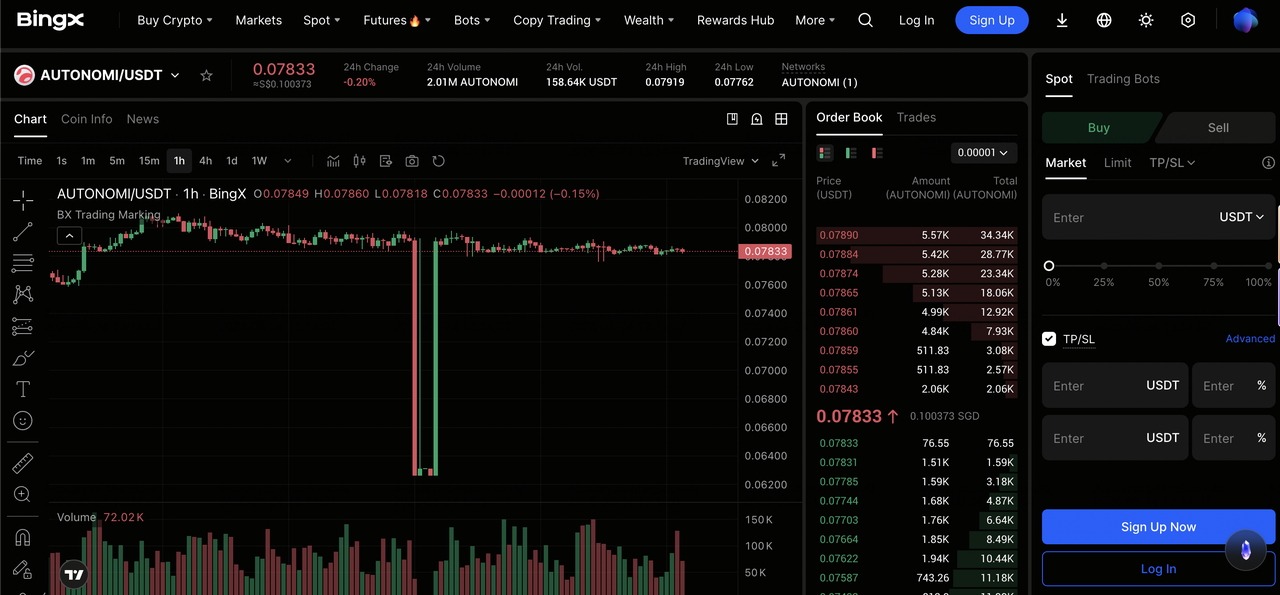
AUTONOMI/USDT trading pair on BingX spot market
You can utilize the highly optimized BingX Web3 AI trading platform to track real-time liquidity distributions and efficiently manage your positions. Follow this concise step-by-step guide to trade the AUTONOMI/USDT trading pair on the spot market:
- Access the Spot Terminal: Log into your BingX account, hover over the Spot navigation header, select Spot Trading, and enter AUTONOMI in the asset search bar to open the dedicated AUTONOMI/USDT interface.
- Transfer or Deposit Collateral: Ensure your fund account has an adequate balance of Tether (USDT). If needed, execute an instant, zero-fee internal transfer from your futures account to your spot wallet.
- Configure Order Parameters: Navigate to the order execution panel on the right side of the layout and choose Limit Order to specify a precise manual target entry price, or Market Order to fill your allocation immediately at the best available order-book depth.
- Execute and Monitor: Enter the total quantity of USDT or AUTONOMI you wish to exchange, verify your input metrics, and click Buy AUTONOMI or Sell AUTONOMI to route the transaction to the matching engine.
5 Critical Considerations Before Investing in Autonomi (ANT)
Before allocating capital or setting up network infrastructure, keep these primary risk parameters in mind:
- Transition to Native Infrastructure: ANT currently runs on the Arbitrum blockchain. The eventual migration to a native, blockchainless DLT architecture will introduce complex cross-network token swaps.
- Hardware & Uptime Commitments: While consumer hardware limits are low, as nodes require a maximum of 64GB of space, nodes must maintain consistent uptime. If your home internet experiences frequent dropouts, your node will be penalized and cut from reward distributions.
- The Agentic Adoption Curve: The allocation of the remaining 232 million emission tokens hinges heavily on the adoption of the x0x agent-to-agent gossip network. If AI agent coordination lags, this pool's utility could stall.
- Vesting Supply Extensions: The Autonomi Foundation's 50-year release schedule is front-loaded, with substantial tranches entering circulation within the first five years to fund global ecosystem growth.
- Market Volatility vs. Utility Pricing: Upload pricing is determined algorithmically by real-time supply and demand. Severe fluctuations in the market price of $ANT will cause the fiat-equivalent cost of data uploads to vary dynamically.
Final Thoughts: Is Autonomi (ANT) a Good Investment?
Autonomi introduces a structurally distinct approach to decentralized infrastructure by removing both the client-server model and traditional blockchain dependencies. By relying on client-side self-encryption, localized XOR addressing, and a one-time upfront payment model sustained by hardware cost efficiencies, the protocol presents a highly scalable alternative for permanent data storage and machine-to-machine communication. Its recent 2.0 architectural evolution further integrates post-quantum cryptographic layers and the x0x agent network, positioning the platform as a foundational data fabric designed specifically for the requirements of an autonomous digital economy.
Ultimately, the long-term viability of the ecosystem hinges on organic network usage, developer integration across its 15 supported languages, and the seamless future migration from the Arbitrum network to a native blockchainless currency.
Risk Reminder: Engaging with decentralized protocols, utility token systems, and distributed node hosting involves inherent technical, operational, and market risks. Users and node operators should carefully evaluate network uptime dependencies, protocol updates, and structural tokenomics factors before allocating capital or computing resources. BingX assumes no responsibility for external deployment decisions or financial outcomes.
Related Reading
- What Are the Top 10 AI Agent Crypto Projects of 2026?
- What Are the Top 10 Base AI Agent Projects to Know in 2026?
- Top 7 AI Agent Tokens on Solana to Watch in 2026 Amid the Rise of the Machine Economy
- What Is AI Rig Complex (ARC) Ryzome Universal App Store for AI Agents and How to Buy ARC?
- What Is DeAgentAI (AIA) and How Does This New AI Infrastructure Work?
