



Wells Fargo (WFC) provides deposits, lending, investment services and corporate banking for households and businesses. Its large customer franchise supplies recurring interest income, while expanded commercial lending and investment banking create opportunities to earn more from existing relationships. Loan pricing, deposit costs and credit performance determine whether balance-sheet growth translates into sustainable earnings and stronger per-share returns.
The latest quarter showed stronger lending income while higher credit costs limited earnings conversion. Wells Fargo Q3 2026 revenue rose 2% to $21.87 billion, with net interest income increasing 5%. EPS reached $1.87, while credit provisions rose to $1.029 billion. The Q4 test is whether approximately $13 billion in interest income can support better profitability.
The WFC stock forecast for 2026 now centers on two competing views:
- The lending recovery case: Growing customer loans and stable funding costs lift interest income, while lower operating expenses allow more revenue to reach shareholders.
- The margin pressure case: Higher deposit prices and credit provisions absorb lending growth, leaving weaker fee income and capital needs constraining returns on expanding assets.
This guide breaks down the WFC stock forecast, 2026 price scenarios, key risks and analyst outlooks, drawing on Wells Fargo’s October 13 earnings release, presentation, quarterly supplement and market data through October 21, plus how to buy WFC stock on BingX TradFi with USDT or USDC.
Top 5 Things for Wells Fargo Investors to Know in October 2026
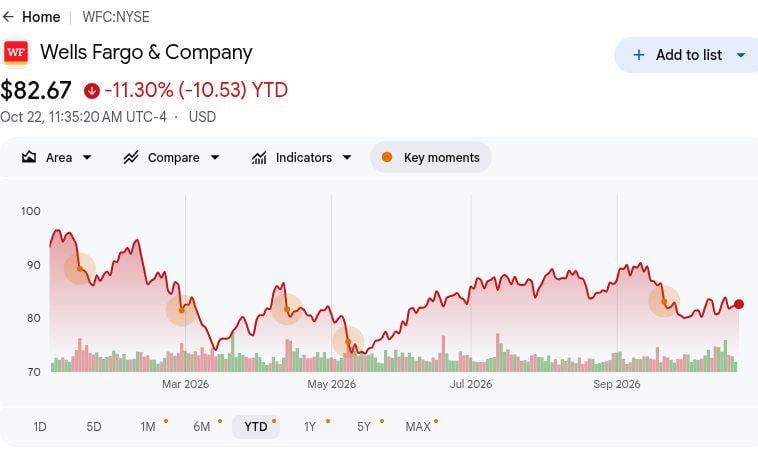
- WFC closed at $82.42 on October 21, down 11.57% YTD: Shares remain below their opening-year level, making the $105 bull scenario dependent on improved lending economics. Continued gains require deposit-funded asset growth to strengthen returns, rather than relying on balance-sheet expansion alone.
- Q3 revenue increased to $21.87 billion from $21.44 billion a year earlier: Revenue also fell from $22.62 billion in Q2, showing sequential weakness. However, interest income contributed to growth, making it important to distinguish lending expansion from a broader fee recovery.
- Average loans and deposits both increased 11% as customer activity expanded: The Q3 balances and stronger commercial lending provide evidence of customer demand. Loan yields, deposit pricing, and credit performance will determine how much of that scale translates into sustainable per-share earnings.
- Q4 guidance sets a net interest income delivery test: Management targeted approximately $13 billion for the next quarter, compared with $12.52 billion in Q3. Stable funding costs and sustained loan demand will determine whether that outlook supports sustained earnings and capital generation.
- A 10.0% CET1 ratio supports continued lending and capital management: Wells Fargo reported $134.6 billion in CET1 capital alongside a lower diluted share count. This provides support for financing customers, although maintaining credit quality and capital efficiency will be essential to long-term shareholder value.
What Is Wells Fargo (WFC)?

Wells Fargo (WFC) is a diversified financial services company providing banking, investment and lending services to individuals, businesses and institutions. Its four operating segments are Consumer Banking and Lending, Commercial Banking, Corporate and Investment Banking, and Wealth and Investment Management. The bank earns interest on loans and securities, alongside advisory, brokerage, payments and investment-banking fees. Profitability depends on the spread between asset yields and funding costs, the efficiency of its operations, and the credit performance of customers borrowing across its businesses.
Wells Fargo’s growth strategy focuses on expanding customer lending, strengthening investment banking, and improving operating efficiency. Its expanded Google Cloud relationship uses Google Agentspace to deploy agentic AI tools supporting employees and customer service. In June 2026, Wells Fargo also became a preferred mortgage lender for ICON, connecting home financing with the company’s 3D-printed housing projects. With average loans and deposits both growing 11% in Q3, these initiatives aim to deepen customer relationships and support revenue growth while technology investment improves the cost of delivering financial services.
Read More: Top Financial Services and Fintech Stocks to Buy in 2026 Amid Agentic AI, Stablecoin Rails Shift
Wells Fargo (WFC) Q3 2026 Earnings Overview: Lending Income Lifts EPS Despite Higher Credit Costs
Wells Fargo reported Q3 2026 revenue of $21.87 billion, up 2% year over year but down from $22.62 billion in Q2, driven by higher net interest income. Diluted EPS rose 13% to $1.87, while credit provisions increased to $1.029 billion and noninterest expense declined 1% to $13.74 billion. With average loans and deposits each growing 11% and Q4 net interest income guided near $13 billion, future earnings depend on converting customer growth into stronger margins without a disproportionate increase in credit costs.
|
Financial Metric |
Guidance / Consensus |
Reported / Actual |
Surprise |
|
Total revenue |
$21.436B Q3 2025 |
$21.870B |
Improved. Up 2% YoY. |
|
Net interest income |
$11.950B Q3 2025 |
$12.517B |
Expanded. Up 5% YoY. |
|
Diluted EPS |
$1.66 Q3 2025 |
$1.87 |
Higher. Up 13% YoY. |
|
Net income |
$5.589B Q3 2025 |
$5.951B |
Improved. Up 6% YoY. |
|
Noninterest expense |
$13.846B Q3 2025 |
$13.743B |
Lower. Down 1% YoY. |
|
Credit provisions |
$681M Q3 2025 |
$1.029B |
Higher. Up $348M. |
|
ROTCE |
15.2% Q3 2025 |
16.30% |
Improved. Up 1.1 points. |
|
Q4 net interest income |
New forward guidance |
~$13B |
Outlook. Next-quarter target. |
- Q3 revenue increased 2% to $21.87 billion. Revenue declined 3% sequentially despite annual growth, reflecting weaker noninterest income and trading activity. Sustained customer lending and fee generation will be important to maintaining earnings momentum.
- Net interest income rose 5% to $12.52 billion. Higher loan balances and fixed-rate asset repricing drove performance across the lending franchise. Continued loan demand and deposit growth could support earnings, although funding costs and asset yields influence profitability.
- Diluted EPS rose 13% to $1.87 despite higher provisions. Operating expenses declined 1% to $13.74 billion, while credit provisions reached $1.029 billion. Lending income supported profitability, but expense efficiency will be important as customer credit demand expands.
- Wealth client assets reached $2.45 trillion. Assets increased 11% annually, supporting 12% revenue growth in Wealth and Investment Management during the quarter. Expanding client investments strengthens recurring fee revenue and reduces reliance on market-sensitive lending and trading activity.
- Q4 net interest income guidance reached approximately $13 billion. The outlook implies sequential growth, with delivery depending on customer lending and deposit pricing. Replenishing customer deposits, maintaining loan quality, and controlling expenses will be important to future earnings growth.
Wells Fargo (WFC) 2026 Investment Outlook: $105 Bull Case vs. $72 Bear Case
Wells Fargo’s 2026 outlook depends on whether expanding customer loans can generate higher earnings after funding and credit costs. Q3 interest income improved, but the 10.0% CET1 ratio and rising provisions make returns on additional assets central to valuation. The following editorial scenarios reflect how lending economics and operating efficiency could shape performance through year-end.
The Bull Case: Loan Growth and Cost Control Push WFC Toward $105
More profitable customer lending would lift interest income while operating efficiency turns that revenue into stronger earnings. Q3 net interest income reached $12.52 billion and expenses declined 1%, despite higher technology spending. Sustained deposit-funded growth would improve the earnings contribution from additional loans without requiring a matching increase in overhead or credit provisions.
The $105 scenario would gain support if Q4 interest income exceeds the approximately $13 billion guide and credit charges stabilize. Better lending margins and continued expense control would need to lift returns above the latest quarter's level.
The Base Case: Steady Lending Keeps WFC Between $88 and $96
Continued lending growth could sustain earnings even if funding and credit costs absorb part of the additional revenue. Q3 average loans and deposits both increased 11%, while provisions rose to $1.029 billion. Customer expansion would support interest income and fees, but limited margin improvement would leave returns dependent on expense control and adequate credit pricing.
An $88 to $96 range would fit delivery near the annual interest income outlook, stable loan quality and modest fee growth. Lower funding costs could support the upper end, while additional credit provisions would limit the benefit of customer expansion.
The Bear Case: Funding Pressure and Credit Costs Pull WFC Toward $72
Higher funding costs and worsening credit performance would reduce the profit retained from a growing loan book. Average deposit costs rose to 1.56% in Q3, while credit provisions increased from $681 million a year earlier. If customer borrowing weakens and delinquency losses rise, lending expansion could consume capital without producing a proportionate improvement in earnings.
The $72 scenario would become more likely if interest income misses the Q4 outlook while credit provisions continue rising. Weaker fee generation would then provide less support for earnings, reducing the capital available for distributions and a valuation recovery.
WFC Stock Price Forecasts for 2026 By Wall Street Analysts
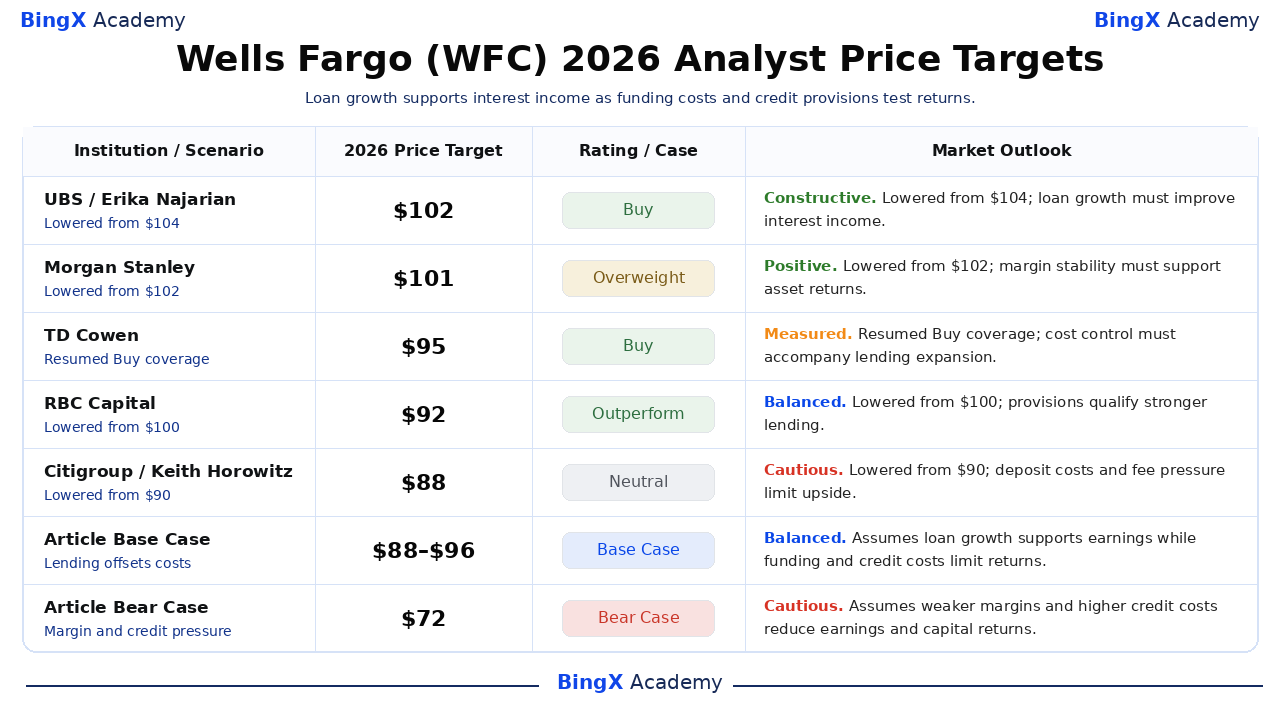
The following Wells Fargo analyst actions provide twelve-month reference points rather than guaranteed December 2026 prices. Several firms reduced targets around the latest quarter, despite retaining positive ratings. The article’s $105 bull scenario, $88 to $96 base range and $72 bear scenario are separate editorial cases tied to the operating conditions discussed above.
|
Institution / Scenario |
2026 Price Target |
Rating / Case |
Market Outlook |
|
UBS |
$102 |
Buy |
Constructive. October 5, 2026: Lowered from $104; maintained Buy. Editorial view: Deposit-funded loan growth must improve net interest income. |
|
Morgan Stanley |
$101 |
Overweight |
Positive. October 14, 2026: Lowered from $102; maintained Overweight. Editorial view: Margin stabilization must support returns on growing assets. |
|
TD Cowen |
$95 |
Buy |
Measured. October 8, 2026: Resumed Buy coverage at $95. Editorial view: Cost control can support earnings as lending capacity expands. |
|
RBC Capital |
$92 |
Outperform |
Balanced. October 14, 2026: Lowered from $100; maintained Outperform. Editorial view: Higher credit provisions qualify stronger loan growth. |
|
Citigroup |
$88 |
Neutral |
Cautious. October 14, 2026: Lowered from $90; maintained Neutral. Editorial view: Deposit pricing and weaker fee income can limit near-term gains. |
|
Article Base Case |
88–96 |
Base Case |
Balanced. Editorial December 2026 scenario. Assumes lending growth offsets funding and credit pressure. |
|
Article Bear Case |
$72 |
Bear Case |
Cautious. Editorial December 2026 scenario. Assumes higher funding and credit costs reduce earnings. |
How to Buy Wells Fargo (WFC) Stock on BingX
Buy and hold Wells Fargo shares through BingX Stocks Trading using USDT or USDC, subject to listing and account eligibility. Wells Fargo offers exposure to consumer lending, commercial banking, investment services and corporate financing. Eligible users can size holdings according to their investment goals without using leverage or paying perpetual funding fees.
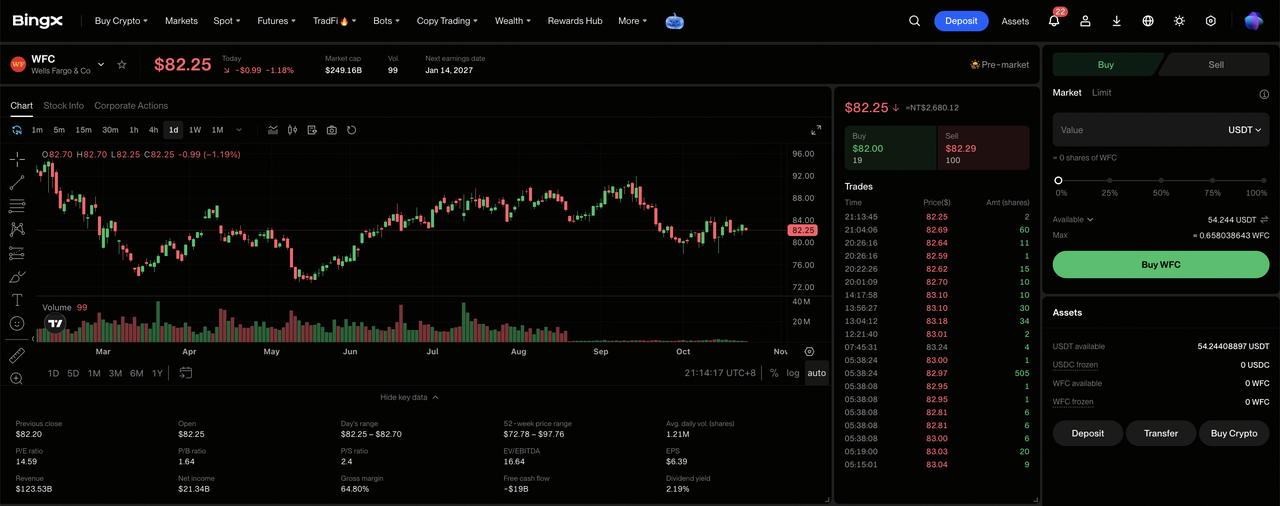
Step 1: Access BingX Stocks Trading. Sign up or log in to BingX, complete the required identity verification, and navigate to “TradFi > Stocks”. Accept the Stock Trading Risk Disclosure if accessing the product for the first time.
Step 2: Prepare USDT or USDC. Ensure your Spot Account has sufficient funds for the purchase. Transfer USDT or USDC from your Fund Account or Wealth Account if needed. Review the selected stock’s minimum order amount and fractional eligibility before choosing the investment size.
Step 3: Select Wells Fargo (WFC). Open the Stocks market, search for Wells Fargo (WFC), and confirm that the share is available to your account. Review the company identity, current share price, trading session and available order types.
Step 4: Buy Wells Fargo Shares. Select “Buy”, enter an allowed investment amount or share quantity, and choose a supported market or limit order. Market orders use available prices during supported sessions, while limit orders require the specified price or better and sufficient liquidity to execute.
Step 5: Review and Manage Your Holdings. Open “Stocks > Positions” to monitor your WFC shares and unrealized profit or loss. Use All Orders to review transactions or sell shares when needed. T+1 settlement generally affects when sale proceeds become withdrawable, rather than when purchased shares can be sold.
Top 5 Risks to Watch for Wells Fargo Investors in 2026
Wells Fargo’s large deposit franchise, diversified banking businesses, and expanding customer relationships support its earnings outlook. However, funding costs, credit quality, fee generation, and capital requirements could pressure profitability and shareholder returns.
- Weaker loan demand could pressure revenue: Q3 average loans increased 11%, supported by commercial financing and consumer borrowing. Lower loan volumes or weaker customer balances could reduce interest income and returns on the expanded asset base.
- Rising deposit costs could constrain margins: Q3 average deposit costs reached 1.56%, five basis points above Q2. Higher funding expenses and technology costs could weaken profitability if lending income and recurring fees grow more slowly.
- Banking delays could limit fee growth: Q3 investment banking revenue reached $611 million, but fees declined 3% sequentially despite stronger annual activity. Delayed mergers, debt underwriting, or equity transaction completions could reduce future revenue visibility.
- Capital requirements could restrict shareholder returns: Wells Fargo reported a 10.0% CET1 ratio during Q3, while expanding lending required substantial capital. Higher credit provisions or regulatory capital needs could constrain future distributions and per-share earnings growth.
- Weaker returns could pressure valuation: Wells Fargo’s Q3 ROTCE reached 16.3%, supported by stronger lending income and efficiency gains. Slower lending, weaker fee performance, or rising credit costs could reduce returns and trigger share-price declines.
Final Thoughts: Should You Invest in Wells Fargo in 2026?
Wells Fargo’s $12.52 billion in quarterly net interest income and 16.3% ROTCE demonstrate its ability to earn more from expanding customer relationships. Commercial lending, consumer banking, and wealth-management fees provide earnings support while technology and operating initiatives create opportunities to improve efficiency. Sustaining that growth will depend on controlling deposit costs and maintaining sound loan performance.
The $105 bull case assumes stronger lending margins, stable credit charges, and continued cost efficiency. The $88 to $96 base case reflects steady customer growth, while the $72 bear case accounts for funding pressure and weaker credit. With WFC closing at $82.42 on October 21, investors should watch whether lending expansion produces sustainable returns on capital.
Risk Reminder: Wells Fargo’s large customer franchise does not eliminate investment risk. Higher deposit costs, worsening loan losses, or weaker fee income could reduce earnings and shareholder returns. Investors should assess valuation, credit performance, and their risk tolerance before buying WFC shares.
Related Reading
- Top Financial Services and Fintech Stocks to Buy in 2026 Amid Agentic AI, Stablecoin Rails Shift
- JPMorgan Chase (JPM) Price Prediction 2026: Can Rising Interest Income Drive JPM Toward $425?
- Goldman Sachs (GS) Price Prediction 2026: Can Record Equities Revenue Lift GS Toward $1,150?
- BlackRock (BLK) Price Prediction 2026: Can Strong ETF Demand Push BLK Toward $1,400?
- Bank of America (BAC) Price Prediction 2026: Can Wealth Management Growth Lift BAC Toward $68?
