
In late June 2026, UiPath (NYSE: PATH) sits at a pivotal operational crossroads. Trading at $10.53 after a solid 6.04% pop on June 29, the PATH stock remains deeply bruised, down over 33.69% year-to-date and caught in a wider software-as-a-service (SaaS) valuation correction.
While public equity markets are heavily punishing pure-exposure artificial intelligence plays that lack clear execution, UiPath is flashing concrete signs of financial maturity. The enterprise software specialist recently achieved its first full year of GAAP profitability and delivered a robust first-quarter earnings beat. Yet, a cloud of skepticism hangs over the company: can its legacy Robotic Process Automation (RPA) engine truly absorb the paradigm shift to autonomous AI agents, or will modern tech titans completely erode its customer base?
This comprehensive guide breaks down the UiPath stock forecast for the remainder of 2026, drawing from recent earnings metrics, institutional fund positioning, structural index flows, and product updates. You can also discover how to trade UiPath (PATH) stock futures on BingX TradFi with USDT collateral.
Top 5 Things UiPath (PATH) Traders to Track
As UiPath attempts to rewrite its investment narrative from a basic automation tool to an elite AI orchestration layer, market participants should anchor their strategies to these five core drivers:
- The Maestro Case Launch: Introduced mid-June 2026, Maestro Case is an AI-native case management architecture designed to handle complex, long-running workflows across people, applications, and AI agents. Early enterprise adopters report a 60–80% reduction in average handling times, indicating direct competitive pressure on legacy systems like ServiceNow (NOW) and Pegasystems (PEGA).
- The $500 Million Capital Return Support: To actively combat equity depreciation, UiPath's board authorized a $500 million Class A stock buyback program. The firm aggressively deployed capital in early 2026, purchasing 20.4 million shares at an average price of $11.47 through April 30, and another 2.4 million shares at $9.63 in early May, reinforcing a psychological floor under the float.
- Decelerating Revenue vs. Massive ARR: UiPath turned in Q1 revenue of $418.4 million, a 17.3% year-over-year expansion. However, long-term projections point toward an underlying challenge. Forward-looking 12-month consensus growth is expected to flatten to around 7.1% to 7.7%, well below the company’s five-year compounded annual growth rate (CAGR) of 19.7%. Despite this, the firm maintains a huge $1.90 billion Annual Recurring Revenue (ARR) baseline.
- The Russell Semi-Annual Rebalancing Flow: Volatility surged in late June as FTSE Russell implemented its new twice-a-year U.S. index rebalancing framework. UiPath experienced a dramatic liquidity spike on June 26, trading 66.3 million shares, 186% of its typical 65-day average volume, sparked by indexing adjustments hitting shorted shares (short interest was high at 32.23% of float leading into the event).
- Big Fund Capitulation: Despite pristine 83% non-GAAP gross margins, institutional sentiment remains mixed. High-profile money managers have aggressively scaled down risk; notably, Capital Impact Advisors trimmed its PATH exposure by over 2.75 million shares, an estimated $35 million liquidation, during the first half of the year, moving assets into high-growth megacaps like Nvidia and Meta.
What Is UiPath (PATH)?
UiPath Inc. (NYSE: PATH) provides an AI-powered enterprise automation platform. Originally founded in 2005 as a specialist in Robotic Process Automation (RPA), using software bots to copy repetitive human clicking and data entry, the corporate structure under CEO Daniel Dines has fundamentally adapted.
Today, UiPath operates as a central enterprise orchestration layer. Rather than simply automating isolated tasks, the platform uses machine learning and agentic frameworks to manage multi-tiered business operations. The software integrates seamlessly across heavily regulated corporate infrastructure in banking, healthcare, and telecommunications to handle high-volume workflows like automated accounts payable, KYC compliance, and claim handlings.
UiPath's 2026 Technical and Financial Performance Review
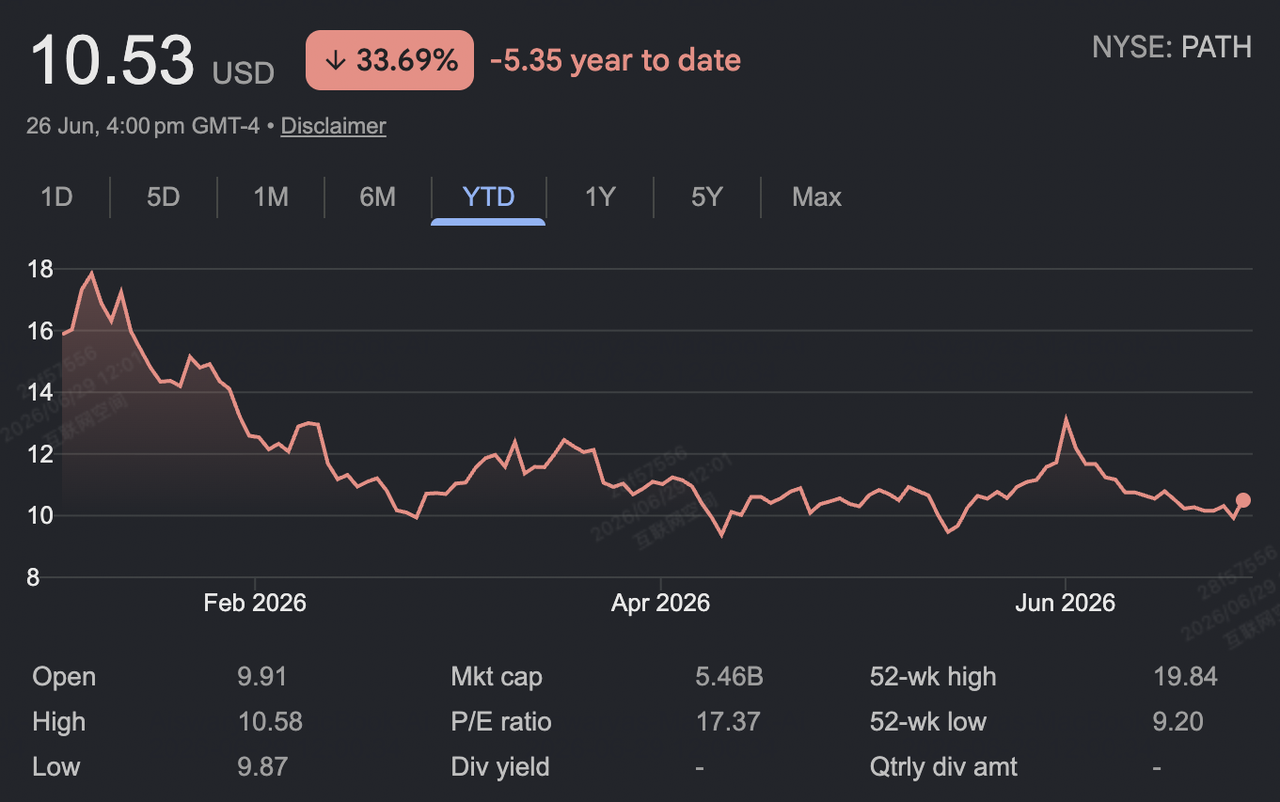
UiPath stock performance YTD as of June 2026 | Source: Google Finance
UiPath’s historical data highlights a stock trying to establish a firm bottom following post-IPO repricing.
|
Metric |
Latest Q1 Reported Figures |
|
Revenue |
$418.38M (+17.32% YoY) |
|
Net Income (GAAP) |
$22.52M (+199.87% YoY) |
|
Diluted EPS |
$0.04 (+200.00% YoY) |
|
Adjusted EPS (Non-GAAP) |
$0.15 |
|
Operating Margin |
6.7% (Up from -4.6% YoY) |
|
Cash & Cash Equivalents |
$1.42B (~26% of Total Market Cap) |
UiPath's clean sheet balances out macro headwinds. By hoarding $1.42 billion in liquid cash, equivalents, and marketable securities against a total market capitalization of roughly $5.46 billion, the stock trades at a deep cash-adjusted valuation multiple, clocking in at just about 2.1 times its annualized recurring revenue.
UiPath Trading Strategy for the Remainder of 2026
To navigate PATH futures or spot positions on BingX, traders must ignore simple retail sentiment and look closely at corporate value boundaries:
1. The Critical $9.20 to $10.00 Floor
Technically, the 52-week low of $9.20 acts as major structural support. The late June volume surge confirmed aggressive defensive buying as the asset dipped below $10.00. As long as weekly charts print solid closes above this boundary, the base accumulation phase remains intact.
2. The Tech-Stack Threat
The core short thesis against UiPath is built on the risk of AI cannibalization, the idea that foundational large language models from OpenAI, Anthropic, or Microsoft Copilot will allow enterprises to orchestrate workflows natively, bypassing third-party RPA applications entirely. Traders must watch if UiPath's newly deployed agentic features actively counter this threat by deepening customer retention metrics, which recently ticked up to a 109% dollar-based net retention rate.
3. Exploiting the PATH Stock Valuation Disconnect
Trading at a forward P/E ratio below 13.2x and a forward price-to-earnings metric near 11.91x by conservative consensus tracking, UiPath is priced like a dying legacy business. This is well below the software infrastructure industry average of 24.48x. Any sustained improvement in expansion ARR can spark a fast, violent valuation mean-reversion move to the upside.
UiPath 2026 Stock Forecast: Bull, Base, and Bear Cases
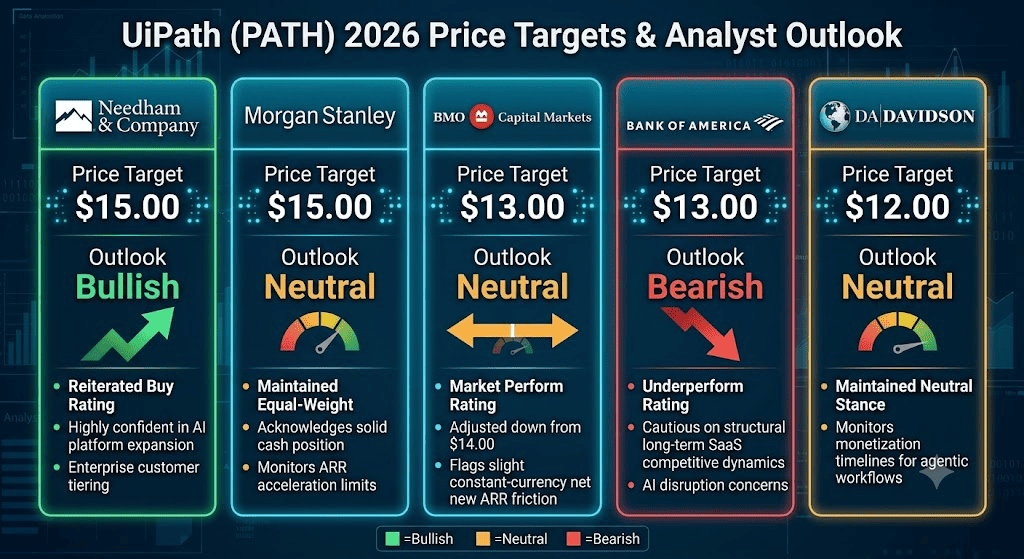
UiPath stock price predictions for 2026 by Wall Street analysts
Evaluating UiPath’s price path over the coming quarters requires weighting structural cash flows against systemic tech industry competition.
The Bull Case: Target $15.00 – $18.00
The bullish setup requires the newly deployed Maestro Case platform to see rapid commercial adoption. If enterprises successfully scale these agentic workflows into highly governed, production-level environments, UiPath will prove it can effectively monetize the modern AI cycle rather than get replaced by it.
Supported by aggressive targets from firms like Morgan Stanley ($15.00) and Needham ($15.00), this path assumes the company converts its $1.90 billion ARR base into high-margin double-digit expansion. If short covers catch fire alongside corporate buybacks, the stock can break heavy overhead resistance to challenge its 52-week high of $19.84.
The Base Case: Target $12.00 – $13.87
The most mathematically probable scenario sees PATH consolidating within a definitive trading range. Revenues will likely track to management's full-year guidance midpoint of $1.78 billion. In this environment, steady enterprise revenue growth of 7% to 10% satisfies value investors, but deceleration fears keep growth funds at bay. Expect the asset to gradually drift toward the Wall Street consensus average target of $13.87, fluctuating as the market balances strong cash flows against competitive pressures from Microsoft's Power Platform.
The Bear Case: Target $9.20 Floor
The bearish breakdown assumes that net new ARR growth slows down significantly over the summer and autumn months. If enterprise buyers pause software spend due to broader macroeconomic uncertainty, or choose to build custom workflow engines directly on top of raw LLMs, UiPath's core product adoption will falter. Underweight ratings, like Bank of America's $13.00 target coupled with an Underperform label, keep downward pressure alive. Breaking below the technical $9.87 intermediate low would leave the stock exposed to a full retest of the structural $9.20 52-week low.
UiPath (PATH) Analyst Price Targets and Outlook
|
Institution |
2026 Price Target |
Overall Market Outlook |
|
Needham & Company LLC |
$15.00 |
Bullish: Reiterated Buy; highly confident in AI platform expansion and enterprise customer tiering. |
|
Morgan Stanley |
$15.00 |
Neutral: Maintained Equal-Weight; acknowledges solid cash position but monitors ARR acceleration limits. |
|
BMO Capital Markets |
$13.00 |
Neutral: Market Perform; adjusted down from $14.00; flags slight constant-currency net new ARR friction. |
|
Bank of America |
$13.00 |
Bearish: Underperform rating; cautious on structural long-term SaaS competitive dynamics. |
|
DA Davidson |
$12.00 |
Neutral: Maintained Neutral stance; monitors monetization timelines for agentic workflows. |
How to Trade UiPath (PATH) Stock Futures on BingX TradFi
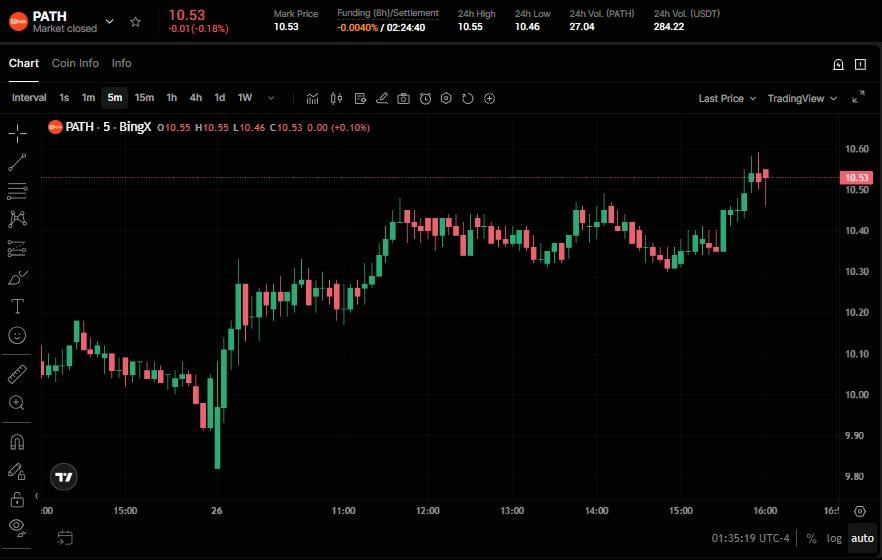
PATH/USDT perpetual contract on BingX TradFi market
As UiPath undergoes this volatile phase of public price discovery, tactical traders can capitalize on intraday price action through the BingX platform.
- Access the Dashboard: Go to the specialized TradFi section on the main BingX exchange page.
- Locate the Contract: Search for and select the PATH-USDT perpetual futures contract.
- Determine Your Direction: Select Open Long if you believe the cheap forward P/E and Maestro Case customer wins will propel the asset to its $13.87 consensus target. Select Open Short to trade against the position if you expect institutional outflows and LLM competition to break the floor.
- Configure Leverage: Set your preferred Cross or Isolated margin parameters alongside proper risk leverage to maximize capital efficiency.
- Enforce Downside Protection: Utilize advanced BingX Take-Profit and Stop-Loss (TP/SL) orders to keep your capital safe from sudden, headline-driven market gaps.
Top 5 Risks for UiPath (PATH) Traders to Monitor
Before executing positions on PATH, market participants must carefully evaluate the core operational, competitive, and financial risks that could derail the stock's turnaround.
- Generative AI and LLM Cannibalization: The rapid advancement of native autonomous agents from foundational models like OpenAI’s GPT or Anthropic’s Claude could allow enterprises to automate complex workflows directly, threatening to bypass third-party orchestration platforms completely.
- Decelerating Net New ARR Growth: While a $1.90 billion ARR baseline provides a strong safety net, forward-looking revenue growth projections have slowed into the single digits, signaling that large-scale customer acquisitions are becoming harder to capture.
- Intensifying Enterprise Workflow Competition: Pushing into case management via Maestro Case places UiPath in a direct, high-stakes battle against entrenched industry giants like ServiceNow and Pegasystems, both of which possess massive enterprise footprints.
- Institutional Capital Flight: The ongoing reduction of exposure by major institutional funds, such as Capital Impact Advisors cutting millions of shares, creates a persistent supply overhang in the public float that dampens upward price momentum.
- Hyped-Up Monetization Timelines: A significant portion of UiPath’s forward-looking valuation premium rests on its ability to commercialize agentic AI; however, enterprise budget approvals for regulated production deployments often move slowly, threatening short-term earnings disappointments.
Final Thoughts: Is PATH Stock a Buy in 2026?
UiPath offers a unique value profile in an expensive tech sector. With clean GAAP profitability, an elite 81-83% gross margin structure, and massive cash reserves that guard against downside risk, the underlying business is clearly moving in the right direction.
However, trading a stock facing secular platform evolution requires strict technical discipline. Short-term traders can capitalize on clear, high-volume consolidation boundaries via BingX futures markets. Long-term spot accumulators should build positions defensively, verifying that early agentic AI pilot programs steadily transform into recurring balance sheet growth.
Risk Disclaimer: Trading equities and derivative products involves significant capital risk due to sector volatility, macroeconomic changes, and shifting competitive technology landscapes. Always utilize disciplined position sizing and strict stop-loss protocols to protect your capital.
Related Reading
- Infleqtion Stock Price Prediction 2026: $22 CHIPS Boom or Insider Selling Trap?
- Microsoft (MSFT) Stock Outlook for 2026: Can Azure AI and Copilot Growth Drive MSFT Stock to $550+?
- Intel (INTC) Stock Forecast 2026: Foundry Breakthrough to $89 or Value Trap?
- Meta (META) Stock Price Prediction 2026: Can AI Efficiency and Custom Silicon Drive META to $900?
- Nvidia (NVDA) Stock Price Outlook for 2026: Can Blackwell and Vera Rubin Take NVDA Back to $300?
