
Solo mining Bitcoin in mid-2026 is structurally identical to buying a high-tech lottery ticket. With the global network hashrate consolidating between 900 EH/s and 1 ZH/s and the network difficulty hovering around 125 trillion, despite a recent historic 10.09% downward difficulty correction on June 14, 2026, the odds of an individual rig discovering a valid block on its own are infinitesimally small.
For the vast majority of participants, joining a traditional mining pool to receive steady fractions of a Bitcoin is the standard path to predictable revenue. However, solo mining continues to experience a cultural and technological renaissance. Driven by a desire for operational sovereignty, network decentralization, and the alluring potential of landing a full post-halving block reward of 3.125 BTC plus transaction fees (frequently worth upwards of $250,000 to $350,000), a distinct market has emerged for solo mining hardware.
This comprehensive guide evaluates the top solo mining rigs available in 2026, dividing the options between massive industrial-tier machinery and ultra-compact residential lottery devices. We also break down the math behind solo mining probabilities and explain how to seamlessly move your mined BTC rewards to BingX to capture spot market profits or hedge your yields.
What Is Solo Mining Bitcoin (BTC) and How Does It Work?
Solo mining is the process of dedicating independent ASIC (Application-Specific Integrated Circuit) computing power to solve Bitcoin’s cryptographic SHA-256 puzzle without sharing the underlying workload with a pool. If your hardware happens to find a valid block hash before anyone else globally, you do not split the revenue; you are credited with the entire 3.125 BTC block subsidy alongside 100% of the associated transaction fees contained in that block.
The operational pipeline for a true solo miner relies on maintaining a direct, local connection to a synchronized full Bitcoin node. However, because setting up a full node can be complex for retail users, the mid-2026 mining ecosystem relies heavily on dedicated solo-mining tracking servers, most notably Solo CKPool.
What Is the Role of Solo Lottery Pools for Mining BTC?
When you point your rig to a solo mining pool like Solo CKPool, you are not engaging in shared pool mining. Instead, the platform acts strictly as an infrastructure bridge:
- It packages global transaction data into candidate blocks and distributes them to your hardware.
- It charges a modest, flat administrative fee, typically around 1% to 2%, only if your rig hits a block.
- If your individual machine solves the puzzle, you receive the remaining 98% to 99% of the full reward sent straight to your wallet.
This setup enables tiny devices delivering only a few terahashes per second (TH/s) to safely participate in the network without maintaining a heavy software stack.
Read more: How to Mine Bitcoin (BTC) in 2026: A Beginner's Guide
Solo Mining vs. Pool Mining: Key Differences
|
Attribute |
Solo Mining (Independent / Solo Pools) |
Pool Mining (Shared Reward Pools) |
|
Payout Consistency |
Extremely volatile; long periods of zero income punctuated by rare, massive rewards. |
Highly stable; predictable, programmatic micro-payouts received daily or hourly. |
|
Reward Distribution |
Winner-takes-all. You retain the full block reward (minus a small solo pool fee). |
Distributed proportionally based on your exact hashrate contribution (PPS/FPPS models). |
|
Infrastructure Needs |
Requires a full Bitcoin node or connection to a solo proxy like CKPool. |
Low infrastructure friction; standard connection to institutional pools (e.g., Binance Pool). |
|
Best Suited For |
High-capital industrial operations or home hobbyists seeking educational "lottery" setups. |
Retail miners looking to offset ongoing monthly electricity bills with consistent revenue. |
The structural division between solo mining and pool mining is governed by a strict trade-off between statistical variance and cash-flow predictability. In pool mining, participants eliminate individual luck by combining their computing power to secure regular, programmatic payouts based on structures like FPPS (Full Pay-Per-Share), which account for both the 3.125 BTC block subsidy and real-time transaction network fees. For a retail operator utilizing an industrial rig consuming 3,500W, pool mining acts as a predictable corporate balance sheet, generating stable micro-payouts every few hours to offset ongoing local utility overheads. Conversely, solo mining operates as a winner-takes-all lottery; with global network difficulty sustained at historic multi-trillion thresholds, an isolated rig faces an exceptionally high mathematical probability of generating exactly zero revenue for years, punctuated only by a fraction-of-a-percent chance of capturing an undivided block payout.
From an infrastructure and capital deployment perspective, pool mining offers near-zero friction, requiring nothing more than pointing an ASIC’s stratum configuration toward institutional servers like Binance Pool. Solo mining, however, demands specialized architectural sovereignty, either via a locally synchronized full Bitcoin node to independently validate and broadcast candidate blocks, or through low-overhead proxy bridges like Solo CKPool, which retain a minor 1% to 2% administrative fee only upon successful block resolution. Consequently, solo configurations are practically restricted to two distinct market cohorts: enterprise-scale mining farms wielding tens of petahashes (PH/s) to systematically smooth out variance, and residential hobbyists running sub-100W pocket ASICs who accept infinite ROI horizons purely for network decentralization, educational exploration, and the speculative thrill of hitting a multi-thousand-dollar block reward.
Read more: Cloud Mining vs. Mining Pools vs. Solo Mining: What’s the Best Way to Mine Bitcoin in 2026?
What Are the Best Industrial-Grade Solo Mining Rigs for Bitcoin?
If you have access to cheap commercial power matrices (ideally below $0.05/kWh), dedicated ventilation, and significant upfront capital, utilizing high-end industrial miners maximizes your mathematical probability of finding a block. These machines generate extreme heat and loud noise levels (75 to 90 dB), requiring placement in isolated facilities or garages.
1. Bitmain Antminer S23 Hyd 3U
Released in early 2026, the S23 Hyd 3U represents the absolute pinnacle of high-throughput industrial ASIC technology.
- Hashrate: 1.16 PH/s (1,160 TH/s)
- Power Consumption: 11,020W
- Efficiency: 9.5 J/TH
- Price Range: $7,700+
The Bitmain Antminer S23 Hyd 3U represents the absolute peak of industrial-grade SHA-256 performance, delivering a monumental hashrate of 1.16 PH/s (1,160 TH/s) with a power draw of 11,020W. Engineered strictly for commercial server racks or modular container farms, it breaks the sub-10 barrier with an ultra-optimized energy efficiency of 9.5 J/TH.
At a price point starting around $7,700, this 3U rack-mountable beast leverages a closed-loop hydro-cooling system to completely eliminate traditional fan whine, capping operational noise at a manageable 50 dB. For institutional solo miners, the S23 Hyd 3U serves as a premier deployment asset, generating the highest density of concurrent cryptographic guesses per second available from a single industrial chassis to maximize block lottery odds.
2. Bitdeer SealMiner A4 Ultra Hydro
A highly competitive option from Bitdeer featuring proprietary advanced 5nm mining architecture.
- Hashrate: 886 TH/s
- Power Consumption: 8,372W
- Efficiency: 9.45 J/TH
- Price Range: Variable by batch
Unveiled as Bitdeer’s flagship generational leap, the SealMiner A4 Ultra Hydro leverages an advanced 5nm proprietary SEAL04 chip architecture to achieve a hyper-efficient 9.45 J/TH. The device pumps out a stable 886 TH/s of raw hashing power while under a continuous thermal load of 8,373W, maintaining a sub-10 J/TH barrier protection line against escalating network difficulty curves.
Utilizing structural 2U server rack metrics (482 × 665 × 86 mm) and three-phase 380–480V AC input to minimize internal power conversion losses, its liquid-cooling loop allows the unit to run near-silently even in extreme ambient temperatures up to 55°C. This makes the A4 Ultra Hydro a highly optimized choice for capital-intensive solo operators seeking structural immunity against hardware obsolescence and high utility rate spikes.
3. Bitmain Antminer S21 XP / XP Hydro
The current industry workhorse balancing cost-to-performance metrics for serious miners.
- Hashrate: 270 TH/s to 473+ TH/s (Air/Hydro variants)
- Power Consumption: 3,000W to 5,500W
- Efficiency: ~1 to 13.5 J/TH
- Price Range: $8,000 – $15,000
Serving as the institutional workhorse of the mid-2026 mining matrix, the Antminer S21 XP series balances flexible deployment models with rugged structural reliability. Ranging from 270 TH/s on baseline air-cooled systems to over 473 TH/s on hydro-cooled variations, these units carry an operational efficiency profile spanning 11 to 13.5 J/TH with power consumption thresholds resting between 3,000W and 5,500W.
Priced as a mid-tier commercial asset between $8,000 and $15,000, the S21 XP is highly favored by scaling operations looking to deploy multi-unit parallel setups. This flexibility allows professional solo miners to assemble custom, modular terahash arrays, giving them a dependable and highly customizable asset base for hunting independent network block subsidies.
What Are the Top Home-Friendly Lottery BTC Mining Rigs Under $500?
For residential hobbyists, students, and decentralization advocates, running a full-size ASIC at home is practically impossible due to standard household breaker limits and noise complaints. Home-friendly pocket miners use minimal electricity (often less than a smartphone charger or a video game console), run completely silent or whisper-quiet (20 to 40 dB), and are intended as educational tools that double as perpetual lottery tickets.
1. NerdMiner NerdQaxe++ Rev 6.1
- Price: ~$349
- Hashrate: 6 TH/s
- Power Draw: 100W
- Interface: Ethernet-only
Priced at $349, the NerdQaxe++ Rev 6.1 is an engineering marvel for small-scale deployment, outputting a substantial 6 TH/s at a steady 100W power draw. Built strictly with an Ethernet interface to eliminate the latency spikes and packet loss common to home WiFi setups, it ensures your shares land instantly at solo pools like Solo CKPool.
Its dual-fan cooling layout keeps the acoustic footprint at a stable 40 dB, equivalent to a quiet office environment, while drawing less than 1 amp on standard residential 110V/220V circuits. This makes it an exceptionally safe, plug-and-play desktop node for hobbyists who want meaningful block-lottery participation without modifying their home electrical panels.
Best For: Highest performance under $500. It utilizes dual cooling fans to maintain a stable 40 dB footprint and runs comfortably on standard household outlets without tripping breakers.
2. Magicminer BG02
- Price: ~$359
- Hashrate: 7 TH/s
- Power Draw: 150W
- Interface: Ethernet-only
The Magicminer BG02 is the raw processing king of the sub-$500 segment, pushing out a class-leading 7 TH/s for an accessible $359. This higher throughput requires a 150W continuous power load, meaning it consumes roughly as much energy as a mid-tier gaming console and generates a modest thermal output that requires basic room ventilation.
Operating over a hardwired Ethernet connection to guarantee network uptime, its dual-fan air assembly holds noise levels at 40 dB. If your domestic utility rate is low and your primary goal is to squeeze every possible cryptographic guess per second out of a compact, consumer-grade desktop device, the BG02 maximizes your data-driven lottery odds.
Best For: Maximizing household raw computing power. It draws slightly more electricity but provides the highest raw hashrate available in the sub-$500 budget category.
3. Bitaxe Gamma 601 / Supra Hex 701
- Price: $109 – $229
- Hashrate: 1.2 TH/s to 4.2 TH/s
- Power Draw: 17W to 90W
- Interface: WiFi-enabled
The Bitaxe line represents the pinnacle of open-source, community-driven hardware, spanning a highly efficient price-to-performance matrix from $109 to $229. The entry-level Gamma 601 delivers 1.2 TH/s while drawing an incredibly low 17W, equivalent to a standard LED lightbulb, allowing it to run continuously for pennies a month over integrated WiFi.
For miners wanting more compute density, the premium Supra Hex 701 steps up the processing clock to deliver 4.2 TH/s at a 90W load. Embodying a true open-source ethos, both models feature fully accessible BM1370/BM1366 chip firmware, letting tech-savvy users custom-tune and overclock their rigs directly via a web browser dashboard.
Best For: True open-source hobby mining. The Gamma 601 draws an astonishingly low 17W, equivalent to a smart lightbulb, making it virtually free to run 24/7 on a nightstand or desk via local WiFi.
4. Canaan Avalon Nano 3S
- Price: $299
- Hashrate: 6 TH/s (Hobby tier) / 6 GH/s (USB-only learning variant)
- Power Draw: 5W to 140W (depending on version)
- Interface: USB / WiFi
Engineered by industrial manufacturing giant Canaan, the $299 Avalon Nano 3S brings enterprise-grade build stability down to a portable, consumer form factor. In its full-power residential configuration, it yields 6 TH/s at a 140W draw over a flexible WiFi interface, while its ultra-compact, USB-powered learning variant scales down to 6 GH/s at a microscopic 5W.
What sets the Nano 3S apart is its whisper-quiet acoustic profiling, running between 20 and 33 dB, which makes it virtually silent in a bedroom or office. It serves as an incredibly stable, zero-maintenance crypto nightlight for beginners who value premium hardware engineering and completely silent operation.
Best For: Absolute whisper-quiet operation at 20 to 33 dB. Built by institutional manufacturer Canaan, it offers unmatched retail build stability.
Should You Solo Mine Bitcoin in 2026: Calculating True Profitability
Before deploying capital, it is critical to align your expectations with statistical reality. The mathematical probability P of finding a block during a single 10-minute interval can be expressed using your individual hashrate relative to the total network hashrate:
Probability = Your Hashrate / Global Network Hashrate
If you are running a single Bitaxe Gamma (1.2 TH/s) against a global network power of 950 EH/s (950,000,000,000,000,000 hashes per second), your mathematical odds per block are roughly 1 in 791 billion.
The Reality Checklist: For retail home setups, your continuous monthly electricity cost is low, around $1 to $15 depending on local utility rates for units under 100W, meaning you can safely run the machine for years as a fun background hobby. However, your expected direct ROI (Return on Investment) timeline is functionally infinite. If you require stable, guaranteed revenue to pay off your hardware, you must configure your devices to mine via traditional pool mechanics instead.
How to Set Up a Home Solo Miner to Mine Bitcoin: Step-by-Step Guide
Setting up modern plug-and-play lottery ASICs takes less than 10 minutes by following this simple procedure:
- Power the Device: Connect your miner to its dedicated AC wall adapter or USB power source. Wait for the onboard status lights to stabilize.
- Access the Local Dashboard: If using a WiFi-based miner like Bitaxe or Lucky Miner, look for the unit's local hotspot on your phone or laptop. Connect to it and navigate to 192.168.4.1 in your browser. For Ethernet units, look up the device's assigned local IP via your router dashboard.
- Configure Your Local Network: Select your primary home network from the dashboard list, enter your secure wireless password, and save. The device will reboot and join your local network.
- Input Solo Pool and Wallet Credentials: Enter your chosen solo pool URL, e.g., Solo CKPool's Stratum address. In the Worker/Wallet Address field, paste your unique, personal Bitcoin address. Set the password field to x and hit Apply.
Read more: Top Bitcoin Wallets: Best Ways to Store BTC in 2026
How to Manage and Secure Your Mined BTC Rewards on BingX
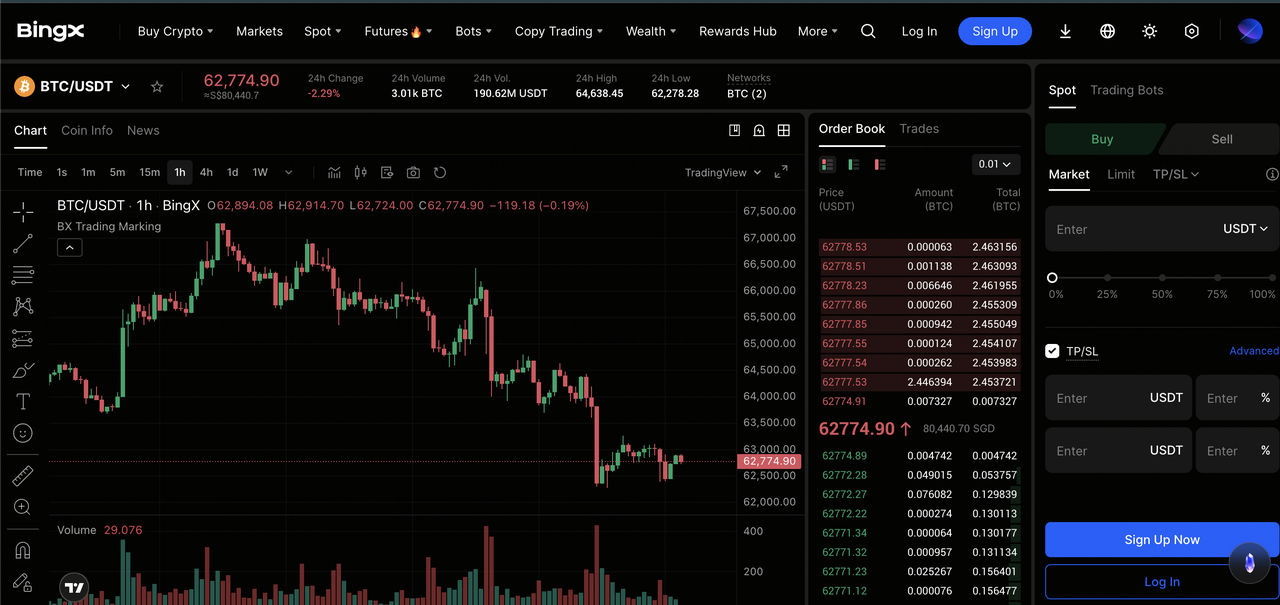
BTC/USDT trading pair on BingX spot market
If your solo mining rig happens to buck the global odds and successfully hits a block, your pool will instantly route your payout directly to your configured Bitcoin wallet address. Because a full block reward represents significant wealth, migrating your funds onto a secure trading venue like BingX allows you to systematically lock in profits, convert to stablecoins, or initiate hedges.
- Locate Your Deposit Credentials: Log into your verified BingX account via the app or web portal. Navigate to Asset -> Deposit, select BTC (Bitcoin), and choose the native BTC / Bitcoin network. Copy the provided alphanumeric address.
- Execute the Wallet Transfer: Open your external storage application or hardware signer containing your block rewards. Initiate a transaction, paste your unique BingX deposit address, review the network priority fees, and broadcast the transaction.
- Verify Settlement and Manage Capital: Monitor the transaction via a blockchain explorer. Once the required network confirmations are completed, your funds will reflect in your BingX Funding Account.
From here, you can instantly navigate to the BTC/USDT Spot Market to liquidate your positions or convert into alternative high-utility assets. Advanced operators can also utilize BingX Futures to open tactical short contracts, effectively hedging their operations against shifting global macro trends.
5 Key Risks to Consider When Solo Mining BTC
While hunting for an independent block reward carries significant upside potential, solo miners operate under an aggressive, high-variance risk architecture that can easily penalize unhedged capital.
- Extreme Variance and Cash-Flow Deprivation: With global network difficulty hovering around historical peaks of 125 to 136 trillion, a solo rig faces an exceptionally high mathematical probability of generating exactly zero revenue for months or years at a time.
- Sunk Operational Power Drag: In contrast to pool mining where payouts scale linearly with hashrate, solo operations must continuously pay for local electricity overheads out-of-pocket without any baseline income to cushion the expenses.
- Rapid Capital Depreciation of Hardware: As major manufacturers aggressively roll out hyper-efficient, sub-10 J/TH ASIC architectures, legacy or less efficient hardware faces rapid competitive obsolescence and steep liquidation value drops.
- Aggressive Industrial Network Consolidation: Institutional public mining conglomerates deploying thousands of megawatt-scale hydro arrays continuously drive the global hashrate upward, systematically diluting the structural lottery odds of isolated retail nodes.
- Thermal, Acoustic, and Electrical Infrastructure Strains: Running heavy industrial ASICs demands high continuous power loads, often upwards of 3,000W to 11,000W, and complex ventilation or liquid-cooling loops, creating acute noise, ambient heat, and fire hazards if deployed in non-commercial residential properties.
Conclusion: Should You Solo Mine Bitcoin in 2026?
Solo Bitcoin mining in 2026 has definitively transitioned from a viable yield-generation business model into a highly bifurcated, speculative endeavor. For the elite enterprise cohort wielding multi-petahash industrial configurations and grid-level power costs, it remains an uncompromising play for total reward sovereignty and network decentralization. For the rapidly growing residential hobbyist community, running compact, low-wattage pocket ASICs serves as an excellent educational gateway into the mechanics of the blockchain, acting as a low-cost, perpetual lottery ticket that can be safely left running in the background for pennies a month.
Ultimately, your choice of hardware should align precisely with your capital flexibility, physical space constraints, and risk tolerance. If your operational survival demands immediate, predictable cash flow to cover your upfront equipment expenses, configuration via traditional shared reward pools remains the only sensible path forward. Regardless of the deployment strategy you select, always ensure that your successfully mined distributions are systematically moved into secure self-custody or transferred directly to your BingX trading account to successfully preserve your hard-earned wealth.
Risk Reminder: Cryptocurrency mining involves high capital expenditures, volatile network difficulty adjustments, and intense underlying asset price fluctuations. Past block rewards are completely independent of future performance; running any solo mining device exposes capital to prolonged periods of zero yield, and there is no guarantee that a standalone machine will ever solve a block within its operational lifecycle. Fully analyze your local electricity utility rates and hardware efficiency parameters before committing funds.
Related Reading
- How to Mine Bitcoin (BTC) in 2026: A Beginner's Guide
- How to Mine Bitcoin (BTC) on Your PC in 2026
- Is Bitcoin Mining Still Profitable in 2026: How to Calculate BTC Mining Profitability?
- Cloud Mining vs. Mining Pools vs. Solo Mining: What’s the Best Way to Mine Bitcoin in 2026?
- The Shift to ASICs: Why You Can’t Mine Bitcoin with a GPU in 2026
- Best 7 Cloud Mining Platforms to Mine Bitcoin in 2026
FAQs on Bitcoin Solo Mining
1. What are the realistic odds of a home rig hitting a solo block in 2026?
With the global network hashrate consolidating between 900 EH/s and 1 ZH/s, the odds are structurally equivalent to winning a major national lottery. For example, running a single 1.2 TH/s Bitaxe Gamma 601 against a 125-trillion network difficulty yields a mathematical probability of roughly 1 in 791 billion per 10-minute block interval. While historical anomalies exist, such as an independent 70 TH/s Antminer S17+ successfully capturing a full block reward in early 2026, retail home miners should view solo setups strictly as educational, low-cost hobby experiments rather than predictable income streams.
2. Is it better to set up a full Bitcoin node or use a solo proxy pool?
For true structural sovereignty and absolute privacy, running a dedicated local full Bitcoin node is the gold standard because it allows you to construct and broadcast candidate blocks without relying on a third party. However, maintaining a full node demands constant storage updates and high local bandwidth uptime. For retail miners, pointing hardware toward a solo proxy server like Solo CKPool provides the exact same 'winner-takes-all' payout structure with near-zero software overhead. Proxy pools handle block construction on your behalf and deliver shares over a lightweight connection, charging a flat 1% to 2% fee only if your machine solves a block.
3. How do global tax authorities treat solo mining block rewards?
In prominent financial jurisdictions like the United States (IRS), successfully mined block rewards are classified as ordinary income evaluated at their exact fair market value at the timestamp of receipt, requiring accurate ledger tracking regardless of whether you liquidate the coins immediately or hold them. Furthermore, if you later transfer those rewards onto an exchange like BingX to sell or swap, any subsequent price appreciation from your initial cost basis triggers capital gains tax liabilities.
Conversely, tax havens or unique jurisdictions like Singapore do not impose capital gains taxes on individual retail investors, classifying hobbyist mining rewards as tax-exempt assets, though professional corporate mining operations remain fully subject to standard corporate income taxes. Always audit your localized cross-border regulatory frameworks to remain compliant.
