


MicroStrategy (MSTR) has entered 2026 at a historic inflection point, trading near $138 as it reinforces its position as the world's largest corporate Bitcoin treasury company. With holdings exceeding 738,000 BTC and aggressive accumulation continuing, MicroStrategy is transitioning from a business intelligence software provider to a leveraged Bitcoin proxy. Explore the institutional price targets, the Bitcoin strategy roadmap, and whether MSTR is a buy in 2026. In early 2026, MicroStrategy (MSTR) fully embraced its Bitcoin treasury identity. While the core software business provides modest revenue stability, the company's massive Bitcoin holdings drive valuation dynamics. As of March 2026, the narrative centers on Bitcoin price movements, BTC yield metrics, and capital raising efficiency amid ongoing volatility.
MicroStrategy enters 2026 with strong structural tailwinds from its Bitcoin accumulation playbook. Executive Chairman Michael Saylor continues to emphasize perpetual Bitcoin purchases funded by equity and preferred instruments, targeting ongoing BTC per share growth. With Bitcoin trading around $70,000 and geopolitical factors supporting digital asset adoption, 2026 is poised as a pivotal year.
This guide breaks down the MicroStrategy stock price prediction for 2026 using data from multiple analysts and consensus estimates. You will also discover how to gain exposure to Microstrategy (MSTR) stock futures through BingX TradFi
Key Highlights: Top 5 Things for MicroStrategy Investors to Know in 2026
1. Bitcoin Treasury Dominance: Holdings reached 738,731 BTC as of March 2026, acquired at an average cost of approximately $66,385 per coin, with total cost basis around $49 billion.
2. Capital Raising Scale: Raised $25.3 billion in 2025 through equity and preferred offerings, enabling continued Bitcoin accumulation.
3. BTC Yield Achievement: Delivered 22.8% BTC Yield in 2025, increasing Bitcoin per share despite dilution.
4. Polarized Targets: Analyst forecasts for 2026 range from bearish lows around $54 to bullish highs of $705.
5. Valuation Dynamics: Stock trades with high beta to Bitcoin, often at a premium or discount to net asset value based on BTC price.
What Is Strategy (MSTR), Formerly MicroStrategy?
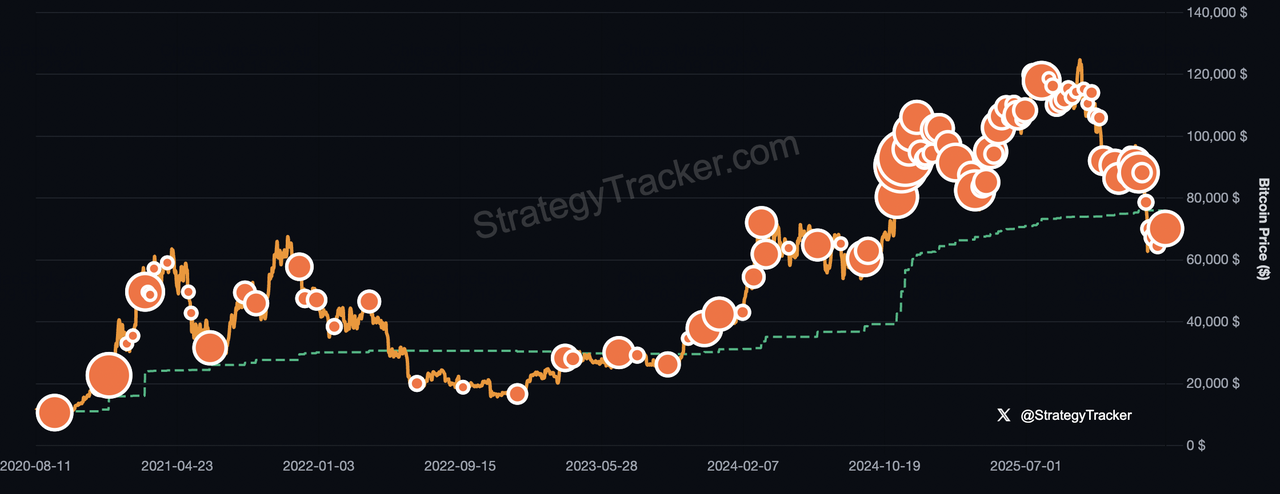
Source: StrategyTracker
MicroStrategy, now Strategy, is a Bitcoin treasury and enterprise analytics company. Originally known for business intelligence software, in 2026 it is increasingly viewed as the premier corporate Bitcoin holder. Its core value lies in its massive Bitcoin reserve, which serves as a primary treasury asset. As of March 9, 2026, Strategy's Bitcoin reserve value is $51.86 billion according to Strategy Tracker.
Unlike traditional software firms, MicroStrategy's ecosystem includes aggressive Bitcoin accumulation funded by capital markets, providing leveraged exposure to Bitcoin's price. The company serves enterprise clients with analytics tools while using proceeds to expand its Bitcoin holdings.
MicroStrategy's Strategic Evolution (1989-2026): From BI Software to Bitcoin Treasury Leader
Founded in 1989, MicroStrategy's history features innovation in data analytics. The company went public in 1998 and built a solid software business. In 2020, it pioneered corporate Bitcoin adoption, acquiring its first BTC as a treasury reserve. By 2025, Bitcoin strategy dominated, with massive capital raises funding holdings growth. From analytics roots to Bitcoin leadership, MicroStrategy has redefined corporate treasury management.
MicroStrategy's Key Growth Phases Over the Years: From Software to Bitcoin Proxy
MicroStrategy's journey spans distinct eras:
• The Software Phase (1989-2019): Building enterprise analytics platforms.
• The Bitcoin Adoption Era (2020-2024): Initial acquisitions establishing treasury strategy.
• The Bitcoin Dominance Era (2025+): Hyper-accumulation, yield focus, and leveraged exposure.
MicroStrategy (MSTR) 2025 Performance Overview: The Bitcoin Volatility Year
In 2025, MicroStrategy (now rebranded as Strategy in some contexts but still trading as MSTR) navigated extreme Bitcoin price volatility while aggressively executing its Bitcoin treasury strategy. The core software business continued to provide modest, stable revenue, but the company's massive Bitcoin holdings dominated performance, financial reporting, and investor sentiment. Through relentless capital raises totaling $25.3 billion via equity and preferred instruments, MicroStrategy significantly expanded its Bitcoin position, achieving a strong BTC yield despite market headwinds and unrealized losses in certain quarters. This combination of software stability and leveraged Bitcoin exposure led to record-breaking accumulation but also amplified stock price swings tied directly to BTC movements.
1. MSTR Stock Price's 53% Drop in Q4, Market Cap Fluctuations
MicroStrategy's stock exhibited extreme volatility throughout 2025, closely tracking Bitcoin's price action with amplified beta. Shares experienced sharp declines during BTC corrections, including a 53% drop in Q4 2025 amid a 25% Bitcoin pullback in the December quarter, and overall underperformance with the stock sliding approximately 49 to 52% for the year in some periods. Despite these drawdowns, rallies in Bitcoin triggered powerful recoveries, with market capitalization fluctuating dramatically, often trading at premiums or discounts to the net asset value of its Bitcoin treasury. The stock's high correlation to BTC made it one of the most volatile names in the market, reflecting investor views of MSTR as a leveraged Bitcoin proxy rather than a traditional software company.
2. Financial Performance: Software Revenue Stable, Bitcoin Drop Drives $17.44B Loss
The software segment delivered consistent but modest results, with full-year revenue around $474 to $477 million, showing limited growth or slight declines in certain metrics amid a multi-year trend of -22.1% three-year revenue growth. Core business intelligence tools generated quarterly revenues in the $116 to $123 million range, providing a baseline cash flow foundation. However, Bitcoin fair-value accounting (adopted in recent years) introduced massive swings: unrealized gains in bullish quarters contrasted with significant unrealized losses, such as $17.44 billion reported in Q4 2025 during Bitcoin weakness. These non-cash adjustments led to volatile reported net income and EPS figures, overshadowing software performance and highlighting the treasury strategy's outsized influence on overall financials.
3. Bitcoin Accumulation Surges Past 700,000 BTC: Holdings Expanded Significantly
MicroStrategy accelerated its Bitcoin purchases aggressively in 2025, raising $25.3 billion in capital, the largest equity issuance among U.S. public companies for the second consecutive year, to fund additions. Holdings grew substantially throughout the year, reaching over 700,000 BTC by year-end and continuing into early 2026. Key milestones included multiple large weekly buys funded by at-the-market offerings, with the company maintaining a no-sell policy. This relentless accumulation positioned MicroStrategy as the world's largest corporate Bitcoin holder, representing over 3% of total BTC supply, while average acquisition costs hovered around $74,000 to $76,000 per coin depending on timing and market conditions.
4. Strategic Milestones: 22.8% BTC Yield and Capital Instruments
A standout achievement was delivering 22.8% BTC Yield for full-year 2025, within or near the updated target range of 22.0% to 26.0%, demonstrating successful Bitcoin per share growth despite dilution from equity raises. BTC Gain metrics reflected strong accumulation efficiency, with year-to-date gains in coins and dollar terms supporting the strategy's long-term compounding. The company innovated with instruments like the flagship STRC (Stretch) digital credit product, which grew to $3.4 billion in size with variable dividend mechanisms (ex., 11.25% rate) to maintain stability and liquidity. These tools enabled continued Bitcoin purchases even in weaker BTC environments, reinforcing the treasury playbook and providing amplification for common shareholders through Bitcoin Per Share (BPS) expansion.
The MicroStrategy Thesis for 2026: 5 Pillars of $MSTR Stock Valuation
While the legacy software business offers reliable baseline revenue, MicroStrategy's valuation in 2026 overwhelmingly reflects its role as a leveraged Bitcoin treasury vehicle, with holdings and yield metrics driving the majority of investor focus and potential upside.
1. Bitcoin Holdings: The Core Asset Layer
As of early March 2026, MicroStrategy holds approximately 738,731 BTC, acquired at an aggregate cost of around $56.04 billion (average ~$75,862 per coin). This massive reserve provides direct, leveraged exposure to Bitcoin's price appreciation, with unrealized value fluctuating based on BTC market levels (often around $50 to $60 billion mark-to-market). The sheer scale, representing roughly 3.5% of Bitcoin's total supply, positions the company as the dominant corporate holder, creating asymmetric upside in BTC bull scenarios.
2. Accumulation Strategy: The Growth Layer
The ongoing "Bitcoin acquisition playbook" targets perpetual BTC per share increases through efficient capital raises. In 2026, continued use of at-the-market equity, preferred instruments like STRC, and other funding sources enable weekly or periodic purchases, even amid volatility. This compounding mechanism aims to grow holdings and yield metrics, delivering shareholder value through expanded Bitcoin exposure without selling assets.
3. Leverage and Beta: The Amplification Layer
MicroStrategy's high beta to Bitcoin (often 2 to 3x or more) amplifies BTC price moves in both directions. In rallies, treasury value surges disproportionately due to leverage from debt/equity funding; in downturns, dilution and unrealized losses pressure shares. This dynamic creates potential for outsized returns if Bitcoin recovers strongly, while introducing significant downside risk during corrections.
4. Funding Efficiency: The Capital Layer
Innovative instruments such as variable-rate preferreds (ex., STRC with mechanisms for price stability) and large-scale equity programs allow low-cost or accretive accumulation. Raising billions annually without selling Bitcoin preserves the treasury while funding growth, with declining volatility in instruments supporting sustained access to capital markets even in challenging environments.
5. Treasury Moat: The Defensive Layer
As the pioneering and largest corporate Bitcoin holder, MicroStrategy benefits from first-mover advantages, brand recognition in digital asset treasuries, and institutional credibility. This moat includes no-sell discipline, transparent reporting, and alignment with broader Bitcoin adoption trends (ex., regulatory tailwinds, ETF flows), providing a unique defensive positioning amid increasing corporate and sovereign interest in BTC as a reserve asset.
MicroStrategy Price Forecasts for 2026: Bull vs. Bear Outlook
Institutional views on MicroStrategy stock remain among the most polarized in the market, reflecting the high-stakes bet on Bitcoin's trajectory and the company's ability to sustain leveraged treasury accumulation amid extreme volatility.
| Institution | 2026 Price Target | Market Outlook |
| Benchmark | $705+ | Super-Bullish: Strong Bitcoin recovery above $100,000 combined with continued aggressive accumulation drives significant treasury value expansion. |
| Average Bull Targets | $500 to $650 | Bullish: Emphasizes BTC Yield maintenance, capital raise efficiency, and asymmetric upside from leveraged Bitcoin exposure. |
| Market Consensus (MarketBeat, TipRanks) | $350 to $400 | Neutral: Hold ratings dominate as investors await clearer Bitcoin price direction and funding sustainability. |
| Trefis Team / Bearish Estimates | $150 to $250 | Pessimistic: Points to dilution risks, premium compression, and potential BTC stagnation or correction. |
| Deep Bearish Outlooks (Wells Fargo) | $50 to $120 | Hyper-Bearish: Views current valuation as unsustainable leverage on Bitcoin with severe downside if BTC declines or capital markets tighten. |
Source: Aggregated from Investing.com and Yahoo Finance (as of early March 2026)
The wide range from ultra-bullish targets above $700 to deeply bearish calls below $120 captures the market's uncertainty around MicroStrategy's ability to convert massive Bitcoin holdings and ongoing accumulation into durable shareholder value while managing dilution, leverage, and BTC price swings.
The Bull Case: The Bitcoin Surge Drives MSTR Stock Price Above $700
Bulls focus on Bitcoin's potential recovery and MicroStrategy's proven execution of its treasury strategy. If Bitcoin rallies substantially in 2026, potentially toward or beyond $100,000 driven by institutional adoption, ETF inflows, or macroeconomic factors, the company's leveraged holdings (approximately 738,731 BTC) would see disproportionate value expansion. Sustained BTC Yield achievement through efficient capital raises, no-sell discipline, and innovative funding instruments like STRC would further compound Bitcoin per share growth. This positions MicroStrategy as the premier corporate Bitcoin proxy, offering amplified upside compared to direct BTC ownership. Analysts in the bullish camp see this path supporting targets of $500 to $700 or higher by year-end 2026.
The Bear Case: The Fundamental Correction to $100 or Lower
Bears highlight MicroStrategy's extreme dependence on Bitcoin price and the risks embedded in its leveraged model. If Bitcoin stagnates, corrects sharply, or fails to break key resistance levels, unrealized losses and fair-value accounting swings could lead to prolonged negative earnings and erode investor confidence. Ongoing dilution from equity and preferred raises, combined with potential funding constraints in tighter credit markets or rising rates, leaves limited margin for error. Increased competition from other corporate treasuries or direct Bitcoin vehicles, along with any regulatory tightening on digital asset holdings, could compress the premium and drive a re-rating toward treasury-adjusted or lower multiples. Bears contend this scenario pushes the share price well below current levels, with some targets clustering in the $50 to $120 range.
How to Trade Strategy (MSTR) on BingX
BingX supports trading for selected tokenized stocks, allowing users to gain price exposure to U.S. equities such as Strategy Inc (formerly MicroStrategy) without using a traditional brokerage account. On BingX, users can access Strategy-related exposure through spot tokenized stocks like MSTRX (xStocks) and MSTRON (Ondo), as well as MSTR stock price-linked futures.
Availability may vary depending on region and regulatory requirements, and product offerings can differ between spot and futures markets.
1. Buy, Sell, or HODL MicroStrategy Tokenized Stocks MSTRX, MSTRON on Spot
If you prefer continuous access, fractional exposure, and a crypto-native trading experience, you can buy MicroStrategy tokenized stocks directly on BingX Spot using USDT.
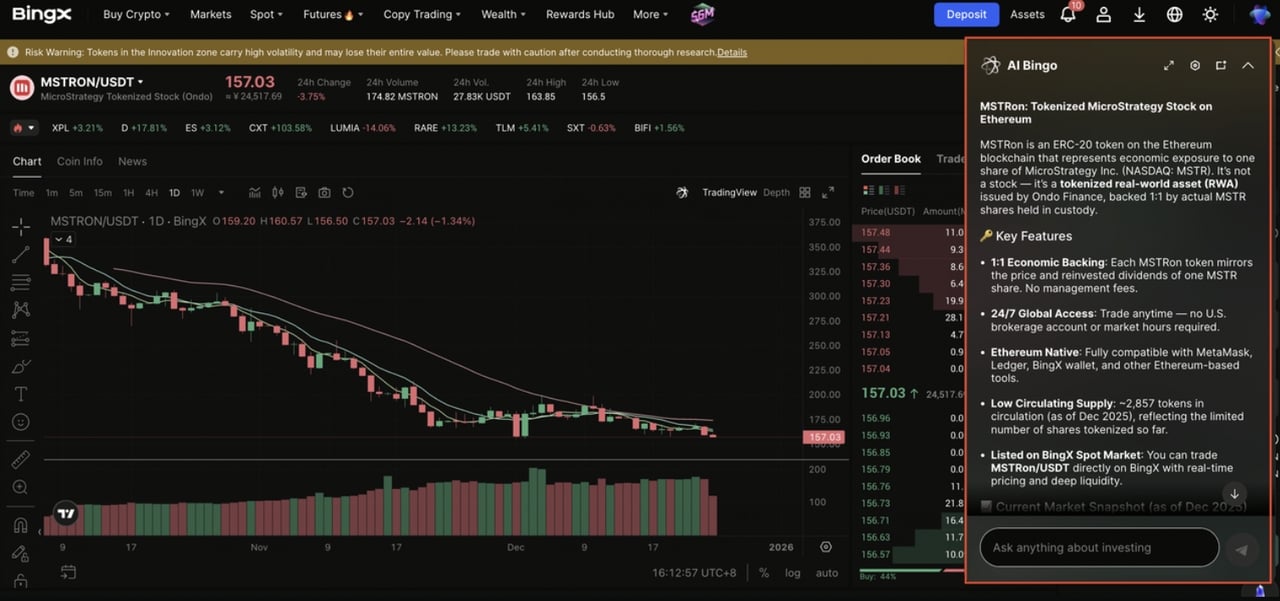
Source: BingX MicroStrategy Tokenized Stock MSTRON Price
1. Create and secure your BingX account: Register on BingX, complete identity verification (KYC) if required, and enable security features such as two-factor authentication (2FA) to protect your account.
2. Deposit USDT or supported assets: Transfer USDT or other supported stablecoins into your BingX wallet. Make sure to select the correct blockchain network and review any minimum deposit requirements or fees.
3. Search for MicroStrategy tokenized stocks in Spot Trading: Go to the Spot market and search for MSTRX/USDT or MSTRON/USDT, depending on availability. Review the real-time price, order book depth, and recent trading activity before proceeding.
4. Use BingX AI to assess market conditions: Before placing an order, you can ask BingX AI about recent price trends, key technical levels, or short-term sentiment related to MSTR and Bitcoin market movements.
5. Place your buy order: Choose a market order for immediate execution or a limit order to set your desired entry price. Enter the purchase amount and confirm the trade.
Once completed, MicroStrategy tokenized stocks will appear in your BingX spot wallet and can be held alongside other crypto assets.
Read More: Ondo Global Markets Unlocks 100+ Tokenized U.S. Stocks on Ethereum - All You Need to Know
2. Long or Short MicroStrategy Stock (MSTR) Price-Linked Futures on BingX TradFi
For users seeking leverage, directional exposure, or hedging opportunities, BingX Futures offers MSTR stock price-linked futures. These contracts allow traders to speculate on MicroStrategy’s stock price movements without holding the spot tokenized stock.
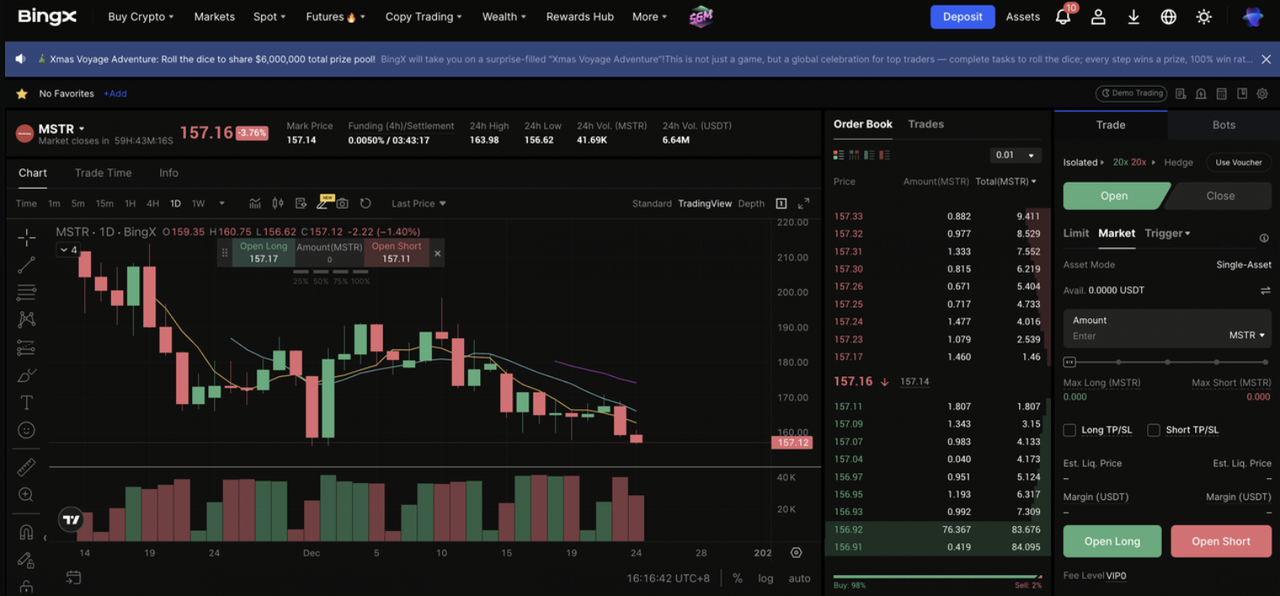
Source: BingX MicroStrategy Tokenized Stock MSTR Future Price
1. Enable futures trading: Log in to your BingX account, complete the required verification, and transfer USDT or supported collateral into your Futures wallet.
2. Open the MSTR stock price-linked futures market: Search for the MSTR-USDT perpetual contract and review leverage options, funding rates, and margin requirements before opening a position.
3. Use BingX AI to evaluate volatility and sentiment: Ask BingX AI about recent volatility, trend direction, or Bitcoin-related sentiment that may influence MSTR’s price behavior.
4. Choose long or short with your preferred leverage: Go long if you expect MSTR’s price to rise, or short if you anticipate a decline. Adjust leverage carefully based on your risk tolerance.
5. Execute and manage your trade: Place your order, set take-profit and stop-loss levels, and monitor funding rates, margin ratios, and overall market conditions throughout the trade.
This structure allows investors and traders to access MicroStrategy exposure on BingX through both spot tokenized stocks and futures, depending on whether they prioritize long-term holding, active trading, or leveraged strategies.
5 Critical Risks to Watch for MicroStrategy in 2026
While the Bitcoin treasury strategy offers substantial upside through leveraged exposure to BTC appreciation, investors must navigate a complex landscape of price volatility, capital structure, regulatory, and execution-related headwinds.
1. Bitcoin Price Volatility and Downside Exposure
MicroStrategy's valuation is overwhelmingly driven by its massive Bitcoin holdings of approximately 738,731 BTC as of March 2026. Sharp declines in Bitcoin's price directly amplify losses due to the company's leveraged structure, with unrealized fair-value adjustments causing significant reported earnings swings and potential multi-quarter net losses. A prolonged BTC bear market or failure to recover above key levels could erode treasury value and trigger steep share price corrections.
2. Dilution from Ongoing Capital Raises
To sustain Bitcoin accumulation, MicroStrategy relies heavily on frequent equity issuances, at-the-market offerings, and preferred instruments like STRC. These raises, which totaled $25.3 billion in 2025 alone, increase the share count substantially and dilute existing shareholders. If dilution accelerates without corresponding BTC per share growth or if market conditions make raises less accretive, it could pressure the stock even in flat or modestly rising Bitcoin environments.
3. Debt and Funding Access Risks
MicroStrategy's strategy involves significant leverage through convertible notes, preferred securities, and other debt-like instruments. Rising interest rates, credit market tightening, or shifts in investor appetite for Bitcoin-proxy debt could increase borrowing costs or limit access to capital. Any disruption in funding channels would slow or halt Bitcoin purchases, undermining the core accumulation thesis and exposing the company to liquidity strain.
4. Regulatory and Accounting Uncertainty
Changes in U.S. or global cryptocurrency regulations, tax treatment of digital assets, or SEC/FASB accounting standards for fair-value reporting could materially impact MicroStrategy. Adverse rulings, such as restrictions on corporate Bitcoin holdings, unfavorable tax policies, or shifts away from fair-value mark-to-market, might force balance sheet adjustments, increase compliance costs, or reduce the perceived attractiveness of the treasury model, leading to valuation compression.
5. Core Software Business Stagnation and Execution Risks
The legacy business intelligence software segment generates modest revenue of around $474 to $477 million in 2025 with limited growth prospects and a multi-year declining trend. If the analytics business continues to underperform or fails to contribute meaningful cash flow, it provides little buffer against treasury volatility. Any operational missteps in capital allocation, investor communication, or maintaining BTC Yield targets could further erode confidence in management's execution.
Conclusion: Should You Invest in MicroStrategy (MSTR) Stock in 2026?
Deciding whether to invest in MicroStrategy in 2026 requires viewing it primarily as a leveraged Bitcoin play rather than a traditional software company. For high-conviction investors with strong belief in Bitcoin's long-term appreciation and tolerance for extreme volatility, the company's massive holdings, disciplined no-sell policy, and proven accumulation track record (delivering 22.8% BTC Yield in 2025) support significant upside potential if BTC rallies substantially. Successful execution of the treasury strategy could drive outsized returns as the largest corporate Bitcoin holder benefits from broader adoption trends.
For conservative or risk-averse investors, the stock's high beta to Bitcoin, ongoing dilution, leverage risks, and dependence on sustained capital market access present substantial downside. The performance now ties almost entirely to Bitcoin price action: strong BTC rallies amplify gains through treasury value expansion, while prolonged weakness or funding disruptions could lead to sharp corrections. Closely monitor Bitcoin trends, quarterly holdings updates, BTC Yield metrics, capital raise announcements, and any regulatory developments as the clearest signals of whether MicroStrategy can continue compounding shareholder value at scale.
Risk Reminder: Trading and investing in equities like MSTR involves substantial risk of capital loss. MicroStrategy's extreme volatility, heavy reliance on Bitcoin price movements, leverage, and dilution risks make it a high-risk asset. Investors should conduct thorough independent research and consider professional financial advice before allocating capital.
