
Quantum Computing Inc. (QUBT) develops photonic quantum systems, components and manufacturing services for commercial and government customers. Its acquired photonics operations supply current revenue, while Dirac optimization machines and NeuraWave computing provide potential routes into broader enterprise workloads. Shareholder returns depend on converting that technical portfolio into repeat paid deliveries with enough gross profit to support research and manufacturing costs.
The latest quarter showed commercial expansion alongside a substantial operating cost burden. Quantum Computing Inc. Q2 2026 revenue reached $5.6 million, principally from photonics products, versus $61,000 a year earlier. Operating expenses reached $21.8 million, while interest income and smaller warrant losses helped narrow the net loss to $11.8 million. The next test is whether recognized shipments and gross profit rise as the acquired businesses integrate.
The QUBT stock forecast for 2026 now centers on two competing views:
- The commercial conversion case: Photonics shipments and accepted quantum systems turn backlog into growing gross profit, giving the existing cash reserve a more productive role.
- The integration pressure case: Delayed deliveries and acquisition spending absorb capital before the enlarged portfolio generates enough product profit to justify its anticipated commercial scale.
This guide breaks down the QUBT stock forecast, 2026 price scenarios, key risks and analyst outlooks, drawing on Quantum Computing Inc. earnings, official product information and Stock Analysis records through October 21, plus how to buy QUBT stock on BingX TradFi with USDT or USDC.
Top 5 Things for Quantum Computing Inc. Investors to Know in October 2026
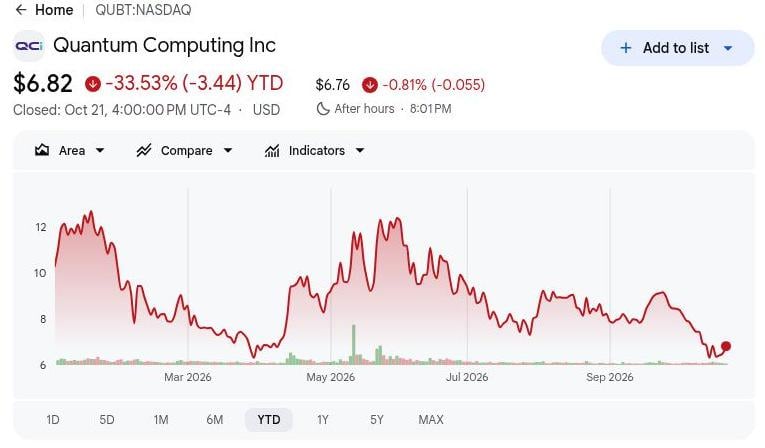
- QUBT closed at $6.82 on October 21, down 33.53% YTD: Shares remain well below their opening-year level, making the $18 bull scenario dependent on stronger commercial execution. A sustained recovery requires evidence that photonic systems can generate repeatable revenue rather than relying on valuation expectations.
- Q2 revenue increased to $5.6 million from $61,000 a year earlier: Sales also rose from $3.7 million in Q1, showing sequential progress. However, acquired photonics component sales contributed to growth, making it important to distinguish broader product demand from quantum-computing adoption.
- Backlog reached $42.5 million as commercial activity expanded: The June 30 backlog and delivered Dirac-3 installation at a consulting firm provide evidence of customer demand. Revenue recognition, customer acceptance, and product margins will determine how much of that pipeline translates into earnings.
- NeuraWave and Planck Dynamics provide additional growth opportunities: NeuraWave achieved commercial readiness in Q2, followed by a framework agreement with Planck Dynamics. Future deliveries and recognized revenue will determine whether these milestones develop into sustained commercial growth.
- Approximately $1.3 billion in cash and investments supports expansion: QUBT retained substantial liquidity after roughly $180 million in acquisition spending, including transaction expenses. This provides funding for development and commercialization, although improving gross profit and acquisition returns will be essential to long-term shareholder value.
What Is Quantum Computing Inc.?
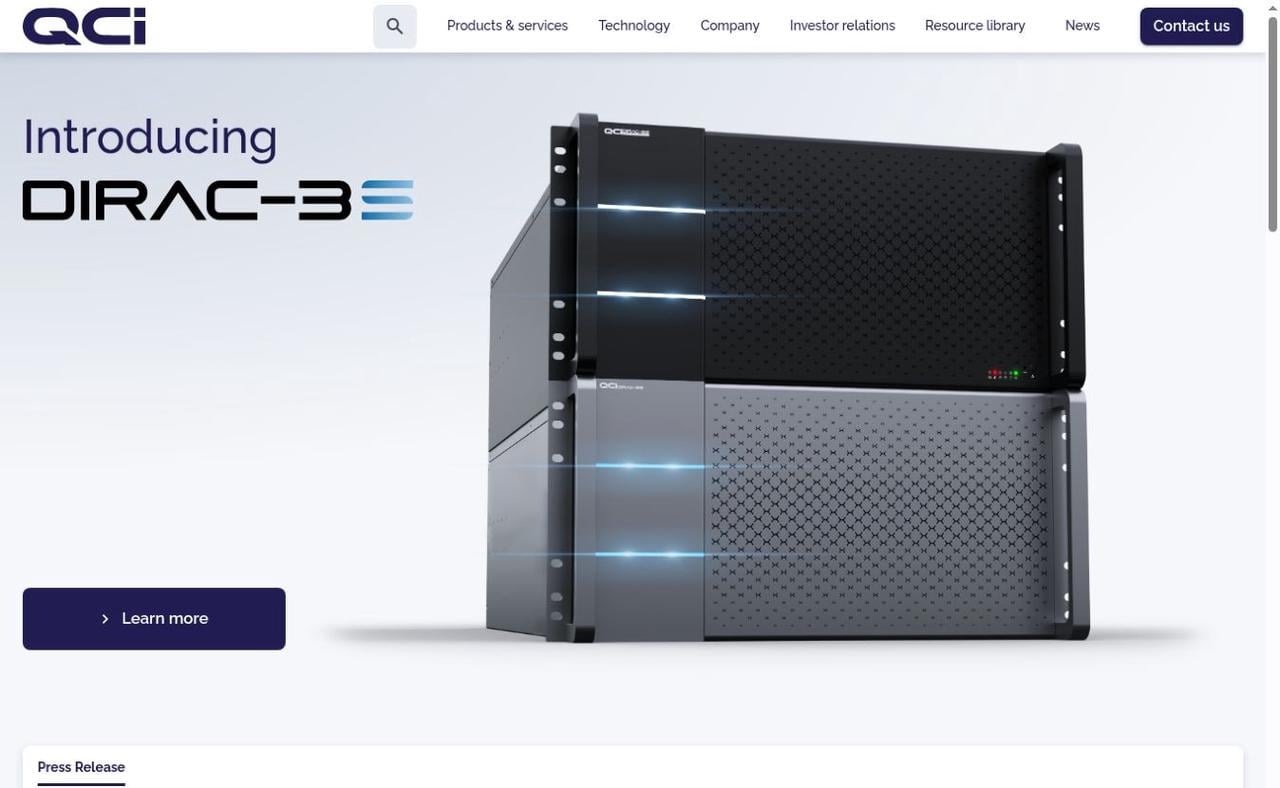
Quantum Computing Inc. (QUBT) develops room-temperature photonic quantum and quantum-inspired technologies, alongside photonics components and semiconductor manufacturing services. Its Dirac systems target optimization problems, while NeuraWave uses photonic reservoir computing for inference and signal processing. Customers include commercial enterprises, research institutions, and government-related organizations. Component sales and manufacturing services currently provide a more established revenue base, while broader quantum system adoption depends on customer acceptance, repeat orders, and manufacturing utilization.
QUBT's growth strategy focuses on commercializing its Dirac and NeuraWave systems while expanding photonics manufacturing through acquisitions, including NHanced, Freedom Photonics, and EM4. The company delivered a Dirac-3 system to an unnamed consulting firm and secured a framework agreement with Planck Dynamics following NeuraWave's commercial readiness. Its NHanced acquisition also supported the launch of Fab 2, expanding advanced packaging and manufacturing capabilities. These initiatives aim to turn QUBT's $42.5 million backlog into recurring product and manufacturing revenue, although customer deliveries and production utilization remain important measures of progress.
Read More: Top 10 Quantum Computing Stocks to Watch in 2026: Companies Driving Next-Gen Computation
Quantum Computing Inc. (QUBT) Q2 2026 Earnings Overview: Revenue Growth Accelerates as Operating Costs Rise
Quantum Computing Inc. reported Q2 2026 revenue of $5.6 million, up from $61,000 a year earlier and $3.7 million in Q1, driven primarily by photonics product sales. Operating expenses increased 114% to $21.8 million, while the net loss narrowed to $11.8 million, supported by higher interest income and lower warrant valuation losses. With $42.5 million in backlog and approximately $1.3 billion in cash and investments, future growth depends on converting commercial demand into profitable revenue.
|
Financial Metric |
Guidance / Consensus |
Reported / Actual |
Surprise |
|
Revenue |
$61K Q2 2025 |
$5.6M |
Surged. About 92 times prior sales. |
|
Sequential revenue |
$3.7M Q1 2026 |
$5.6M |
Rose. About 51% higher. |
|
Operating expenses |
$10.2M Q2 2025 |
$21.8M |
Increased. Up 114% YoY. |
|
Net loss |
$36.5M Q2 2025 |
$11.8M |
Narrowed. $24.7M smaller loss. |
|
Basic loss per share |
−$0.26 Q2 2025 |
−$0.05 |
Narrowed. $0.21 smaller loss. |
|
Interest and other income |
$1.8M Q2 2025 |
$13.0M |
Rose. $11.2M higher. |
|
Cash and investments |
~$1.5B at Dec. 31, 2025 |
~$1.3B |
Declined. About $200M lower. |
|
Contract backlog |
No comparable figure cited |
~$42.5M |
Pipeline. At June 30, 2026. |
- Q2 revenue climbed to $5.6 million, up 51% sequentially. Sales increased from $3.7 million in Q1 and just $61,000 a year earlier, reflecting improving commercial activity. Sustained quarterly growth will provide stronger evidence of demand than the unusually large annual percentage increase.
- Photonics products drove most of the revenue growth. Sales to aerospace, government, and industrial applications expanded QUBT's commercial base. However, recurring component orders and broader adoption of its quantum systems remain important to establishing sustainable growth.
- Net loss narrowed to $11.8 million despite higher operating costs. Operating expenses increased 114% to $21.8 million, while warrant valuation losses declined to $1.7 million from $28 million and interest and other income reached $13 million. These non-operating contributions improved reported results, but underlying profitability remains a challenge.
- Acquisitions expanded QUBT's manufacturing capabilities. Approximately $180 million, including transaction expenses, was spent on Luminar Semiconductor, NuCrypt, and NHanced. The investments support photonics production and advanced packaging, although future returns depend on manufacturing utilization and gross profit growth.
- The $42.5 million backlog provides visibility into future deliveries. The June 30 balance represents a substantial pipeline relative to Q2 revenue, but recognition depends on shipment timing and customer acceptance. Converting backlog into recurring sales, improving margins, and generating cash will be central to QUBT's next growth phase.
Quantum Computing Inc. (QUBT) 2026 Investment Outlook: $18 Bull Case vs. $5 Bear Case
QUBT's remaining-year outlook turns on whether backlog and acquired photonics operations produce enough additional gross profit to narrow the gap with operating spending. Q2's $5.6 million revenue base is still small beside $21.8 million of expenses. The cash reserve provides development time, while the following editorial December 2026 scenarios test how product conversion changes its value to shareholders.
The Bull Case: Faster Backlog Conversion Gives the $18 Scenario an Earnings Basis
Faster acceptance of photonic systems would lift gross profit while the existing cash reserve continues funding development. Q2 revenue reached $5.6 million against $21.8 million of operating expenses, with $42.5 million of backlog still to convert. Repeated shipments and fuller manufacturing utilization would spread fixed costs across more sales and reduce reliance on investment income.
The $18 scenario would gain support if recognized revenue rises clearly above Q2 and product margins improve while spending growth slows. Those changes would give investors an earnings mechanism for valuing the commercial pipeline more highly.
The Base Case: Photonics Sales and Cash Support an 8–11 Range
Continued photonics shipments would provide incremental revenue while cash supports integration, leaving the heavy expense base only partly absorbed. Q2 sales were $5.6 million and cash plus investments were approximately $1.3 billion after acquisitions. Gradual backlog conversion would extend commercial evidence without yet making the enlarged manufacturing and research operations self-funding.
An 8–11 range would fit steady recognized shipments and visible backlog conversion with controlled cash use. Without a substantial gross-margin improvement, the balance sheet would support the valuation while continuing operating losses limit the case for a larger premium.
The Bear Case: Delivery Delays Expose the Cost Base at $5
Slower system acceptance would reduce incremental gross profit and leave acquisition integration costs more exposed. Q2 operating expenses were $21.8 million, including $7.3 million of transaction costs, against $5.6 million of revenue. If delivery delays persist, research and manufacturing commitments would consume cash before the purchased capabilities establish sufficient paying utilization.
The $5 scenario would become more plausible if sequential sales weaken and backlog conversion stalls while cash spending continues. That combination would reduce confidence in the acquisitions' future returns, even with a substantial financial reserve still available.
QUBT Stock Price Forecasts for 2026 By Wall Street Analysts
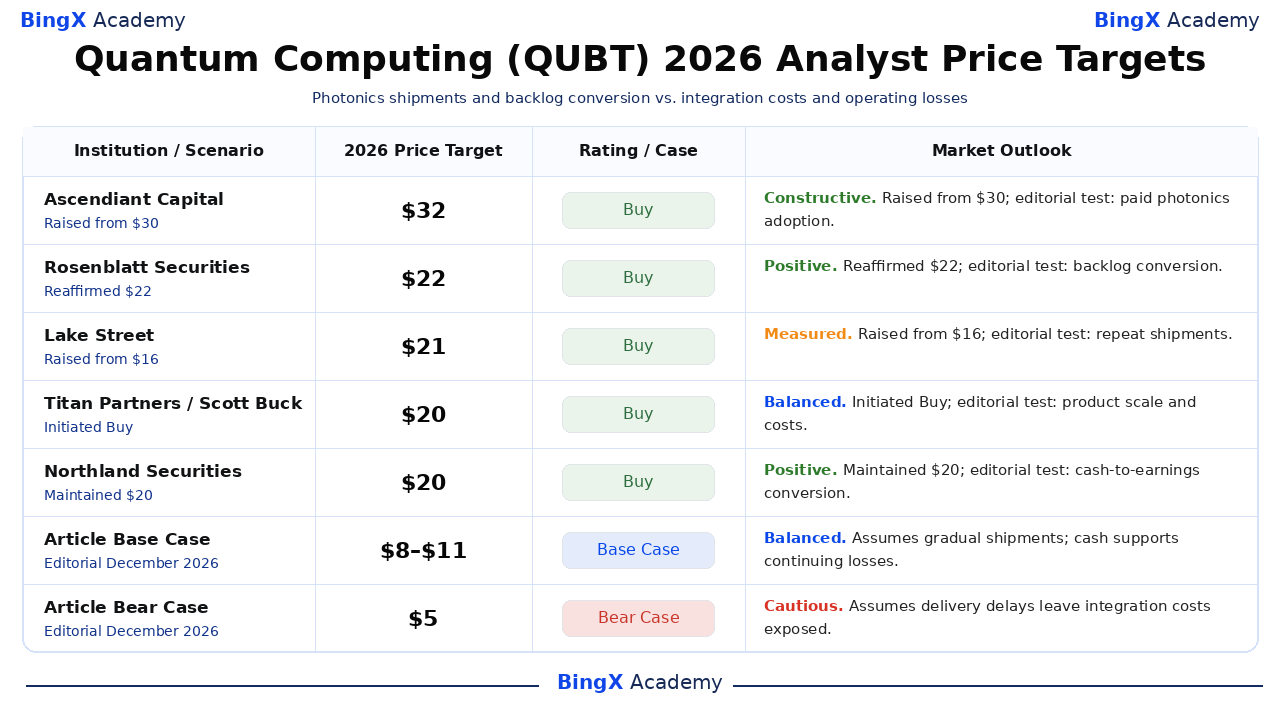
The selected calls concern QUBT common shares on NASDAQ and span approximately 12-month analyst horizons, often beyond December 2026. Stock Analysis records the dated actions; ratings use its standardized labels. The spread reflects differing valuation assessments, while the explanations marked editorial are this article’s interpretation. Base and Bear rows are separate editorial year-end scenarios.
|
Institution / Scenario |
2026 Price Target |
Rating / Case |
Market Outlook |
|
Ascendiant Capital |
$32 |
Buy |
Constructive. August 26, 2026: Raised from $30; maintained Buy. Editorial view: Scale depends on paid photonics adoption. |
|
Rosenblatt Securities |
$22 |
Buy |
Positive. October 19, 2026: Reaffirmed Buy and a $22 target. Editorial view: Backlog must become recognized product revenue. |
|
Lake Street |
$21 |
Buy |
Measured. August 11, 2026: Raised from $16; reiterated Buy. Editorial view: Repeat shipments must support the enlarged portfolio. |
|
Titan Partners |
$20 |
Buy |
Balanced. September 22, 2026: Initiated Buy at $20. Editorial view: Commercial adoption must justify the operating cost base. |
|
Northland Securities |
$20 |
Buy |
Positive. August 11, 2026: Maintained Buy and a $20 target. Editorial view: Cash support needs stronger operating economics. |
|
Article Base Case |
8–11 |
Base Case |
Balanced. Editorial December 2026 scenario. Assumes gradual shipments; cash supports continuing losses. |
|
Article Bear Case |
$5 |
Bear Case |
Cautious. Editorial December 2026 scenario. Assumes delivery delays leave integration costs exposed. |
How to Buy Quantum Computing Inc. (QUBT) Stock on BingX
Buy and hold Quantum Computing Inc. shares through BingX Stocks Trading using USDT or USDC, subject to listing and account eligibility. Quantum Computing offers exposure to photonic quantum systems, photonics components and semiconductor manufacturing services. Eligible users can size holdings according to their investment goals without using leverage or paying perpetual funding fees.
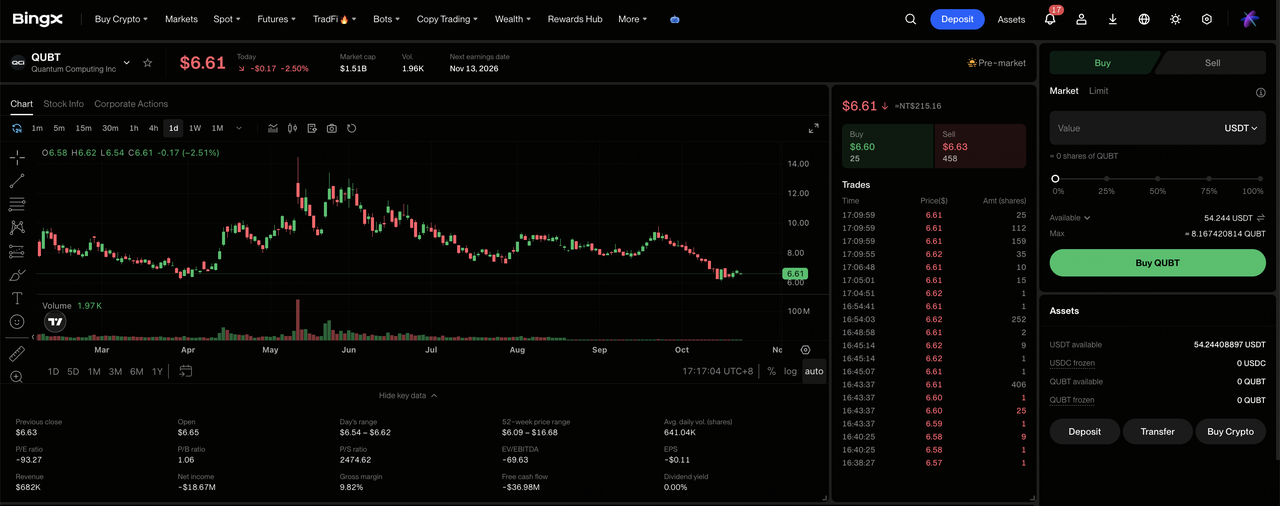
Step 1: Access BingX Stocks Trading. Sign up or log in to BingX, complete the required identity verification, and navigate to “TradFi > Stocks”. Accept the Stock Trading Risk Disclosure if accessing the product for the first time.
Step 2: Prepare USDT or USDC. Ensure your Spot Account has sufficient funds for the purchase. Transfer USDT or USDC from your Fund Account or Wealth Account if needed. Review the selected stock’s minimum order amount and fractional eligibility before choosing the investment size.
Step 3: Select Quantum Computing Inc. (QUBT). Open the Stocks market, search for QUBT, and confirm that the share is available to your account. Review the company identity, current share price, trading session and available order types.
Step 4: Buy Quantum Computing Inc. Shares. Select “Buy”, enter an allowed investment amount or share quantity, and choose a supported market or limit order. Market orders use available prices during supported sessions, while limit orders require the specified price or better and sufficient liquidity to execute.
Step 5: Review and Manage Your Holdings. Open “Stocks > Positions” to monitor your QUBT shares and unrealized profit or loss. Use All Orders to review transactions or sell shares when needed. T+1 settlement generally affects when sale proceeds become withdrawable, rather than when purchased shares can be sold.
Top 5 Risks to Watch for Quantum Computing Inc. Investors in 2026
QUBT's expanding photonics business, acquisition strategy, and substantial cash reserves support its commercialization plans. However, limited revenue scale, rising operating costs, backlog conversion, and technology adoption remain key risks to profitability and shareholder returns.
- Limited revenue scale could make growth volatile: Q2 revenue reached $5.6 million, but the business remains sensitive to individual aerospace, government, and system orders. Delayed contracts or shipments could cause significant quarterly fluctuations and pressure valuation.
- Operating costs could outpace revenue growth: Q2 operating expenses reached $21.8 million, nearly four times revenue. Continued manufacturing and engineering investments could extend losses if sales and production utilization fail to improve quickly enough.
- Backlog conversion could delay future earnings: QUBT's $42.5 million backlog supports revenue visibility, but delivery schedules and customer acceptance remain uncertain. Slower conversion could weaken near-term growth expectations despite a healthy pipeline.
- Acquisitions could deliver weaker-than-expected returns: Approximately $180 million was spent on acquisitions, including transaction expenses. Integration challenges, low manufacturing utilization, or additional investment needs could limit gross profit growth and reduce shareholder value.
- High valuation sensitivity could amplify share-price swings: QUBT's early commercial stage leaves its valuation dependent on future technology adoption and revenue growth. Changing investor sentiment, competition, or disappointing execution could trigger significant declines even without major changes in current sales.
Final Thoughts: Should You Invest in Quantum Computing Inc. in 2026?
Quantum Computing's $5.6 million in quarterly revenue and $42.5 million backlog show commercial expansion alongside substantial work awaiting delivery. Photonics sales and a delivered Dirac-3 provide commercial evidence, while acquired manufacturing capacity and cash reserves support development. Sustaining that progress will depend on converting orders into profitable shipments and controlling integration and research spending.
The $18 bull case assumes faster shipments, higher manufacturing utilization, and stronger gross margins. The $8 to $11 base case reflects gradual order conversion, while the $5 bear case accounts for delivery setbacks and cash consumption. With QUBT closing at $6.82 on October 21, investors should watch whether commercial expansion generates enough gross profit to narrow operating losses.
Risk Reminder: Quantum Computing's photonics portfolio and cash reserves do not eliminate commercialization risk. Delayed deliveries, acquisition integration problems, or persistent operating losses could weaken cash generation and shareholder returns. Investors should assess valuation, commercial progress, and their risk tolerance before buying QUBT shares.
Related Reading
- Top 10 Quantum Computing Stocks to Watch in 2026: Companies Driving Next-Gen Computation
- How to Buy U.S. Stocks on BingX With USDT or USDC: A Beginner's Guide
- IonQ (IONQ) Price Prediction 2026: Can Full-Stack Quantum Growth Push IONQ Toward $65?
- Infleqtion (INFQ) Price Prediction 2026: Can NASA and Quantum Computing Growth Push INFQ Toward $28?
- Quantinuum (QNT) Price Prediction 2026: Can Enterprise Quantum Demand Push QNT Toward $155?
- QuantumScape (QS) Price Prediction 2026: Can Solid-State Battery Progress Push QS Toward $10?
