In mid-June 2026, Nokia Oyj (NOK) finds itself positioned at a dramatic crossroads between unprecedented industrial demand for AI data center infrastructure and legacy macroeconomic drag. Following a spectacular 140% vertical surge earlier in the year that saw shares hit a 17-year high near $17.45 on June 3, the Helsinki-headquartered telecommunications giant is currently trading near $14.09, exhibiting a highly volatile but robust net gain year-to-date.
While the stock spent years labeled as "dead money" by traditional retail market participants, back-to-back structural breakthroughs have completely revolutionized its long-term revenue outlook. Investors are aggressively weighing an exceptionally strong fiscal first-quarter report and raised full-year guidance against a volatile macro environment and sudden short-term sector profit-taking.
As the global technology ecosystem transitions toward specialized agentic AI frameworks, the absolute necessity for high-capacity optical transport networks and intelligent edge fabrics has transformed Nokia into a primary digital bottleneck breaker. However, deep structural debates regarding its legacy mobile hardware exposure continue to create a persistent valuation overhang.
This guide breaks down the Nokia stock forecast and price prediction for the remainder of 2026, utilizing data from Bank of America Securities, Morgan Stanley, JPMorgan, Zacks Investment Research consensus estimates, and official corporate financial disclosures. You can also learn how to trade Nokia stock futures on BingX TradFi with USDT collateral.
Top 5 Things for Nokia (NOK) Traders to Know in 2026
As Nokia navigates a high-stakes environment of structural AI-RAN scaling and intensive legacy infrastructure rebalancing, traders must closely monitor these five market-moving factors:
- The $1 Billion NVIDIA Anchor Investment: In a massive validation of Nokia's infrastructure architecture, NVIDIA executed a milestone $1 billion equity investment in Nokia at $6.01 per share. The comprehensive partnership anchors Nokia as a preferred networking vendor for the high-growth Nscale data center framework.
- Surging AI and Cloud Revenues: During its latest Q1 2026 earnings print, Nokia recorded a stunning 49% year-over-year expansion in AI and cloud infrastructure revenue, booking over €1 billion in fresh cloud orders in a single quarter primarily tied to optical networking equipment.
- The Agentic AI Framework Launch: On June 11, 2026, Nokia officially brought an operating update introducing its advanced agentic AI framework to its Network Services Platform, enabling automated troubleshooting, root-cause analysis, and autonomous operations across complex IP network topologies.
- The Infinera Integration Acceleration: Management officially confirmed that the integration of U.S. optical networking pioneer Infinera is tracking ahead of schedule, providing Nokia with a powerful, early-access captive capability to deliver 800G ZR/ZR+ pluggables to hyperscale data center clusters.
- NVIDIA 6G Encroachment Concerns: Despite current deep ties, early June 2026 witnessed intense multi-broker volatility across the entire telecom equipment spectrum due to emerging industry chatter regarding NVIDIA's long-term ambitions to directly deploy native 6G mobile-network processing layers.
What Is Nokia Corporation (NOK)?
Nokia Corporation is a global leader in B2B digital infrastructure, specialized network routing, and optical transport hardware solutions. Shifting completely away from its legacy legacy consumer hardware identity, the modern Nokia operates as a fundamental architectural layer underpinning the global internet and corporate intranet layout.
Following a comprehensive internal restructuring effective January 2026 under CEO Justin Hotard, the entity operates through a streamlined, application-optimized layout focused on two massive market verticals: Network Infrastructure comprising highly technical Fixed Networks, IP Networks, and Optical Networks, and Mobile Infrastructure encompassing 5G, Open RAN, and next-generation AI-RAN architectures.
Nokia's Performance in Early 2026: The Post-Earnings Repricing
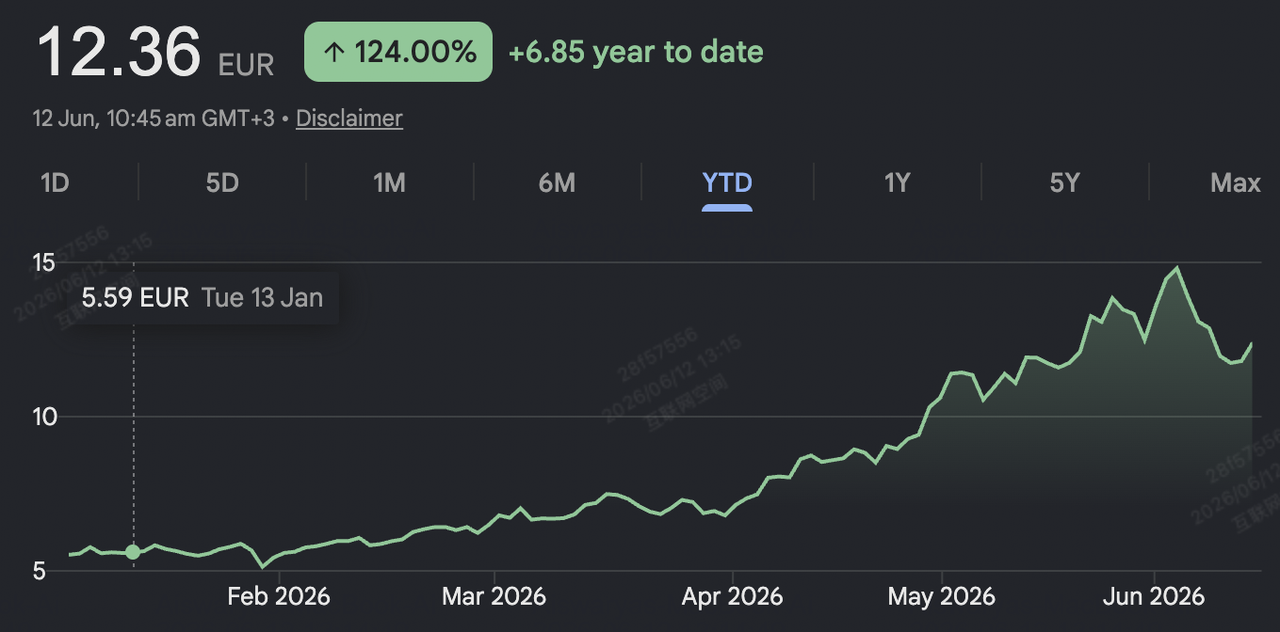
Nokia stock performance 2026 YTD as of June | Source: Google Finance
The company kicked off its structural re-rating by reporting standout fiscal first-quarter 2026 financial results on April 23. Net sales climbed to approximately €4.5 billion, marking a resilient 4% year-over-year expansion in constant currency. While legacy spending pauses by certain global telecom carriers slightly impacted total revenue, the underlying data center segments experienced a fundamental acceleration.
Here is the reformatted table for your article, optimized using standard Markdown for clean rendering and a professional, scannable layout.
Nokia Q1 2026 Key Financial Performance Metrics
|
Metric |
Reported Figure |
YoY Change |
|
Total Net Sales |
€4.5 Billion |
+4% (CC) |
|
Comparable Operating Profit |
€281 Million |
0.54 |
|
AI & Cloud Infrastructure Sales |
8% of Total Group |
0.49 |
|
Net Cash Position |
€3.8 Billion |
Robust Floor |
Crucially, comparable operating profit surged 54% to €281 million, easily outstripping the €250 million Wall Street consensus forecast. Driven by high-margin optical data center sales, the company's adjusted earnings per share (EPS) hit €0.0586 ($0.05), beating projections by more than 31%.
This massive margin expansion prompted management to aggressively lift full-year organic growth expectations for Network Infrastructure to a 12%–14% range, while projecting Optical and IP Networks to grow at an 18%–20% clip.
Nokia's 2026 Trading Strategy: Navigating Volatility Multiples
- The $11.50 – $13.00 Structural Support Window: Following a healthy 18% technical pullback from its early June peaks near $17.45, driven by sector-wide rotation and macro inflation caution, technical analysts view the $11.50 to $13.00 zone as a critical near-term structural floor. Maintaining daily closes above this window keeps the long-term bullish trend intact.
- Evaluating Stretched Multiples vs. Cash Flow: Trading at a forward price-to-earnings (P/E) multiple ranging between 30x and 37x, Nokia is experiencing significant multiple expansion relative to its historical values. However, compared to pure-play AI networking counterparts like Arista Networks trading north of 45x, Nokia offers a substantial fundamental discount, backed by €3.8 billion in protective net cash.
- The Sum-of-the-Parts Framework: Because Nokia's high-growth AI optical networking units are packaged alongside its mature, slower-moving mobile infrastructure division, tactical traders should utilize a sum-of-the-parts analysis rather than viewing the corporation under a single legacy multiple.
Nokia 2026 Investment Outlook: $20 Street-High Peak vs. $5 Value Trap
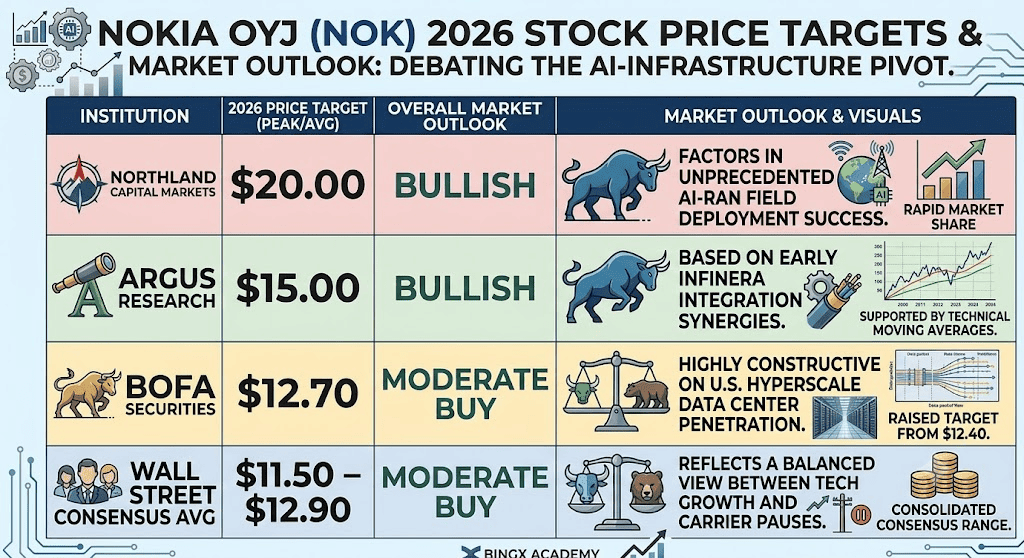
Evaluating Nokia's forward price target for the remainder of 2026 requires balancing an explosive, multibillion-dollar optical hyperscale pipeline against the cyclical expenditure patterns of traditional mobile network operators.
Nokia's Bull Case: The $20 AI-RAN and Optical Supercycle Monopoly
The bullish thesis hinges on structural market re-rating. Underpinned by ultra-bullish street targets from Northland pointing toward the $20 mark, this outlook assumes that the AI-RAN alliance with NVIDIA converts into dominant design wins across tier-1 operators globally, building on early momentum with T-Mobile, SoftBank, and Vodafone.
In this scenario, Nokia’s accelerating 800G optical transport shipments to U.S. hyperscalers completely overwhelm any legacy mobile network drag. If the upcoming Q2 earnings report on July 23 validates sustained margin widening and confirms order book expansion beyond the initial €1 billion quarterly clip, institutional capital will likely trigger a massive second leg, pushing the stock past near-term resistance toward structural target extensions.
The Base Case: NOK Stock's $11 – $15 Consolidation Plateau
The base case envisions a prolonged, healthy consolidation where the market systematically rewards Nokia's immense cloud hardware growth while applying a slight discount for its legacy telecom exposure. Under this framework, aggregate corporate revenue expands at a steady 4.6% per annum, guided by insatiable global data-center buildouts.
The stock trades natively between $11.00 and $15.00, matching a balanced fair value estimate. Abrupt spikes driven by high-profile corporate updates, such as the Sunnyvale AI Networking Innovation Lab rollouts, are occasionally paired with periodic profit-taking as the market awaits multi-quarter validation of bottom-line cash generation.
The Bear Case for Nokia Stock: The $5 Legacy Value Trap and Disintermediation Risk
The bearish outlook focuses on capital expenditure cyclicality and structural margin erosion. If hyperscaler AI data center investments experience a sudden mid-year cooling cycle, or if competitive pricing wars with entrenched hardware peers like Cisco, Ciena, or Ericsson cut into gross margins, Nokia's forward multiple could compress rapidly.
Furthermore, if industry anxieties regarding NVIDIA or large hyper-scalers developing cloud-native infrastructure software directly onto standard off-the-shelf components become reality, the 'mini-Arista' growth thesis within Nokia could unravel. A technical breach below the key $11.50 support line could trigger deep institutional liquidation, causing a mean-reversion move down toward long-term historical accumulation baselines.
Nokia (NOK) Price Predictions for 2026 by Wall Street Analysts
|
Institution |
2026 Price Target (Peak/Avg) |
Overall Market Outlook |
|
Northland |
$20.00 |
Bullish: Factors in unprecedented AI-RAN field deployment success and rapid market share gains. |
|
Argus Research |
$15.00 |
Bullish: Based on early Infinera integration synergies and technical moving average support. |
|
BofA Securities |
$12.70 |
Moderate Buy: Raised target from $12.40; highly constructive on U.S. hyperscale data center penetration. |
|
Wall Street Consensus Avg |
$11.50 – $12.90 |
Moderate Buy: Reflects a balanced view between hyper-growth optical tech and legacy carrier pauses. |
How to Trade Nokia (NOK) Stock Futures on BingX TradFi
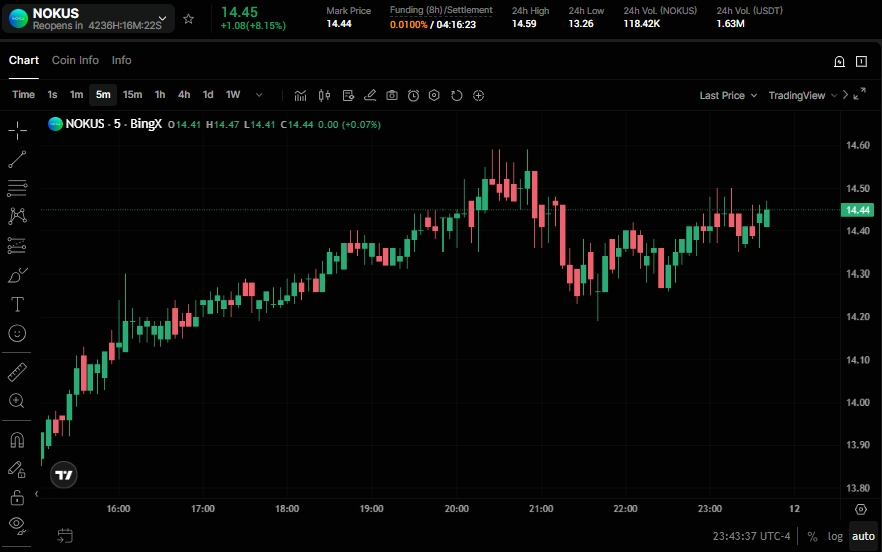
NOKUS/USDT perpetual contract on BingX futures market
As Nokia navigates this structural transition and exhibits high daily trading volumes, tactical market participants can capitalize on both upward momentum and down-trend corrections via the BingX ecosystem.
- Access BingX TradFi: Log in and navigate to the specialized TradFi section on the main BingX exchange dashboard.
- Select Nokia (NOK): Search for the NOK-USDT perpetual futures contract on the asset indexing board.
- Choose Your Direction: Select Open Long if you anticipate that expanding agentic AI networking platform orders will propel the asset to retest its yearly highs. Select Open Short to capitalize on technical corrections, macro resistance, or sector-wide profit-taking.
- Configure Risk Parameters: Set your Isolated or Cross-Margin preferences alongside conservative leverage ratios to maximize capital utility.
- Enforce Absolute Risk Controls: Always configure automated Take-Profit and Stop-Loss (TP/SL) points immediately upon order placement to safeguard your trading account from sudden news-driven gap moves.
Top 5 Risks to Consider Before Investing in NOK Stock
While Nokia's transition into an artificial intelligence networking powerhouse presents a compelling growth narrative, capital allocators must carefully weigh the structural headwinds and competitive pressures facing its legacy business models.
- Carrier Spending Reductions: Traditional telecommunications operators globally maintain highly rigid, conservative capital expenditure profiles, which can limit near-term top-line mobile revenue growth.
- Intense Hardware Pricing Competition: Entrenched sector giants like Ciena, Cisco, and Ericsson are aggressively defending their market footprints, presenting a constant risk of competitive margin compression.
- Technological Disintermediation: The potential for major semiconductor developers or cloud service providers to design specialized, in-house open network configurations could alter long-term demand dynamics.
- Cyclical Capital Investment Waves: Corporate infrastructure spending on hardware is historically subject to intense cyclical build phases followed by sudden digestion periods.
- Currency Conversion Friction: As a major multi-national entity reporting financials in Euros while deriving significant revenue from U.S. and Asian end-markets, Nokia remains vulnerable to global exchange rate volatility.
Final Thoughts: Is Nokia (NOK) Stock a Buy in 2026?
Nokia represents one of the most compelling and highly debated transformation plays in the modern computing landscape. The underlying numbers from its latest quarter clearly show that its strategic entry into high-speed optical routing and software-driven network automation is a tangible growth engine rather than mere marketing rhetoric.
For short-term tactical traders, the equity's newly discovered high beta and volatile pricing ranges create an excellent, liquid environment for volatility capture using advanced trading vehicles. Long-term position builders, conversely, must carefully observe upcoming financial updates to confirm that high-margin cloud infrastructure orders continue to systematically outpace legacy telecom constraints on the macro corporate balance sheet.
Risk Reminder: Trading global digital infrastructure equities involves inherent financial risk due to capital-intensive development timelines, shifting technology standards, and broader macroeconomic factors. Always utilize strict risk parameters, enforce disciplined position allocation, and never trade with capital you cannot afford to lose.
Related Reading
- AAOI Stock Prediction 2026: $260 Photonics Boom or Dilution Trap?
- Lumentum Stock Forecast 2026: Can AI Optics Boom, AI Data Center Supercycle Drive LITE Above $1,200?
- Top 10 AI Hardware Stocks to Watch in 2026: The Architecture Driving Next-Gen Intelligence
- Top AI Data Center Stocks to Buy in 2026: Cloud, Servers, and AI Compute Infrastructure
- Top AI Semiconductor Stocks to Buy in 2026: AI Chips and Supply Chain Complete Guide
