


Keel Infrastructure (KEEL), formerly Bitfarms, is a North American developer and owner of data centers and energy infrastructure for high-performance computing and artificial intelligence. The company is winding down Bitcoin mining and redirecting its power, land and grid connections toward large computing campuses. Its 2.2 GW development pipeline creates substantial capacity optionality, though the stock remains sensitive to tenant agreements, permits, construction costs and financing.
The latest quarter showed why the transition can look weak before new leases begin producing revenue. Keel Infrastructure Q2 2026 revenue fell 50% to $30.4 million as Keel shut its Moses Lake mining operation, while adjusted EBITDA moved from a $6.6 million profit to a $23.7 million loss. The investment case now depends on whether $819 million of liquidity can carry Panther Creek, Sharon and Moses Lake through permitting and lease execution.
The KEEL stock forecast for 2026 now centers on two competing views:
- The power-pipeline and tenant-contract case: permits and hyperscale leases could convert 341 MW of energized capacity and 430 MW of secured capacity into long-duration AI infrastructure cash flow.
- The development-delay and capital case: leasing slippage, cost overruns or new funding needs could consume liquidity before the 2.2 GW pipeline produces material high-performance-computing revenue.
This guide breaks down the KEEL stock forecast, 2026 price scenarios, key risks and analyst outlooks, drawing on Keel Infrastructure's August 10 Q2 2026 earnings release, quarterly filing and market data through September 18, plus how to trade KEEL stock futures on BingX TradFi with USDT collateral.
Top 5 Things for Keel Infrastructure Investors to Know in September 2026
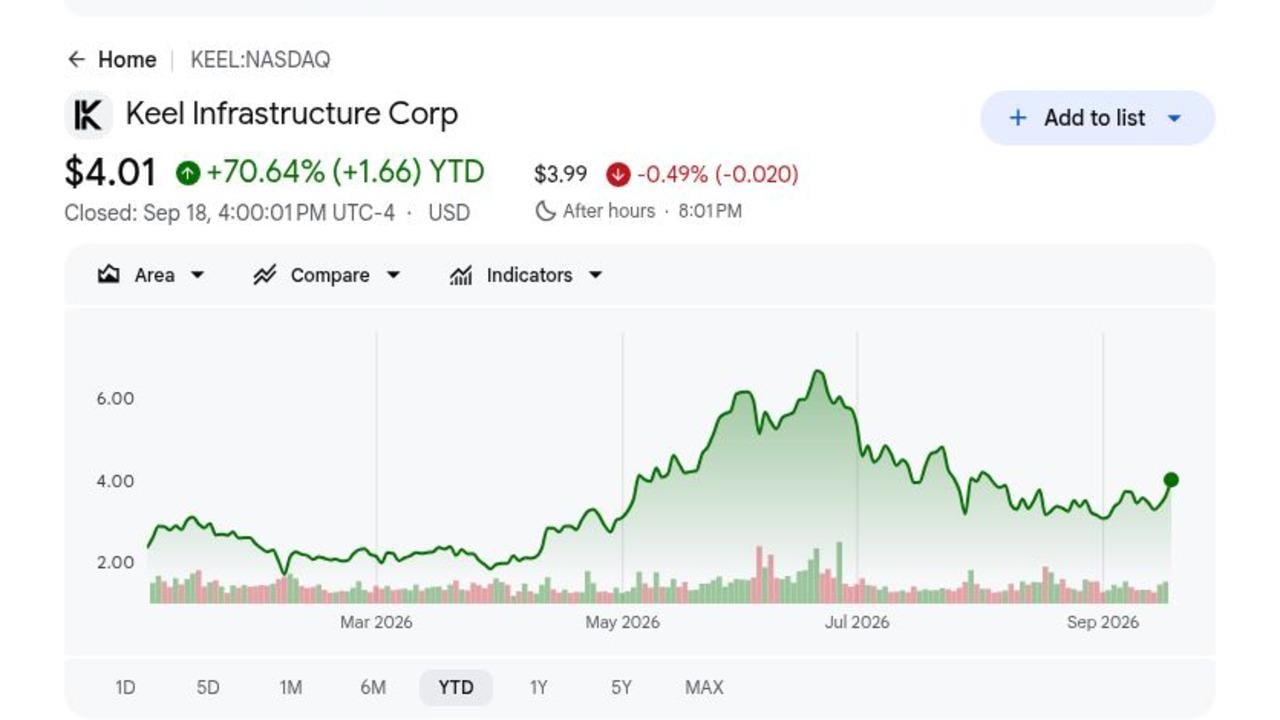
- KEEL closed at $4.01 after gaining 70.64% in 2026: The September 18 close followed an 11% daily gain as investors revalued the former Bitcoin miner around AI infrastructure. The rally raises execution expectations before Keel has signed a major HPC lease.
- Q2 revenue fell 50% to $30.4 million: Revenue declined from $60.9 million as Bitcoin prices weakened and U.S. mining at Moses Lake shut in April. The transition is partly intentional, but it leaves a gap between declining mining revenue and future data-center rent.
- The development pipeline reached 2.2 GW: Keel reported 341 MW of energized capacity, 430 MW of secured capacity and 1.5 GW of expansion potential across Pennsylvania, Washington and Quebec. The value depends on permits, leases and construction turning power access into occupied facilities.
- Liquidity reached $819 million after a $458 million note offering: The August 7 balance included $698 million of unrestricted cash and $121 million of unencumbered Bitcoin. That funding supports site development before tenant commitments, though convertible debt and future equity can still dilute shareholders.
- Three priority sites entered active tenant negotiations: Panther Creek, Sharon and Moses Lake were nearing full permitting with multiple prospective tenants at each site. A signed lease would provide the clearest proof that Keel can convert power access into contracted data-center revenue.
What Is Keel Infrastructure (KEEL)?

Keel Infrastructure is an infrastructure-first company that controls power-connected sites for data centers and high-performance computing. Its operating portfolio spans Pennsylvania, Washington State and Quebec, where grid interconnections, land and energy access can support large computing campuses. Keel develops and owns the underlying facilities rather than selling chips or cloud software. Revenue still reflects legacy Bitcoin mining, though the intended long-term model is contracted infrastructure income from AI and HPC tenants.
The strategy centers on Panther Creek and Sharon in Pennsylvania, Moses Lake in Washington and Sherbrooke in Quebec. Keel accepted its first Vertiv modules at Moses Lake, advanced long-lead equipment at Sharon, began final fiber contracts across the three priority sites and signed an agreement with Hydro-Sherbrooke covering the conditional transfer and operation of 96 MW. Those projects place Keel within the broader AI data-center infrastructure cycle, though management still needs signed customers and construction economics.
Read More: Top Bitcoin Mining Stocks to Buy in 2026: BTC Hashrate Meets the AI Infrastructure Pivot
Keel Infrastructure (KEEL) Q2 2026 Earnings Overview: Legacy Revenue Falls Before AI Leases Begin
Keel reported Q2 revenue of $30.4 million, down 50% from $60.9 million, and a $64.0 million loss from continuing operations equal to $0.11 per diluted share. Adjusted EBITDA moved to negative $23.7 million from positive $6.6 million, while G&A expense rose 62% to $31.3 million as the company hired infrastructure specialists. Liquidity of $819 million and a 2.2 GW pipeline funded the transition, though new HPC revenue had not yet offset the mining wind-down.
|
Financial Metric |
Guidance / Consensus |
Reported / Actual |
Surprise |
|
Q2 2026 revenue |
$60.9M a year earlier |
$30.4M |
Contracted. Revenue fell 50% as Keel shut Moses Lake mining and Bitcoin prices weakened. |
|
Q2 diluted EPS |
$0.02 profit a year earlier |
-$0.11 |
Widened. Continuing operations moved to a loss during the infrastructure transition. |
|
Q2 operating loss |
$10.8M operating income a year earlier |
-$140.8M |
Deteriorated. The result included $84.1M of depreciation and digital-asset effects. |
|
Q2 adjusted EBITDA |
$6.6M a year earlier |
-$23.7M |
Turned negative. Development hiring and lower mining revenue reduced earnings. |
|
Q2 G&A expense |
$19.4M a year earlier |
$31.3M |
Increased. Expense rose 62% as Keel hired senior infrastructure specialists. |
|
Liquidity at August 7 |
— |
$819M |
Strengthened. The balance included $698M cash and $121M of unencumbered Bitcoin. |
|
Development pipeline |
— |
2.2 GW |
Advanced. The portfolio included 341 MW energized and 430 MW secured capacity. |
|
Bitcoin sold since April 1 |
— |
1,085 BTC for $75M |
Transitioned. Keel continued funding the move away from mining. |
- Revenue of $30.4 million fell by $30.5 million year over year: The 50% decline reflected Keel's mining exit and weaker Bitcoin economics. Future quarters should be judged more on lease milestones because legacy comparisons will remain distorted until HPC rent begins.
- The $0.11 loss per share replaced a $0.02 profit: Continuing operations lost $64.0 million, while a $77.0 million derivative gain partly offset the $140.8 million operating loss. Operating cash needs therefore provide a cleaner view than headline net income.
- Adjusted EBITDA fell by $30.3 million to negative $23.7 million: Higher development staffing and lower mining revenue pushed the margin to negative 78%. The result shows that the transition is consuming capital before tenant contracts begin producing recurring cash flow.
- Liquidity reached $819 million: Keel held $698 million in cash and $121 million in unencumbered Bitcoin after raising $458 million through convertible notes. The balance provides development runway, though future financing terms remain important as construction spending rises.
- The 2.2 GW pipeline remains the main value driver: The portfolio included 341 MW energized, 430 MW secured and 1.5 GW under expansion review. Leasing even part of that capacity could reshape revenue, though unsigned expansion megawatts should not be treated as contracted demand.
Keel Infrastructure (KEEL) 2026 Investment Outlook: $10 Bull Case vs. $3 Bear Case
Keel's 2026 outlook depends on whether its large power portfolio can convert into signed AI data-center leases before mining revenue fades further. The upside comes from tenant wins and project financing, while leasing delays and dilution remain the main risks.
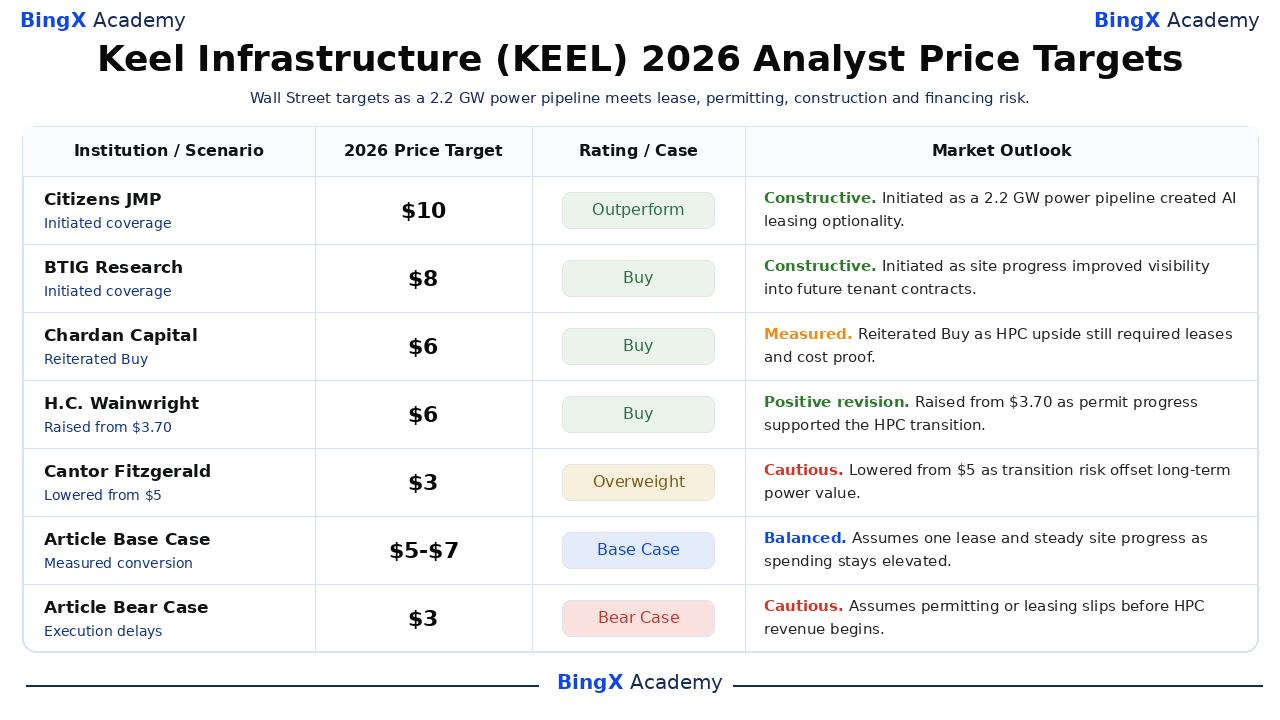
The Bull Case: Signed AI Data Center Leases Push KEEL Toward $10
The Bull Case assumes Keel signs a creditworthy hyperscale tenant at one or more priority sites, completes key permits and converts part of its 341 MW energized capacity into contracted HPC revenue. The $819 million liquidity position gives management room to advance long-lead equipment without accepting weak lease terms.
A move toward $10 would require clear lease terms, including capacity, duration, rent and credit support, followed by financing that limits dilution. Visible construction at Moses Lake, Sharon or Panther Creek and a repeatable cost per megawatt would strengthen the case.
Read More: Top High-Performance Computing (HPC) Stocks to Watch in 2026: Accelerated Computing Market Leaders
The Base Case: Steady Site Progress Keeps KEEL Between $5 and $7
The Base Case assumes Keel completes permits and signs one initial tenant agreement, while most expansion capacity remains pre-revenue. Mining sales keep declining, development expenses stay elevated and investors wait for construction milestones before assigning more value to the pipeline.
KEEL could trade mainly between $5 and $7 under these conditions. A lease covering meaningful energized or secured capacity would support the upper end. Repeated delays, adjusted EBITDA below negative $24 million or falling liquidity without contracted revenue would weaken the range.
The Bear Case: Leasing Delays Pull KEEL Toward $3
The Bear Case assumes tenant negotiations take longer, permits slip and equipment commitments raise cash use before construction financing closes. Mining revenue continues declining from $30.4 million without enough replacement rent, leaving development costs unsupported by recurring income.
A move toward $3 would become more likely if no material lease is signed, the $819 million liquidity balance falls quickly or Keel issues additional equity at a low valuation. Greater dilution and a lower value assigned to the 2.2 GW pipeline would add further pressure.
KEEL Stock Price Forecasts for 2026 By Wall Street Analysts
These five dated analyst actions span $3 to $10 and capture the divide between Keel's scarce power assets and the execution risk of a pre-lease pipeline. They are third-party reference points rather than a single forecast. The final Base and Bear rows are BingX Academy editorial scenarios.
|
Institution / Scenario |
2026 Price Target |
Rating / Case |
Market Outlook |
|
Citizens JMP |
$10 |
Outperform |
Constructive. June 24: initiated as Keel's 2.2 GW power pipeline created AI leasing optionality. |
|
BTIG Research |
$8 |
Buy |
Constructive. July 22: initiated as site progress improved visibility into future tenant contracts. |
|
Chardan Capital |
$5.50 |
Buy |
Measured. June 8: reiterated Buy as HPC upside still required leases and construction-cost proof. |
|
H.C. Wainwright |
$5.50 |
Buy |
Positive revision. May 11: raised from $3.70 as permit progress supported the HPC transition. |
|
Cantor Fitzgerald |
$3 |
Overweight |
Cautious. April 9: lowered from $5 as transition risk offset long-term power value. |
|
Article Base Case |
$5-$7 |
Base Case |
Balanced. Assumes one lease and steady site progress as spending stays elevated. |
|
Article Bear Case |
$3 |
Bear Case |
Cautious. Assumes permitting or leasing slips before HPC revenue begins. |
How to Trade Keel Infrastructure (KEEL) Stock on BingX
Trade Keel Infrastructure's tenant-contract, permitting and data-center development outlook using BingX TradFi and BingX AI tools. Because KEEL can react sharply to leases, financing, Bitcoin disposals and construction milestones, traders should define both the catalyst and risk limits before entering a position.
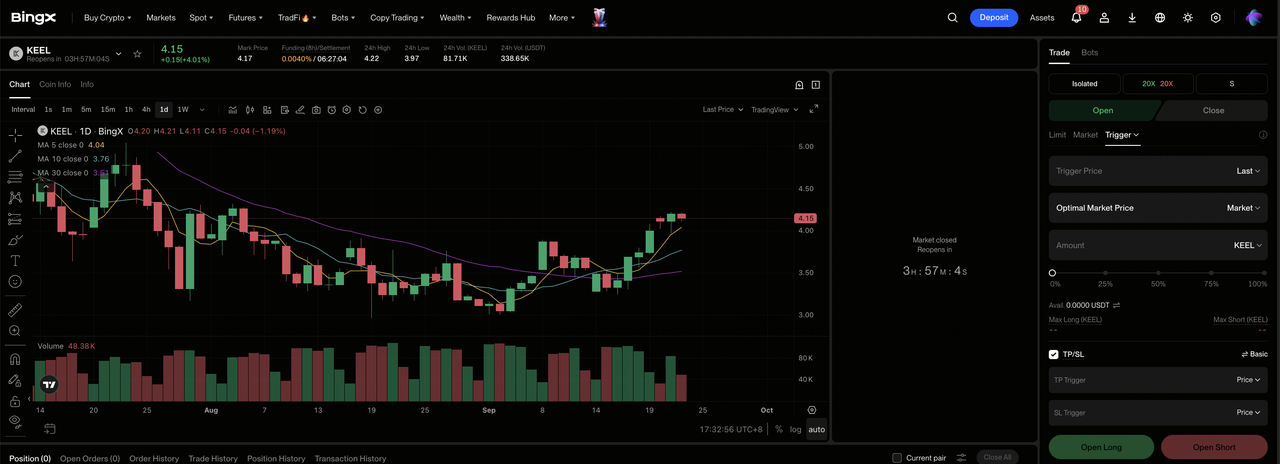
Step 1: Access BingX TradFi. Sign up and navigate to the specialized TradFi section on the BingX exchange dashboard.
Step 2: Select Keel Infrastructure (KEEL). Search for and select the KEEL-USDT perpetual futures contract.
Step 3: Choose your direction. Select Open Long if leases and permits improve project visibility. Select Open Short if delays or financing weaken expected per-share economics.
Step 4: Select leverage and margin mode. Choose Isolated or Cross-Margin based on your risk tolerance. The roughly 11% September 18 move shows why conservative leverage and clear position sizing are important.
Step 5: Execute strict risk protocols. Set Take-Profit and Stop-Loss (TP/SL) levels before or immediately after entering the trade. KEEL can react quickly to leases, permitting, construction costs, capital raises and Bitcoin prices.
Top 5 Risks to Watch for Keel Infrastructure Investors in 2026
Keel's 2.2 GW pipeline creates significant upside potential, but shareholders still face leasing, construction, financing and legacy-Bitcoin risks before data-center rent replaces declining mining revenue.
- The 2.2 GW pipeline is not yet contracted revenue: Most capacity still depends on permits, utility work and tenant decisions. Delays could push future rent further out while development costs continue.
- Current losses can reduce the liquidity runway: Q2 adjusted EBITDA was negative $23.7 million and G&A reached $31.3 million before meaningful HPC revenue began. Continued losses could shrink the $819 million liquidity balance and increase future financing needs.
- Data-center construction is highly capital intensive: Power-connected sites still need buildings, cooling, networking and electrical equipment. Cost overruns or higher interest rates could weaken project returns, especially with 1.5 GW still classified as expansion capacity.
- Convertible financing can dilute shareholders: Keel raised $458 million through convertible notes. Future conversions or additional equity issuance could expand the share count before new facilities begin generating earnings.
- Bitcoin still adds volatility during the transition: Keel held 1,861 BTC on August 7 after selling 1,085 BTC for $75 million. Bitcoin price moves and disposal timing can still affect liquidity and headline earnings while the company shifts toward AI infrastructure.
Final Thoughts: Should You Invest in Keel Infrastructure in 2026?
Keel controls a sizable 2.2 GW development pipeline and had $819 million of liquidity to advance it, creating a credible route from Bitcoin mining toward AI infrastructure. The present financial profile remains transitional. Q2 revenue fell to $30.4 million, adjusted EBITDA reached negative $23.7 million and no major HPC lease had yet begun replacing legacy revenue.
The Bull Case needs signed tenants, permits and disciplined financing to support $10. The Bear Case reflects delayed leasing and dilution that could pull KEEL toward $3. Conservative traders may wait for contract economics, construction schedules and a clearer path from 341 MW of energized capacity to recurring cash flow.
Risk Reminder: Trading and investing in equities like KEEL involves a high risk of capital loss. Company execution, market volatility, financing and leveraged trading can produce rapid losses. Conduct independent research before allocating capital.
Related Reading
- Top High-Performance Computing (HPC) Stocks to Watch in 2026: Accelerated Computing Market Leaders
- Top AI Energy Stocks to Buy in 2026: Nuclear, Gas, Fuel Cells, and the AI Power Buildout
- Top Bitcoin Mining Stocks to Buy in 2026: BTC Hashrate Meets the AI Infrastructure Pivot
- MARA Holdings (MARA) Price Prediction 2026: Can Bitcoin Scale and AI Infrastructure Push MARA Toward $24?
- TeraWulf (WULF) Price Prediction 2026: Can AI Data Centers Push WULF Toward $20?
- Riot Platforms (RIOT) Price Prediction 2026: Can the AI Data Center Pivot Push RIOT Toward $43?
