
BNB (Build and Build) is the native token of BNB Chain, the fifth-largest cryptocurrency by market cap, used for gas fees on BNB Smart Chain, fee discounts on Binance, NFT purchases, DeFi protocol interactions, and launchpad allocations. Buying BNB in the USA in 2026 is straightforward: the asset is now listed on multiple US-regulated platforms, including Coinbase, Kraken, and BingX. The challenge is not access; it is cost. Fee structures vary dramatically between platforms, and for active traders, choosing the wrong one can cost hundreds of dollars per year on unnecessary charges.
This guide compares every major US-accessible platform for buying BNB in 2026, breaks down the real fee differences, and walks you through the full process of buying, withdrawing, and using BNB on BNB Smart Chain.
What Is BNB Chain (BNB)?
Before comparing platforms, it helps to understand what you are actually buying and why fee efficiency matters for BNB specifically.
BNB has multiple uses that make it actively traded rather than a passively held asset:
- Gas fees on BNB Smart Chain: Every transaction on BSC incurs a small fee on BNB. Active DeFi users, NFT traders, and gamers in the BNB Chain ecosystem need BNB on hand at all times.
- Fee discounts on Binance: Holding BNB and paying fees on BNB gives a 25% discount on Binance trading fees, a meaningful saving for active traders.
- Launchpad and Launchpool access: Holding BNB is often required to participate in new token launches within Binance's ecosystem.
- BNB NFT ecosystem: BNB is the primary currency for BNB NFT purchases and gaming economies.
Because BNB is actively used rather than just held, traders often buy it repeatedly and in varying amounts, which makes trading fees compound significantly over time.
Where to Buy BNB in the USA: Platform Overview
Five platforms offer US traders reliable access to BNB in 2026. Here is the landscape before we dive into fees:
|
Platform |
BNB pairs available |
Fiat on-ramp |
BNB Chain withdrawal |
Best for |
|
BingX |
BNB/USDT, BNB/USDC |
Yes (card, bank) |
Yes (BEP-20) |
Low fees, active traders |
|
Coinbase |
BNB/USD, BNB/USDC |
Yes (ACH, card) |
Yes (BEP-20) |
Beginners, brand trust |
|
Kraken |
BNB/USD, BNB/EUR |
Yes (ACH, wire) |
Yes (BEP-20) |
Mid-volume traders |
|
KuCoin |
BNB/USDT, BNB/BTC |
Limited for US |
Yes (BEP-20) |
Altcoin access |
|
Binance.US |
BNB/USD, BNB/USDT |
Yes |
Yes (BEP-20) |
High volume, BNB discounts |
The Fee Reality: What Each Platform Actually Charges
This is where the platforms diverge most sharply and where most traders make their decision.
BingX
BingX is a global cryptocurrency exchange established in 2018, known for its strong emphasis on social and copy trading features. It has built a growing user base, including some US traders who access it where permitted (availability can vary by state and often requires checking current compliance). The platform stands out for competitive low spot trading fees, a wide range of trading products, and solid support for the BNB Chain ecosystem, making it attractive for users interested in BNB specifically.
BingX Fee Structure (2026)
BingX offers straightforward, competitive spot trading fees with a VIP tier system based on 30-day trading volume.
|
Account Level |
Maker Fee |
Taker Fee |
30d Spot Volume Requirement (USD) |
|
Standard (VIP 0) |
0.10% |
0.10% |
< 1,000,000 |
|
VIP 1 |
0.09% |
0.09% |
≥ 1,000,000 |
|
VIP 2 |
0.08% |
0.08% |
≥ 4,000,000 |
|
VIP 3+ / Higher |
Lower |
Lower |
Higher thresholds |
Higher VIP levels (up to Supreme VIP) can reduce fees significantly for active traders. At the standard 0.10% rate, a $1,000 BNB purchase costs just $1.00 in trading fees. This compares favorably to approximately $6 on Coinbase Advanced Trade or $15+ on Coinbase Simple Buy (including spreads).
BingX Advantages
- Ultra-low spot fees: Among the most competitive for US-accessible platforms, ideal for cost-conscious spot traders.
- Full BNB Smart Chain support: Seamless deposits and withdrawals on the BEP-20 network (BNB Chain, Chain ID 56). This enables low-cost transfers to wallets like MetaMask, Trust Wallet, or hardware devices for DeFi, staking, or NFT use.
- Perpetual futures: BNB/USDT pairs with leverage options (up to industry-high levels where available) and competitive futures fees (maker 0.02%, taker 0.05% base).
- Copy trading platform: One of BingX’s flagship features. Easily follow and automatically copy experienced BNB traders, great for beginners or passive strategies.
- Advanced trading tools: Integrated TradingView charting, technical indicators, and a user-friendly interface for spot analysis.
- Additional perks: Demo accounts, a wide selection of assets (1,000+ cryptocurrencies), P2P options in supported regions, and mobile apps with a strong UX.
- Transparency: Regular proof-of-reserves updates.
BingX Challenges
- Smaller brand recognition versus Coinbase for first-time buyers
- Fiat on-ramp requires verification, not instant like Coinbase
Coinbase
Coinbase is the most trusted name in US crypto and the easiest platform for fiat on-ramping. But it is one of the most expensive options for active BNB buyers.
Coinbase Fee Structure (2026)
|
Order type |
Fee |
|
Simple Buy/Sell (default interface) |
~1.49%, up to 3.99% for card purchases |
|
Advanced Trade, taker (under $10K/month) |
0.60% |
|
Advanced Trade, maker (under $10K/month) |
0.40% |
|
Advanced Trade, taker ($50K–$250K/month) |
0.40% |
|
Advanced Trade, maker ($250M+ /month) |
0.00% |
The Simple Buy interface, which most retail users default to, charges up to 1.49% per transaction plus a spread fee, meaning a $1,000 BNB purchase can cost $15–$20 in fees alone. The Advanced Trade interface reduces this, but still starts at 0.40–0.60% taker fees for entry-level users.
For a $1,000 BTC buy, the cost gap is significant. On Coinbase Simple Trade, you pay roughly $15, while on Coinbase Advanced Trade, you pay around $6 at the default taker tier. Over a year of weekly buys, Coinbase costs $300 to $780 more than lower-fee alternatives for the same notional volume.
Coinbase Strengths
- Best fiat on-ramp in the US, ACH, debit, and wire all work smoothly
- Highest regulatory trust, SEC-compliant, publicly listed company
- Easiest UX for first-time buyers
Coinbase Cons
- Significantly higher fees than every other platform on this list
- Simple Buy interface obscures the true cost with spreads on top of fees
- No native BNB fee discount mechanism
Kraken
Kraken is a well-established US-regulated exchange with a transparent fee structure and competitive rates for mid-volume traders.
Kraken Fee Structure in 2026
|
Volume (30-day) |
Maker fee |
Taker fee |
|
$0–$10,000 |
0.16% |
0.26% |
|
$10K–$50K |
0.14% |
0.24% |
|
$50K–$100K |
0.12% |
0.22% |
|
$100K–$250K |
0.10% |
0.20% |
Kraken charges less than Coinbase at every volume tier. For a $1,000 BNB taker order, the cost is $2.60 at the base tier, versus Coinbase's $6 on Advanced Trade or $15 on Simple Buy. Kraken's ACH deposit is free and arrives within 1–5 business days.
Pros of Kraken
- Lower entry-level fees than Coinbase
- Strong US regulatory standing (licensed in multiple states)
- BNB/USD pair is available with good liquidity
Cons of Kraken
- Still higher than the lowest-fee options
- No token-based fee discount mechanism
- Less BNB trading infrastructure than BNB-native platforms
Binance.US
Binance.US is the US-compliant arm of Binance, offering direct access to BNB with the same token-based fee discount mechanism as Binance globally.
Binance.US Fee Structure (2026)
|
Standard rate |
With BNB discount |
|
0.10% maker / 0.10% taker |
0.075% (25% discount when paying fees in BNB) |
The BNB fee discount creates a circular incentive: holding BNB reduces the cost of trading BNB. For active traders, this can be meaningful. However, Binance. US has experienced regulatory uncertainty in recent years; it is worth checking its current operational status in your specific state before relying on it as a primary platform.
KuCoin
KuCoin technically lists BNB and is accessible to some US users, but it does not hold a US regulatory license. US residents using KuCoin assume additional regulatory and account-freeze risk. It is not recommended as a primary platform for US traders.
Platform Fee Comparison: Side by Side
This table shows the real cost of buying $1,000 of BNB on each platform at the default tier:
|
Platform |
Interface |
Fee rate |
Cost on $1,000 BNB purchase |
|
BingX |
Spot, standard |
0.10% taker |
$1.00 |
|
Binance.US |
Spot, standard |
0.10% taker |
$1.00 ($0.75 with BNB discount) |
|
Kraken |
Spot, base tier |
0.26% taker |
$2.60 |
|
Coinbase |
Advanced Trade, base tier |
0.60% taker |
$6.00 |
|
Coinbase |
Simple Buy (default) |
~1.49–1.99% |
$14.90–$19.90 |
Annual Fee Impact for a Trader Buying $1,000 of BNB Weekly
|
Platform |
Weekly fee |
Annual fee cost |
|
BingX |
$1.00 |
$52/year |
|
Binance.US |
$1.00 ($0.75 with BNB) |
$52/year ($39 with discount) |
|
Kraken |
$2.60 |
$135/year |
|
Coinbase Advanced Trade |
$6.00 |
$312/year |
|
Coinbase Simple Buy |
$14.90 |
$775/year |
The fee difference between Coinbase Simple Buy and BingX over one year of weekly $1,000 BNB purchases is over $720, with no difference in the BNB you actually receive.
How to Buy BNB on BingX: Step-by-Step
For US traders prioritizing low fees and full BNB Chain support, here is the complete process:
Step 1: Create and Verify Your BingX Cccount
Go to BingX.com and complete registration. US users need to complete KYC verification (a government ID and a selfie). Verification typically completes within a few hours.
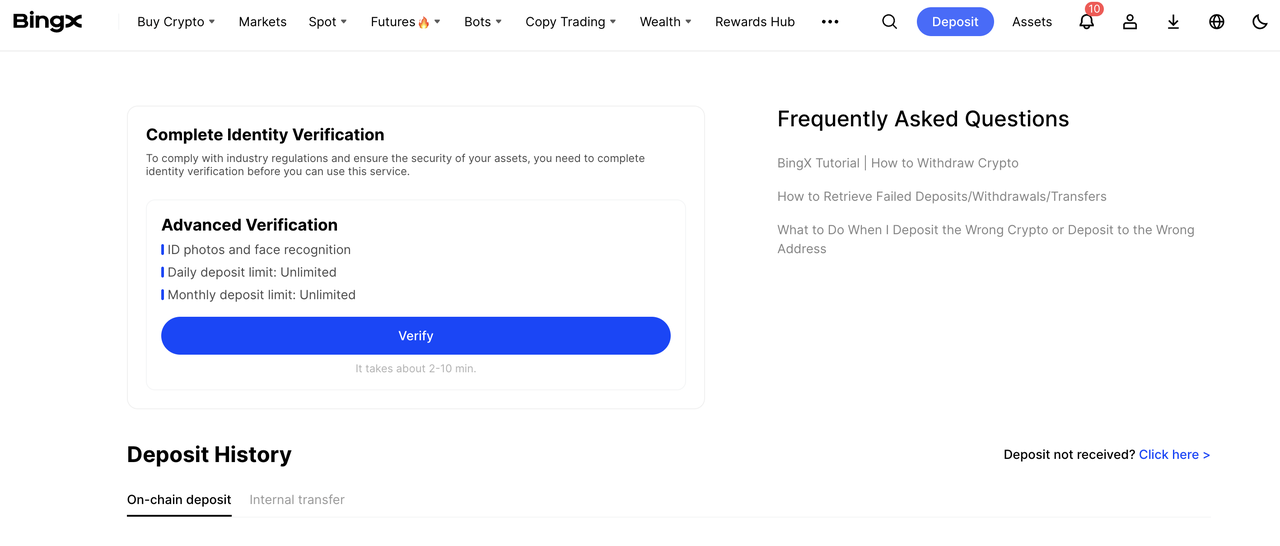
Step 2: Deposit Funds
Navigate to Wallet → Deposit. Options for US users include:
- USDT or USDC transfer from another exchange or wallet
- Credit/debit card purchase (slightly higher fee applies)
- Bank transfer via supported third-party providers
For the lowest total cost, fund with USDT via bank transfer from your existing exchange, then swap to BNB on BingX's spot market.
Step 3: Buy BNB on the Spot Market
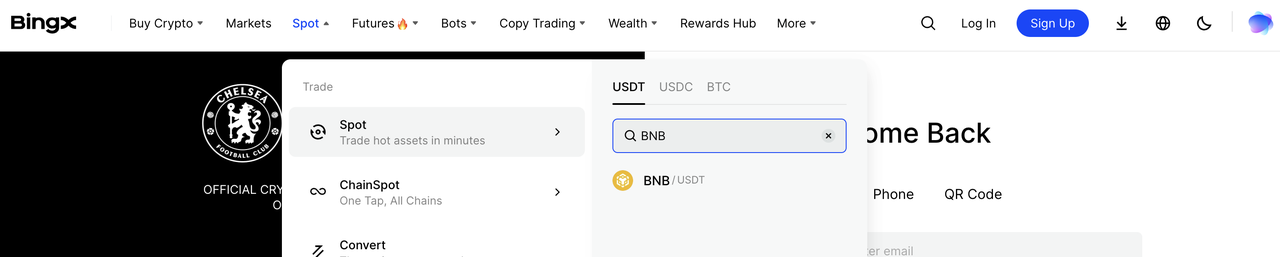
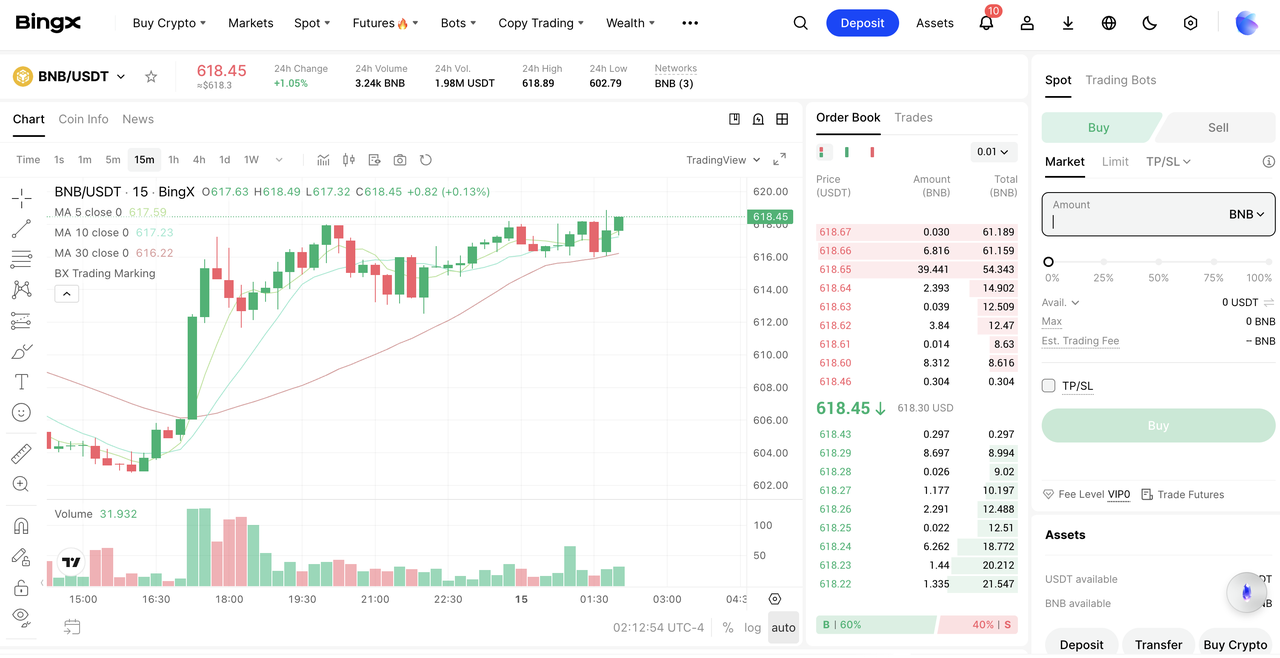
Go to Spot → BNB/USDT. Select the amount you want to buy. Use a limit order at your target price to pay the maker fee (0.10%) rather than a market order taker fee. Click Buy BNB.
Step 4: Withdraw BNB to BNB Smart Chain (Optional)
If you want to use BNB on-chain for DeFi, NFTs, or gaming:
- Go to Wallet → Withdraw → BNB
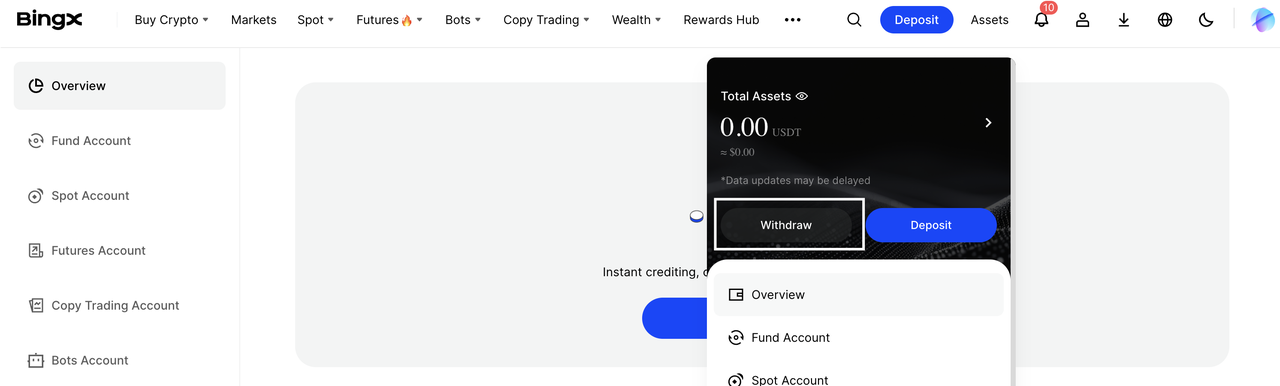
- Enter your MetaMask or Trust Wallet address
- Select BNB Smart Chain (BEP-20) as the network
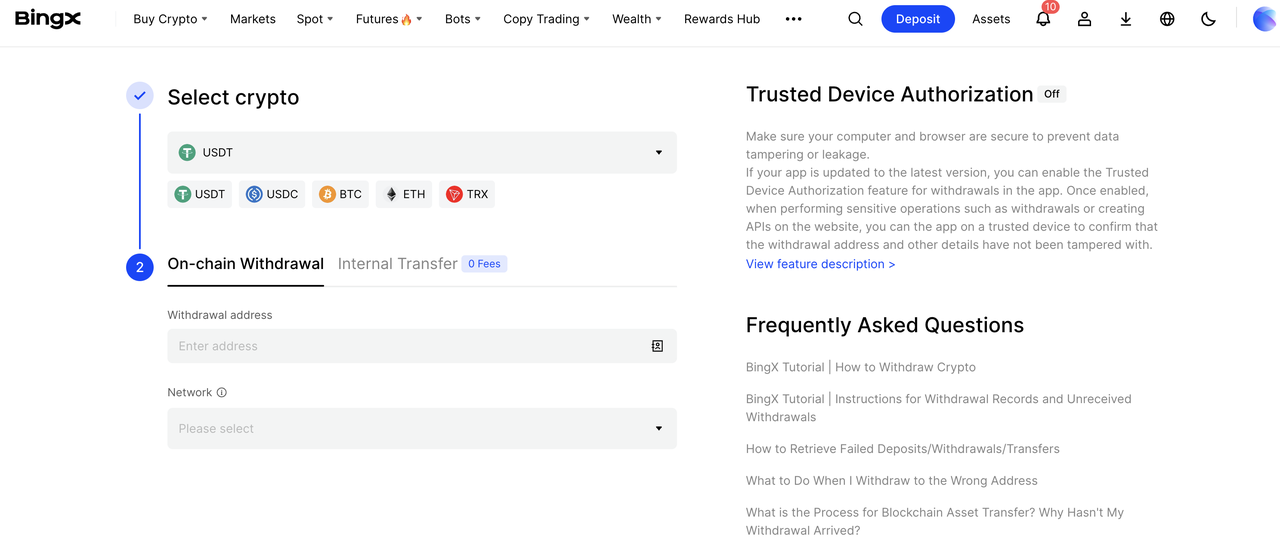
- Confirm Chain ID 56 is active in your wallet before submitting
Where to Transfer Your BNB: The Network Selection Guide
Regardless of which platform you use to buy BNB, withdrawing to your own wallet for on-chain use requires selecting the correct network. Getting this wrong is the most common and costly mistake.
|
Network option |
What it means |
When to use it |
|
BNB Smart Chain (BEP-20) |
BNB on Chain ID 56, for DeFi, NFTs, gaming |
For all BNB Chain applications |
|
Ethereum (ERC-20) |
Wrapped BNB on Ethereum |
Only if specifically needed for Ethereum DApps |
|
BNB Beacon Chain (BEP-2) |
Legacy chain, largely deprecated |
Avoid unless you have a specific legacy use case |
Always verify: Before submitting any withdrawal, confirm your receiving wallet is set to the correct network. In MetaMask, this means Chain ID 56 is active. In Trust Wallet, "Smart Chain" should be selected. Sending BNB to the wrong network address may result in permanent loss of funds.
For a full guide on BNB Chain network configuration, see our BNB Chain explainer.
What Can You Do With BNB After Buying?
Once you hold BNB, the asset has multiple use cases that make it actively valuable rather than a passive hold:
1. Use on BNB Smart Chain
- Pay gas fees for DeFi protocols (PancakeSwap, Venus)
- Purchase BNB NFTs and in-game items
- Participate in gaming economies (Heroes and Empires, Tiny World)
2. Use for Trading Fee Discounts
- On Binance, paying fees with BNB gives a 25% discount
- At high trading volumes, this saves meaningfully over time
3. Hold as Part of a Diversified Portfolio
- BNB has historically appreciated during altcoin seasons when BNB Chain activity surges
- Track your BNB position performance using the Sharpe ratio framework for risk-adjusted evaluation
4. Stablecoin Integration
BNB Chain hosts FDUSD and RLUSD, two major stablecoins covered in our stablecoin guide, which can be used for yield generation within the BNB ecosystem
Regulatory Considerations for BNB Buyers in the US
BNB is listed on multiple US-regulated exchanges, Coinbase, Kraken, and Binance.US all offer it, which means buying it through these platforms carries no additional regulatory concern beyond standard crypto ownership rules.
Key points for US traders:
- Tax treatment: BNB is treated as property by the IRS. Every purchase, sale, or swap, including using BNB to pay gas fees, is a taxable event. Keep detailed records using a trading journal or dedicated crypto tax software.
- Platform choice: Stick to regulated platforms with US licenses or clear compliance programs. Avoid offshore-only exchanges without US regulatory standing for primary purchases.
- Self-custody: Moving BNB to a self-custodied wallet (MetaMask, Trust Wallet, Ledger) removes exchange counterparty risk. This is best practice for any holding beyond immediate trading use.
Conclusion: Why Is BingX the Best Place to Buy BNB in 2026?
Buying BNB in the USA in 2026 is straightforward; the asset is widely available on regulated platforms, and there are no significant barriers to access for US traders. The decision point is fees.
Coinbase is the most trusted brand and the easiest fiat on-ramp, but its Simple Buy interface charges up to 15× as much per transaction as the lowest-cost alternatives. Using Coinbase Advanced Trade reduces this significantly, but even at 0.40–0.60% per trade, it remains 4–6× more expensive than BingX's 0.10% standard rate.
For US traders who buy BNB regularly, whether for DeFi gas fees, NFT purchases, or portfolio allocation, the annual fee savings from choosing a lower-cost platform can amount to several hundred dollars, even with modest weekly purchase amounts. The BNB you receive is identical regardless of where you buy it.
The practical recommendation: use Coinbase for initial fiat-to-crypto conversion if you value its regulatory standing and ACH on-ramp, then transfer USDT or USDC to BingX for ongoing BNB purchases at 0.10% fees. This captures both the trust of the regulated on-ramp and the fee efficiency of a competitive trading platform.
Buy BNB on BingX, 0.10% spot fee
Related Articles
- BNB NFTs in 2026: Top Collections, Marketplaces & How to Get Started
- Making Every Trade Efficient: A Guide to Stable Spot Portfolio Growth
- Risk Management in Crypto Trading: 7 Rules Every Trader Must Know
- How to Keep a Trading Journal: A Complete Guide for Crypto Traders
- Implied Volatility in Crypto: What It Means and How to Trade It
- Altcoin Season: What It Is, How to Spot It, and How to Trade It
FAQs on Buying BNB Chain (BNB) in US
1. Can I buy BNB in the USA?
Yes, BNB is available on multiple US-regulated exchanges in 2026, including BingX, Coinbase, Kraken, and Binance.US. There are no US-specific restrictions on purchasing BNB as a retail investor.
2. What is the cheapest way to buy BNB in the USA?
BingX and Binance.US both offer 0.10% standard spot trading fees, among the lowest available to US traders. Compared to Coinbase's Simple Buy interface (up to 1.49–3.99%) or Advanced Trade base tier (0.60%), BingX offers significantly lower costs for regular BNB purchases.
3. Why are Coinbase fees so high for buying BNB?
Coinbase's Simple Buy interface bundles its fee into a spread rather than displaying it as a line item, making the true cost easy to miss. At the default retail tier, fees range from 1.49% to 3.99% depending on payment method. Switching to Coinbase Advanced Trade reduces this to 0.40–0.60% at the base tier, but even this is 4–6× higher than BingX's 0.10% standard rate.
4. How do I withdraw BNB to BNB Smart Chain from any exchange?
When withdrawing BNB from any exchange, select the BNB Smart Chain (BEP-20) network option. Ensure your receiving wallet (MetaMask or Trust Wallet) is set to Chain ID 56 before submitting. Never send BNB over the Ethereum (ERC-20) network unless your wallet specifically requires it for Ethereum DApp use.
5. Is it safe to buy BNB on BingX?
BingX is a regulated global crypto exchange with a growing US user base, offering spot, futures, and copy trading. For best security practices with any exchange, enable two-factor authentication, use a unique strong password, and withdraw large holdings to a self-custodied wallet rather than leaving them on the exchange.
6. What can I do with BNB after buying it?
BNB has multiple active uses: paying gas fees on BNB Smart Chain for DeFi protocols and NFT purchases, receiving a 25% fee discount on Binance when paying trading fees in BNB, participating in Binance Launchpad token sales, and holding as a portfolio asset that tends to benefit during BNB Chain ecosystem growth phases.
7. What is the difference between BEP-20 and BNB Smart Chain for withdrawals?
BEP-20 is the token standard for BNB Smart Chain, selecting "BNB Smart Chain (BEP-20)" as the withdrawal network sends your BNB to Chain ID 56, where all DeFi, NFT, and gaming applications run. This is the correct network for virtually all BNB Chain use cases. BEP-2 is an older legacy standard and should be avoided unless specifically required.
8. How do Coinbase fees compare to BingX for buying BNB?
For a $1,000 BNB purchase at standard retail rates: Coinbase Simple Buy costs approximately $14.90–$19.90, Coinbase Advanced Trade costs approximately $6.00, and BingX costs $1.00. For a trader making weekly $1,000 BNB purchases, this difference amounts to over $720 per year between Coinbase Simple Buy and BingX.
