Data compiled by Kaiko Research in early 2026 shows that the average trading fee across major global exchanges is approximately 0.15% for makers and 0.194% for takers. For a Brazilian trader with a monthly trading volume of R$ 50,000, this can represent up to R$ 2,900 per year quietly eroded from their portfolio—excluding withdrawal costs and spread. With the Brazilian crypto market regulated under Law No. 14,478/2022 and supervised by the Central Bank, competition among platforms has intensified and fees have decreased. However, choosing the lowest-cost exchange requires looking beyond the headline rates displayed on the homepage.
Direct answer: The exchanges with the lowest fees in Brazil in 2026 are BingX (0.1% spot, 0.02%/0.05% futures, with no requirement to hold a native token for VIP discounts), Binance (0.1% spot with a 25% discount via BNB), and Bybit (0.1% spot, 0.02%/0.055% futures). To reduce costs: use limit orders whenever possible, increase your VIP tier through trading volume, choose low-cost networks for withdrawals, and compare the actual spread—not just the advertised fee.
What Are Maker and Taker Fees
Every centralized exchange operates on a model known as maker-taker. A trader who places an order that enters the order book and waits for execution is a maker. They are adding liquidity to the market and therefore pay lower fees. A trader who executes an existing order, such as a market buy, is a taker. They remove liquidity and pay a slightly higher fee.
It works like a marketplace: those who set up stalls with fixed prices are creating the market, while buyers consume that liquidity. Exchanges incentivize liquidity providers because deeper order books improve market efficiency for all participants.
In practice, consistently trading as a taker on an exchange with a 0.1% fee can cost twice as much as trading as a maker on platforms that differentiate between the two. In futures markets, this difference is typically even more pronounced.
Beyond maker/taker fees, there are additional costs that are often overlooked in most analyses.
Spread is the difference between the bid and ask price. In low-liquidity trading pairs, it can exceed the trading fee itself. An exchange with a 0.05% fee but a 0.3% spread on your trading pair can be more expensive than one with a 0.1% fee and a 0.05% spread.
Withdrawal fee varies depending on the cryptocurrency and the selected network. Withdrawing USDT via the Ethereum network can cost between $5 and $20 depending on congestion. Using Tron (TRC-20) or Solana typically costs only a few cents.
Funding rate applies exclusively to perpetual contracts. It is paid directly between long and short traders to keep the contract price aligned with the spot market. While it does not go to the exchange, it impacts the real cost of positions held over multiple days.
Formula for the Real Cost of a Trade
Many traders underestimate their costs by focusing only on trading fees. The true cost is:
Total cost = (Volume x Fee) + Withdrawal fee + Implicit spread
Example with BTC/USDT:
You buy 0.5 BTC at $100,000 per unit. Order volume: $50,000.
- With a 0.1% taker fee: $50,000 x 0.001 = $50 in fees
- With a 0.05% fee (VIP tier): $25
Executing 20 such trades per month results in a difference of $500 monthly, or $6,000 annually—simply by choosing the right tier or exchange.
Add to that $8 in withdrawal fees via Ethereum mainnet, compared to $0.50 on Tron. Over 12 withdrawals per year, that’s an additional $90 difference from this detail alone.
BingX: Competitive Fees Without Requiring a Native Token
BingX offers a standard fee of 0.1% for both maker and taker on the spot market, which is below the industry average of approximately 0.15% for makers and 0.194% for takers based on publicly available 2026 data. In perpetual futures, the maker fee is 0.02% and the taker fee is 0.05%.
The platform’s key differentiator compared to most competitors lies in its VIP structure. While Binance requires users to hold BNB to access maximum discounts, and Bybit combines volume and balance requirements, BingX bases its tier progression solely on 30-day trading volume. At higher tiers, spot maker fees can drop to 0.014%, and futures maker fees can reach zero.
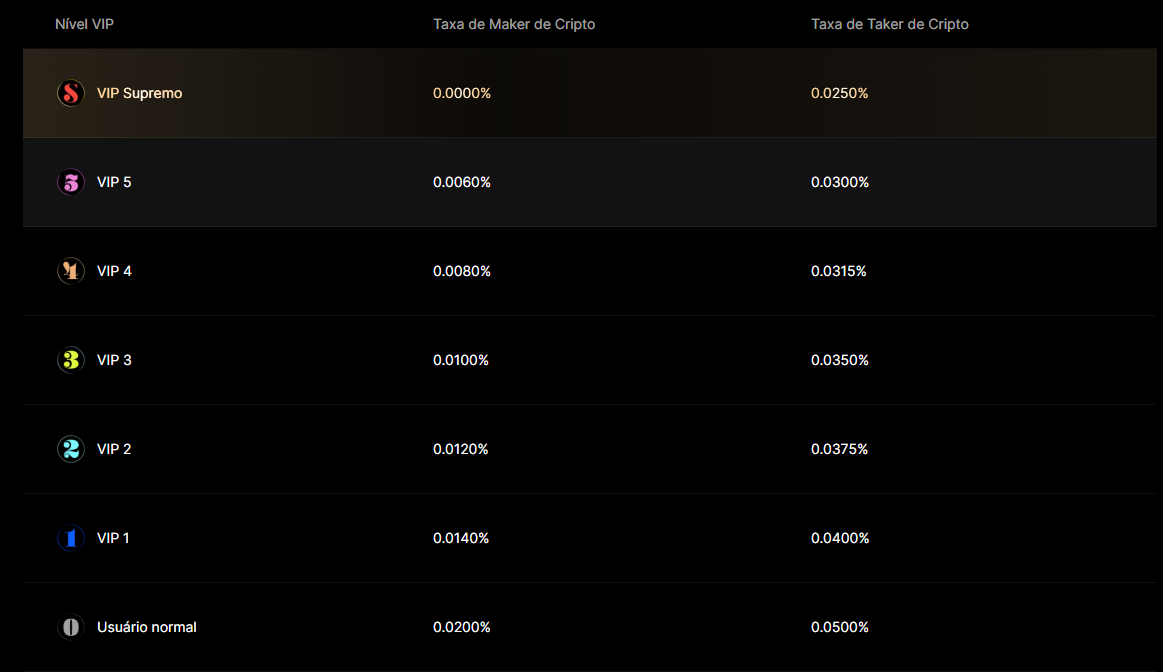
For withdrawals, the platform does not charge fees on crypto deposits. Withdrawal costs vary depending on the selected network. Using Solana, Tron (TRC-20), or Ethereum Layer 2 networks significantly reduces costs compared to the mainnet.
BingX also offers zero-fee conversion across more than 100 cryptocurrencies. For users who frequently rebalance their portfolios, this eliminates a cost that can quickly accumulate on other platforms. The minimum deposit is just $1 for most cryptocurrencies, making the platform accessible both for beginners and for users who want to test the infrastructure before allocating larger volumes.
Base Fee Comparison in 2026
The table below summarizes the base-level account fees across the main exchanges used in Brazil. All values are presented without discounts from native tokens or trading volume.
| Exchange | Spot Maker | Spot Taker | Futures Maker | Futures Taker | Discount without native token |
| BingX | 0.10% | 0.10% | 0.02% | 0.05% | Yes |
| Binance | 0.10% | 0.10% | 0.02% | 0.04% | Partial (requires BNB) |
| Bybit | 0.10% | 0.10% | 0.02% | 0.055% | Yes (volume or balance) |
| Kraken | 0.25% | 0.40% | — | — | No |
| Coinbase Advanced | 0.40% | 0.60% | — | — | No |
Data collected from the official fee pages of each platform, March/April 2026. Subject to change.
In spot trading, BingX, Binance, and Bybit operate at the same base fee level. Kraken and Coinbase charge significantly higher fees at the entry tier. In futures trading, BingX delivers one of the most competitive taker fee structures in the market without requiring a native token.
Binance
Binance maintains the highest global trading volume, which directly impacts spreads on highly liquid pairs such as BTC/USDT and ETH/USDT. At the base level, the spot fee is 0.10% for both maker and taker, comparable to BingX.
A key consideration for Brazilian traders is that reaching higher VIP tiers on Binance requires meeting two criteria simultaneously: trading volume and BNB holdings. For VIP 3, users must achieve $20 million in trading volume and hold 250 BNB. This structure is designed for high-volume traders rather than retail participants.
Bybit
Bybit has a strong reputation in the derivatives market. For spot trading, it charges 0.1% maker and taker at the base level. In perpetual contracts, fees are 0.02% for makers and 0.055% for takers.
For traders primarily focused on perpetual contracts, Bybit is a competitive alternative. However, BingX offers a lower futures taker fee of 0.05% compared to Bybit’s 0.055%, without requiring users to hold any additional tokens to access volume-based discounts.
How to Reduce Fees in Practice
Use limit orders whenever possible. Acting as a maker instead of a taker can reduce costs from 0.1% to near zero on some platforms. On exchanges with a maker-taker fee model, this behavioral shift can significantly lower total monthly trading costs. Tools such as BingX AI help identify optimal entry points and improve order execution.
Increase your VIP tier through volume. On BingX, progression is based on 30-day trading volume without requiring additional token holdings. As volume increases, fees are automatically reduced.
Choose the right withdrawal network. Withdrawing USDT via the Ethereum network can cost between $5 and $20 per transaction. The same transaction via Tron or Solana costs only a few cents. Always compare available network options before withdrawing.
Monitor zero-fee promotions. BingX and Binance periodically offer zero-fee campaigns on selected trading pairs. Executing trades during these periods can generate direct cost savings.
Compare the spread, not just the fee. In low-liquidity altcoins, the bid-ask spread can exceed 0.5%. An exchange with a 0.05% fee but a 0.4% spread can be more expensive than one with a 0.1% fee and a 0.05% spread on the same pair. Well-defined risk management strategies help avoid entering low-liquidity markets.
CEX vs. DEX: Why Fee Comparison Is Not Straightforward
Decentralized exchanges such as Uniswap and PancakeSwap charge protocol fees ranging from 0.01% to 0.3% per trade. The real cost lies in gas fees, which on Ethereum can range from $5 to $50 depending on network congestion. For smaller trades, this can make DEX usage economically inefficient.
Additionally, DEXs use the AMM (automated market maker) model, where prices are determined by the asset ratio within liquidity pools. In low-volume pools, price impact can exceed 1% on a mid-sized order. This is a hidden cost that does not appear explicitly in the fee structure.
For Brazilian investors who need to convert BRL to crypto quickly via PIX and maintain compliance with tax authorities, regulated CEXs offer a much more predictable cost structure. The BingX P2P marketplace with PIX support and zero fees is a direct example of this advantage.
Fees and Income Tax
In Brazil, trading fees paid on exchanges can be deducted from the asset acquisition cost when calculating capital gains. The tax rate on crypto profits ranges from 15% to 22.5% depending on the amount. Every unit of currency paid in fees reduces the taxable base, and lower fees ultimately reduce the total cost after tax impact.
Platforms that generate exportable reports compatible with the Federal Revenue system simplify this process. BingX provides such reporting tools, saving users significant time during tax filing. Users of BingX Copy Trading or automated trading bots can also consolidate their trading history directly through the platform.
FAQ
Which exchange has the lowest spot fee in Brazil in 2026?
BingX, Binance, and Bybit are tied at 0.1% at the base level. With volume-based discounts on BingX or BNB-based discounts on Binance, these fees can be reduced significantly.
Does BingX charge a deposit fee?
Not for crypto deposits. For fiat deposits via PIX, conditions may vary. It is worth checking the updated fee schedule directly on the platform before each transaction.
Is it worth paying fees with the exchange’s native token?
It depends on your trading volume. On Binance, the BNB-based discount is 25% on spot trading fees, which can be worthwhile for users already trading sufficient volume. On BingX, VIP discounts based on trading volume do not require holding any extra token, eliminating token price exposure and simplifying account management.
What is the funding rate and how does it affect the cost of perpetual futures?
It is a periodic payment exchanged between long and short traders to keep the contract price close to the spot market. On BingX, it is settled three times per day. The rate varies according to market sentiment, and during strong trends it can become a meaningful cost for positions held for days or weeks. It is not paid to the exchange, but it should still be included in the total cost calculation of the trade. Learn more about trading on the BingX futures market.
How do I choose the right withdrawal network to pay less?
Compare the available options on the exchange before each withdrawal. Withdrawing USDT via Tron (TRC-20) or Solana costs only a few cents. Via Ethereum mainnet, it can cost several dollars. Over the course of a year, the accumulated difference can exceed the total amount paid in trading fees for moderate-volume traders.
Does spread count as a fee?
It does not appear as an explicit fee, but it has the same financial effect. Spread is the difference between the buy and sell price. In low-liquidity pairs, it can exceed 0.5% per trade, making it more expensive than the trading fee of any exchange listed in this guide. Exchanges with deeper liquidity and more robust order books can therefore be cheaper in practice even when their nominal fees are similar. Using staking and other BingX products may also help offset part of these operating costs by generating passive yield on idle assets.
Key Takeaways
- Trading fees are only one component of the real cost: spread, withdrawal fees, and funding rates complete the equation
- BingX offers competitive fees in spot (0.1%) and futures (0.02%/0.05%) with VIP progression based on trading volume, without requiring a native token
- Binance and Bybit compete at the same 0.1% base spot fee level, with different discount models: BNB on Binance, and volume or balance on Bybit
- Using limit orders, choosing low-cost withdrawal networks, and moving up VIP tiers are the three main ways to reduce costs without switching exchanges
- Fees paid can be added to acquisition cost for Brazilian income tax calculations, reducing taxable capital gains
- In Brazil, PIX integration and regulatory compliance are differentiators that go beyond the fee figure itself