
Superfortune is an AI-powered InfoFi platform that blends centuries-old Eastern metaphysical systems with blockchain technology and crypto market analytics. Incubated by Manta Labs, the team behind Manta Network, the project integrates classical Chinese traditions such as Bazi (八字,Four Pillars of Destiny) and I Ching divination to uncover patterns in the highly volatile crypto market.
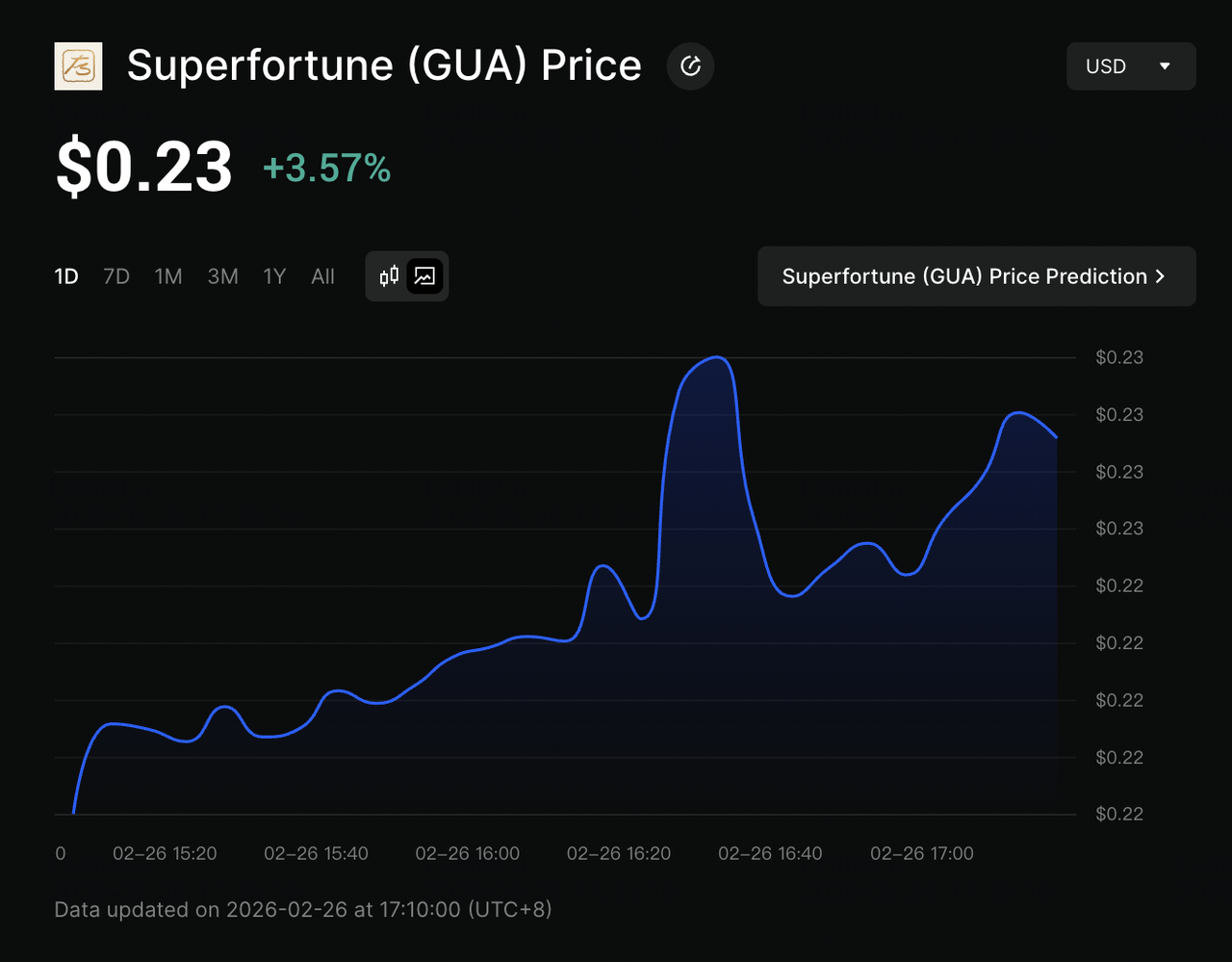
Source: BingX Superfortune (GUA) Price
$GUA is the native utility token powering the Superfortune ecosystem. Since its Token Generation Event on November 27, 2025, GUA (卦) has drawn strong market attention as one of the first large-scale Web3 projects built around metaphysics and AI-driven forecasting. Trading volume surged more than 110%, and the token recorded a 58% weekly gain, outperforming the broader crypto market.
By combining AI prediction tools, on-chain utility, a zero-VC funding structure, and access to a largely untapped metaphysics audience, GUA has emerged as one of the more distinctive InfoFi tokens in the current cycle. This article explains how the Superfortune platform works, what drives $GUA’s token utility, and how to trade GUA on BingX.
What Is Superfortune (GUA) and How Does It Work?
Superfortune is positioned as an AI-powered InfoFi consumer platform that transforms ancient Eastern metaphysical systems into interactive crypto market insights. Rather than competing as a technical infrastructure layer, it focuses on cultural pattern recognition rooted in traditions that have guided decision-making across Asia for centuries. The platform runs on BNB Smart Chain as a BEP-20 token, with ecosystem ties to Manta Pacific, and is designed to serve both crypto-native users and Web2 audiences unfamiliar with wallets or DeFi.
The product is structured around four core pillars:
1. Daily Personal Fortune Readings: Users receive AI-generated readings based on Bazi (八字) and I Ching (易經) frameworks. The system combines birth data with current market conditions to deliver personalized daily guidance. This creates a gamified, repeat-use experience designed to drive retention across both Web2 and Web3 audiences.
2. Token Energy Analysis: Users can submit a token or smart contract address for a metaphysical “energy reading.” The engine evaluates perceived bullish or bearish momentum through a cosmological lens, offering an alternative signal layer distinct from traditional technical analysis.
3. Wallet Qi Purification: In collaboration with Junk.Fun, users can submit dormant or low-value tokens from their wallets into a Qi Purification mechanism. These tokens are recycled and converted into $GUA rewards, transforming inactive assets into ecosystem participation and creating ongoing utility-driven demand.
4. Karmic Chemistry and Compatibility Analysis: The platform allows users to assess compatibility between wallets, X accounts, or individuals. Using classical metaphysical frameworks, Superfortune extends beyond trading use cases into broader cultural and social applications, particularly in East Asian markets where compatibility readings are widely practiced.
Together, these pillars position Superfortune not just as a trading tool, but as a culturally driven AI consumer layer bridging Web2 engagement with Web3 mechanics.
Who Founded Superfortune (GUA)?
SUPERFORTUNE was incubated by Manta Labs, the team behind Manta Network, an Ethereum Layer 2 ecosystem project. Launched in July 2025, it positioned itself as the first large-scale Web3 initiative centered on Eastern metaphysical systems. Its Chinese name, meaning “Endless Gains” (连连有盈), reflects its ambition to merge traditional cultural wisdom with crypto-native financial narratives.
The project raised no venture capital and conducted no public sale, relying instead on community-driven growth. Its Token Generation Event (TGE) on November 27, 2025, launched liquidity directly on PancakeSwap for immediate decentralized access. By December 2025, the SUPERFORTUNE mobile app was live on Google Play, expanding beyond DeFi users and ranking among the top AI dApps on BNB Chain at the time of release.
What Is the $GUA Token Utility?
the primary medium of exchange for all value-added platform features. Unlike a speculative meme token, GUA is designed to gate real services and power a self-reinforcing economic loop:
According to official Superfortune documentation, $GUA is the ecosystem’s native utility token and functions as the payment and access layer for core platform services. Rather than existing purely as a speculative asset, GUA is structured to support platform usage and recurring economic activity.
• Unlocking Premium AI Reports: Users spend GUA to access advanced fortune readings, token energy analyses, and extended Bazi reports, directly tying engagement to token demand.
• Purchasing NFT Charms and Amulets: GUA is used to acquire digital lucky charms and tradeable NFT amulets, creating ongoing in-platform spending and circulation.
• In-App Payment Currency: GUA powers services such as 1-on-1 consultations and ritual features. Fiat integration lowers onboarding friction and converts Web2 users into GUA participants.
• Buyback and Burn Mechanisms: Qi Purification triggers open-market GUA buybacks, and periodic burn events help manage circulating supply, reinforcing token value dynamics.
What Is Superfortune ($GUA) Tokenomics?
$GUA has a fixed total supply of 1,000,000,000 tokens (1 billion GUA). The project conducted no venture capital raise, no public sale, and no external fundraising, positioning it as a community-first launch. At TGE, the initial circulating supply was approximately 4.5% (45 million GUA), intentionally designed to support controlled price discovery while limiting immediate sell pressure.
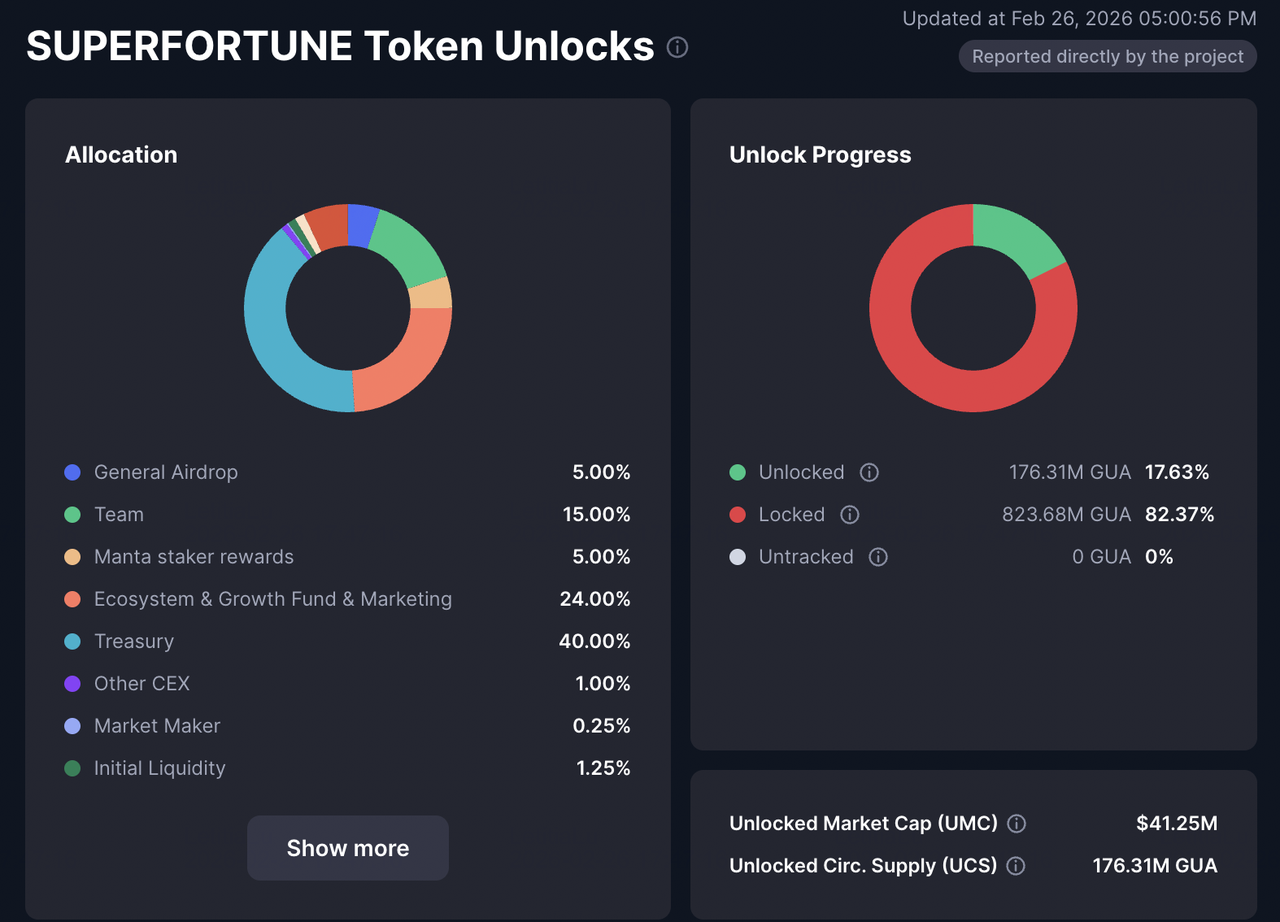
According to project-reported data, the full token allocation is structured as follows:
• Treasury - 40.00% for long-term protocol sustainability and ecosystem management
• Ecosystem, Growth Fund, and Marketing - 24.00% to fund development and user expansion
• Team - 15.00% subject to an 18-month lockup
• General Airdrop - 5.00% distributed to early users and community participants
• Manta Staker Rewards - 5.00% allocated to $MANTA ecosystem stakers
• Other CEX Listings - 1.00% reserved for centralized exchange expansion
• Initial Liquidity - 1.25% locked at TGE
• Market Maker - 0.25% allocated to support trading depth
As of February 26, 2026, approximately 176.31 million GUA (17.63%) has been unlocked, while 823.68 million GUA (82.37%) remains locked under the vesting schedule. Based on the circulating supply of 176.31 million GUA, the unlocked market cap stands at approximately $41.24 million, highlighting the early-stage nature of the token’s distribution curve.
Superfortune’s Anti-Dump Design and the QIAN In-App Currency
A core structural feature of Superfortune’s tokenomics is the separation between the tradable $GUA token and an internal, non-tradable in-app currency called QIAN. QIAN functions strictly as a reward unit within the platform and cannot be traded on the open market.
By routing routine user incentives and engagement rewards through QIAN instead of $GUA, the protocol reduces direct inflationary pressure and minimizes the constant sell-offs commonly seen in play-to-earn or reward-heavy token models. Meanwhile, $GUA is reserved for premium features and value-added services, positioning it as a demand-driven utility token rather than a reward emission faucet. This dual-currency structure is designed to better protect token value over time while maintaining user engagement.
How to Trade Superfortune (GUA) on BingX
Leverage BingX AI trend analysis tools to navigate GUA's volatility with precision. By tracking real-time volume expansion, funding rate shifts, RSI divergence, and trend strength indicators, BingX AI helps traders identify momentum windows across the emerging InfoFi and AI crypto sectors and make more informed entry and exit decisions.
Buy or Sell GUA/USDT on Spot Trading
For investors building exposure to Superfortune's growing ecosystem and the broader InfoFi narrative, the BingX Spot market provides direct access without leverage risk.
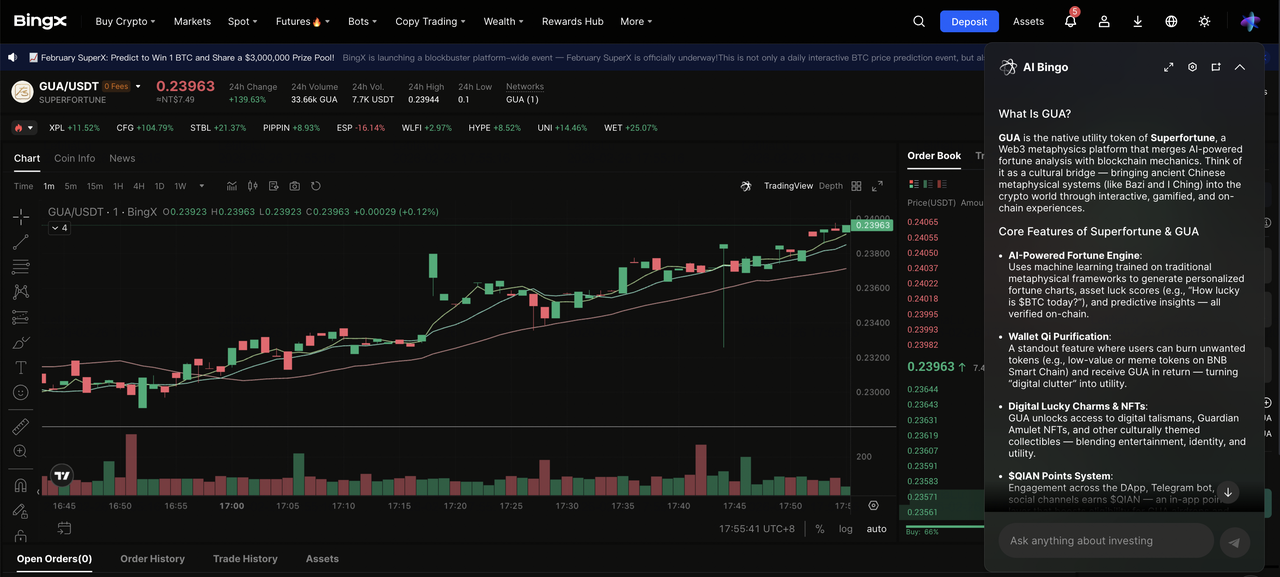
Source: BingX GUA/USDT on Spot Trading
1. Fund Your Account: Ensure your Spot Account is funded with USDT.
2. Find the Pair: Search for GUA/USDT in the Spot market.
3. Execute Your Strategy: Use a Limit Order to accumulate during pullbacks or consolidation phases, or a Market Order to enter immediately during breakout momentum windows driven by new platform feature launches or mobile app adoption milestones.
Trade GUA Perps in the Futures Market for Volatility
Traders seeking to capitalize on GUA's high-beta price movements or hedge against broader market pullbacks can use GUA/USDT Perpetual Contracts for directional exposure with leverage.
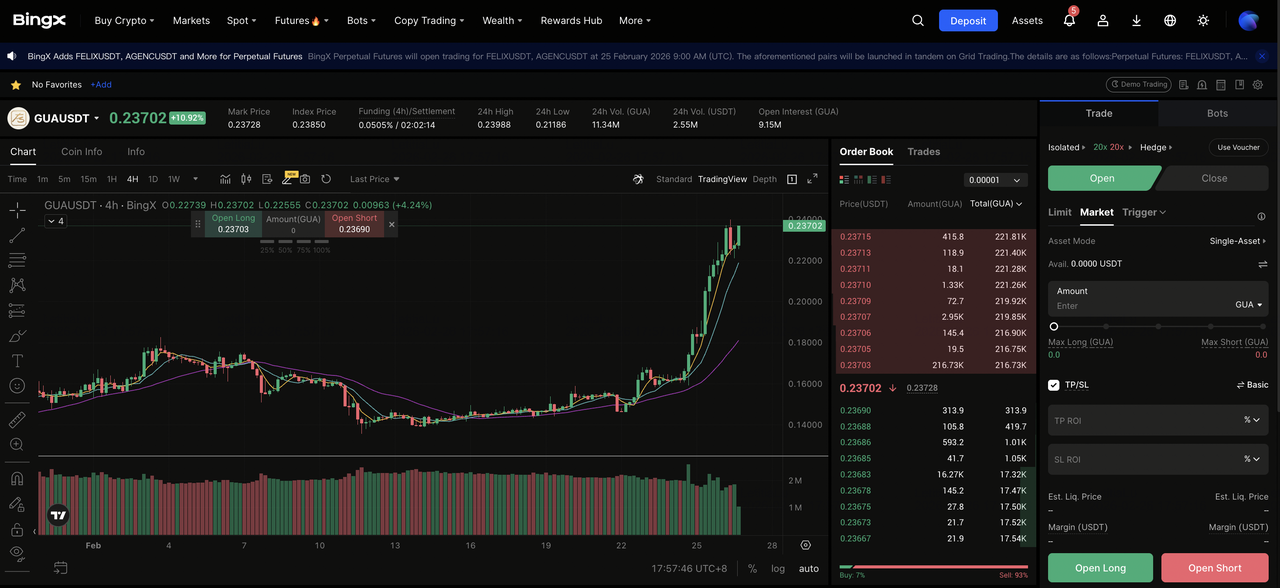
1. Transfer Margin: Move USDT to your Futures Account.
2. Trade GUA Futures: Search for the GUA/USDT perpetual contract and open a long or short position based on your directional conviction.
3. Monitor Catalysts: Track mobile app user growth milestones, new feature launches (FortuneTeller appointments, charm NFT releases), Wallet Qi Purification volume, and broader BNB Chain sentiment as key leading indicators for GUA price action.
4. Manage Risk: Use leverage cautiously. GUA is a small-cap token with a tight float of 4.5% circulating supply, making it susceptible to sharp two-way volatility. Always apply Stop-Loss (SL) and Take-Profit (TP) orders to control downside exposure on every position.
3 Key Considerations Before Trading Superfortune (GUA)
Before trading GUA, it is important to understand several core factors that can significantly impact pricing dynamics, timing, and overall trading risk in fast-moving crypto markets.
1. Tight Float and Future Unlock Risk: At launch, only about 4.5% to 5.5% of total supply was circulating, with the remaining tokens subject to a structured vesting schedule. While the 18 month team lock reduces near term sell pressure, airdrop and ecosystem allocations unlocking over 8 to 48 months may introduce periodic supply driven volatility. Tracking the unlock schedule is critical.
2. Adoption Driven Valuation: GUA’s value depends primarily on consumer app traction rather than network security metrics. Key indicators include daily active users, Qi Purification activity, mobile app downloads, and premium feature usage. Slowing user growth would weaken the long term thesis regardless of short term price strength.
3. Regulatory and Cultural Sensitivity: Operating at the intersection of metaphysics, AI prediction tools, and tokenized rewards introduces regulatory ambiguity. In some jurisdictions, fortune based financial guidance may face scrutiny if interpreted as investment advice. Regulatory shifts targeting AI driven prediction platforms could materially affect the ecosystem and token performance.
Conclusion: Is Superfortune (GUA) a Good Investment in 2026?
For investors evaluating GUA in 2026, the thesis centers on differentiation. SUPERFORTUNE is not competing on blockchain infrastructure or DeFi yields, but targeting the estimated $392 billion global metaphysics market with an AI powered, blockchain integrated consumer app. Its zero VC funding model removes typical institutional unlock overhang, while the tight initial float and QIAN in app currency design reflect a more deliberate token structure than many early stage projects.
The risks remain substantial. GUA is a small cap token with most of its supply still locked and future unlocks capable of introducing volatility. Long term value depends entirely on sustained user adoption, mobile app execution, and the platform’s ability to convert cultural interest into daily engagement. As with any early stage crypto consumer product, disciplined sizing and careful due diligence are essential before allocating capital.