

Fabric Foundation is the architectural rail for the Robot Economy, where intelligent machines are no longer just hardware but first-class economic participants. In an era where AI is moving from digital screens into physical atoms, Fabric provides the decentralized identity, payment, and coordination infrastructure needed for robots to work safely alongside humans. By integrating the OM1 universal operating system with the FABRIC protocol, the foundation enables robots from different manufacturers, such as UBTech, AgiBot, and Fourier, to share intelligence, execute on-chain transactions, and verify their actions.
ROBO Token (ROBO) is currently the centerpiece of one of the most anticipated DePIN (Decentralized Physical Infrastructure Networks) launches of 2026. Following a successful $20 million funding round led by Pantera Capital and a high-demand public sale on Kaito, the token has become a focal point for investors betting on the convergence of robotics and Web3. Amid the heightened interest in AI and robotics globally in early 2026, social momentum has reached a fever pitch.
This article breaks down the mechanics of the Fabric ecosystem, the utility of the $ROBO token, and a guide on how to trade ROBO on BingX.
What Is Fabric Foundation (ROBO) and How Does It Work?
Fabric functions as the nervous system for the robotics industry. It solves the Isolation Problem where different robot brands operate in closed loops, unable to communicate or transact with one another.
The ecosystem provides a standardized layer where a robot’s mind (AI) and body (hardware) meet a secure wallet (blockchain). By utilizing the Base network and with plans for a native L1, Fabric allows robots to hold cryptographic keys, sign contracts, and pay for their own maintenance or charging without human intervention.
What Are the Key Components of the Fabric Protocol and OpenMind Ecosystem?
• OM1 Operating System: Often described as the Android for Robotics, OM1 is a hardware-agnostic OS. It allows a single software application to run across humanoids, quadrupeds, and robotic arms, drastically reducing development costs.
• The FABRIC Protocol: A trust and coordination layer that acts as a Social Network for Machines. It enables robots to verify identities, share situational context, and exchange skills in real-time using on-chain registries.
• Robot Crafter & App Store: A marketplace where developers can publish skills or tasks. For example, a logistics company can deploy a delivery skill to any OM1-compatible robot in a specific city.
• Proof of Robotic Work (PoRW): A consensus mechanism that rewards participants for verified machine labor, data contributions, or hardware coordination.
How to Use Fabric Foundation: Real-World Use Cases
| Use Case | Core Component | Target User | Key Benefit |
| Fleet Deployment | Robot Coordination Pools | Investors / Operators | Decentralized funding for robot fleets |
| Skill Sharing | FABRIC Protocol | Developers | Instant knowledge transfer between robots |
| Machine Payments | ROBO Wallet | Service Providers | Automated machine-to-machine (M2M) billing |
| Humanoid Governance | $ROBO Staking | Community | Voting on safety and operational policies |
The Fabric Foundation serves as the connective tissue between advanced AI models and physical hardware, enabling robots to move beyond pre-programmed routines into autonomous economic roles.
1. Decentralized Fleet Genesis: Using $ROBO-denominated participation units, communities can collectively fund and deploy robot fleets, e.g., delivery or warehouse robots, bypassing the need for massive institutional CAPEX.
2. Unified Machine Identity: Robots utilize the FABRIC registry to maintain a global, on-chain passport that tracks their permissions, historical performance, and ownership, allowing them to move between different jurisdictions and employers.
3. Autonomous Service Procurement: Through integrated crypto wallets, robots can independently pay for machine services, such as high-speed charging, cloud compute upgrades, or specialized insurance, without human intervention.
4. Hardware-Agnostic Skill Deployment: Developers use the OM1 platform to build a single skill like shelf stocking and deploy it across a diverse fleet of humanoids, quadrupeds, and robotic arms, regardless of the manufacturer.
5. Human-Machine Labor Coordination: The network functions as a marketplace that matches robotic labor to available tasks, settling fees in $ROBO based on verifiable Proof of Robotic Work and real-world task completion.
What Is the $ROBO Token Utility in Fabric Protocol?
The $ROBO token is the native utility and governance asset of the Fabric Foundation. With a total supply of 10,000,000,000 tokens, it fuels every transaction within the robot economy:
• Network Fees: All transactions, from identity verification to task settlement, are paid in $ROBO.
• Coordination Staking: To participate in Robot Genesis for coordinating new hardware deployment, users must stake $ROBO.
• Developer Access: Apps and OEMs (Original Equipment Manufacturers) must stake $ROBO to join the ecosystem and access the machine labor pool.
• Deflationary Pressure: A portion of protocol revenue is used to acquire $ROBO on the open market, creating persistent buy pressure.
What Is $ROBO Tokenomics?
The $ROBO tokenomics are designed for long-term ecosystem stability:
• Ecosystem & Community (29.7%): Incentives for Proof of Robotic Work.
• Investors (24.3%): 1-year cliff followed by 36-month linear vesting.
• Foundation Reserve (18.0%): Long-term stewardship and research.
• Community Airdrop (5.0%): 100% unlocked at TGE.
What Is the $ROBO Airdrop and How to Claim ROBO Tokens?
Source: Fabric blog
The $ROBO airdrop is a community distribution initiative by the Fabric Foundation designed to reward early contributors and ecosystem participants who helped bootstrap the network. The first eligibility window ran from February 20 to February 24, 2026, targeting active contributors within the OpenMind ecosystem, GitHub developers, and partner communities such as OpenMind, Kaito, and Surf AI. This phase focused on identifying genuine, high-signal participants rather than broad, passive airdrop farming.
At present, registration is closed, and eligible users who successfully registered and bound their wallets are now waiting for the claim phase. Once the claim window opens, participants will be able to finalize receipt of their $ROBO tokens on the Base network, with no further eligibility actions required, only a standard onchain claim transaction from the registered wallet.
How to Trade Fabric Foundation (ROBO) on BingX
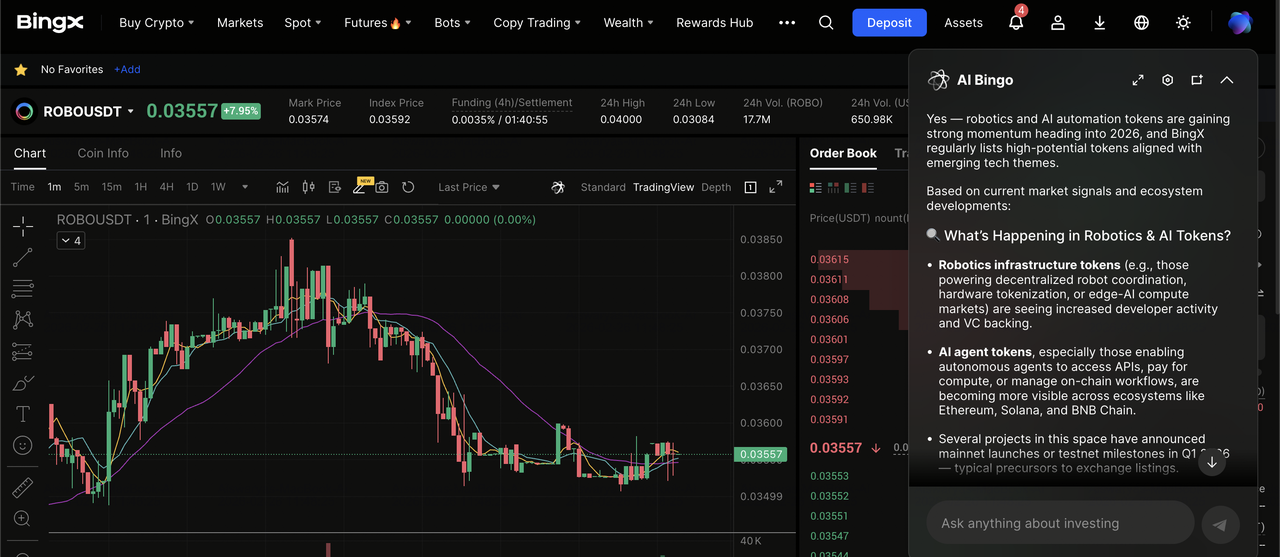
ROBO/USDT perpetuals on the futures market powered by BingX AI analysis
As the robotics narrative gains traction, ROBO has become a high-volatility asset favored by narrative-driven traders.
Long or Short ROBO Perps on BingX Futures
Capitalize on the volatility of the AI-Robotics cycle:
1. Transfer Funds: Move USDT to your Standard or Perpetual Futures account.
2. Select Direction: Go Long on ROBO/USDT perpetuals if you anticipate positive news regarding the airdrop claim or Short to hedge during market pullbacks.
3. Leverage Management: $ROBO is a high-beta asset. Use stop-loss (SL) orders to protect your capital from rapid 20-30% swings.
Conclusion: Should You Invest in Fabric Protocol (ROBO) Token?
The Fabric Foundation represents a significant shift in the robotics sector, moving from closed-loop hardware toward an open, interoperable Robot Economy. By integrating a universal operating system (OM1) with a blockchain-native coordination layer, the protocol addresses the critical scaling bottlenecks of machine identity and autonomous payments. Its success in 2026 depends largely on the real-world performance of its partnership network, including major humanoid manufacturers, and whether the $ROBO token can effectively capture the value of machine-to-machine transactions as a standardized infrastructure layer.
However, the long-term investment profile of $ROBO is characterized by the high-beta volatility typical of the AI and DePIN sectors. While the project’s mission to decentralize the robot economy is ambitious, it faces structural challenges, including a substantial portion of the supply (over 80%) currently being locked and subject to future vesting dilution. As with any early-stage infrastructure play, the value of the network will be tied to actual industrial adoption rather than speculative interest. Investors should monitor the progress of the upcoming L1 migration and the consistent growth of Proof of Robotic Work metrics to gauge the protocol’s fundamental health.
Risk Reminder: Cryptocurrency investments in the AI and robotics sectors carry extreme market risk and volatility. The $ROBO token is subject to supply inflation through scheduled unlocks and the inherent technical risks of migrating to a native blockchain. Always conduct your own research and never invest more than you can afford to lose.