


The AI buildout is often described through chips and cloud, but the physical unit that actually gets deployed is the server. In 2026, AI servers have stopped being standalone boxes and have become integrated rack-scale systems that combine GPUs, CPUs, memory, high-speed networking, and liquid cooling into a single engineered product. As hyperscalers, neoclouds, and sovereign buyers race to install compute capacity, the companies that design, assemble, power, and cool these systems have become some of the most direct public-market plays on the AI infrastructure cycle.
This guide focuses on the key stocks behind the AI server theme, including GPU platform vendors, merchant server OEMs, networking suppliers, CPU architecture licensors, and power and cooling infrastructure providers. Rather than looking only at chip designers, the article examines the businesses that turn silicon into deployable AI infrastructure and explains how global traders can gain exposure to selected names on BingX TradFi through USDT-margined perpetual contracts.
Read More: Top 10 AI Infrastructure Stocks to Buy in 2026: Chip Manufacturing and Design Leaders
What Is an AI Server?
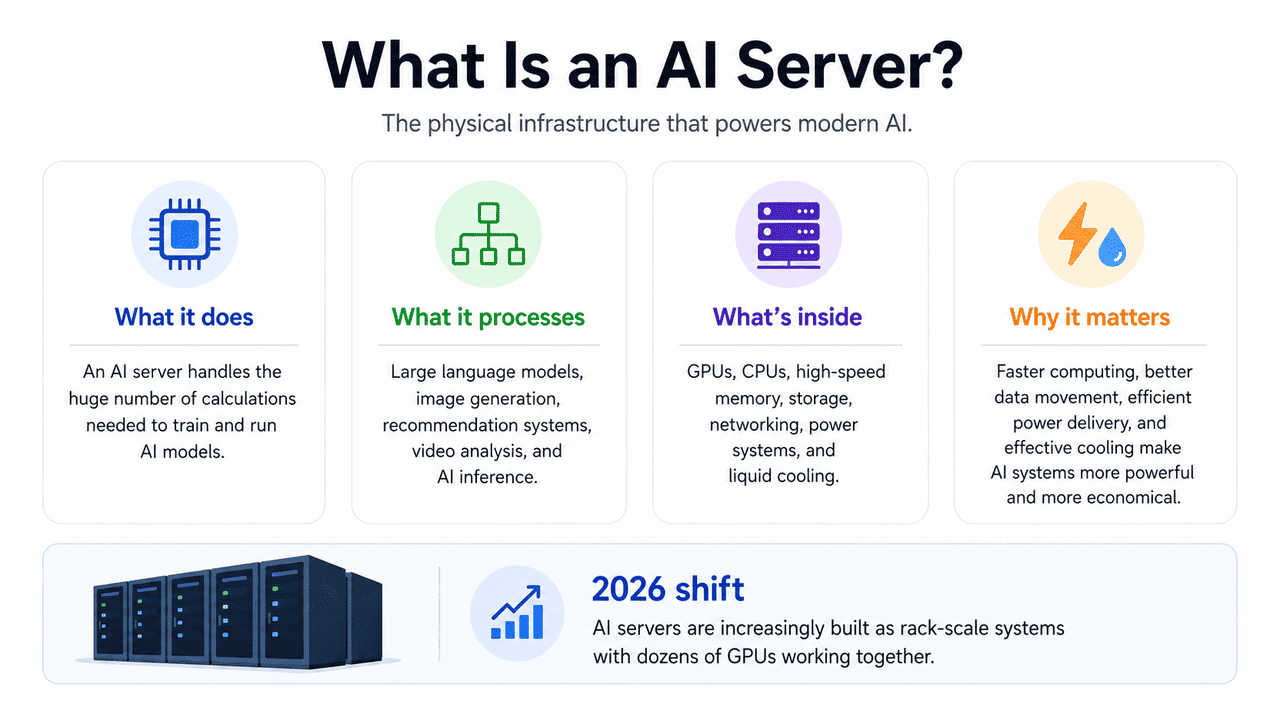
An AI server is a high-performance computing system built to handle the large number of calculations required to train and run artificial intelligence models. It processes workloads such as large language models, image generation, recommendation systems, and AI inference, using GPUs or other accelerators that can perform many calculations in parallel.
Inside an AI server are GPUs, CPUs, high-speed memory, storage, networking, and power systems. Modern AI workloads also consume large amounts of electricity and generate significant heat, so power delivery and liquid cooling have become essential parts of the design. In 2026, these components are increasingly integrated into full rack-scale systems with dozens of GPUs working together.
Demand is being driven by AI training, inference, and cloud expansion. Companies such as OpenAI need large clusters to train frontier models and serve growing inference workloads, while AI hyperscalers such as Google, Microsoft, and Amazon are expanding cloud infrastructure so businesses can access AI computing on demand. As more AI applications move into production, server demand increasingly comes not only from building new models, but also from running them continuously for millions of users and enterprise workloads.
AI Server Market Overview in 2026: Why the Rack Has Become the Product
The 2026 AI server cycle is defined less by a shortage of demand than by the difficulty of building, powering, and cooling enough systems to meet it. Server vendors, networking suppliers, and power and cooling companies are all being pulled into the same buildout. Four structural realities explain where value is flowing across the AI server stack.
- Rack-scale now defines the product, and single orders run into the billions. AI workloads run on integrated racks, not individual servers. NVL72-class systems wire 72 GPUs together with switching and cooling into a single validated design, shifting value toward vendors that deliver a complete rack rather than loose parts. Dell alone booked $24.4 billion in AI server orders in one quarter, most of it rack-scale.
- Liquid cooling is now mandatory, and it is lifting margins by hundreds of basis points. Rising power density has pushed air cooling past its limits, and direct liquid cooling is the default for new high-density AI designs. That makes thermal management a margin lever: Vertiv's liquid-cooling-led mix helped lift its operating margin 430 basis points year over year to 20.8%.
- The buyer base has broadened past 5,000 customers beyond the top hyperscalers. Demand is no longer concentrated in a few clouds. Neoclouds, sovereign AI projects, and enterprises deploying inference have all become real buyers, with Dell's AI server customer count now past 5,000. This spreads backlogs across more vendors and reduces single-customer risk.
- Vendors are moving up the stack, adding networking that can grow 148% a year. AI deals increasingly bundle networking, storage, power, and cooling alongside the server. HPE's networking revenue jumped 148% year over year after the Juniper acquisition, showing how vendors capture more of each project by attaching more of the stack.
2026 AI Server Stocks Overview and Comparison by Supply Chain Role
AI server stocks span the infrastructure stack, from GPU platform vendors and merchant OEMs to networking, CPU architecture, and power and cooling. This comparison shows how each company captures a different part of the 2026 AI server buildout.
|
Ticker |
Primary Role |
Key Advantages |
What to Watch in 2026 |
|
NVDA |
Rack-scale platform |
Makes the GPUs and full server racks most of the industry builds around |
World's most valuable chipmaker; next-gen Vera Rubin systems launch this year |
|
AMD |
Alternative platform + server CPU |
The main rival to NVIDIA, plus a fast-growing server processor business |
Largest-ever AI chip deal, supplying up to 6 gigawatts of GPUs to Meta |
|
DELL |
Largest AI server maker |
Sells more AI servers than anyone else, to the widest set of customers |
World's biggest AI server vendor, with a record $51.3 billion order backlog |
|
HPE |
AI servers plus networking |
Bundles servers and networking together after buying Juniper |
Networking sales up 148%; a top-two AI systems vendor after the Juniper deal |
|
CSCO |
AI networking and chips |
Supplies the networking and optics that connect AI servers |
$9.3 billion in AI orders this year from cloud giants like Microsoft and Google |
|
ARM |
Chip design behind processors |
Its designs power a growing share of AI data center processors |
Powers processors at Amazon, Microsoft, and Google; AI chip demand tops $2 billion |
|
VRT |
Power and cooling |
Provides the power systems and liquid cooling AI racks depend on |
Leading data center cooling supplier, with over $15 billion in backlog |
|
SMCI |
AI server specialist |
A pure play on building complete, liquid-cooled AI server racks |
One of the largest liquid-cooled AI server makers; $36-40 billion sales guidance |
What Are the Top AI Server Stocks in 2026?
Eight companies stand out across the AI server stack. NVIDIA and AMD supply the accelerators and rack-scale platforms, Dell and HPE build complete AI servers, Cisco provides networking, Arm supplies CPU architecture, Vertiv handles power and liquid cooling, and Super Micro Computer focuses on rack-scale AI systems.
1. NVIDIA (NVDA)
Core Role: Rack-scale AI systems and GPU compute platform
NVIDIA is best known as a chip designer, but in 2026 it is also a rack-scale systems vendor. Its DGX and GB-class NVL72 systems serve as the reference architecture much of the industry builds around, integrating GPUs, Grace CPUs, networking, and cooling into a single validated rack. This places NVIDIA at the center of the AI server buildout, not just the accelerator layer beneath it.
Q1 FY2027 results reinforced that position, with revenue of $81.6 billion, ahead of consensus. The next major catalyst is the Vera Rubin platform in the second half of 2026, which management expects to stay supply-constrained, and with a market cap near $5.4 trillion, NVIDIA is still the most direct large-cap exposure to AI compute demand. It is hard to displace at the system level because its rack designs define how the rest of the supply chain builds, keeping the company central even as merchant vendors assemble the final systems.
Read More: Nvidia (NVDA) Stock Price Outlook for 2026: Can Blackwell and Vera Rubin Take NVDA Back to $300?
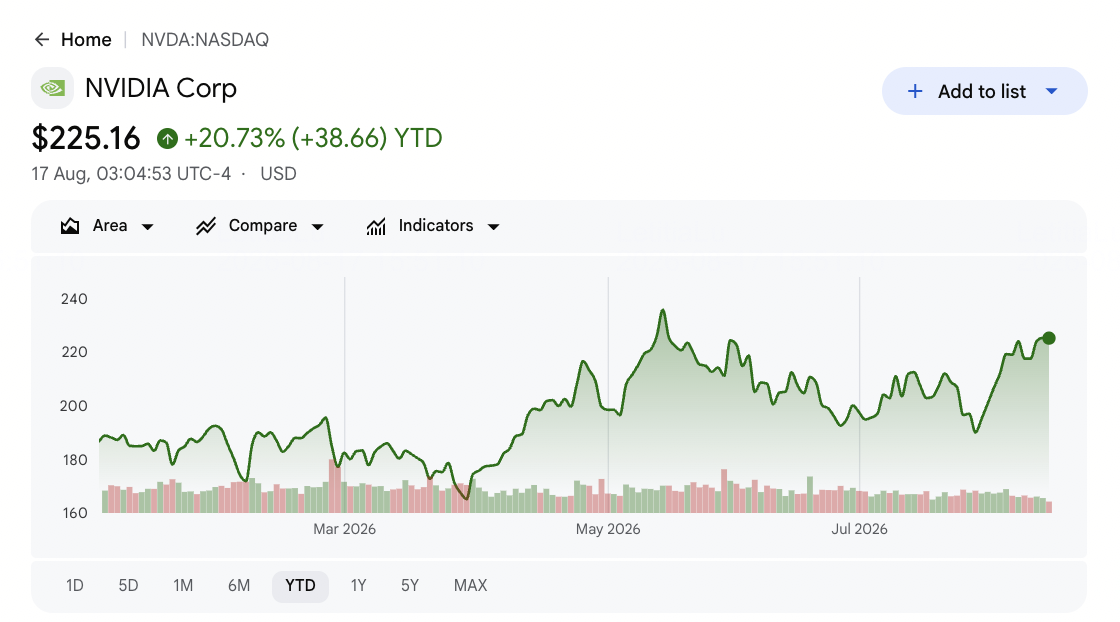
NVDA Price Trend (2020-2026 YTD)
|
Year |
Yearly High |
Yearly Low |
Annual Return |
Market Conditions |
|
2020 |
$15.06 |
$4.83 |
122% |
Pandemic-era gaming and data center demand |
|
2021 |
$33.36 |
$11.50 |
125% |
Crypto mining peak; data center momentum |
|
2022 |
$30.04 |
$10.81 |
-50% |
Crypto bust; mining card glut; Fed rate hikes |
|
2023 |
$50.41 |
$14.10 |
239% |
ChatGPT moment; Hopper ramp; AI rally begins |
|
2024 |
$152.89 |
$45.95 |
171% |
Blackwell launch; market cap surpasses $3T |
|
2025 |
$190.95 |
$86.62 |
26% |
Consolidation year; Blackwell shipments scale |
|
2026 YTD |
~$220 (May) |
~$140 (Jan) |
+45% YTD (est.) |
Q1 FY27 beat; Rubin ramp positioning; $5.4T cap |
2. Advanced Micro Devices (AMD)
Core Role: Alternative rack-scale AI platform and server CPU franchise
AMD is the primary commercial alternative to NVIDIA in rack-scale AI systems, while its EPYC server CPU franchise gives it a strong position inside data center infrastructure regardless of which accelerator a customer chooses. The MI300 series built momentum through 2025, and the upcoming MI450 platform, with the Helios rack-scale architecture, anchors a multi-year Meta agreement to deploy up to 6 gigawatts of AMD Instinct GPUs.
Q1 2026 revenue reached $10.3 billion, up 38% year over year, with Data Center revenue up 57%. The underappreciated part of AMD's server thesis is the CPU side: agentic AI workloads raise host-CPU requirements for every accelerator deployed, supporting server CPU revenue growth of more than 70% in 2026. As Helios systems ramp, AMD gains a second path into AI servers beyond merchant accelerator sales, with investor focus now on MI450 execution and EPYC share gains.
Read More: AMD Price Prediction 2026: $525 AI Sovereignty or $300 Valuation Trap?
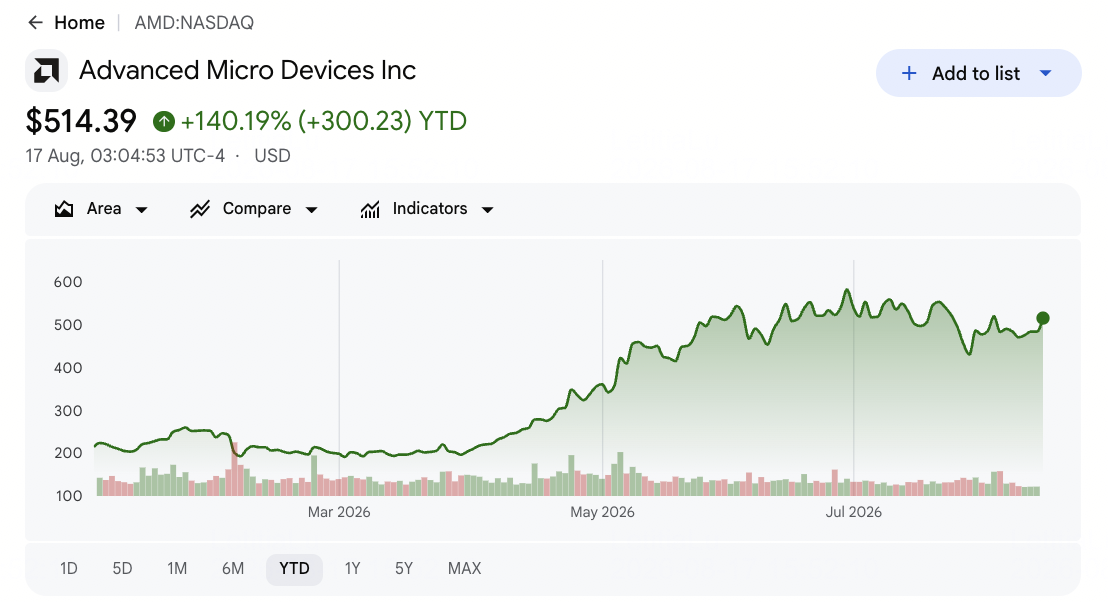
AMD Price Trend (2020-2026 YTD)
|
Year |
Yearly High |
Yearly Low |
Annual Return |
Market Conditions |
|
2020 |
$97.98 |
$36.75 |
100% |
Pandemic gaming and data center surge |
|
2021 |
$164.46 |
$72.50 |
57% |
EPYC share gains; data center growth |
|
2022 |
$155.42 |
$54.57 |
-55% |
Tech sell-off; PC market weakness |
|
2023 |
$151.05 |
$60.05 |
128% |
AI rally; MI300 launch expectations |
|
2024 |
$227.30 |
$116.37 |
-18% |
MI300 shipments begin but margin disappoints |
|
2025 |
$215.00 |
$78.21 |
22% |
Stabilization; Meta GPU deal speculation |
|
2026 YTD |
~$352 (Apr) |
~$210 (Jan) |
+66% YTD |
Meta 6GW deal confirmed; Q1 rev +38%; Data Center +57% |
3. Dell Technologies (DELL)
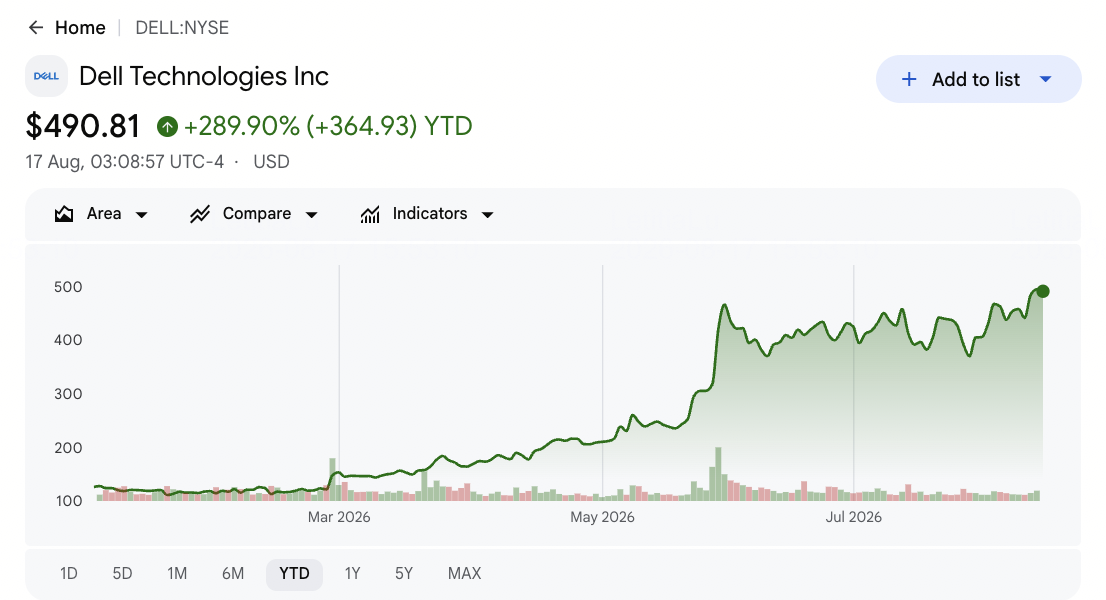
Core Role: Largest merchant AI server vendor by revenue
Dell is the largest merchant AI server OEM, shipping close to a fifth of all AI-optimized servers globally and serving hyperscaler, neocloud, sovereign, and enterprise customers through its Infrastructure Solutions Group (ISG). Its Dell AI Factory approach, developed with NVIDIA and other partners, packages compute, storage, networking, and services into deployable AI infrastructure, positioning Dell as a one-stop vendor for buyers that want validated systems at scale.
Q1 FY2027 results were a record, with revenue up 88% year over year and a record $51.3 billion AI backlog exiting the quarter, prompting management to lift its AI server revenue target to $60 billion. The key thesis is that Dell's growth is now gated by supply rather than demand, with memory, NAND, and CPUs the primary constraints; its customer base has passed 5,000 across neocloud, sovereign, and enterprise segments, though the backlog's size raises the stakes around component availability and integration timelines.
Read More: Dell Stock Price Prediction 2026: $500 AI Server Boom or $1.7B Insider Selling Trap?
DELL Price Trend (2020-2026 YTD)
|
Year |
Yearly High |
Yearly Low |
Annual Return |
Market Conditions |
|
2020 |
$52.19 |
$25.00 |
34% |
Pandemic PC demand; VMware spinoff planning |
|
2021 |
$59.59 |
$44.51 |
38% |
VMware spinoff completed; server recovery |
|
2022 |
$53.30 |
$32.91 |
-25% |
Tech sell-off; PC downcycle; enterprise slowdown |
|
2023 |
$78.94 |
$34.02 |
90% |
AI server narrative emerges; ISG stabilization |
|
2024 |
$179.70 |
$70.42 |
40% |
AI server ramp; backlog builds; index inclusion |
|
2025 |
$147.66 |
$66.25 |
5% |
Consolidation; margin scrutiny; supply concerns |
|
2026 YTD |
$514.00 (Aug) |
~$85 (Apr) |
+290% YTD |
Record Q1 FY27; $51.3B AI backlog; stock nearly quadruples |
4. Hewlett Packard Enterprise (HPE)
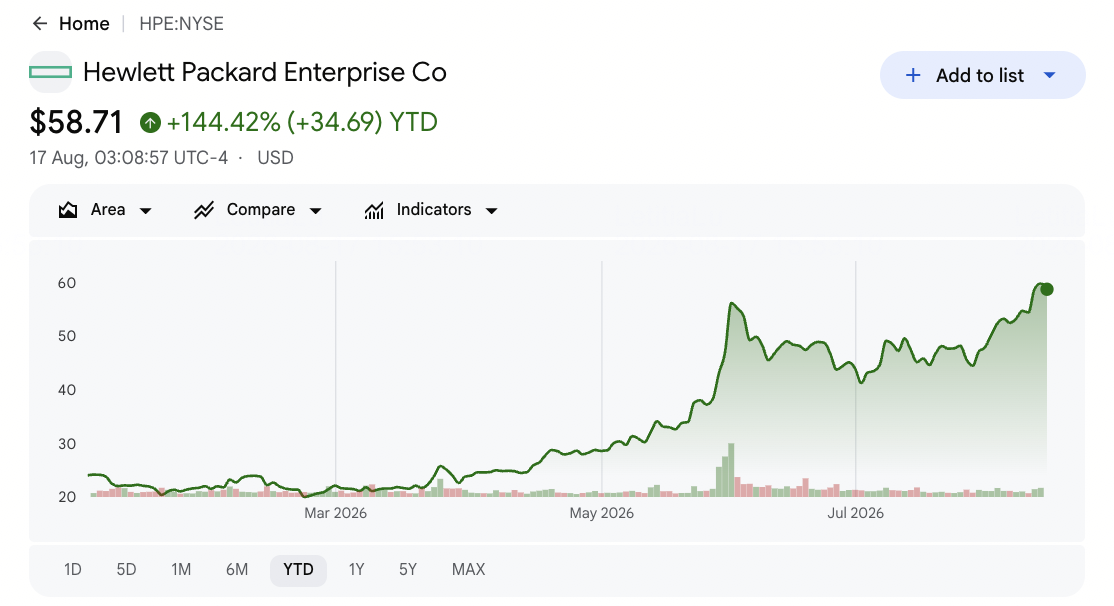
Core Role: AI systems vendor with integrated networking
HPE has become a broader AI infrastructure vendor after its Juniper Networks acquisition, combining AI servers with data center switching, routing, and AI-native networking. This lets HPE compete for larger deals where the buyer wants compute and networking from a single vendor, positioning it around enterprise and sovereign AI deployments that extend beyond raw GPU procurement.
Q2 FY2026 results set records, with revenue up 40% year over year and Networking revenue jumping 148% to $2.7 billion on the Juniper integration, alongside a $5.9 billion AI systems backlog. HPE's advantage is that networking has become a pull-through engine for broader portfolio deals, as it productizes liquid-cooled switching and co-packaged optics; the main constraint is supply rather than demand, with inflating DRAM and NAND costs pressuring margins, leaving HPE an AI systems vendor whose networking attach increasingly differentiates it from pure server OEMs.
HPE Price Trend (2020-2026 YTD)
|
Year |
Yearly High |
Yearly Low |
Annual Return |
Market Conditions |
|
2020 |
$16.51 |
$7.62 |
-12% |
Pandemic disruption; enterprise IT slowdown |
|
2021 |
$17.66 |
$10.00 |
37% |
Recovery; edge-to-cloud strategy ramp |
|
2022 |
$17.71 |
$12.30 |
-6% |
Tech sell-off; supply chain constraints |
|
2023 |
$18.29 |
$13.86 |
2% |
AI narrative emerges; GreenLake growth |
|
2024 |
$22.85 |
$14.87 |
18% |
AI systems demand builds; Juniper deal announced |
|
2025 |
$24.19 |
$11.00 |
12% |
Juniper close; networking integration begins |
|
2026 YTD |
~$64 (52-wk) |
~$20 (Jan) |
+150% YTD |
Record Q2; Networking +148%; $5.9B AI backlog |
5. Cisco (CSCO)
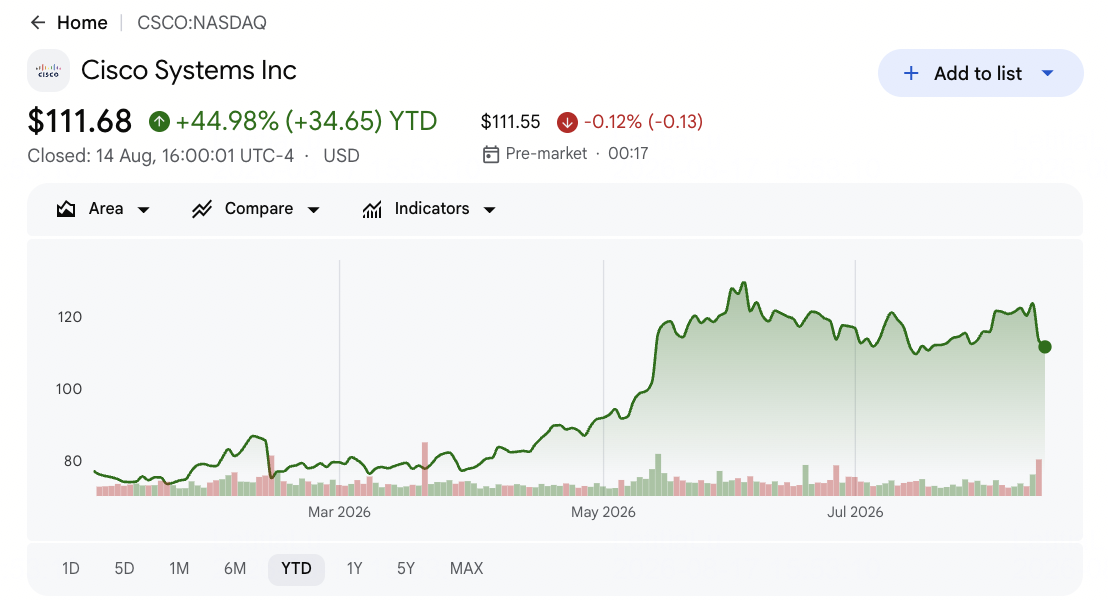
Core Role: AI networking, silicon, and hyperscaler infrastructure
Cisco has moved to the center of the AI infrastructure conversation through its Silicon One systems, Acacia optics, and data center switching, all of which connect the servers inside AI clusters. While Cisco is not a primary AI server OEM like Dell or HPE, its networking and silicon are essential to the buildout, and its hyperscaler order momentum makes it a direct beneficiary of rack-scale deployment.
Cisco closed a record fiscal 2026 with Q4 revenue up 18% year over year, and AI infrastructure orders from hyperscalers reached $9.3 billion for the year, roughly 4.5 times the prior year, with management guiding to $7.5 billion of AI hyperscaler revenue in FY2027. Cisco's thesis is a networking supercycle driven by both AI hyperscaler demand and a multi-year enterprise campus refresh; the main watch points are gross margin pressure from higher memory costs and execution on a restructuring expected to generate up to $1 billion in charges, leaving Cisco the networking and silicon layer that ties AI servers together.
Read More: Cisco (CSCO) Stock Price Outlook for 2026: Can AI Growth and Splunk Drive CSCO Back to $90?
CSCO Price Trend (2020-2026 YTD)
|
Year |
Yearly High |
Yearly Low |
Annual Return |
Market Conditions |
|
2020 |
$50.28 |
$32.40 |
-5% |
Pandemic disruption; enterprise spending pause |
|
2021 |
$64.29 |
$42.62 |
43% |
Recovery; supply-constrained networking demand |
|
2022 |
$64.13 |
$40.82 |
-24% |
Tech sell-off; backlog digestion |
|
2023 |
$58.19 |
$43.94 |
4% |
Splunk acquisition announced; AI positioning |
|
2024 |
$61.00 |
$45.86 |
18% |
Splunk close; AI infrastructure orders begin |
|
2025 |
$80.00 |
$55.00 |
30% |
Surpasses dot-com high; hyperscaler orders ramp |
|
2026 YTD |
~$124 (Aug) |
~$76 (Jan) |
+53% YTD |
Record FY26; $9.3B AI orders; networking supercycle |
6. Arm Holdings (ARM)
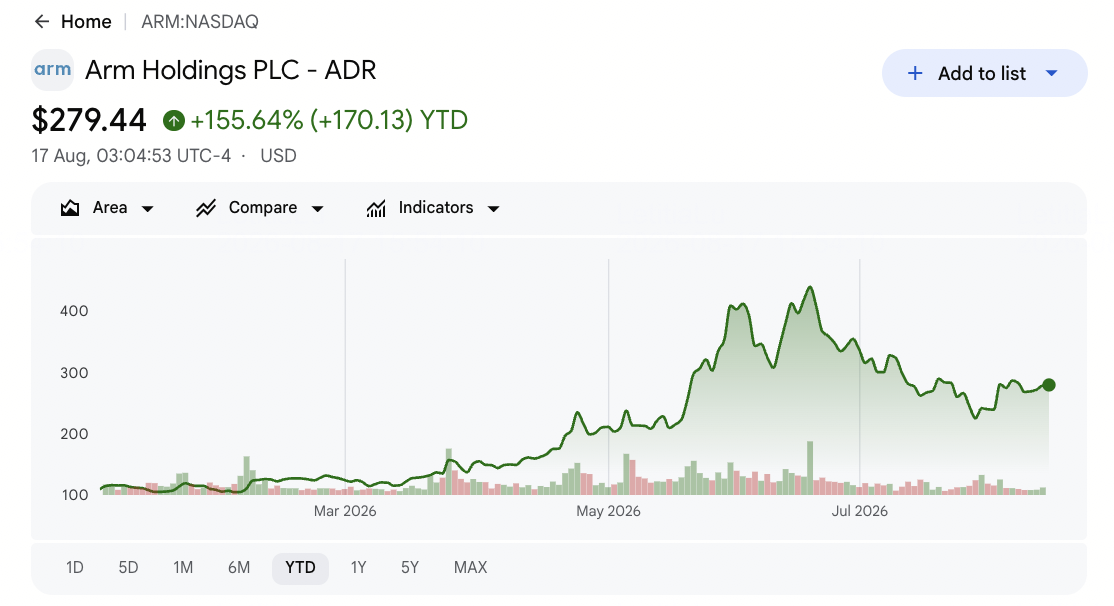
Core Role: CPU architecture for AI data centers and host compute
Arm is the CPU architecture increasingly used inside AI servers, both as the host processor paired with accelerators and as the basis for custom data center silicon. Its Neoverse cores and Compute Subsystems (CSS) let hyperscalers and chipmakers build power-efficient server CPUs, while the new Arm AGI CPU targets cloud and AI data centers directly. This makes Arm an architecture-level beneficiary of the buildout regardless of which vendor assembles the final system.
Q1 FY2027 results were a record, with revenue up 22% year over year, data center royalty revenue more than doubling, and Arm AGI CPU demand for FY2027 and FY2028 now exceeding $2 billion. Arm's thesis is a structural shift of AI infrastructure toward its architecture, with higher royalty rates per chip from Armv9 and CSS; the main near-term drag is smartphone weakness tied to higher memory prices, which trimmed fiscal-year royalty growth expectations to the high teens, though data center strength is expected to offset it, making Arm a high-margin, architecture-level way to play the AI server CPU transition.
Note: Arm began trading on Nasdaq in September 2023, so multi-year historical data prior to the IPO is not directly comparable.
Read More: Arm Holdings (ARM) Stock Outlook 2026: AI Licensing and the $200+ Price Target
ARM Price Trend (2023 IPO-2026 YTD)
|
Year |
Yearly High |
Yearly Low |
Annual Return |
Market Conditions |
|
2023 |
$69.00 |
$46.50 |
+47% (partial) |
Nasdaq IPO in September; AI licensing interest |
|
2024 |
$164.00 |
$46.50 |
0.6416 |
Armv9 ramp; data center royalty growth begins |
|
2025 |
$175.00 |
$80.00 |
-11.39% |
CSS adoption; Neoverse hyperscaler share gains |
|
2026 YTD |
~$290 (Jul) |
~$110 (Jan) |
+120% YTD |
Record Q1 FY27; data center royalties double; AGI CPU >$2B |
7. Vertiv (VRT)
Core Role: Power and liquid cooling for AI server racks
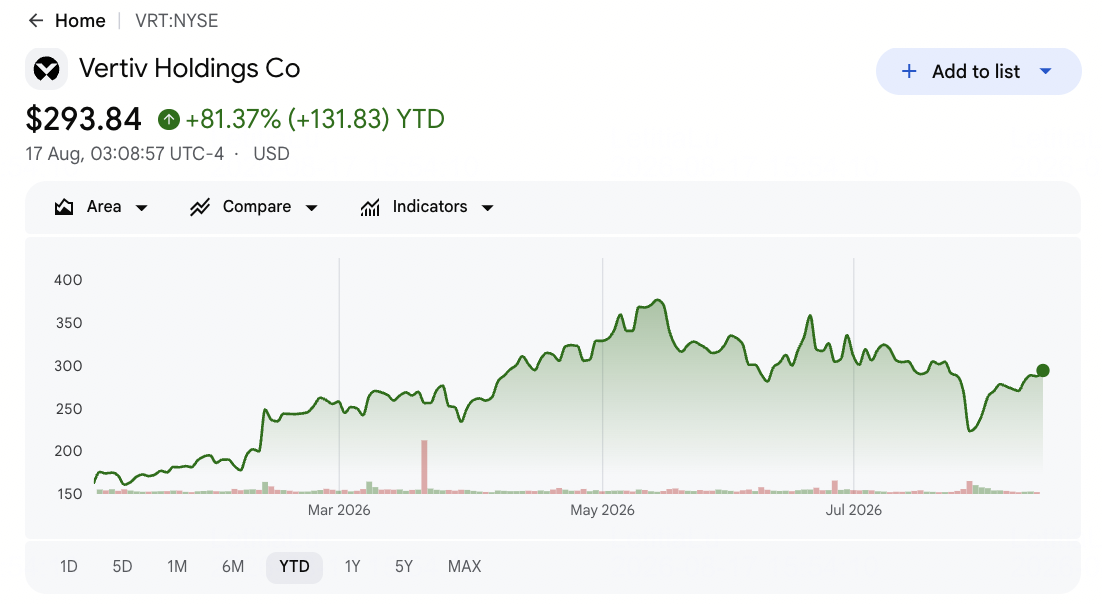
Vertiv is the power and thermal infrastructure that makes high-density AI servers possible. The company supplies uninterruptible power supplies, switchgear, busways, racks, chillers, and liquid cooling distribution units, sitting in the critical path of every high-density AI deployment. As liquid cooling becomes the default for AI rack designs, Vertiv is one of the most direct server-adjacent beneficiaries of the buildout.
Q1 2026 revenue rose 30% year over year, with adjusted operating margin expanding 430 basis points to 20.8% and project backlog more than doubling to over $15 billion, leading management to raise full-year guidance to around 30% organic growth. Vertiv's thesis rests on converting that backlog as high-density power and liquid cooling demand accelerates alongside next-generation GPU ramps; the main risks are hyperscaler capex pauses, supply bottlenecks during ramp, and a premium valuation that leaves little room for misses, but Vertiv extends the AI server theme into the power and cooling layer that has become a binding constraint.
VRT Price Trend (2020-2026 YTD)
|
Year |
Yearly High |
Yearly Low |
Annual Return |
Market Conditions |
|
2020 |
$22.00 |
$10.00 |
0.32 |
SPAC listing; data center infrastructure base |
|
2021 |
$28.00 |
$18.00 |
0.34 |
Data center demand recovery |
|
2022 |
$16.00 |
$6.50 |
-45.26% |
Cost inflation; supply chain pressure; sell-off |
|
2023 |
$50.00 |
$11.00 |
2.5186 |
AI narrative emerges; cooling demand ramps |
|
2024 |
$155.00 |
$42.00 |
1.3682 |
AI data center capex surge; backlog builds |
|
2025 |
$145.00 |
$60.00 |
0.428 |
Liquid cooling adoption accelerates |
|
2026 YTD |
$379.94 (52-wk) |
~$160 (Jan) |
+84% YTD |
Q1 rev +30%; $15B+ backlog; joins S&P 500 |
8. Super Micro Computer (SMCI)
Core Role: Rack-scale AI servers and liquid cooling systems
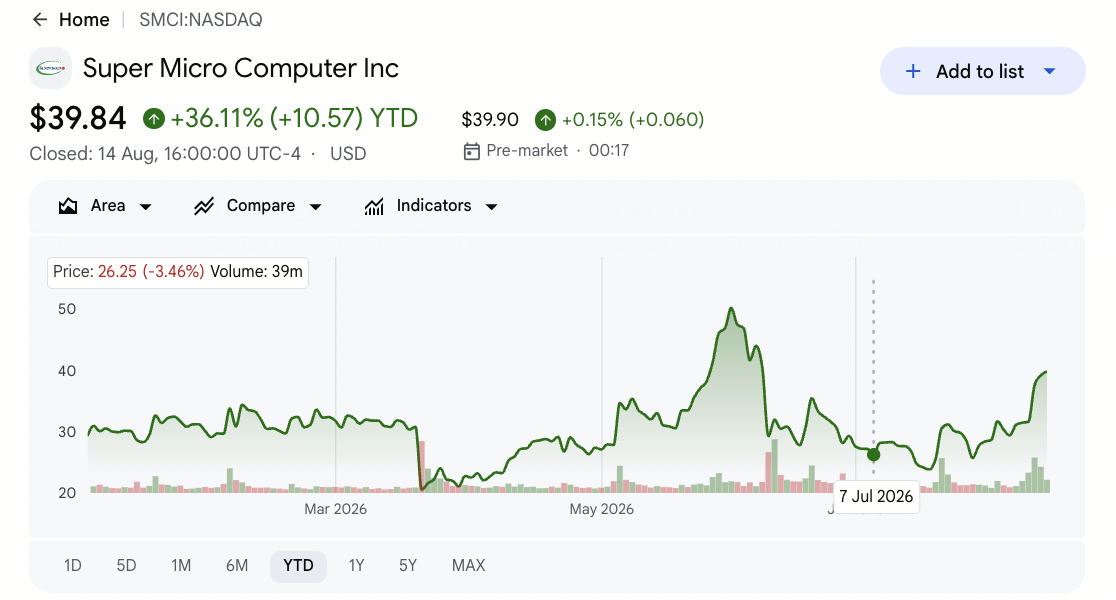
Super Micro Computer is one of the most direct AI server infrastructure plays on U.S. exchanges. The company builds complete rack-scale AI systems that integrate GPUs, CPUs, networking, memory, and liquid cooling. Its direct liquid cooling position is especially important as high-density AI data centers require more efficient thermal management, making SMCI a pure-play on the rack-scale trend defining the 2026 cycle.
Growth remains strong, but volatility is high. Trailing twelve-month revenue reached $33.7 billion through March 2026, up 56% year over year, with FY2026 guidance of $36 billion to $40 billion, though Q3 included a $2.25 billion revenue miss on data center order timing. The main risk is execution and governance: SMCI has faced delayed filings, auditor changes, and accounting concerns, and shares now trade around $35, far below the March 2024 high of $118.81, making it a high-beta AI server stock with meaningful upside if rack-scale demand accelerates but significant downside if execution problems continue.
Read More: SMCI Stock Price Prediction 2026: $65 Street-High Rack-Scale Boom or Corporate Governance Trap?
SMCI Price Trend (2020-2026 YTD)
|
Year |
Yearly High |
Yearly Low |
Annual Return |
Market Conditions |
|
2020 |
~$8 |
~$3 |
0.45 |
Pandemic recovery; server demand modest |
|
2021 |
~$15 |
~$6 |
0.39 |
Data center hardware cycle begins |
|
2022 |
~$25 |
~$7 |
0.87 |
AI server early demand; GPU shortages |
|
2023 |
~$70 |
~$12 |
2.46 |
ChatGPT moment; AI server orders explode |
|
2024 |
$118.81 |
~$30 |
0.07 |
March 2024 ATH; 10-K delay, auditor change, governance |
|
2025 |
~$62 |
~$20 |
-15% (est.) |
Auditor resolution; co-founder allegations; volatility |
|
2026 YTD |
$62.36 (52-wk) |
$19.48 (52-wk) |
~flat YTD |
Q3 FY26 revenue miss; $36-40B FY26 guidance; $21B market cap |
How to Trade AI Server Stocks on BingX
BingX offers a crypto-native way to gain exposure to leading AI server stocks without using a traditional brokerage account. The main execution path is through USDT-margined perpetual contracts on BingX TradFi, which allow active traders to go long or short and trade around earnings, backlog updates, capex announcements, and broader AI server cycle headlines.
Long or Short AI Server Stock Futures with USDT on BingX TradFi
For active traders looking to capitalize on short-term momentum, earnings volatility, or AI infrastructure catalysts, BingX TradFi allows users to trade server-linked stock futures with USDT. These USDT-settled perpetual contracts mirror the price movements of underlying equities, offering flexible long and short exposure without requiring users to hold the physical stock.
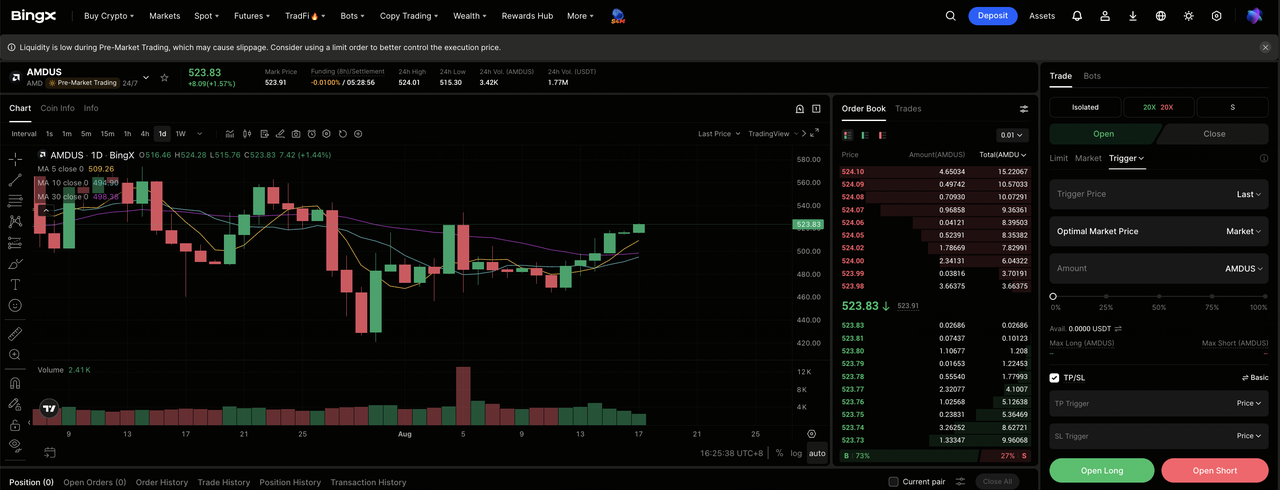
Step 1: Account setup and security. Sign up and log into your BingX account, complete the identity verification (KYC) required in your region, and enable two-factor authentication.
Step 2: Allocate trading capital. Transfer USDT from your spot wallet into your futures account, where it will serve as collateral.
Step 3: Select your contract. Navigate to the TradFi markets. Choose server-linked perpetual contracts such as NVDA-USDT, AMDUS-USDT, DELL-USDT, HPE-USDT, CSCO-USDT, ARM-USDT, VRT-USDT, or SMCI-USDT.
Step 4: Set direction and leverage. Open long if you expect the stock price to rise, or open short if you expect a pullback. Choose leverage based on your risk plan.
Step 5: Execute and manage risk. Set stop-loss and take-profit orders before submitting the trade. PnL settles dynamically in USDT.
Risks and Core Considerations When Trading AI Server Stocks
- SMCI carries the highest execution risk in the group: Auditor scrutiny, compliance concerns, customer concentration, order timing, and margin pressure can all drive sharp moves in SMCI.
- Strong demand does not eliminate supply and cost pressure: Memory, NAND, CPUs, and other components can still constrain shipments or compress margins for Dell, HPE, and other server vendors.
- Hyperscaler spending remains the biggest demand dependency: A slowdown or reprioritization in AI capex from hyperscalers and neoclouds could quickly affect orders, backlogs, and revenue growth across the stack.
- Pricing power may weaken as AI hardware becomes more standardized: Custom silicon, merchant server competition, and standardized rack designs can pressure margins for vendors that lack differentiation in networking, cooling, or integration.
- High expectations leave little room for execution misses: Record backlogs and premium valuations mean delays, weaker guidance, or slower backlog conversion can trigger sharp repricing, especially for traders using leverage.
Final Thoughts: Should You Add AI Server Stocks to Your 2026 Portfolio?
The eight names above offer different ways to participate in the 2026 AI server buildout. NVIDIA and AMD supply the rack-scale platforms, Dell and HPE anchor the merchant server thesis with record backlogs, Cisco provides the networking and silicon that tie clusters together, Arm supplies the CPU architecture increasingly used in AI data centers, Vertiv delivers the power and liquid cooling that high-density racks require, and Super Micro Computer provides direct exposure to rack-scale AI server deployment. Together, they cover the key parts of the AI server stack, from compute systems and networking to CPU IP, power, and cooling.
The trade-off is that each stock carries a different risk profile. NVIDIA and AMD face custom-silicon and execution risk, Dell and HPE face supply constraints and margin pressure, Cisco faces margin and restructuring execution, Arm faces smartphone weakness offsetting data center strength, Vertiv faces backlog conversion and valuation risk, and Super Micro Computer faces execution and governance risk. For traders using BingX TradFi, conservative position sizing, leverage control, and stop-loss orders are essential when trading AI server stock futures through USDT-margined perpetual contracts.
Related Reading
- Top 10 AI Infrastructure Stocks to Buy in 2026: Chip Manufacturing and Design Leaders
- Top AI Compute and GPU Stocks to Buy in 2026: The Shift to Inference and Custom Silicon
- Top AI Data Center Stocks to Buy in 2026: Cloud, Servers, and AI Compute Infrastructure
- Top 10 AI Hardware Stocks to Watch in 2026: The Architecture Driving Next-Gen Intelligence
- Top AI Cloud Infrastructure Stocks to Buy in 2026 Amid Hyperscaler Capex and the Neocloud Boom
- Top AI Memory Stocks to Buy in 2026: DRAM, HBM, and AI Storage Demand Explained
