
Sidus Space (SIDU) is a small space and defense technology company providing satellite manufacturing, payload integration, mission operations, AI-enabled data services and defense hardware. LizzieSat is the core orbital platform, supported by the Orlaith AI ecosystem, FeatherEdge processing and Fortis VPX mission computers. This integrated model offers several commercialization paths, though SIDU remains sensitive to contract timing, negative gross margin and dilution.
The latest quarter strengthened liquidity without proving commercial scale. Sidus Space Q2 2026 revenue fell 54% to $583,000 as fixed-price milestones shifted between periods, gross loss narrowed 39% to $630,000 and net loss improved 15% to $4.8 million. Cash reached $166.5 million with no term debt after equity offerings, making the central investment question whether that capital can produce recurring government and commercial revenue before the share base expands again.
The SIDU stock forecast for 2026 now centers on two competing views:
- The commercialization and defense-contract case: LizzieSat missions, Fortis VPX adoption and new government or intelligence awards could lift revenue from the $583,000 quarterly base and support a move toward $6.
- The revenue-timing, loss and dilution case: delayed milestones, continued negative gross margin and further equity issuance could reduce each share's claim on future growth and pull SIDU toward $1.
This guide breaks down the SIDU stock forecast, 2026 price scenarios, key risks and analyst outlooks, drawing on Sidus Space's August 14 Q2 2026 earnings release, quarterly filing and market data through September 15, plus how to trade SIDU stock futures on BingX TradFi with USDT collateral.
Top 5 Things for Sidus Space Investors to Know in September 2026
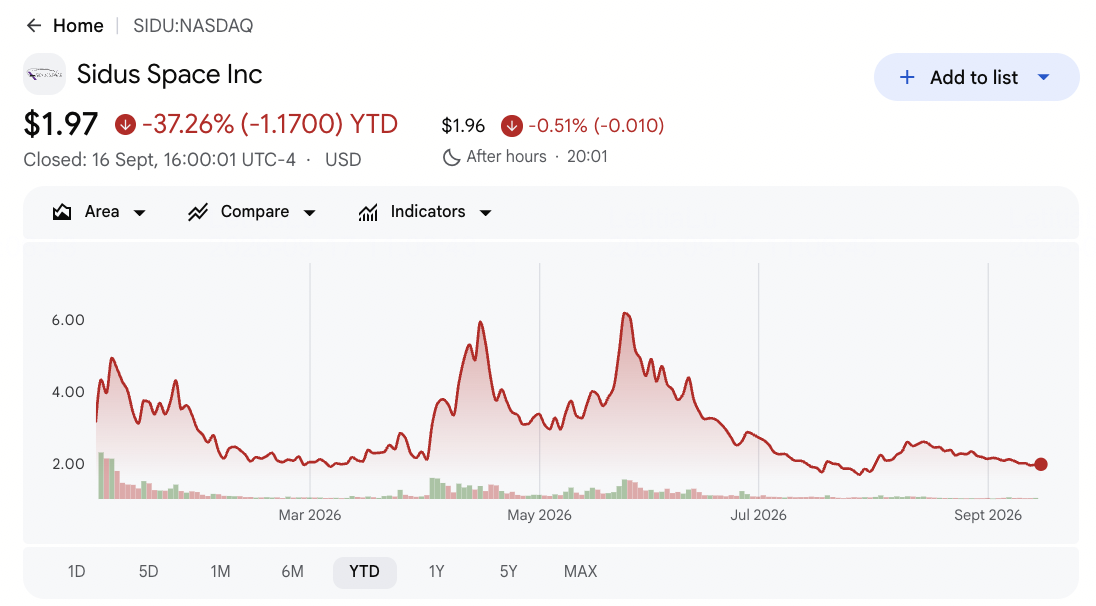
- SIDU closed at $1.96 on September 15 and was down about 38.65% YTD: Shares traded as high as $6.79 in 2026, showing how quickly small-cap space valuations can reverse. A sustained recovery now depends more on contract conversion than narrative momentum.
- Q2 revenue fell 54% to $583,000: Revenue declined from $1.261 million as fixed-price contract milestones shifted between periods. The small base means one customer acceptance event can materially change quarterly results.
- Gross loss narrowed 39% to $630,000: Cost of revenue fell 47% to $1.213 million, faster than the revenue decline. The improvement helps, though revenue still does not cover direct costs.
- Cash reached $166.5 million with no term debt: The balance rose from $43.2 million at year-end after capital raises, including a $100 million May offering at $5.08 per share. The larger runway supports development but increases dilution risk.
- LizzieSat completed vibration testing with Fortis VPX Maxima integrated: The platform combines an ARM processor, FPGA and NVIDIA edge AI engine for onboard inference. Commercial value still depends on launch, on-orbit performance and customer adoption.
What Is Sidus Space (SIDU)?

Sidus Space designs and manufactures satellites and space hardware, integrates customer payloads, supports mission planning and operations, and develops space-based data services. Its 35,000-square-foot Florida facility performs manufacturing, assembly, integration and testing near major launch infrastructure. LizzieSat provides a modular multi-sensor spacecraft for hosted payloads and company-operated missions. Revenue can come from engineering and manufacturing contracts, payload hosting, mission services and eventually recurring AI-enhanced data products for government, defense, intelligence and commercial customers.
The long-term strategy moves Sidus from project-based engineering toward proprietary platforms and recurring services. LizzieSat supplies the orbital layer, Orlaith and FeatherEdge process sensor information, and Fortis VPX Maxima extends software-defined mission computing across space, air, land and sea. The company has integrated an NVIDIA edge AI engine and worked with Element U.S. Space & Defense on environmental qualification. Russell 2000, Russell 3000 and Russell Microcap inclusion may improve visibility, though durable value still depends on customer contracts and repeatable mission execution.
Read More: Top Space Stocks to Buy Ahead of SpaceX IPO
Sidus Space (SIDU) Q2 2026 Earnings Overview: Lower Revenue, Narrower Net Loss and Stronger Liquidity
Sidus reported Q2 revenue of $583,000, down 54% from $1.261 million, and diluted loss per share of $0.06 versus $0.31 a year earlier. Gross loss improved 39% to $630,000 and net loss narrowed 15% to $4.781 million, though adjusted EBITDA loss widened to $5.076 million as SG&A rose 19%. Cash increased to $166.5 million with no term debt, separating a much stronger funding position from an operating model that has yet to achieve positive gross profit.
|
Financial Metric |
Guidance / Consensus |
Reported / Actual |
Surprise |
|
Q2 revenue |
$1.261M in Q2 2025 |
$0.583M |
Declined. Down 54% on milestone timing. |
|
Diluted loss per share |
$(0.31) in Q2 2025 |
$(0.06) |
Improved. A narrower loss and higher share count reduced per-share loss. |
|
Gross loss |
$(1.027)M in Q2 2025 |
$(0.630)M |
Improved. Gross loss narrowed 39%. |
|
Net loss |
$(5.625)M in Q2 2025 |
$(4.781)M |
Improved. Narrowed $0.844M, or 15%. |
|
Adjusted EBITDA loss |
$(3.946)M in Q2 2025 |
$(5.076)M |
Widened. Investment increased the loss by $1.129M. |
|
SG&A |
$4.263M in Q2 2025 |
$5.063M |
Increased. Up 19% YoY. |
|
Cash |
$43.176M at Dec. 31 |
$166.521M |
Strengthened. Equity raises increased liquidity. |
|
May offering |
— |
$100M gross proceeds |
Raised capital. 19.685M shares or pre-funded warrants at $5.08. |
- Revenue of $583,000 fell by $678,000 year over year: The 54% decline reflected fixed-price milestone timing rather than recurring subscription weakness. Contract schedules and customer acceptance remain the key near-term revenue drivers.
- Loss per share improved to $0.06 from $0.31: Net loss narrowed by $844,000, but the weighted-average share count rose from 18.3 million to 85.3 million. The per-share improvement therefore reflects dilution as well as better net income.
- Gross loss improved by $397,000 to $630,000: Cost of revenue fell 47% to $1.213 million. Sidus still spent more than two dollars of direct cost for each dollar of revenue, keeping scale and mix central to commercialization.
- Adjusted EBITDA loss widened by $1.129 million to $5.076 million: SG&A rose 19% to $5.063 million as Sidus invested in its platform and corporate infrastructure. Revenue must grow substantially before fixed costs are absorbed.
- Cash increased by $123.3 million to $166.5 million: Sidus eliminated term debt and gained runway, though the May offering added 19.685 million shares or equivalents. Future value depends on revenue growing faster than dilution.
Sidus Space (SIDU) 2026 Investment Outlook: $6 Bull Case vs. $1 Bear Case
Sidus Space's 2026 outlook depends on whether LizzieSat, edge AI hardware and government programs can turn its strong liquidity position into repeatable revenue. The main risk is that commercialization remains slow while operating losses and dilution continue.
The Bull Case: Stronger Space and Defense Demand Pushes SIDU Toward $6
The Bull Case assumes the next LizzieSat advances on schedule, Fortis VPX wins external customers and government or intelligence awards create repeatable mission revenue. Quarterly sales move well above $583,000 and gross loss turns positive as direct costs are absorbed.
A move toward $6 would require named contracts, successful launch execution and a clear path to lower adjusted EBITDA losses. Stronger bookings, positive gross margin and more recurring data-service revenue without another large equity raise would strengthen the case.
The Base Case: Steady Commercial Progress Keeps SIDU Between $2.50 and $3.50
The Base Case assumes Sidus uses its $166.5 million cash balance to fund product and mission development as contract revenue improves gradually. Milestone timing keeps quarterly results uneven, while operating expenses remain high relative to sales.
SIDU could trade mainly between $2.50 and $3.50 if liquidity stays strong and commercialization milestones advance. Higher quarterly revenue and smaller adjusted EBITDA losses would support the range, while stagnant sales or another large share issuance would weaken the upper end.
The Bear Case: Weak Revenue and Dilution Pull SIDU Toward $1
The Bear Case assumes contracts shift further out, LizzieSat commercialization takes longer and gross profit remains negative. Cash then funds development and corporate expenses without enough revenue to narrow the $5.076 million adjusted EBITDA loss.
A move toward $1 would become more likely if quarterly revenue stays near $583,000, gross margin remains negative or Sidus returns to equity markets despite its current cash balance. Additional shares would further reduce existing investors' claim on future program value.
SIDU Stock Price Forecasts for 2026 By Wall Street Analysts
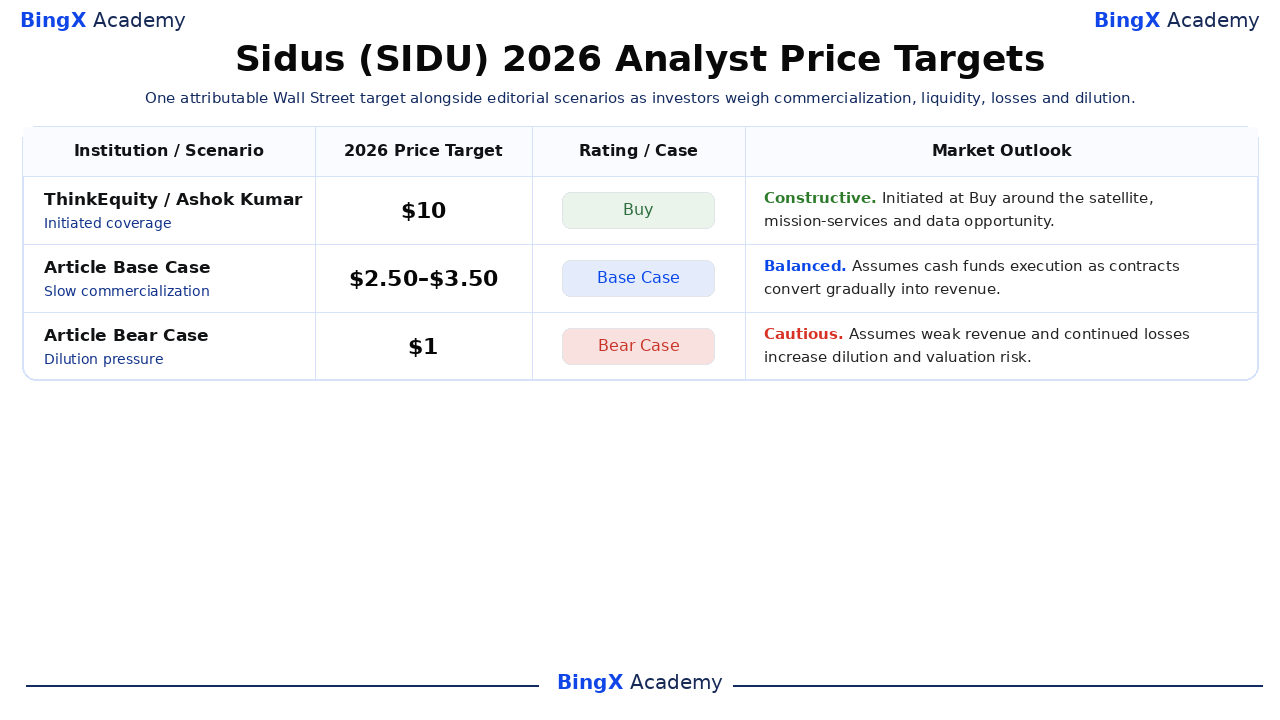
SIDU has exceptionally thin sell-side coverage. Only one attributable, dated institutional action was found across MarketScreener, Benzinga, Zacks and Investing.com. The table therefore shows that real action and two clearly labeled BingX Academy editorial scenarios instead of duplicating the same target or inventing firms.
|
Institution / Scenario |
2026 Price Target |
Rating / Case |
Market Outlook |
|
ThinkEquity / Ashok Kumar |
$10 |
Buy |
Constructive. April 8: initiated coverage in 2024 around the satellite, mission-services and data opportunity. |
|
Article Base Case |
$2.50–$3.50 |
Base Case |
Balanced. Assumes cash funds execution as contracts convert gradually into revenue. |
|
Article Bear Case |
$1 |
Bear Case |
Cautious. Assumes weak revenue and continued losses increase dilution and valuation risk. |
How to Trade Sidus Space (SIDU) Stock on BingX
Trade Sidus Space's mission, contract-conversion and funding outlook using BingX TradFi and BingX AI tools. Because SIDU can react sharply to launches, awards and financing, traders should define both the catalyst and risk limits before entering a position.
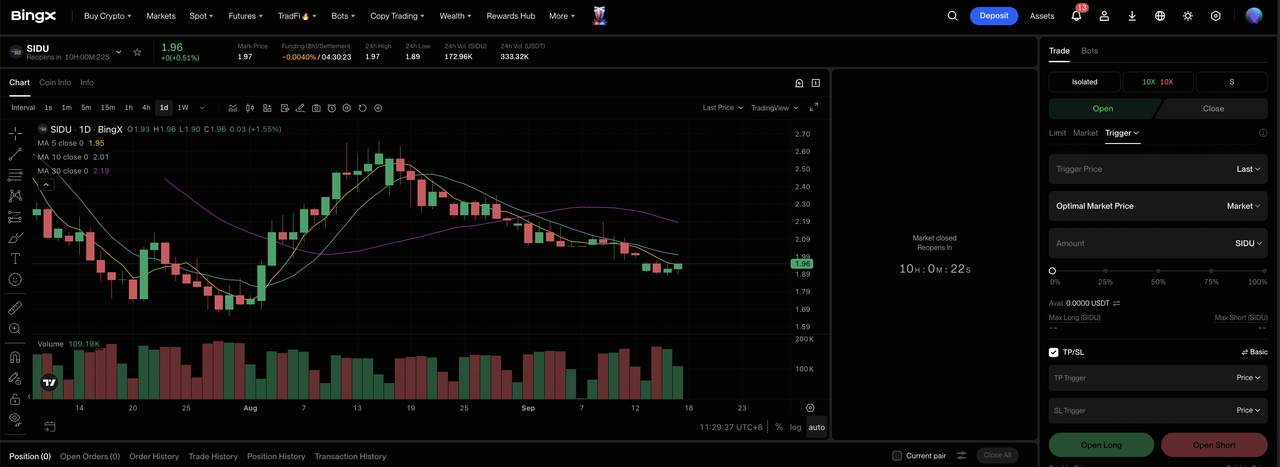
Step 1: Access BingX TradFi. Sign up and navigate to the specialized TradFi section.
Step 2: Select Sidus Space (SIDU). Search for and select the SIDU-USDT perpetual futures contract.
Step 3: Choose your direction. Select Open Long if contracts and missions improve revenue. Select Open Short if losses or dilution weaken per-share value.
Step 4: Select leverage and margin mode. Choose Isolated or Cross-Margin based on your risk tolerance. The $1 to $6 scenario span supports conservative leverage.
Step 5: Execute strict risk protocols. Set Take-Profit and Stop-Loss (TP/SL) levels before or immediately after entering the trade.
Top 5 Risks to Watch for Sidus Space Investors in 2026
Sidus faces contract timing, margin, dilution and mission-execution risks. These factors can affect revenue visibility, cash use and per-share value.
- Contract timing can move most quarterly revenue: Q2 sales fell by $678,000 as fixed-price milestones shifted between periods. Delays can reduce both reported revenue and cash receipts even when contracts remain active.
- Negative gross profit leaves little operating cushion: Sidus recorded a $630,000 gross loss on $583,000 of revenue. Cost overruns or low-margin work could widen losses before SG&A is considered.
- Dilution can offset operating progress: Weighted-average shares rose from 18.3 million to 85.3 million year over year. More issuance would spread future earnings and contract value across a larger share base.
- Launch or spacecraft failures could delay commercialization: LizzieSat still needs successful launch and reliable on-orbit operation. Technical issues could delay customers, add replacement costs and interrupt data collection.
- Thin analyst coverage increases valuation uncertainty: Only one attributable $10 target provides limited external comparison. Sentiment or liquidity changes could therefore produce sharp price moves even without major changes in operating results.
Final Thoughts: Should You Invest in Sidus Space in 2026?
Sidus enters the commercialization phase with far more liquidity, no term debt and a broader proprietary technology stack. LizzieSat and Fortis VPX offer legitimate routes into government, defense and commercial markets. Q2 revenue of only $583,000 and a $5.076 million adjusted EBITDA loss show that technical progress has not yet become financial scale.
The Bull Case requires contracts, missions and positive gross profit to support $6. The Bear Case reflects slow revenue, persistent losses and dilution that could pull SIDU toward $1. Conservative traders may wait for repeatable quarterly revenue, positive gross margin and lower cash burn before treating the strengthened balance sheet as durable per-share value.
Risk Reminder: Trading and investing in equities like SIDU involves a high risk of capital loss. Mission failures, contract delays, negative margins, dilution, small-cap volatility and leveraged trading can produce rapid losses. Conduct independent research before allocating capital.
Related Reading
- Top Defense Stocks to Buy in 2026: Primes, Missiles, Drones, Space, and AI-Enabled Warfare
- Top Space Stocks to Buy Ahead of SpaceX IPO
- Rocket Lab (RKLB) Price Prediction 2026: Can New Rocket and Defense Growth Push RKLB Toward $150?
- Redwire (RDW) Price Prediction 2026: Can Space and Defense Orders Push RDW Toward $24?
- Firefly Aerospace (FLY) Price Prediction 2026: Can Launch and Defense Growth Push FLY Toward $55?
- Lockheed Martin (LMT) Price Prediction 2026: Can Record Backlog Push LMT Toward $700?
