



Oklo (OKLO) is an advanced fission technology company developing small powerhouses, nuclear-fuel recycling and radioisotope production. Its Aurora design targets reliable electricity and heat for data centers, industrial sites, communities and defense facilities, while Atomic Alchemy provides a potential earlier route to isotope revenue. This vertically integrated model creates several growth paths, though valuation remains highly sensitive to licensing, construction timing, fuel availability and capital intensity.
The latest quarter showed operating progress alongside the financial cost of commercialization. Oklo Q2 revenue reached $1.21 million, yet the company reported a $0.28 loss per share and an $81.6 million first-half net loss. Cash and marketable securities approached $3.0 billion after financing, while the Groves isotope test reactor achieved first criticality on August 6, leaving the conversion of technical milestones into commercial cash flow as the central investment test.
The OKLO stock forecast for 2026 now centers on two competing views:
- The licensing and deployment case: Groves execution, Aurora regulatory progress and long-term agreements with data-center and industrial customers could validate Oklo's integrated model and expand the value assigned to future contracted power.
- The timing and dilution case: extended licensing schedules, fuel constraints and rising project investment could push revenue farther out, consume the larger liquidity balance and reduce each share's claim on eventual cash flow.
This guide breaks down the OKLO stock forecast, 2026 price scenarios, key risks and analyst outlooks, drawing on Oklo's August 7 Q2 2026 company update, quarterly filing and market data through September 11, plus how to trade OKLO stock futures on BingX TradFi with USDT collateral.
Top 5 Things for Oklo Investors to Know in September 2026
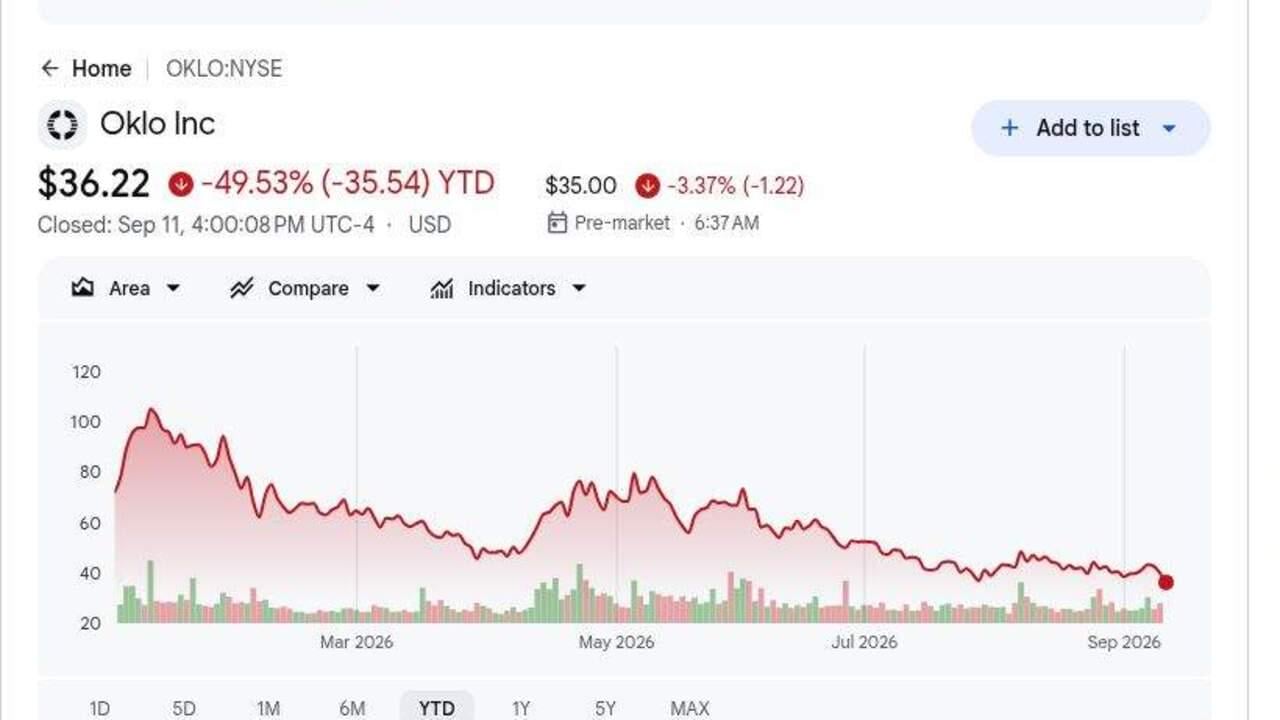
- OKLO closed at $36.22 on September 11 and was down about 49.53% YTD: Shares fell 9.18% in one session after the company announced a new $1 billion equity program. The move shows how financing concerns can outweigh technical progress while Aurora revenue remains years away.
- Q2 revenue reached $1.21 million versus roughly $0.09 million expected: The beat came from a very small base, and revenue remains minor relative to operating expenses. Investors still value Oklo mainly on licensing, customer commitments and future project economics.
- First-half net loss widened to $81.6 million: Operating loss reached $124.2 million, while operating cash use more than doubled to $65.5 million. Higher engineering and development spending can advance the platform but also raises the return required from future projects.
- Cash and marketable securities approached $3.0 billion: The balance increased from about $1.4 billion at the end of 2025 after equity financing. The larger runway supports Aurora, fuel and isotope projects, though repeated share issuance can dilute future per-share value.
- The Groves reactor achieved first criticality on August 6: The milestone followed Department of Energy startup authorization in July and provides real operating experience in isotope infrastructure. It does not replace the licensing still required for commercial Aurora powerhouses.
What Is Oklo (OKLO)?
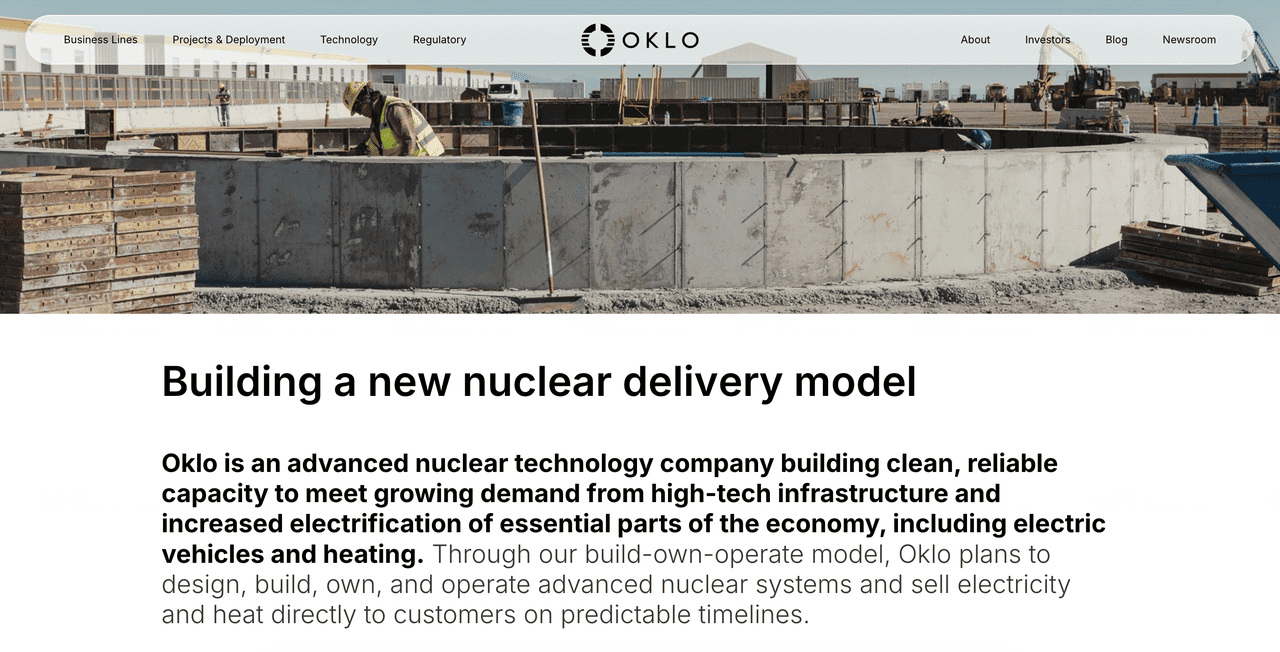
Oklo is developing compact advanced fission systems intended to sell electricity and heat through long-term power agreements rather than primarily selling reactors. Its Aurora powerhouse uses fast-reactor technology and is designed around long operating periods, passive safety characteristics and the ability to use recovered or newly enriched fuel. The company is also building fuel-recycling capabilities and isotope-production assets through Atomic Alchemy. Target customers include data centers, industrial facilities, government sites, remote communities and other users seeking firm, carbon-free power.
Oklo's long-term strategy connects power generation, fuel supply, manufacturing and isotopes within one platform. The company has a framework with Meta for a nuclear-energy campus in Ohio, a collaboration with Vertiv around power and cooling for data centers, and fuel initiatives involving Centrus and Standard Nuclear. Department of Energy programs support work in Idaho and surplus-plutonium utilization, while acquisitions of ARMEC and Creative Engineers add manufacturing and sodium-system capabilities. These relationships can reduce execution gaps, though every commercial plant still depends on site-specific regulatory and construction progress.
Read More: Top AI Energy Stocks to Buy in 2026: Nuclear, Gas, Fuel Cells, and the AI Power Buildout
Oklo (OKLO) Q2 2026 Earnings Overview: Liquidity, Cash Use and Groves First Criticality
Oklo reported Q2 revenue of $1.21 million versus roughly $0.09 million expected, while GAAP loss per share of $0.28 was $0.12 wider than the $0.16 consensus. First-half net loss reached $81.6 million, operating loss totaled $124.2 million and operating cash use increased to $65.5 million. Property and equipment purchases rose to $126.9 million as physical development accelerated, while cash and marketable securities approached $3.0 billion and Groves achieved first criticality.
Read More: Oklo (OKLO) Q2 FY2026 Earnings Overview: $3.0B Liquidity Position Drives a 14.77% Price Rally
|
Financial Metric |
Guidance / Consensus |
Reported / Actual |
Surprise |
|
Q2 2026 revenue |
$0.09M consensus |
$1.21M |
Beat. Revenue exceeded consensus by about $1.12M. |
|
Q2 GAAP loss per share |
$0.16 loss consensus |
$0.28 loss |
Missed. Loss was $0.12 wider than expected. |
|
First-half net loss |
$53.2M in first half 2025 |
$81.6M |
Widened. Loss increased by $28.4M YoY. |
|
First-half operating loss |
— |
$124.2M |
Higher. Development spending remained elevated. |
|
First-half operating cash use |
$30.7M in first half 2025 |
$65.5M |
Increased. Cash use more than doubled YoY. |
|
First-half property and equipment purchases |
$1.2M in first half 2025 |
$126.9M |
Expanded. Infrastructure buildout accelerated materially. |
|
Cash and marketable securities |
About $1.4B at year-end 2025 |
About $3.0B |
Strengthened. Equity funding expanded the project runway. |
|
Groves reactor milestone |
Startup authorization in July |
First criticality achieved August 6 |
Achieved. The isotope test reactor reached an operating milestone. |
- Revenue of $1.21 million beat consensus by about $1.12 million: The beat establishes an early revenue base, though sales remain small relative to the $124.2 million first-half operating loss. Licensing and project progress still matter more to valuation than quarterly revenue.
- The $0.28 loss per share was $0.12 wider than expected: First-half net loss increased by $28.4 million to $81.6 million. Higher engineering and project spending needs to translate into clear regulatory and construction milestones.
- Operating cash use more than doubled to $65.5 million: The prior-year figure was $30.7 million, while property and equipment purchases rose from $1.2 million to $126.9 million. Oklo is moving from design work toward physical assets, increasing both execution proof and capital exposure.
- Liquidity increased from about $1.4 billion to nearly $3.0 billion: Equity raises expanded the runway for Aurora, fuel and isotope projects. The larger balance reduces near-term funding pressure, though the new $1 billion equity program keeps dilution risk relevant.
- Groves achieved first criticality after July startup authorization: The milestone gives Oklo operating experience in an advanced-reactor setting. Commercial Aurora plants still require separate licensing, fuel, site and customer approvals, so schedule risk remains.
Oklo (OKLO) 2026 Investment Outlook: $100 Bull Case vs. $25 Bear Case
The central test is whether regulatory, fuel and construction milestones can validate future Aurora cash flow quickly enough to justify continuing losses and equity-funded investment.
The Bull Case: Faster Nuclear Development Pushes OKLO Toward $100
The Bull Case assumes Groves strengthens Oklo's regulatory credibility, Aurora licensing advances and customer frameworks become binding projects. Relationships with Meta, Vertiv, Centrus and the Department of Energy help address demand, integration, fuel and site requirements.
A move toward $100 would require clear Idaho Aurora licensing progress, firm commercial terms for major data-center demand and controlled spending against nearly $3.0 billion of liquidity. More fuel commitments, construction milestones and lower expected capital costs would strengthen the case.
The Base Case: Steady Regulatory Progress Keeps OKLO Between $55 and $75
The Base Case assumes Oklo advances licensing, fuel and manufacturing work while Groves begins producing operating data. Customer interest remains strong, though commercial Aurora revenue stays distant and cash use remains elevated as several projects develop in parallel.
OKLO could trade mainly between $55 and $75 under these conditions. Regulatory progress, liquidity above $2 billion and firm customer agreements would support the range. Major Aurora delays or another large equity program would weaken the upper end.
The Bear Case: Project Delays and Dilution Pull OKLO Toward $25
The Bear Case assumes licensing reviews take longer, fuel plans slip and construction costs rise before commercial revenue begins. Higher spending would consume liquidity faster and increase dependence on equity financing.
A move toward $25 would become more likely if Aurora milestones slip by a year or more, operating cash use rises materially above the first-half $65.5 million level, or customer frameworks fail to become financeable contracts. Fuel constraints or cost overruns would add further pressure.
OKLO Stock Price Forecasts for 2026 By Wall Street Analysts
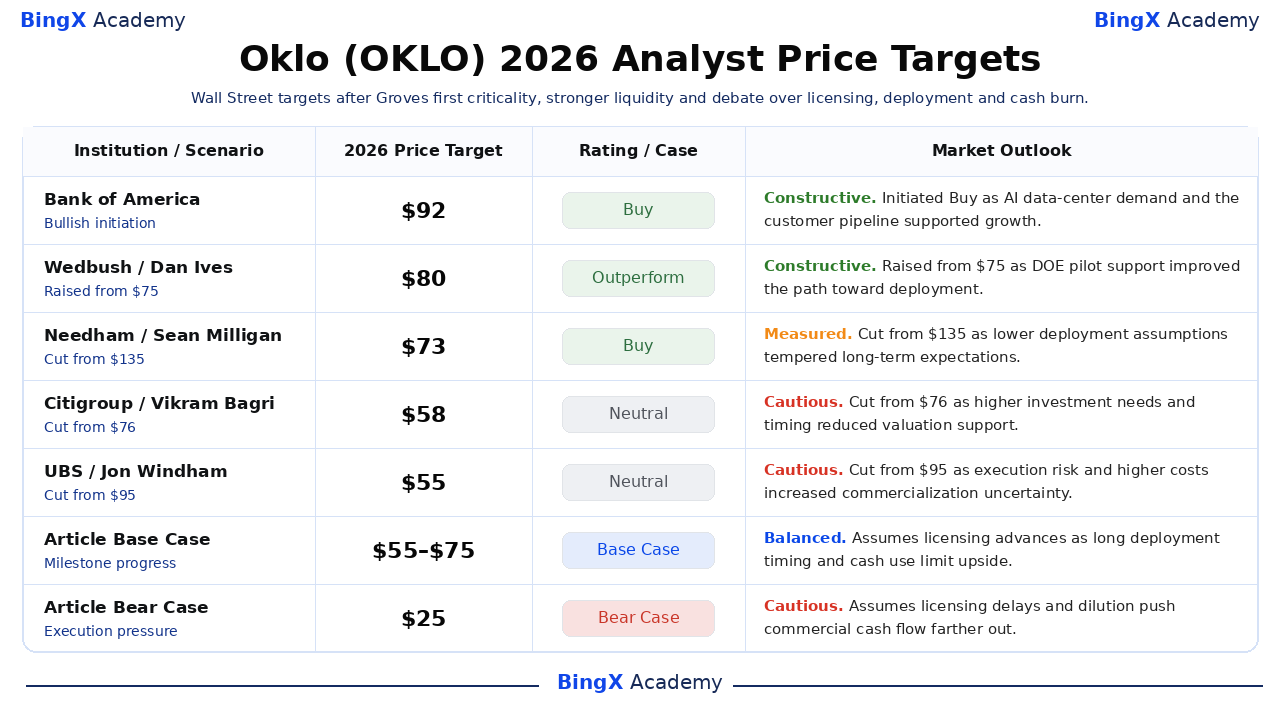
These dated analyst actions span $55 to $92 and reflect different assumptions about data-center demand, licensing, deployment timing and capital needs. They are third-party reference points rather than a single consensus forecast. The final Base and Bear rows are BingX Academy editorial scenarios and are labeled separately.
|
Institution / Scenario |
2026 Price Target |
Rating / Case |
Market Outlook |
|
Bank of America / Dimple Gosai |
$92 |
Buy |
Constructive. September 23: initiated Buy as AI data-center demand and the customer pipeline supported growth. |
|
Wedbush / Dan Ives |
$80 |
Outperform |
Constructive. August 12: raised from $75 as DOE pilot support improved the path toward deployment. |
|
Needham / Sean Milligan |
$73 |
Buy |
Measured. March 26: cut from $135 as lower deployment assumptions tempered expectations. |
|
Citigroup / Vikram Bagri |
$57.50 |
Neutral |
Cautious. March 26: cut from $76 as higher investment needs and timing reduced valuation support. |
|
UBS / Jon Windham |
$55 |
Neutral |
Cautious. March 26: cut from $95 as execution risk and higher costs increased uncertainty. |
|
Article Base Case |
$55–$75 |
Base Case |
Balanced. Assumes licensing advances as long deployment timing and cash use limit upside. |
|
Article Bear Case |
$25 |
Bear Case |
Cautious. Assumes licensing delays and dilution push commercial cash flow farther out. |
How to Trade Oklo (OKLO) Stock on BingX
Trade Oklo's Aurora-licensing, nuclear-deployment and data-center demand outlook using BingX TradFi and BingX AI tools. Because OKLO can react sharply to regulatory milestones, customer agreements and equity financing, traders should define both the catalyst and risk limits before entering a position.
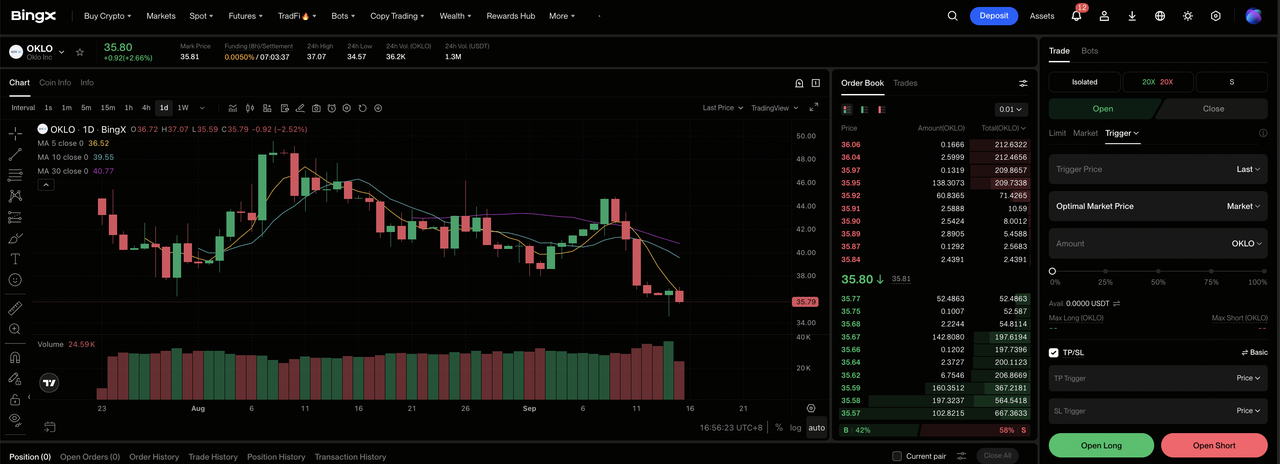
Step 1: Access BingX TradFi. Sign up and navigate to the specialized TradFi section on the BingX exchange dashboard.
Step 2: Select Oklo (OKLO). Search for and select the OKLO-USDT perpetual futures contract.
Step 3: Choose your direction. Select Open Long if licensing, customer commitments and project execution advance. Select Open Short if delays, cash burn or dilution weaken expected per-share value.
Step 4: Select leverage and margin mode. Choose Isolated or Cross-Margin based on your risk tolerance. OKLO fell about 49.53% YTD through September 11, showing why conservative leverage and clear position sizing are important.
Step 5: Execute strict risk protocols. Set Take-Profit and Stop-Loss (TP/SL) levels before or immediately after entering the trade. OKLO can react quickly to NRC actions, DOE milestones, fuel agreements, construction updates, customer contracts and financing.
Top 5 Risks to Watch for Oklo Investors in 2026
Oklo's valuation depends on regulatory progress, fuel supply, construction, customer contracts and financing. These risks can delay future cash flow or reduce its per-share value.
- Licensing delays could postpone power revenue: Groves first criticality is meaningful, but Aurora still requires separate approvals. Longer reviews would extend engineering and site spending before electricity sales begin.
- Fuel supply could slow deployment: Aurora depends on recovered fuel, HALEU or alternative sources. Delays involving suppliers or government material could postpone projects and leave new capacity underused.
- Cash use could rise quickly: First-half operating cash outflow reached $65.5 million, while property and equipment purchases totaled $126.9 million. Multiple power, fuel and isotope projects could consume the nearly $3.0 billion liquidity base faster than expected.
- More equity financing could dilute shareholders: A new $1 billion equity program contributed to the September selloff. Additional shares would spread future revenue and earnings across a larger base.
- Customer agreements may take longer to become binding contracts: Relationships with Meta and other customers support demand, but pricing, delivery dates and credit terms still matter. Weaker commercial terms could reduce project returns and the value assigned to announced capacity.
Final Thoughts: Should You Invest in Oklo in 2026?
Oklo has moved beyond presentations toward physical operating milestones. Groves achieved first criticality, partnerships address data-center demand and fuel, and nearly $3.0 billion of liquidity supports continued development. The financial model remains early, however, with $81.6 million of first-half net loss and $126.9 million of capital purchases preceding material commercial power revenue.
The Bull Case requires licensing, fuel and customer execution to support $100. The Bear Case reflects delays, higher costs and dilution that could pull OKLO toward $25. Conservative traders may wait for a defined Aurora licensing schedule, financeable customer contracts and evidence that liquidity can fund the first commercial plants without repeated large equity programs.
Risk Reminder: Trading and investing in equities like OKLO involves a high risk of capital loss. Licensing delays, construction overruns, fuel constraints, customer changes, cash burn, dilution and leveraged trading can produce rapid losses. Conduct independent research before allocating capital.
Related Reading
- Top Energy Stocks and ETFs to Buy in 2026: The AI Power Crunch Meets Geopolitical Volatility
- Top AI Energy Stocks to Buy in 2026: Nuclear, Gas, Fuel Cells, and the AI Power Buildout
- NuScale Power (SMR) Price Prediction 2026: Clean Energy Breakthrough or Capital-Intensive Mirage?
- SLB Stock Prediction 2026: $83 Digital AI Breakout or $48 Geopolitical Trap?
- Bloom Energy (BE) Price Prediction 2026: Can AI Data-Center Power Push BE Toward $350?
