

Moderna Inc. (MRNA) is a biotechnology company best known for its messenger RNA platform, which uses synthetic mRNA to instruct cells to produce proteins that can trigger immune responses or treat disease. The company built its commercial base around COVID-19 vaccines, but its broader pipeline spans respiratory vaccines, oncology, rare diseases and other therapeutic areas. This gives Moderna exposure to multiple large healthcare markets, but also leaves the stock highly sensitive to clinical trial results, regulatory decisions and the pace at which new products can replace declining COVID revenue.
The growth story increasingly centers on oncology and pipeline diversification. In August 2026, Moderna and Merck reported that personalized cancer therapy intismeran autogene met the primary and a key secondary endpoint in the Phase 3 INTerpath-001 melanoma trial, giving Moderna its strongest late-stage validation outside respiratory vaccines. The result followed improving cost discipline and additional vaccine progress, including approval of mFLUSIVA for adults 50 and older. For investors, the key question is whether the melanoma program and broader pipeline can translate into meaningful commercial revenue quickly enough to reduce Moderna’s dependence on its shrinking COVID franchise.
The MRNA stock forecast for 2026 now centers on two competing views:
- The pipeline validation case: Bulls expect the intismeran oncology program across nine trials, the new flu vaccine, combination and rare-disease candidates, and a strong balance sheet to drive a multi-year re-rating, with analyst targets raised as high as $170.
- The execution case: Bears see a company still generating losses, a shrinking COVID base, a norovirus Phase 3 that missed its early-success criteria, and a valuation that has run far ahead of current revenue on the promise of future approvals.
This guide breaks down the MRNA stock forecast, 2026 price scenarios, key risks, and analyst views, drawing on the July 31 earnings release and August 19 melanoma trial results, plus how to trade MRNA stock futures on BingX TradFi with USDT collateral.
Top 5 Things for Moderna Investors to Know in August 2026
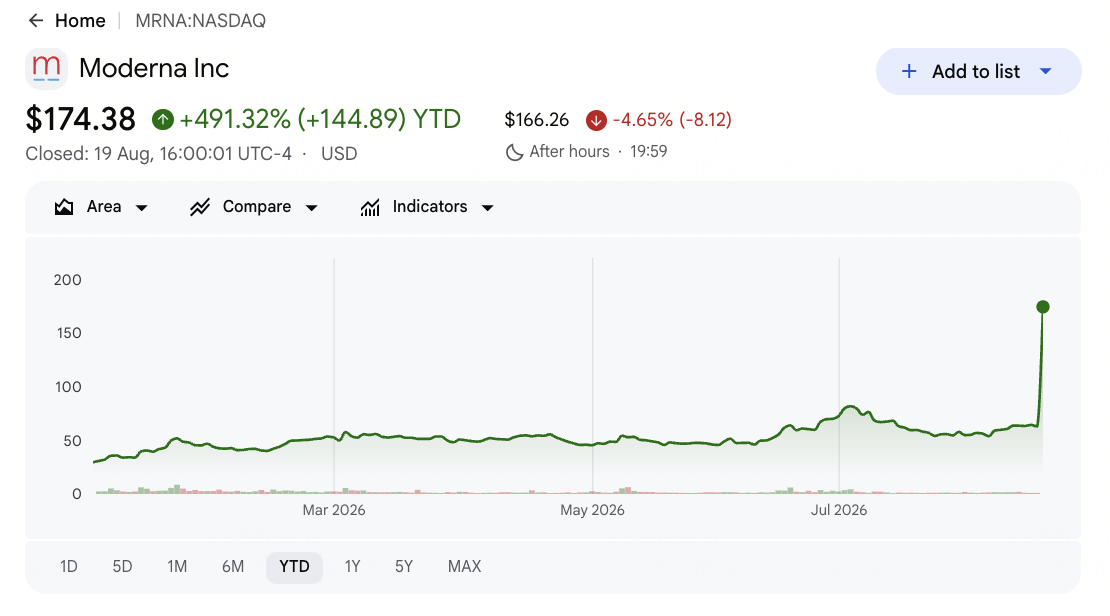
- The melanoma program delivered a positive Phase 3 result: Moderna and Merck said intismeran plus KEYTRUDA met the recurrence-free survival and distant metastasis-free survival endpoints in INTerpath-001. The result provides the strongest late-stage validation yet for Moderna’s oncology platform.
- MRNA surged roughly 126% after the readout: Shares jumped from the low teens to near $30 on August 19, marking one of the stock’s largest single-day moves. Heavy short interest likely amplified the reaction, making follow-through after the initial repricing important.
- Moderna added another approved respiratory vaccine: The FDA approved mFLUSIVA for adults aged 50 and older, giving Moderna its fourth FDA-approved product. The company plans to launch it for the 2026–27 U.S. flu season.
- Q2 showed improving cost discipline: Revenue reached $145 million, while net loss narrowed to $1.97 per share and cost of sales fell 22%. Moderna ended the quarter with $6.9 billion in cash and also lowered its full-year cost outlook.
- Analysts raised targets sharply but remain divided: BofA, RBC, Goldman Sachs, and Morgan Stanley all lifted their targets following the melanoma result, but several retained Neutral or equivalent ratings. The revisions show greater confidence in the pipeline while keeping commercialization and execution as the next tests.
What Is Moderna Inc (MRNA)?

Moderna Inc is a biotechnology company best known for pioneering messenger RNA technology to develop vaccines and therapeutics. The company rose to prominence with its COVID-19 vaccine and is now expanding into seasonal respiratory vaccines, oncology, combination vaccines, and rare-disease treatments. Its business is built around a common mRNA platform that can be adapted across multiple diseases, giving Moderna broad pipeline potential but also making clinical and regulatory execution central to its valuation.
The growth story increasingly extends beyond COVID. Moderna’s respiratory portfolio now includes its flu vaccine mFLUSIVA and other combination programs, while its oncology strategy centers on intismeran autogene, a personalized cancer therapy developed with Merck and tested alongside KEYTRUDA. The broader INTerpath program spans several cancer types, including melanoma, lung, bladder, and renal cancers. For investors, the key question is whether these newer programs can translate into meaningful commercial revenue quickly enough to offset declining COVID demand and support Moderna’s large ongoing research investment.
Read More: Merck (MRK) Price Prediction 2026: Can Pipeline Momentum Push MRK Stock Toward $170?
Moderna (MRNA) Q2 2026 Earnings: What Drove the Re-Rating and the Oncology Debate
- The melanoma readout changed the investment case. Intismeran plus KEYTRUDA met both Phase 3 endpoints in high-risk melanoma, giving Moderna its strongest late-stage validation outside respiratory vaccines. The key question is whether that success can translate into regulatory approval and commercial revenue.
- The stock reaction reflected both repricing and short covering. MRNA surged roughly 126% after the readout as investors reassessed the oncology pipeline and heavily shorted positions were covered. The size of the move means future gains will depend more on execution than on the initial surprise.
- The flu approval broadened the commercial portfolio. FDA approval of mFLUSIVA gave Moderna a fourth approved product and another potential revenue source ahead of the 2026–27 respiratory season. The next test is whether adoption can meaningfully reduce dependence on COVID vaccine sales.
- Cost discipline improved the financial backdrop. Q2 cost of sales fell 22%, losses narrowed, and management lowered full-year cost guidance. That helps preserve cash while Moderna continues funding a broad clinical pipeline.
- Analyst target increases reset valuation expectations. Several firms sharply raised price targets after the melanoma result, but many retained Neutral or equivalent ratings. The divide reflects stronger confidence in the platform alongside continued uncertainty around regulatory filings, commercialization, and follow-up oncology data.
Moderna Q2 2026 Financial and Consensus Profile: Revenue, EPS and Pipeline
Moderna's Q2 profile showed modest revenue growth and improving cost control alongside a pipeline-driven valuation reset. The table separates reported financial results from forward guidance and major clinical catalysts.
|
Financial Metric |
Guidance / Consensus |
Reported / Actual |
Surprise |
|
Q2 2026 Revenue |
~ $127 million consensus |
$145 million |
Beat. Up 2% year over year and above the tracked estimate. |
|
Q2 2026 Net Loss Per Share |
- |
$(1.97) |
Improved. Narrowed from $(2.13) a year earlier. |
|
Q2 2026 Cost of Sales |
- |
Down 22% year over year |
Lower. Manufacturing efficiency reduced the cost burden. |
|
Q2 2026 Cash and Investments |
- |
$6.9 billion |
Declined. Down from $7.5 billion at the end of Q1. |
|
FY2026 Revenue Guidance |
- |
Up to 10% growth |
Maintained. Outlook still reflects uncertainty around COVID vaccination demand. |
|
FY2026 Year-End Cash Guidance |
- |
$4.7 billion to $5.2 billion |
Improved. Lower cost expectations support the projected cash position. |
|
Phase 3 Melanoma Trial |
- |
Met RFS and DMFS endpoints |
Positive. INTerpath-001 delivered a successful late-stage oncology readout. |
|
mFLUSIVA Flu Vaccine |
- |
FDA approved |
Approved. Launch is targeted for the 2026–27 season in adults 50 and older. |
|
Norovirus Phase 3 |
- |
Missed interim early-success criteria |
Mixed. The program did not meet the threshold for early success. |
For context, INTerpath-001 enrolled 1,137 patients and compared intismeran plus KEYTRUDA with KEYTRUDA alone. Moderna and Merck plan to present detailed results and discuss potential filings with regulators. The key valuation question is now whether success in melanoma can extend across the broader oncology pipeline while Moderna continues reducing losses and preserving cash.
Moderna (MRNA) 2026 Investment Outlook: $180 Bull Case vs. $25 Bear Case
Moderna's outlook for the rest of 2026 depends on one central question: whether the Phase 3 melanoma success can develop into a broader oncology franchise, or whether the stock has moved ahead of the regulatory approvals, commercialization and additional trial results still required.
The Bull Case: Oncology Validation and New Vaccines Push MRNA to $180
The bullish case begins with the Phase 3 success of intismeran plus KEYTRUDA in high-risk melanoma. The result gives Moderna its strongest oncology validation to date, while the broader INTerpath program extends across melanoma, lung, bladder and renal cancers. Additional positive readouts could materially increase the value investors assign to the oncology pipeline.
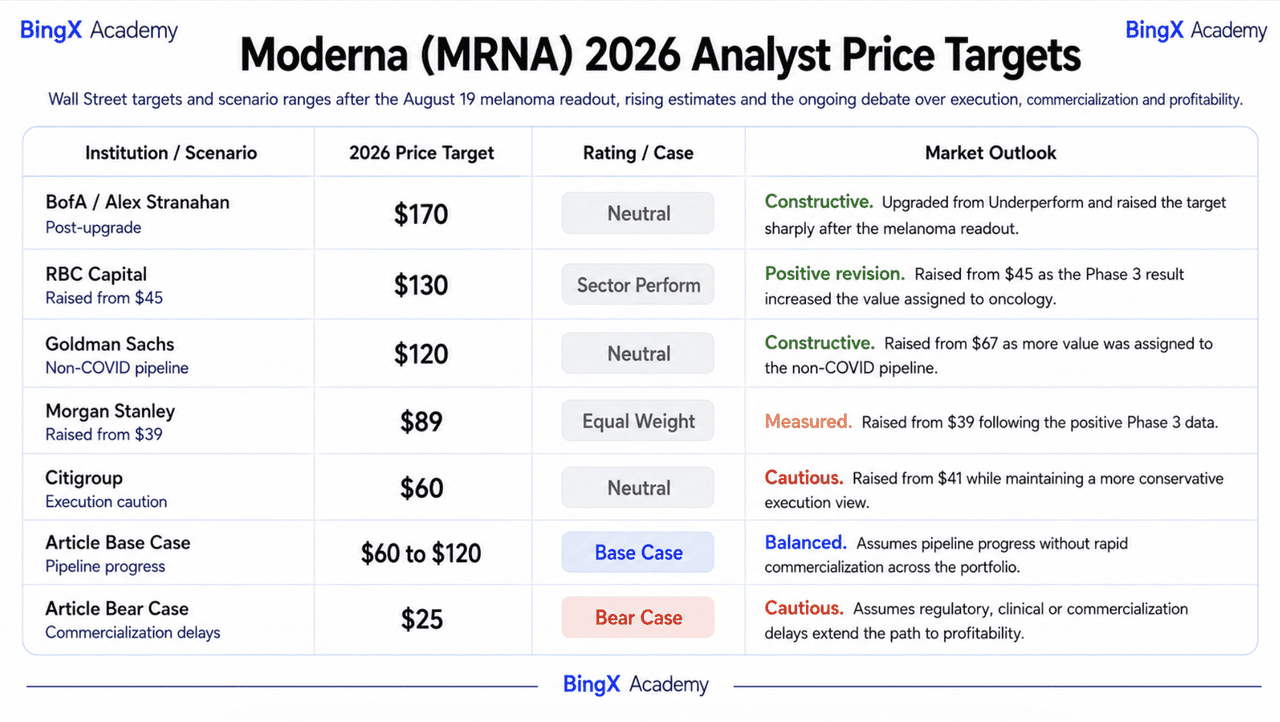
This outcome requires the melanoma data to progress toward regulatory filings and approvals while newer respiratory products begin contributing commercially. BofA raised its target to $170 after the readout, providing the highest named analyst reference in the current set. Continued oncology progress, a successful mFLUSIVA launch and further pipeline execution would strengthen the path toward that level.
The Base Case: Pipeline Progress Keeps MRNA Between $60 and $120
The base case allows Moderna to retain much of its post-readout re-rating without assuming rapid commercialization across the oncology pipeline. The melanoma result improves confidence in the platform, while $6.9 billion in cash and lower costs provide time to fund additional trials and regulatory work.
This scenario would be consistent with continued pipeline progress alongside ongoing losses and a declining COVID revenue base. The cluster of analyst targets from Citi, Morgan Stanley and Goldman Sachs between $60 and $120 reflects this middle ground. Confirmation would come from regulatory milestones, additional oncology data and evidence that newer vaccines can contribute meaningful revenue.
The Bear Case: Execution Risk Pulls MRNA Toward $25
The bear case does not require the melanoma result to fail. It requires the path from positive trial data to approvals, commercialization and profitability to take longer or prove more difficult than investors now expect. Moderna remains loss-making, COVID revenue is declining and the norovirus Phase 3 program missed its interim early-success criteria.
The clearest triggers would be regulatory delays, weaker results from additional oncology trials or slower adoption of new products. A setback in any of these areas could reduce the value assigned to the broader pipeline and pull MRNA back toward the lower end of the current valuation range near $25.
MRNA Stock Price Forecasts for 2026 By Wall Street Analysts
Wall Street sharply raised Moderna price targets after the August 19 melanoma readout, but many firms kept Neutral or equivalent ratings. The combination suggests greater confidence in the oncology pipeline while execution, commercialization and profitability remain important constraints.
|
Institution / Scenario |
2026 Price Target |
Rating / Case |
Market Outlook |
|
BofA / Alex Stranahan |
USD $170 |
Neutral |
Constructive. Upgraded from Underperform and raised the target sharply after the melanoma readout. |
|
RBC Capital |
USD $130 |
Sector Perform |
Positive revision. Raised from $45 as the Phase 3 result increased the value assigned to oncology. |
|
Goldman Sachs |
USD $120 |
Neutral |
Constructive. Raised from $67 as more value was assigned to the non-COVID pipeline. |
|
Morgan Stanley |
USD $89 |
Equal Weight |
Measured. Raised from $39 following the positive Phase 3 data. |
|
Citigroup |
USD $60 |
Neutral |
Cautious. Raised from $41 while maintaining a more conservative execution view. |
|
Article Base Case |
USD $60 to $120 |
Base Case |
Balanced. Assumes pipeline progress without rapid commercialization across the portfolio. |
|
Article Bear Case |
USD $25 |
Bear Case |
Cautious. Assumes regulatory, clinical or commercialization delays extend the path to profitability. |
How to Trade Moderna Inc (MRNA) Stock on BingX
Navigate the volatility of Moderna's pipeline-driven price action using BingX TradFi and BingX AI tools. By leveraging AI-driven predictive analytics, you can better anticipate market sentiment shifts and price action around clinical readouts and regulatory decisions.
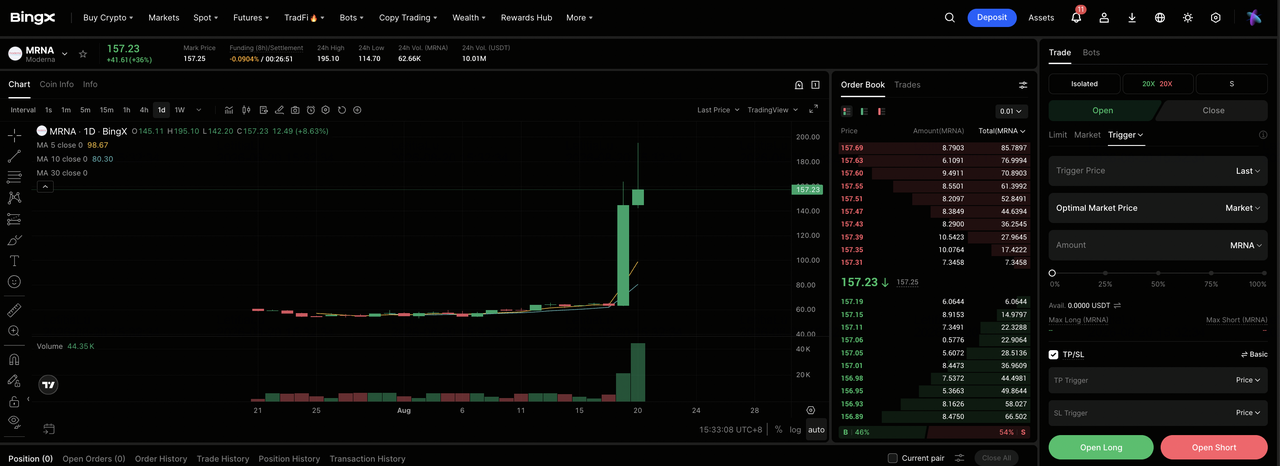
Step 1: Access BingX TradFi. Sign up and navigate to the specialized TradFi section. Complete KYC if required in your region and enable two-factor authentication before funding an account.
Step 2: Select Moderna Inc (MRNA). Deposit USDT, then search for and select the MRNA-USDT perpetual futures contract.
Step 3: Choose your direction. Select Open Long if you expect the oncology pipeline to keep validating, the flu vaccine to ramp, and additional trial readouts to succeed. Select Open Short if you expect execution to disappoint, the COVID base to keep shrinking, or the market to reprice a stock that surged on a single readout.
Step 4: Select leverage and margin mode. Choose Isolated or Cross-Margin based on your risk tolerance. Because MRNA moved roughly 126% in a single session on the melanoma news and remains highly sensitive to clinical data, conservative leverage and clear position sizing are especially important.
Step 5: Execute strict risk protocols. Set Take-Profit and Stop-Loss (TP/SL) levels before or immediately after entering the trade. MRNA can react sharply to clinical trial readouts, FDA decisions, oncology and vaccine pipeline updates, COVID vaccination trends, and shifts in biotech sentiment.
Top 5 Risks to Watch for MRNA Investors in 2026
Moderna’s melanoma success and broader pipeline momentum support the upside case, but five risks could determine whether that re-rating translates into durable revenue and earnings.
- Moderna is still not profitable. The company continues to post net losses, so much of the current valuation depends on future pipeline success rather than current earnings. The key watchpoint is whether new products can narrow losses over time.
- The COVID revenue base is shrinking. Revenue remains seasonal and still relies heavily on COVID vaccines, while management has acknowledged the possibility of lower vaccination rates. New products must scale fast enough to offset that decline.
- Clinical execution remains uneven. The norovirus Phase 3 program missed its interim early-success criteria, showing that not every mRNA program will succeed. Additional oncology and vaccine readouts could therefore materially change the investment case.
- The valuation now depends heavily on future approvals. MRNA surged sharply after the melanoma readout, widening the gap between current revenue and the value investors assign to the pipeline. Further upside requires continued regulatory and clinical progress.
- Commercialization will take time. Even successful Phase 3 data must still move through regulatory filings, approvals and launch execution before generating meaningful revenue. Delays at any stage could slow the path from pipeline value to cash flow.
Final Thoughts: Should You Invest in Moderna in 2026?
Following the August 19 melanoma readout, Moderna combines its strongest oncology validation to date, a newly approved flu vaccine and improving cost discipline. The unresolved question is whether those pipeline gains can translate into approvals, commercial revenue and a path back to profitability quickly enough to justify the stock’s sharp re-rating.
The bull case is that successful Phase 3 melanoma data, a broader nine-trial oncology program and additional vaccine launches create a more diversified growth profile beyond COVID. The bear case is that Moderna remains loss-making, its COVID revenue base is declining and success in one cancer setting does not guarantee similar results across the rest of the pipeline. The next confirmation points are regulatory filings, additional oncology readouts, mFLUSIVA adoption and progress in reducing losses rather than any single analyst target.
Risk Reminder: Trading and investing in equities like MRNA involves a high risk of capital loss. Moderna is exposed to clinical trial outcomes, regulatory decisions, declining COVID demand, commercialization risk, ongoing losses and sharp volatility around pipeline events, any of which can move the stock independently of current revenue. Conduct independent research before allocating capital.
Related Reading
- Merck (MRK) Price Prediction 2026: Can Pipeline Momentum Push MRK Stock Toward $170?
- Pfizer Stock Price Prediction 2026: High-Yield Value Opportunity or Structural Value Trap?
- Abbott (ABT) Stock Price Outlook 2026: Can Medical Device Growth Push ABT Above $130?
- Johnson & Johnson (JNJ) Price Prediction 2026: Can Oncology Growth Carry JNJ Past $100 Billion?
- Eli Lilly (LLY) Stock Outlook 2026: Can Mounjaro and Zepbound Momentum Drive LLYON Stock to $1,200+?
