



Lockheed Martin (LMT) is a global defense contractor spanning aeronautics, missiles and fire control, rotary and mission systems, and space. The F-35 remains central to its scale, while missile defense, munitions and classified space programs are becoming more important to growth. This breadth provides exposure to rising defense demand, although fixed-price contracts, government procurement cycles and production execution can still create abrupt earnings pressure.
The latest quarter showed demand converting into faster growth and stronger cash generation. LMT Q2 2026 sales reached $20.063 billion, up 11% year over year, and $65 billion of new orders lifted backlog to a record $230 billion. The investment case now depends on whether Lockheed Martin can translate that visibility into profitable deliveries without repeating the program charges that distorted the prior-year comparison.
The LMT stock forecast for 2026 centers on two competing views:
- The backlog-conversion case: missile capacity, international demand and broad segment growth support rising earnings and free cash flow.
- The execution-risk case: fixed-price development losses, supply constraints and government funding delays prevent demand from reaching per-share results.
This guide breaks down the LMT stock forecast, 2026 price scenarios, key risks and analyst outlooks, drawing on Lockheed Martin's July 23 Q2 2026 earnings release, quarterly filing and market data through September 2, plus how to trade LMT stock futures on BingX TradFi with USDT collateral.
Top 5 Things for Lockheed Martin Investors to Know in September 2026
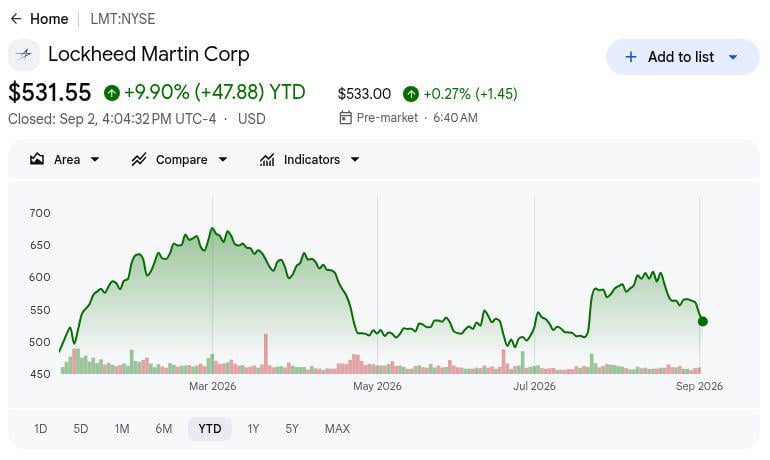
- LMT was up 8.4% YTD through September 2: Shares closed at $531.55 after falling 2.38% that day, leaving a sizable gap to the most bullish analyst targets despite stronger earnings and backlog.
- Q2 sales rose 11% to $20.063 billion: All four operating segments contributed to growth, while diluted EPS recovered to $7.94 from $1.46 a year earlier. The rebound was strong, though the prior-year comparison was depressed by major program charges.
- New orders of $65 billion lifted backlog to a record $230 billion: The order intake improved multi-year revenue visibility and supports further capacity investment, but backlog still has to convert into profitable deliveries and cash.
- Free cash flow recovered to $2.917 billion: That compared with negative $150 million a year earlier, while operating cash flow reached $3.235 billion. Stronger cash conversion gives Lockheed more flexibility for production investment, dividends, and buybacks.
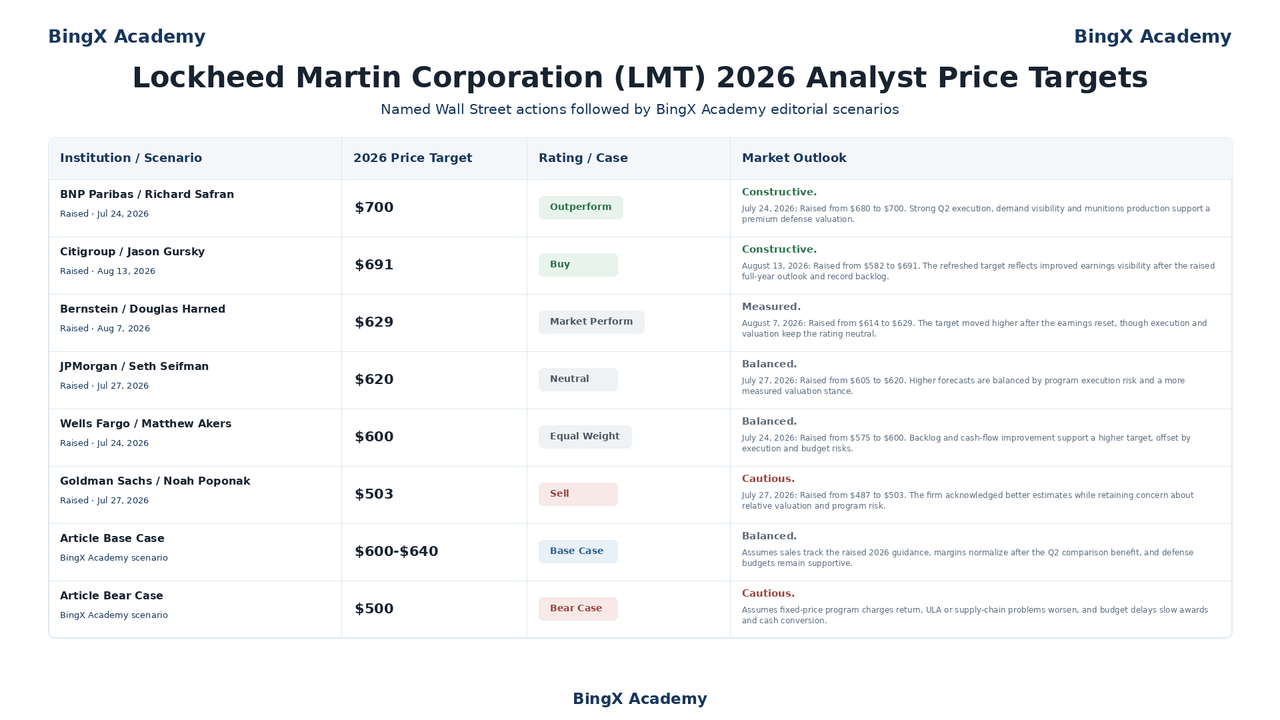
- Selected analyst targets range from $503 to $700: The $197 spread reflects sharply different views on missile demand, backlog conversion, fixed-price program risk, and valuation. The higher end assumes continued execution without another major cost reset.
What Is Lockheed Martin Corporation (LMT)?

Lockheed Martin (LMT) is a Bethesda, Maryland-based defense and aerospace company serving the U.S. government, allied countries, and commercial customers. Its four operating segments span combat aircraft, missile defense, helicopters and mission systems, and space. Major programs include the F-35 fighter jet, THAAD missile-defense system, PAC-3 interceptors, Sikorsky helicopters, satellites, and classified space systems, giving Lockheed exposure across air, land, sea, and space defense.
Its growth strategy is increasingly centered on missile and munitions capacity, international defense demand, and next-generation aerospace and space programs. Lockheed is expanding production for systems such as THAAD and PAC-3 as the U.S. and allied governments replenish inventories and strengthen air-defense capabilities, while the F-35 remains a core long-term program across multiple partner countries. At the same time, investments in classified space, autonomous systems, sensors, and advanced weapons broaden the portfolio beyond traditional aircraft and make backlog conversion and program execution central to long-term growth.
Read More: Top Defense Stocks to Buy in 2026: Primes, Missiles, Drones, Space, and AI-Enabled Warfare
Lockheed Martin (LMT) Q2 2026 Earnings Overview: Sales, EPS and Cash Flow
Lockheed Martin’s Q2 combined broad sales growth, a sharp earnings recovery, record backlog, and much stronger cash generation. Sales reached $20.063 billion, up 11% from $18.155 billion a year earlier, diluted EPS rose to $7.94 from $1.46, and free cash flow recovered to $2.917 billion from negative $150 million. New orders of $65 billion also lifted backlog to a record $230 billion, while management raised its 2026 outlook.
|
Financial Metric |
Prior Period / Guidance |
Reported / Actual |
Surprise |
|
Q2 2026 sales |
$18.155 billion in Q2 2025 |
$20.063 billion |
Higher. Up 11% year over year. |
|
Q2 2026 net earnings |
$342 million in Q2 2025 |
$1.836 billion |
Recovered. Prior year included major program charges. |
|
Q2 2026 diluted EPS |
$1.46 in Q2 2025 |
$7.94 |
Improved. Program comparison normalized. |
|
Cash from operations |
$201 million in Q2 2025 |
$3.235 billion |
Stronger. Collections improved cash conversion. |
|
Free cash flow |
Negative $150 million in Q2 2025 |
$2.917 billion |
Recovered. Cash generation turned strongly positive. |
|
Backlog |
— |
Record $230 billion |
Expanded. New orders reached $65 billion. |
|
2026 guidance |
Prior outlook |
Sales $79.75–$81.75 billion; EPS $29.95–$30.65; FCF above $7 billion |
Raised. Broad demand supports growth. |
- Sales rose 11% to $20.063 billion: All four operating segments contributed, showing that growth extended beyond any single aircraft or missile program.
- Diluted EPS increased to $7.94 from $1.46: The sharp rebound reflected much easier comparisons after prior-year program charges, so future earnings still depend on stable contract execution.
- Net earnings reached $1.836 billion: Profit recovered from $342 million a year earlier, highlighting how strongly contract-cost assumptions can affect reported results.
- Operating cash flow climbed to $3.235 billion: Stronger collections pushed free cash flow to $2.917 billion, giving Lockheed more flexibility for production investment, dividends, and repurchases.
- 2026 guidance now points to roughly 8% sales growth: Management expects sales of $79.75 billion to $81.75 billion, EPS of $29.95 to $30.65, and free cash flow above $7 billion, supported by a record $230 billion backlog.
Read More: Lockheed Martin (LMT) Q2 2026 Earnings News: Record $230.4B Backlog Drives a 10.54% Rally
Lockheed Martin (LMT) 2026 Investment Outlook: $700 Bull Case vs. $500 Bear Case
The central test is whether record demand can convert into profitable deliveries faster than contract and production risks absorb the benefit.
The Bull Case: Missile Demand and Backlog Conversion Push LMT Toward $700
The Bull Case assumes THAAD, munitions, and international orders convert into sustained growth across Lockheed’s portfolio. Record backlog supports production visibility, while firmer segment margins and free cash flow above guidance would show that the Q2 rebound is becoming durable.
A move toward $700 would require capacity additions to stay on schedule, fixed-price programs to avoid major cost revisions, and cash conversion to remain strong. Continued backlog growth and higher earnings guidance would provide the clearest confirmation.
The Base Case: Steady Defense Demand Keeps LMT Between $600 and $640
The Base Case assumes sales track raised guidance, defense budgets remain supportive, and margins normalize after the favorable prior-year comparison. Backlog continues converting into revenue, but execution risk limits how much investors are willing to expand the valuation multiple.
Under this scenario, LMT could trade mainly between $600 and $640. Stable production progress, consistent free cash flow, and no new material program charges would support the range, while weaker collections or contract losses would pressure the upper end.
The Bear Case: Program Charges and Execution Risk Pull LMT Toward $500
The Bear Case assumes fixed-price cost estimates deteriorate, ULA challenges persist, or government funding delays slow awards and payments. Backlog could remain high, but weaker margins and cash flow would reduce the value investors assign to that demand.
A move toward $500 would become more likely if Lockheed records another major reach-forward loss, free cash flow weakens materially, or production delays spread across key programs. In that environment, lower earnings expectations and multiple compression could outweigh the strength of defense demand.
LMT Stock Price Forecasts for 2026 By Wall Street Analysts
These are dated, named third-party actions. Their spread is evidence of uncertainty over backlog conversion, program execution and valuation, not a single consensus forecast. The editorial Base and Bear scenarios are labeled separately.
|
Institution / Scenario |
2026 Price Target |
Rating / Case |
Market Outlook |
|
BNP Paribas |
$700 |
Outperform |
Constructive. July 24: Raised from $680 to $700. Strong Q2 execution, demand visibility and munitions production support a premium defense valuation. |
|
Citigroup |
$691 |
Buy |
Constructive. August 13: Raised from $582 to $691. The refreshed target reflects improved earnings visibility after the raised full-year outlook and record backlog. |
|
Bernstein |
$629 |
Market Perform |
Measured. August 7: Raised from $614 to $629. The target moved higher after the earnings reset, though execution and valuation keep the rating neutral. |
|
JPMorgan |
$620 |
Neutral |
Balanced. July 27: Raised from $605 to $620. Higher forecasts are balanced by program execution risk and a more measured valuation stance. |
|
Wells Fargo |
$600 |
Equal Weight |
Balanced. July 24: Raised from $575 to $600. Backlog and cash-flow improvement support a higher target, offset by execution and budget risks. |
|
Goldman Sachs |
$503 |
Sell |
Cautious. July 27: Raised from $487 to $503. The firm acknowledged better estimates while retaining concern about relative valuation and program risk. |
|
Article Base Case |
$600-$640 |
Base Case |
Balanced. Assumes sales track the raised 2026 guidance, margins normalize after the Q2 comparison benefit, and defense budgets remain supportive. |
|
Article Bear Case |
$500 |
Bear Case |
Cautious. Assumes fixed-price program charges return, ULA or supply-chain problems worsen, and budget delays slow awards and cash conversion. |
How to Trade Lockheed Martin (LMT) Stock on BingX
Trade Lockheed Martin's defense-demand, backlog-conversion and program-execution outlook using BingX TradFi and BingX AI tools. Because LMT can react sharply to contract charges, government awards and guidance changes, traders should define both the catalyst and risk limits before entering a position.
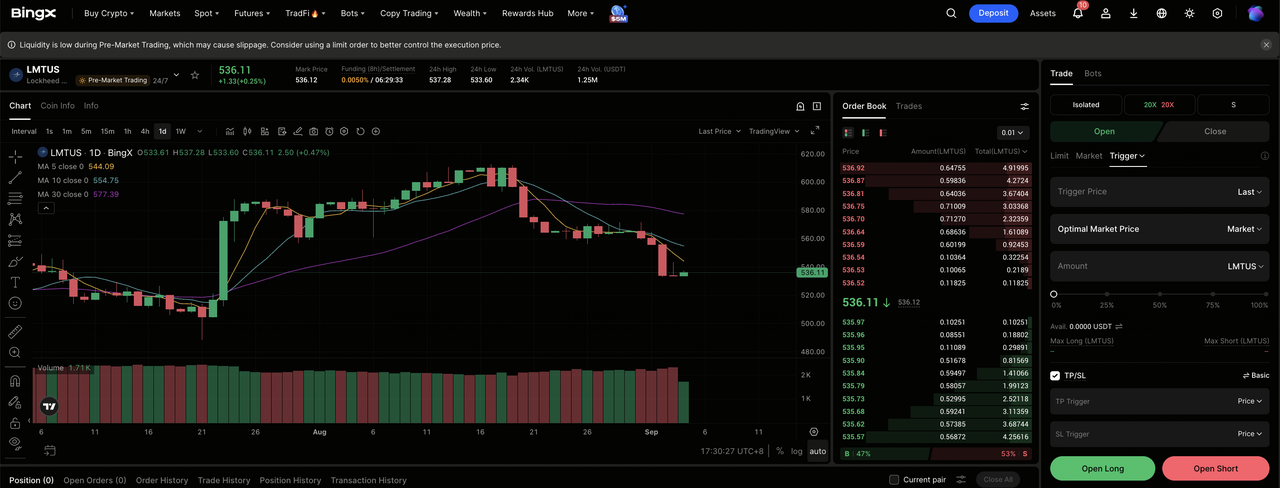
Step 1: Access BingX TradFi. Sign up and navigate to the specialized TradFi section on the BingX exchange dashboard.
Step 2: Select Lockheed Martin (LMT). Search for and select the LMTUS-USDT perpetual futures contract.
Step 3: Choose your direction. Select Open Long if backlog converts cleanly and cash flow remains strong. Select Open Short if program charges return or budget delays weaken delivery and collection timing.
Step 4: Select leverage and margin mode. Choose Isolated or Cross-Margin based on your risk tolerance. The 2.38% September 2 move illustrates why conservative leverage and clear position sizing are important.
Step 5: Execute strict risk protocols. Set Take-Profit and Stop-Loss (TP/SL) levels before or immediately after entering the trade. LMT can react quickly to contract awards, cost revisions, appropriations and guidance updates.
Top 5 Risks to Watch for Lockheed Martin Investors in 2026
Lockheed Martin benefits from record demand visibility, but contract economics, funding timing, production constraints, and program concentration could still pressure earnings and cash flow.
- Fixed-price contracts can trigger sudden margin losses: Higher labor, materials, or engineering costs may require immediate charges, reducing earnings before the full cash impact appears.
- ULA challenges can create indirect financial exposure: Launch delays, cost overruns, or weaker joint-venture economics could increase pressure around ULA-related obligations and guaranteed borrowings.
- Government budget delays can slow awards and collections: Continuing resolutions, procurement delays, or contract protests may push revenue and cash receipts into later periods even when long-term demand remains intact.
- Supply and labor constraints can limit backlog conversion: Record orders only create value if constrained components and skilled labor are available to support timely production and delivery.
- Large-program concentration can magnify execution setbacks: Programs such as the F-35, missile defense, and major space contracts provide long-term visibility, but a schedule slip or procurement change can affect several years of expected revenue and cash flow.
Final Thoughts: Should You Invest in Lockheed Martin in 2026?
Lockheed Martin enters the rest of 2026 with broad sales growth, a record $230 billion backlog, stronger cash generation, and a raised full-year outlook. Those factors support the defense-demand case, but the investment thesis still depends on whether backlog can convert into profitable deliveries without another round of major program charges.
The Bull Case requires clean execution, stable contract margins, and continued free cash flow strength, while the Bear Case centers on renewed fixed-price losses, funding delays, weaker collections, or production bottlenecks. Investors looking for stronger confirmation may want to see another quarter of stable margins and cash conversion before treating the Q2 recovery as fully established.
Risk Reminder: Trading and investing in equities like LMT involves a high risk of capital loss. Fixed-price contracts, government budget timing, ULA exposure, supply constraints, and geopolitical developments can materially affect results. Conduct independent research before allocating capital.
Related Reading
- Top Defense Stocks to Buy in 2026: Primes, Missiles, Drones, Space, and AI-Enabled Warfare
- Top Space Stocks to Buy Ahead of SpaceX IPO
- SpaceX (SPCX) Price Prediction 2026: $227 Street-High AI Fusion or Trillion-Dollar Valuation Bubble?
- Palantir (PLTR) Stock Price Prediction 2026: Can 149% U.S. Commercial Growth Push PLTR Toward $255?
- Redwire Price Prediction 2026: Can Space and Defense Momentum Help RDW Extend Its 220% Rally?
- Rocket Lab Stock Forecast 2026: Can RKLB's Space Infrastructure Play Break $150 After Its 400% Run?
