



Berkshire Hathaway (BRK.B) owns insurance, railroad, energy, manufacturing and service businesses serving consumers and companies. Insurance float and established subsidiaries provide an earnings base, while acquisitions and share repurchases create routes to higher per-share value. Underwriting discipline, acquisition prices and reinvestment returns determine whether deploying its substantial liquidity improves earnings enough to justify a higher valuation.
The latest quarter showed stronger subsidiary earnings alongside weaker insurance results. Berkshire Hathaway Q2 2026 revenue reached $101.81 billion, up 10.0%, while operating earnings reached $12.98 billion. Net earnings more than doubled to $25.67 billion, but insurance underwriting profit fell to $1.73 billion. The next test is whether operating improvements and capital deployment can offset claims pressure and lower insurance investment income.
The BRK.B stock forecast for 2026 now centers on two competing views:
- The capital-deployment case: Buybacks, acquisitions and stronger industrial earnings could increase value per share as Greg Abel puts more capital to work without weakening underwriting discipline.
- The insurance-pressure case: Rising claims costs, lower reinvestment yields and expensive acquisitions could absorb operating gains and limit returns despite Berkshire’s large cash and investment holdings.
This guide breaks down the BRK.B stock forecast, 2026 price scenarios, key risks and analyst outlooks, drawing on Berkshire’s August 8 Q2 earnings release, 10-Q and market data through October 21, plus how to buy BRK.B stock on BingX TradFi with USDT.
Top 5 Things for Berkshire Hathaway Investors to Know in October 2026
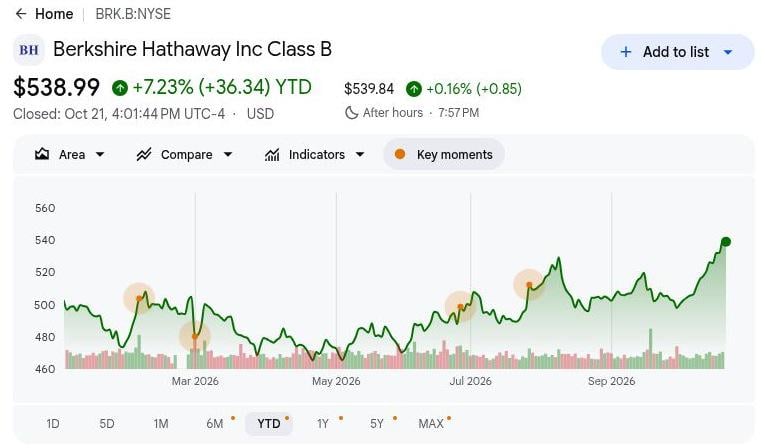
- BRK.B closed at $538.99 on October 21, up 7.23% YTD: Shares remain above their opening-year level, making the $620 bull scenario dependent on stronger insurance results and productive capital deployment. Continued gains require subsidiary earnings growth to translate into sustainable per-share returns.
- Q2 revenue rose 10.0% to $101.81 billion as operating earnings increased: Operating earnings grew 16.3% to $12.98 billion, showing profit growth above sales. However, a favorable currency swing contributed to that improvement, making it important to distinguish subsidiary performance from changes in currency effects.
- Insurance float reached $177.5 billion, supporting Berkshire's investment base: The June balance increased approximately $1.1 billion from year-end 2025, providing funds held before claims are paid. Underwriting discipline and investment returns will determine how much that funding contributes to earnings after policyholder obligations are met.
- The Taylor Morrison acquisition expands Berkshire's homebuilding operations: Berkshire completed the purchase on July 24 for approximately $6.8 billion of equity value, combining it with Clayton's site-built operations. Housing demand and integration results will determine whether the expanded business earns attractive returns on invested capital.
- Approximately $4.5 billion in Q2 buybacks increased capital deployment: Repurchases accelerated from Q1's approximately $234 million, while cash and Treasury bills remained around $364.7 billion net of unsettled purchases. This supports further investment, although acquisition returns and repurchase prices determine the benefit to remaining shareholders.
What Is Berkshire Hathaway (BRK.B)?

Berkshire Hathaway is an Omaha-based conglomerate whose businesses span insurance, freight rail, utilities, manufacturing, services and retail. Its operating model combines decentralized subsidiary management with capital allocation at the parent company, allowing earnings to be retained or redirected across industries. GEICO, BNSF, Berkshire Hathaway Energy and Clayton serve policyholders, shippers, energy customers and homebuyers. Berkshire earns underwriting profits, investment income and subsidiary operating profits, while changes in its listed equity portfolio also flow through reported net earnings.
Under CEO Greg Abel, Berkshire is deploying capital through acquisitions, listed equities and share repurchases while preserving financial flexibility. It completed the OxyChem acquisition in January, adding chemicals used in water treatment, manufacturing and construction. Taylor Morrison joined in July and is being combined with Clayton’s site-built operations, creating a larger platform across 21 states and 52 housing markets. Howard Buffett became chairman in September, with Warren Buffett remaining a director and chairman emeritus. These changes make acquisition returns, subsidiary execution and continuity in capital discipline the main measures of the transition.
Berkshire Hathaway (BRK.B) Q2 2026 Earnings Overview: Operating Earnings Rise as Insurance Profit Declines
Berkshire Hathaway reported Q2 2026 revenue of $101.81 billion, up 10.0% year over year, with manufacturing, service and retail earnings rising 24.1% to $4.47 billion. Operating earnings increased 16.3% to $12.98 billion, while underwriting profit fell 13.1% to $1.73 billion and currency movements supported the improvement. With $177.5 billion in insurance float and approximately $4.5 billion in quarterly buybacks, future returns depend on sustaining subsidiary earnings, restoring underwriting profitability and deploying capital at attractive prices.
|
Financial Metric |
Guidance / Consensus |
Reported / Actual |
Surprise |
|
Q2 revenue |
$92.52B a year earlier |
$101.81B |
Higher. Up 10.0% year over year. |
|
Q2 operating earnings |
$11.16B a year earlier |
$12.98B |
Improved. Up 16.3% year over year. |
|
Q2 GAAP net earnings |
$12.37B a year earlier |
$25.67B |
Higher. Includes $12.68B of investment gains. |
|
Insurance underwriting |
$1.99B a year earlier |
$1.73B |
Lower. Down 13.1% year over year. |
|
Insurance investment income |
$3.37B a year earlier |
$3.06B |
Lower. Down 9.1% year over year. |
|
BNSF earnings |
$1.47B a year earlier |
$1.56B |
Improved. Up 6.3% year over year. |
|
Manufacturing, service and retail |
$3.60B a year earlier |
$4.47B |
Improved. Up 24.1% year over year. |
|
Q2 share repurchases |
$234M in Q1 2026 |
About $4.5B |
Accelerated. Repurchases increased substantially from Q1. |
- Q2 revenue climbed to $101.81 billion, up 10.0% annually. Operating earnings increased to $12.98 billion from $11.16 billion a year earlier, reflecting subsidiary growth alongside favorable currency movements. Sustained underlying earnings growth will provide stronger evidence of business progress than the currency-assisted headline increase.
- Industrial subsidiaries drove growth beyond Berkshire's insurance operations. Manufacturing, service and retail earnings of $4.47 billion and BNSF profit of $1.56 billion expanded Berkshire's earnings base. However, freight demand and healthy manufacturing and retail activity remain important to establishing sustainable growth.
- Operating earnings rose 16.3% despite weaker insurance profitability. Debt-related currency gains reached $326 million, replacing an $877 million loss, while GAAP earnings included $12.68 billion of investment gains. These currency and investment contributions improved reported results, but the durability of underlying subsidiary growth remains a challenge.
- Post-quarter acquisitions expanded Berkshire's homebuilding operations. Approximately $6.8 billion of equity value went toward Taylor Morrison in a purchase completed July 24, combining it with Clayton's site-built operations. The investment supports homebuilding expansion, although future returns depend on housing demand and integration results.
- The $177.5 billion insurance float supports future investment earnings. The June balance represents funds held against policyholder obligations, but earnings depend on investment yields and claims costs. Maintaining underwriting discipline, investing at attractive returns, and generating cash will be central to Berkshire's next growth phase.
Berkshire Hathaway (BRK.B) 2026 Investment Outlook: $620 Bull Case vs. $475 Bear Case
Berkshire’s 2026 outlook depends on whether stronger subsidiary profits and renewed capital deployment can increase earnings per share as insurance results soften. Q2 buybacks show management is willing to act, while claims inflation and lower investment yields make the quality of earnings growth central to valuation. The following editorial scenarios apply to the rest of calendar 2026.
The Bull Case: Lower Claims Pressure Creates a Path Toward $620
Improving GEICO’s claims ratio would give Berkshire a direct route to stronger insurance earnings. Its Q2 loss ratio reached 76.6%, up 4.8 percentage points, reducing the profit retained from premiums. Reversing part of that deterioration would lift underwriting income while manufacturing, services and retail continue contributing to group earnings.
The $620 scenario would gain support if underwriting profit recovers toward $1.99 billion and industrial earnings remain near or above their Q2 levels. Stable insurance investment income and well-priced buybacks would help convert that operating recovery into stronger per-share results.
The Base Case: Industrial Gains Offset Insurance Pressure Within a $525 to $560 Range
Continued industrial growth could keep Berkshire’s earnings moving forward even if insurance improves slowly. Q2 manufacturing, service and retail profit reached $4.47 billion, helping offset weaker underwriting and investment income. The base case assumes those offsets persist, producing moderate underlying growth while leaving the main insurance pressures unresolved.
A $525 to $560 range would fit profitable underwriting, resilient industrial earnings and gradual acquisition contributions. A lower GEICO claims ratio would support the upper end, while further investment-income declines could absorb enough operating progress to limit the share-price upside.
The Bear Case: A Weaker Industrial Offset Pulls BRK.B Toward $475
Slower industrial earnings would expose Berkshire more fully to its insurance pressures. Manufacturing, services and retail supplied an important Q2 profit increase, while underwriting and insurance investment income both declined. If freight demand, housing activity or manufacturing orders weaken, Berkshire could lose that earnings cushion before GEICO’s profitability begins recovering.
The $475 scenario would become more likely if industrial profits fall alongside further declines in underwriting and investment income. Acquisitions would then need to contribute more simply to stabilize earnings, leaving less support for per-share growth and a higher valuation.
BRK.B Stock Price Forecasts for 2026 By Wall Street Analysts
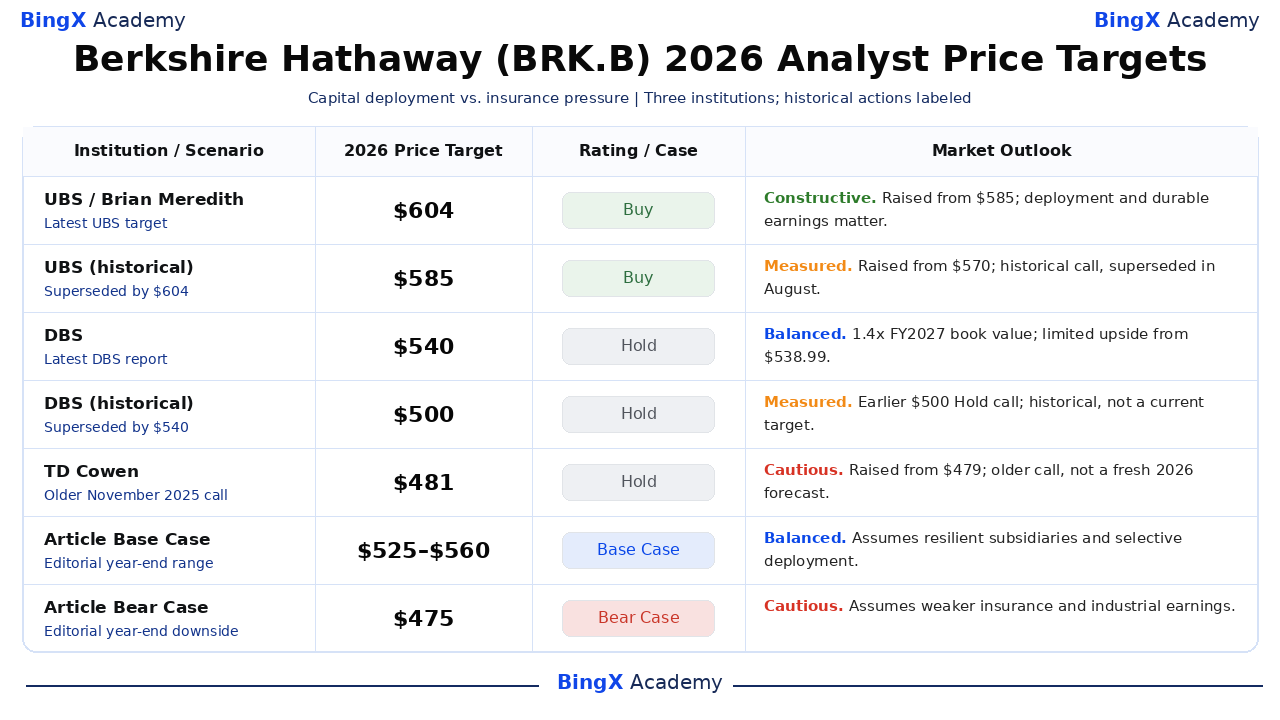
These dated Class B targets generally span roughly 12 months and can extend beyond December 2026. Five actions represent three institutions, including superseded UBS and DBS targets and an older TD Cowen call; brief interpretations are editorial. The final two rows are separate year-end scenarios, while DBS’s latest report retains Hold at $540.
|
Institution / Scenario |
2026 Price Target |
Rating / Case |
Market Outlook |
|
UBS |
$604 |
Buy |
Constructive. August 9, 2026: UBS’s disclosure history records $604, raised from $585. Editorial view: the upside requires durable operating gains and disciplined capital deployment. |
|
UBS (historical) |
$585 |
Buy |
Measured. July 28, 2026: Raised from $570. Historical action, superseded by the August $604 target; retained to show the change in UBS’s assessment, not independent coverage. |
|
DBS |
$540 |
Hold |
Balanced. September 9, 2026: Published a $540 target based on 1.4 times forecast FY2027 book value. Editorial view: the target leaves little upside from the reference close. |
|
DBS (historical) |
$500 |
Hold |
Measured. May 6, 2026: Recorded at $500 in dated analyst history. Superseded by DBS’s later $540 target; this older assessment is context, not an additional current forecast. |
|
TD Cowen |
$481 |
Hold |
Cautious. November 11, 2025: Raised from $479 following Q3 2025 results. Older published action; its age limits relevance to Berkshire’s current operations and capital deployment. |
|
Article Base Case |
525–560 |
Base Case |
Balanced. Assumes resilient subsidiaries, profitable underwriting and selective capital deployment through December 2026. |
|
Article Bear Case |
$475 |
Bear Case |
Cautious. Assumes insurance pressure and weaker industrial earnings reduce recurring per-share returns. |
How to Buy Berkshire Hathaway (BRK.B) Stock on BingX
Buy and hold Berkshire Hathaway shares through BingX Stocks Trading using USDT or USDC, subject to listing and account eligibility. Berkshire offers exposure to insurance, railroads, energy and capital allocation across a diversified group of businesses. Eligible users can size holdings according to their investment goals without using leverage or paying perpetual funding fees.
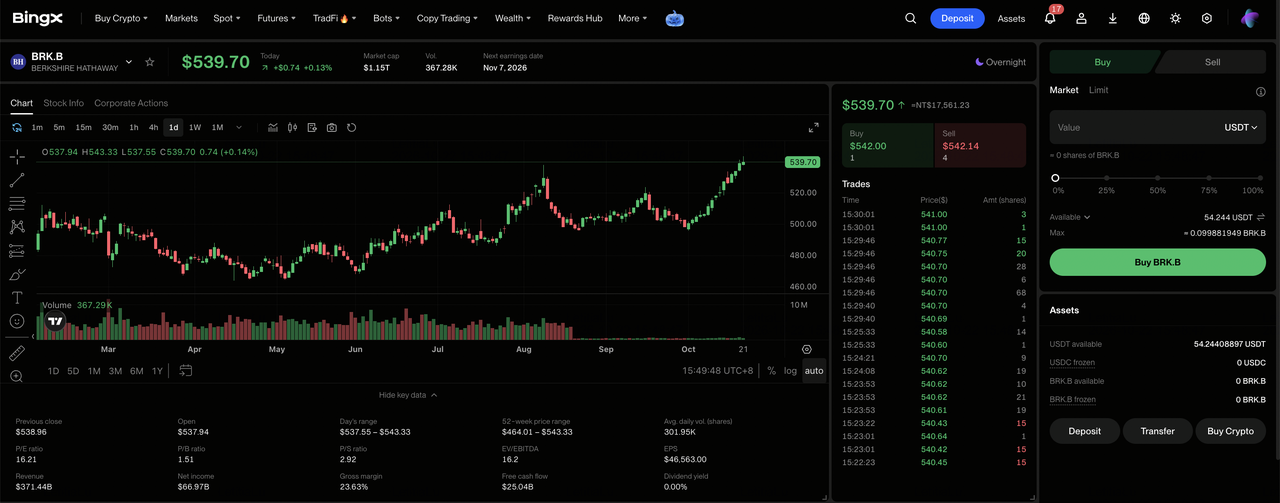
Step 1: Access BingX Stocks Trading. Sign up or log in to BingX, complete the required identity verification, and navigate to “TradFi > Stocks”. Accept the Stock Trading Risk Disclosure if accessing the product for the first time.
Step 2: Prepare USDT or USDC. Ensure your Spot Account has sufficient funds for the purchase. Transfer USDT or USDC from your Fund Account or Wealth Account if needed. Review the selected stock’s minimum order amount and fractional eligibility before choosing the investment size.
Step 3: Select Berkshire Hathaway (BRK.B). Open the Stocks market, search for BRK.B, and confirm that the Class B share is available to your account. Review the company identity, current share price, trading session and available order types.
Step 4: Buy Berkshire Hathaway Shares. Select “Buy”, enter an allowed investment amount or share quantity, and choose a supported market or limit order. Market orders use available prices during supported sessions, while limit orders require the specified price or better and sufficient liquidity to execute.
Step 5: Review and Manage Your Holdings. Open “Stocks > Positions” to monitor your BRK.B shares and unrealized profit or loss. Use All Orders to review transactions or sell shares when needed. T+1 settlement generally affects when sale proceeds become withdrawable, rather than when purchased shares can be sold.
Top 5 Risks to Watch for Berkshire Hathaway Investors in 2026
Berkshire Hathaway's diversified businesses and strong financial position support long-term stability, but insurance profitability, reinvestment returns, acquisitions, and leadership decisions remain key risks to earnings and shareholder value.
- Rising insurance claims could pressure profits: GEICO's Q2 loss ratio rose 4.8 percentage points to 76.6%. If repair costs, medical expenses, and claims outpace premium increases, underwriting margins could weaken.
- Lower interest rates could reduce investment income: Insurance investment income fell 9.1% to $3.06 billion in Q2. Lower reinvestment yields on maturing Treasuries could reduce recurring earnings before new investments offset the decline.
- Acquisitions could deliver weaker returns: Berkshire's $6.8 billion Taylor Morrison investment increases housing exposure. Weak homebuyer demand or affordability pressures could limit its contribution to long-term value.
- Economic weakness could affect multiple businesses: BNSF, Berkshire Hathaway Energy, and manufacturing supported Q2 earnings growth. Slower freight demand, rising utility costs, or weaker industrial orders could pressure these businesses simultaneously.
- Leadership changes could affect capital allocation: Howard Buffett became chairman in September, Greg Abel leads operations, and Warren Buffett remains a director. Disciplined acquisitions and share repurchases remain essential to long-term shareholder returns.
Final Thoughts: Should You Invest in Berkshire Hathaway in 2026?
Berkshire Hathaway's $12.98 billion in quarterly operating earnings and $177.5 billion in insurance float highlight its ability to generate cash across multiple businesses. Stronger contributions from BNSF, Berkshire Hathaway Energy, and manufacturing provide earnings support beyond insurance, while renewed share repurchases and acquisitions create opportunities to improve per-share returns. Sustaining that growth will depend on restoring underwriting profitability and investing capital at attractive returns.
The $620 bull case assumes stronger insurance results, continued subsidiary earnings growth, and successful capital deployment. The $525 to $560 base case reflects steady operations, while the $475 bear case accounts for persistent claims pressure and weaker returns. With BRK.B closing at $538.99 on October 21, investors should watch whether improving operating earnings translate into sustainable per-share growth.
Risk Reminder: Berkshire's diversified operations do not eliminate investment risk. Insurance losses, weaker subsidiary performance, or poor capital allocation could reduce earnings and shareholder returns. Investors should consider valuation and their risk tolerance before buying BRK.B shares.
Related Reading
- What Is BingX Stocks Trading? A Beginner's Guide to Trading U.S. Stocks and ETFs With Crypto
- How to Buy U.S. Stocks on BingX With USDT or USDC: A Beginner's Guide
- Top Financial Services and Fintech Stocks to Buy in 2026 Amid Agentic AI, Stablecoin Rails Shift
- Occidental Petroleum (OXY) Price Prediction 2026: Can Oil and Deleveraging Push OXY Toward $85?
- JPMorgan Chase (JPM) Price Prediction 2026: Fortress Defense or AI-Driven Alpha at $341?
