
The wheel strategy is one of the most reliable income-generating approaches in trading, and its core logic works just as well in crypto as it does in traditional markets. The strategy works by entering positions at controlled, discounted price levels and then systematically capturing profit as the market recovers. In traditional markets, traders do this by selling cash-secured puts and covered calls. On BingX, you replicate the same mechanics using DCA bots, grid bots, limit orders, and trailing take-profit tools, no options required.
This guide explains exactly how the wheel strategy works, why it suits crypto markets, and how to run a full wheel-style cycle on BingX from entry to exit.
What Is the Wheel Strategy in Crypto Trading?
The wheel strategy is a systematic, rules-based trading method that generates recurring income by cycling between two actions: entering a position at a discounted price, and then selling that position at a planned profit level, before repeating the cycle.
In traditional markets, traders execute this by selling cash-secured puts to accumulate an asset below market price, then selling covered calls on that asset to earn premium income. The "wheel" refers to this continuous loop: entry, income, exit, repeat.
What makes the wheel strategy appealing is its structure. There are no guesses, no chart-watching marathons, and no chasing breakouts. Every step has a defined entry level, a defined exit level, and a clear income target. That predictability is why it has become one of the most popular systematic trading approaches among income-focused traders.
How the Wheel Cycle Works
The strategy moves through three repeating phases:
Phase 1 - Accumulate: You define a price level below the current market where you are willing to buy the asset. You wait for the market to come to you, not the other way around.
Phase 2 - Generate Income: Once you hold the asset, you set a structured exit at a higher price. As the market recovers, you capture profit, either through a fixed take-profit, a trailing exit, or a bot that sells in increments.
Phase 3 - Restart: After your position is closed, you reset your entry levels below market and begin the cycle again.
|
Phase |
Traditional Method |
BingX Equivalent |
|
Accumulate |
Sell cash-secured put |
Limit orders / DCA bot |
|
Generate income |
Sell covered call |
Take-profit / trailing TP / grid bot |
|
Restart |
Sell next put |
Reset DCA entries |
This loop is what gives the strategy its name. The wheel keeps turning as long as the market moves, and in crypto, it almost always does.
Why Wheel Strategy Works Without Options Too
The wheel strategy is often described as an options strategy, but the options are just the mechanism, not the idea. The idea is:
- Enter at a controlled price (below market, during a pullback)
- Exit at a planned profit (above your entry, during a recovery)
- Collect income repeatedly from the spread between the two
That logic works whether you are selling puts and calls or using limit orders, bots, and trailing exits. The tool changes. The outcome, structured, repeatable income, stays the same.
This is why BingX traders can apply the full wheel strategy without ever touching an options contract.
How the Traditional Wheel Strategy Works
The traditional wheel strategy runs on two repeating mechanics: selling a cash-secured put to enter a position at a discount, and selling a covered call to generate income while holding that position. Together, these two steps create a continuous, income-producing cycle.
Here is exactly how each step works.
Step 1: Selling Cash-Secured Puts
A cash-secured put is an options contract where you agree to buy an asset at a specific price, called the strike price, in exchange for receiving a cash premium upfront. You set aside enough capital to cover the purchase if the price drops to your strike level. That is the cash-secured part.
There are two possible outcomes:
Outcome A - Price stays above the strike: The option expires worthless. You keep the premium as pure income and repeat the process with another put.
Outcome B - Price drops below the strike: You are assigned the asset at the strike price. Because you already collected the premium, your real cost basis is lower than the strike.
Example:
- BTC is trading at $100,000
- You sell a cash-secured put with a $90,000 strike and collect a $1,000 premium
- If BTC stays above $90,000 → you keep the $1,000 and sell another put
- If BTC drops to $88,000 → you buy BTC at $90,000, but your actual cost is $89,000 after the premium
Either way, you win. You either collect income or you acquire BTC at a discount, which is exactly where Phase 2 begins.
Step 2: Selling Covered Calls
Once you hold the asset, you sell a covered call. This gives someone else the right to buy your asset at a higher price, the call strike, in exchange for another premium paid to you upfront. Your asset "covers" the contract, which is why it is called a covered call.
Again, two possible outcomes:
Outcome A - Price stays below the call strike: The call expires worthless. You keep the premium and your asset. You sell another covered call next cycle.
Outcome B - Price rises above the call strike: Your asset is sold at the strike price. You keep the premium plus the profit from the price increase.
Example:
- You hold BTC with a cost basis of $89,000
- You sell a covered call at $98,000 and collect an $800 premium
- If BTC stays below $98,000 → you keep the $800 and sell another call
- If BTC rises above $98,000 → your BTC is sold at $98,000, locking in $9,000 in price gain plus the $800 premium
The Full Wheel Cycle Trading Strategy at a Glance
|
Step |
Action |
If price stays flat |
If price moves your way |
|
1 |
Sell cash-secured put |
Keep premium, repeat |
Buy asset at discount |
|
2 |
Sell covered call |
Keep premium + asset |
Sell asset at profit + keep premium |
|
3 |
Restart |
Sell next put |
Sell next put |
The wheel keeps spinning. Each cycle either generates premium income or moves you into the next phase at a better price level. Over time, repeated premiums lower your cost basis and compound your returns, without requiring a single market prediction.
What Makes This Powerful in Practice
The strategy does not require the market to go up. It generates income in three different market conditions:
- Flat market: Both puts and calls expire worthless. You collect premiums repeatedly without the market moving at all.
- Rising market: Your covered call gets exercised. You sell at a profit and restart the wheel.
- Falling market: Your put gets assigned. You buy at a discount and begin selling covered calls from a lower cost basis.
The only condition that genuinely hurts the wheel strategy is a severe, sustained downtrend, where you keep getting assigned at levels that continue dropping. This is why asset selection and position sizing matter, a point we will come back to in the risk management section.
Why the Wheel Strategy Works Well in Crypto: Top 5 Factors
Crypto markets are unusually well-suited to the wheel strategy. High volatility, repeating price cycles, and deep liquidity on major assets like BTC and ETH create the exact conditions the strategy needs to generate consistent, recurring income.
Here is why each element of crypto market behaviour supports the wheel.
1. Volatility Creates Larger Income Opportunities
In traditional options markets, premiums are tied directly to volatility. The more an asset moves, the more income you can earn from each put or call you sell. Crypto assets move significantly more than most stocks, which means each cycle of the wheel carries a larger income potential.
Even without traditional options, this principle holds on BingX. Larger price swings mean:
- DCA bots fill more entry levels during pullbacks, building positions at better average costs
- Grid bots generate more buy-sell cycles as price oscillates within a range
- Trailing take-profits capture bigger moves before reversing
A market that barely moves gives the wheel strategy little to work with. Crypto rarely has that problem.
2. Repeating Price Cycles Match the Wheel's Structure
The wheel strategy is built around one repeating pattern: price pulls back, you accumulate, price recovers, you take profit. Bitcoin and Ethereum have historically demonstrated exactly this behaviour, regular oscillations between support and resistance levels, punctuated by broader trend moves.
This means the wheel's three phases, accumulate, generate income, restart, align naturally with how crypto prices actually behave:
|
Crypto Market Behaviour |
Wheel Strategy Response |
|
Price pulls back 5–10% |
DCA entries fill at discounted levels |
|
Price consolidates sideways |
Grid bot collects repeated small profits |
|
Price recovers toward resistance |
Take-profit or trailing TP closes position |
|
Cycle resets |
New DCA entries placed below market |
You are not fighting the market. You are using its natural rhythm to drive the cycle forward.
3. Liquidity on Major Assets Ensures Clean Execution
The wheel strategy depends on orders executing at the levels you set. Illiquid assets create slippage, your limit orders fill at worse prices, your grid bot misfires, and your DCA entries miss their targets. This breaks the strategy's precision.
BTC and ETH avoid this problem entirely. Both assets trade billions of dollars in daily volume on BingX, which means:
- Limit orders fill at or very near your target price
- Grid bots execute cleanly across the full range
- DCA entries trigger reliably during pullbacks without gap risk
This is why the wheel strategy on BingX works best when applied specifically to BTC and ETH, and why applying it to low-liquidity altcoins significantly increases execution risk.
4. Crypto's 24/7 Market Creates More Wheel Cycles
Traditional markets close on weekends and public holidays. The wheel strategy can only spin when the market is open. Crypto trades around the clock, every day of the year, which means more price movement, more bot activity, more entry opportunities, and more completed cycles over any given time period.
For traders running grid bots or DCA strategies on BingX, this is a meaningful structural advantage. A bot that runs continuously through the weekend can complete multiple profit cycles that would simply not exist in a stock or ETF options strategy.
5. The One Condition to Watch
Crypto's volatility is an advantage most of the time, but it cuts both ways. Sharp, news-driven drops, often triggered by macro-driven risk-off environments, can push price through your entire DCA range in minutes. In a sustained downtrend, the wheel accumulates rather than profits, and cost basis can rise faster than the recovery.
This is not a reason to avoid the strategy. It is a reason to size positions conservatively, stick to BTC and ETH, and pause bots during periods of extreme uncertainty, which the risk management section covers in full.
How to Apply Wheel Strategy Principles on BingX (Without Traditional Options)
BingX does not offer traditional crypto options, but the wheel strategy's core mechanics, entering at a discount, generating income while holding, and exiting at a planned profit, can be fully replicated using tools already available on the platform. The tool changes. The outcome stays the same.
This section breaks down both phases of the wheel and shows exactly which BingX tool replicates each one.
Phase 1: Replicating Cash-Secured Puts on BingX
A cash-secured put does one thing: it gets you paid to buy an asset at a lower price. If price never drops to your strike, you earn the premium and repeat. If it does drop, you buy at a discount. BingX replicates both outcomes through three methods.
Method A: Limit Buy Orders as Put Strike Equivalents
The simplest replication. Instead of selling a put at a strike price, you place a limit buy order at the level where you want to enter.
How it works:
- BTC is trading at $100,000
- You place a limit buy order at $92,000
- If BTC never drops to $92,000, your order never fills, you stay in cash, just like a put expiring worthless
- If BTC drops to $92,000, your order fills automatically and you enter at a discount
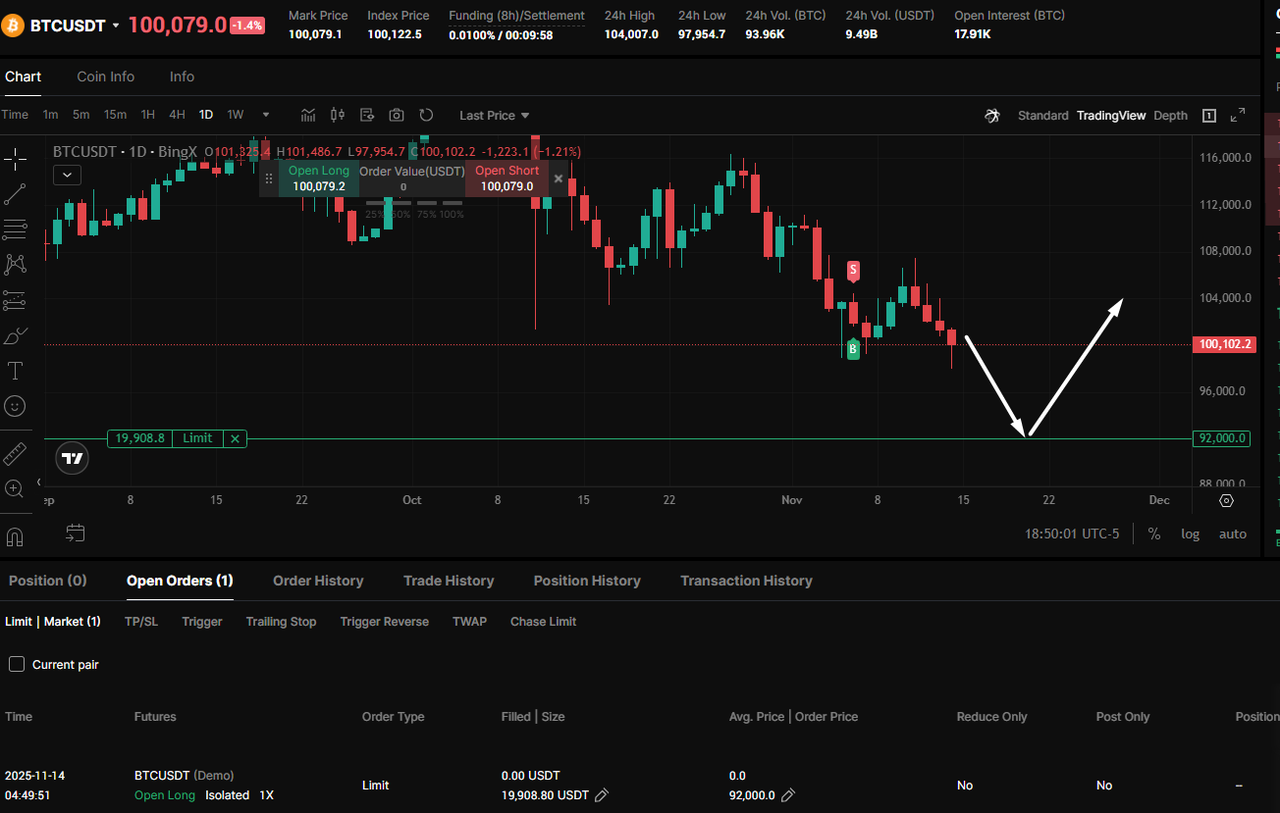
Bitcoin (BTC/USD) Price Chart - Source: BingX
This mirrors the put mechanic precisely: you define your entry price in advance, you only buy if the market comes to you, and you never chase price upward.
Best for: Traders who want full manual control over a single entry level with no automation required.
Method B: DCA Bot for Laddered Entry (Multi-Level Put Replication)
A single limit order gives you one entry point. A DCA bot gives you several, spread across a price range, so your position builds gradually as the market pulls back rather than relying on one level to hold.
How it works:
- You set DCA entries at $96,000 / $94,000 / $92,000 / $90,000 / $88,000
- Each level represents a fraction of your total planned position
- As BTC dips, orders fill one by one, your average cost blends across all filled levels
- If BTC rebounds early, you hold a partial position already in profit
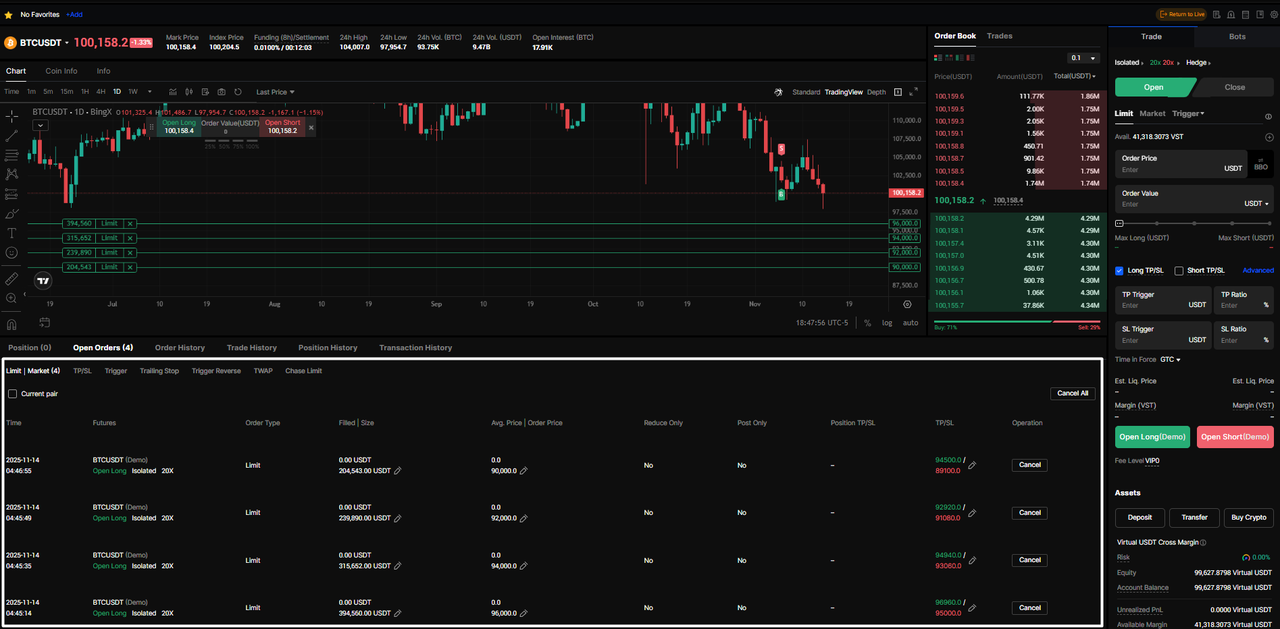
Bitcoin (BTC/USD) Price Chart - Source: BingX
This laddered structure reduces average entry cost while limiting capital deployment. It mirrors the logic of placing multiple cash-secured puts at descending strikes, each one waiting patiently for price to arrive.
Best for: Traders who want to accumulate a full position across a broader pullback without committing all capital at one level.
Method C: Grid Bot to Simulate Premium Income While Waiting
A grid bot set to buy-low and sell-high within a defined price range generates small, repeated profits from price oscillation, similar to collecting option premiums while waiting for assignment.
How it works:
- You set a BTC grid between $90,000 and $100,000
- The bot automatically buys when price dips and sells when price bounces within that range
- Each completed buy-sell cycle produces a small gain
- If BTC eventually drops below $90,000, you are holding accumulated BTC at a blended discount, just like put assignment
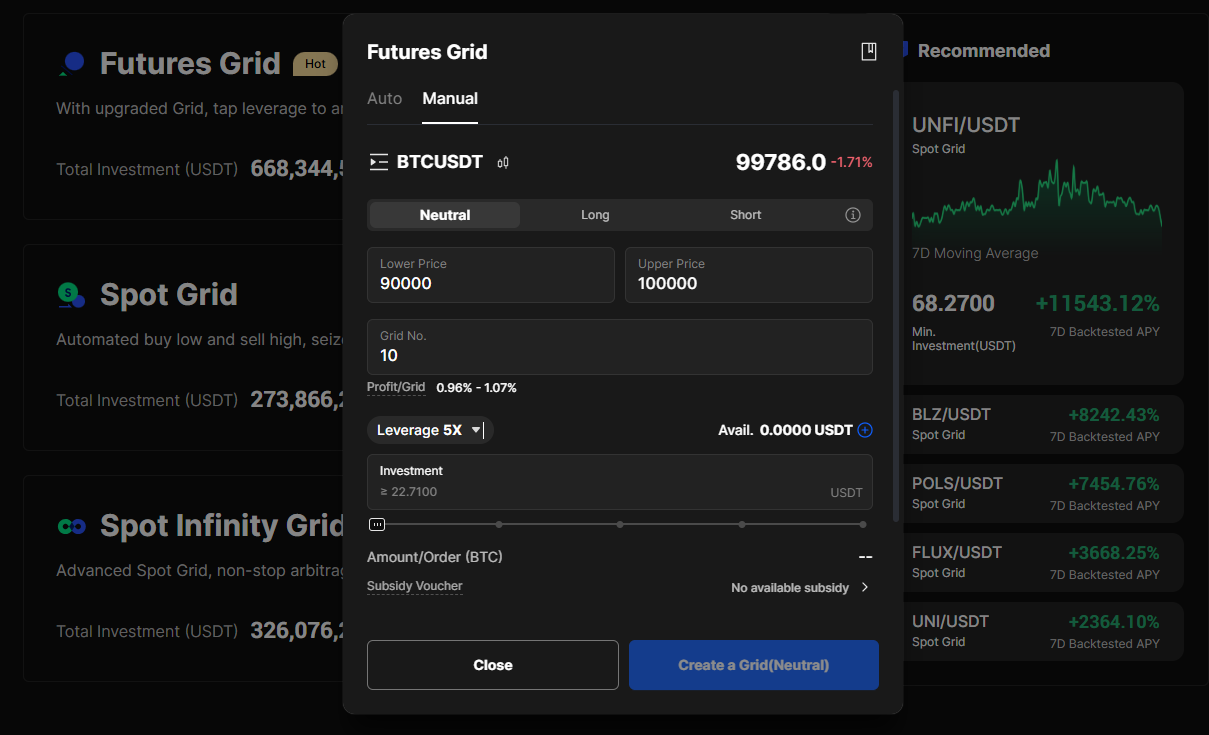
BingX Future Grid Trading (BTC/USD) - Source: BingX
This is the closest BingX equivalent to the earn while you wait dynamic that cash-secured puts provide in traditional options trading.
Best for: Traders who want to generate income during sideways or ranging markets while simultaneously building a position at lower levels.
Phase 2: Replicating Covered Calls on BingX
Once your position is established, covered calls generate income by capping your upside at a target price in exchange for a premium. On BingX, you replicate this by defining structured exits that lock in profit as price rises.
Method A: Fixed Take-Profit Orders as Call Strike Equivalents
The direct equivalent of setting a covered call strike price. You define the level where you are willing to sell your asset and place a take-profit limit order there.
How it works:
- Your BTC average cost is $92,000
- You set a take-profit limit order at $102,000
- If BTC reaches $102,000, the position closes automatically at your planned profit
- If BTC never reaches $102,000, you hold and reassess, just like a covered call expiring worthless
Best for: Traders who have a clear price target and want a simple, no-maintenance exit.
Method B: Trailing Take-Profit to Capture Extended Moves
A trailing take-profit removes the ceiling on your upside while still locking in gains automatically. Instead of fixing your exit at one price, you set a trailing distance, and the exit level rises with the market, only triggering when price reverses by your chosen amount.
How it works:
- Your BTC position is open with an average entry of $92,000
- You set a trailing take-profit with a $500 trailing distance
- As BTC rises from $92,000 to $101,000, your trailing stop follows, sitting at $100,500
- If BTC reverses from $101,000 down to $100,500, the position closes and you lock in the gain
- If BTC keeps rising to $103,000, your stop moves with it to $102,500
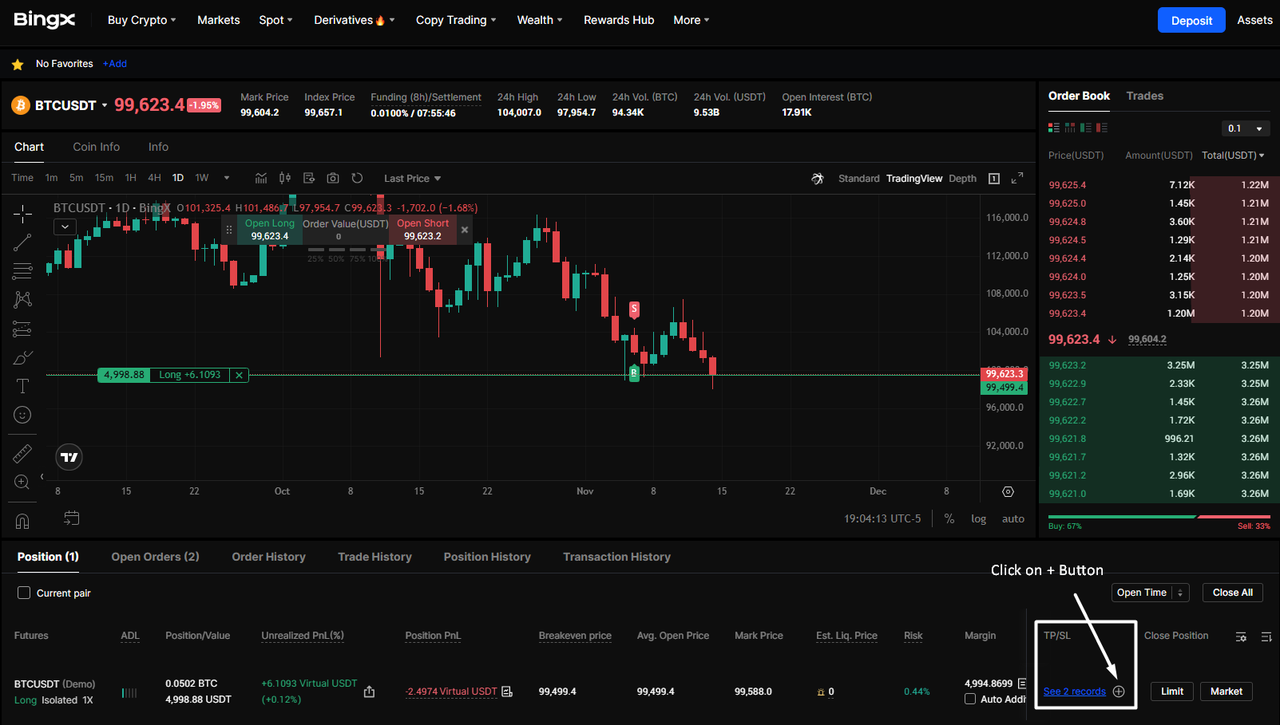
Bitcoin (BTC/USD) Price Chart - Source: BingX
This mirrors the income-capture logic of a covered call, you consistently lock gains as the trend moves in your favour, while removing the hard ceiling that a fixed take-profit imposes.
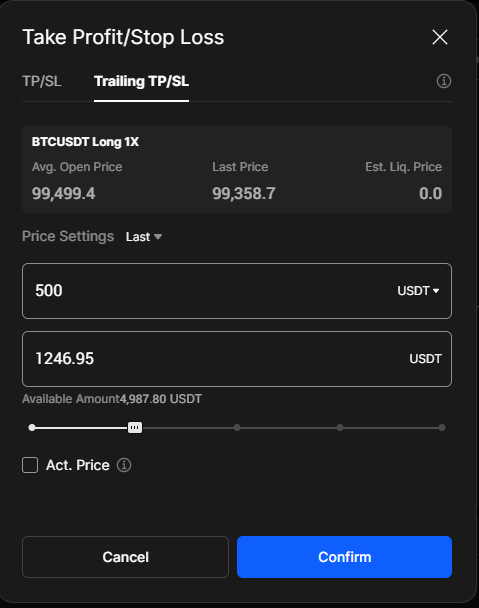
Best for: Traders who want to participate in extended uptrends without manually managing their exit.
Trailing Distance: Once you’re in the trailing TP screen, you set the Trailing Distance. This number tells BingX how much room to give the price before closing the position.
Method C: Hedge With a Small Short Position
For traders using BingX futures, a small short position on BTC futures can simulate the "capped upside" dynamic of a covered call, offsetting some gains if price rises too far while cushioning losses if price falls.
How it works:
- You hold spot BTC accumulated through your DCA entries
- You open a small short position in BTC perpetual futures
- If BTC rises sharply, your spot gains offset futures losses, net result mirrors a capped, premium-adjusted profit
- If BTC falls, your short hedge reduces the drawdown on your spot position
Best for: More experienced traders who are comfortable managing both a spot position and a futures hedge simultaneously.
Method D: Sell-Only Grid Bot for Repeated Premium-Style Income
A sell-only grid bot in short mode generates repeated small profits as price moves upward through a defined range, similar to collecting covered call premiums across multiple strike levels in a single cycle.
How it works:
- You set a short-mode futures grid between $90,000 and $100,000
- As BTC rises toward the upper range, the bot opens short-sell orders at incremental levels
- As price pulls back, those shorts close for profit
- Each completed cycle generates a small gain, repeated as many times as price oscillates through the range
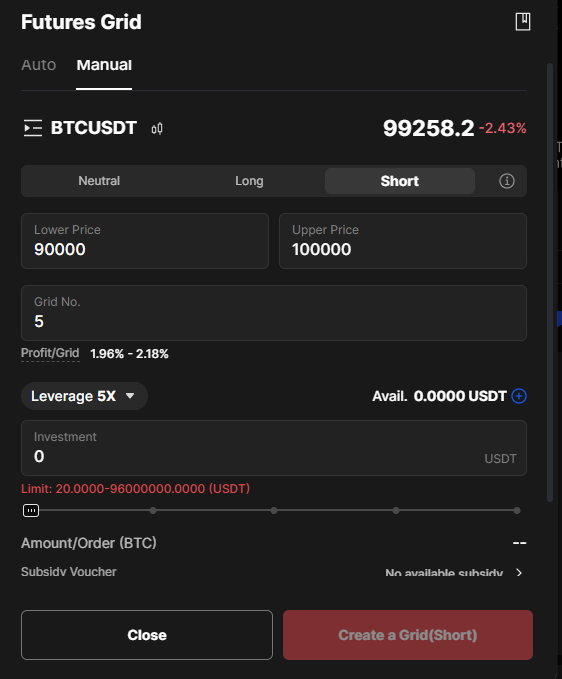
This method works best in slow, grinding uptrends or sideways markets where price moves back and forth through your grid range without breaking out sharply in either direction.
Best for: Traders who want systematic, incremental income generation as price rises gradually — without waiting for a single large exit.
Phase 1 vs Phase 2 at a Glance
|
Wheel Phase |
Traditional Method |
BingX Method |
Best Market Condition |
|
Enter at discount |
Cash-secured put |
Limit order / DCA bot |
Pullback or downtrend |
|
Income while waiting |
Put premium |
Grid bot (buy-sell cycles) |
Sideways / ranging |
|
Exit at profit |
Covered call |
Fixed TP / trailing TP |
Recovery / uptrend |
|
Income while holding |
Call premium |
Sell-only grid bot |
Slow grind upward |
|
Restart cycle |
Sell next put |
Reset DCA entries |
Any condition |
Full BingX Wheel Strategy Cycle: A Step-by-Step Example
The best way to understand the BingX wheel strategy is to walk through a complete cycle from start to finish, one full rotation of entry, income generation, exit, and restart. Here is exactly how that looks in practice using BTC.
The Setup: Starting Conditions
Before running any cycle, you define three things:
- Your accumulation zone - the price range where you are willing to buy BTC
- Your income target - the price level where you plan to exit for profit
- Your position size - the total capital you are committing to this cycle
For this example:
- BTC is currently trading at $100,000
- Your accumulation zone is $88,000 – $96,000
- Your profit target is $102,000
- Your total position size is $10,000 USDT
Step 1: Accumulate at Discounted Levels (Cash-Secured Put Phase)
You activate a DCA bot with five entry levels, each taking an equal share of your total capital:
|
Entry Level |
Capital Deployed |
BTC Purchased (approx.) |
|
$96,000 |
$2,000 |
0.0208 BTC |
|
$94,000 |
$2,000 |
0.0213 BTC |
|
$92,000 |
$2,000 |
0.0217 BTC |
|
$90,000 |
$2,000 |
0.0222 BTC |
|
$88,000 |
$2,000 |
0.0227 BTC |
Over the following days, BTC pulls back from $100,000 to $89,500. Your bot fills the first four levels $96,000, $94,000, $92,000, and $90,000 deploying $8,000 of your capital.
Your blended average cost: approximately $93,000
This is the put-assignment equivalent. You did not chase price. You did not buy at $100,000. The market came to your levels, and you accumulated BTC at a meaningful discount, automatically, while doing nothing.
Step 2: Generate Income While Holding (Covered Call Phase)
BTC stabilises around $90,000–$92,000 and begins moving sideways. While you wait for a recovery, you activate a grid bot within the current range to generate premium-style income from the oscillation.
Grid bot settings:
- Range: $89,000 – $95,000
- Mode: Buy-low / sell-high within range
- Each completed cycle earns a small incremental profit
Over several days, BTC bounces between $90,000 and $94,000 multiple times. The grid bot completes several cycles, generating small but consistent gains on top of your accumulated position. This mirrors the income you would earn from selling covered calls while holding the asset.
Step 3: Exit at Your Profit Target (Call Expiry / Assignment Phase)
BTC begins recovering. It climbs from $90,000 back toward $100,000 and beyond. You have two exit options depending on your approach:
Option A - Fixed Take-Profit: You have a limit sell order sitting at $102,000. When BTC reaches that level, your entire position closes automatically.
- Entry cost: ~$93,000 blended average
- Exit price: $102,000
- Gross profit per BTC: ~$9,000
- Plus grid bot income earned during the holding phase
Option B - Trailing Take-Profit: Instead of a fixed exit, you activate a trailing take-profit with a $500 trailing distance once BTC passes $98,000.
- BTC climbs to $104,000 - your trailing stop sits at $103,500
- BTC reverses to $103,500 - position closes automatically
- You captured an additional $1,500 per BTC compared to the fixed exit
This is the covered call exit equivalent. You locked in profit at a planned level - or better - while the system handled the execution without any manual intervention.
Step 4: Restart the Wheel
Your position is now closed. You are back in USDT with your capital plus profit. The wheel restarts immediately:
- Assess the new market level - BTC is now at $103,500 after the trailing exit
- Reset your accumulation zone - place new DCA entries at $94,000 / $92,000 / $90,000 / $88,000 / $86,000 (adjusted downward relative to current price)
- Wait for the next pullback - your bots are live, your entries are set, and the cycle begins again
Each completed rotation improves your understanding of the range, refines your entry levels, and compounds your total returns over time.
Full Cycle Summary
|
Phase |
Action |
BingX Tool |
Outcome |
|
1 — Accumulate |
Set entries below market |
DCA bot |
BTC acquired at ~$93,000 blended cost |
|
2 — Generate income |
Activate range bot |
Grid bot |
Small profits during sideways consolidation |
|
3 — Exit |
Set structured exit |
Trailing TP or fixed TP |
Position closed at $102,000–$104,000 |
|
4 — Restart |
Reset DCA entries |
DCA bot |
New cycle begins below current market |
How Returns Compound Over Multiple Cycles
The wheel strategy's real power is not one cycle, it is repeated cycles. Each completed rotation adds to your total return without requiring the market to make a new all-time high. As long as BTC continues oscillating, pulling back and recovering, the wheel keeps generating income.
A conservative estimate across three cycles in a trending market:
|
Cycle |
Entry (Blended) |
Exit |
Gross Gain per BTC |
|
1 |
$93,000 |
$102,000 |
~$9,000 |
|
2 |
$91,000 |
$100,000 |
~$9,000 |
|
3 |
$94,000 |
$103,000 |
~$9,000 |
Plus grid bot income earned during each holding phase, compounding the total return further with each rotation.
Top Tips for Risk Management Principles When Trading Wheel Strategy on BingX
Risk control is what keeps a wheel-style system sustainable. Position size should match the cash-secured mindset: only buy what you’re comfortable holding if the market drops. This keeps downside risk manageable and prevents overexposure.
- Leverage should stay low. The wheel strategy works through controlled entries and exits, not high-risk futures trades. When using futures, a soft stop or minimal stop-loss protects the position without breaking the strategy’s structure.
- Stick to high-liquidity assets like BTC and ETH. Illiquid tokens can slip through DCA levels, widen spreads, and distort grid execution.
- Finally, pause bots or pending limit orders during major volatility spikes or news events. This avoids getting filled at unfavorable levels and keeps your system operating in stable conditions.
This simple framework keeps the wheel strategy safe and consistent on BingX without traditional options.
What Are the Best Market Conditions for the Wheel Strategy?
The wheel strategy is not designed for every market condition. It performs best when price moves predictably within a range, and becomes unreliable when markets move sharply in one direction without warning.
Where It Works Best
- Sideways and range-bound markets are the wheel's natural home. When price oscillates between support and resistance without breaking out, grid bots complete more cycles, DCA entries fill at planned levels, and take-profits trigger cleanly on recoveries. Every element of the strategy works as intended.
- Gradual uptrends are the second-best condition. Pullbacks create clean accumulation opportunities, and recoveries give trailing take-profits room to run. The wheel spins smoothly and each cycle builds on the last.
Where It Struggles
- Sharp, news-driven drops can push price through your entire DCA range in minutes, deploying all your capital at once at levels that continue falling. The strategy assumes pullbacks are temporary. Structural breakdowns are not.
- Sustained bear markets are the most dangerous conditions. The wheel is built around mean reversion — the expectation that price will recover after a dip. In a prolonged downtrend, that recovery may take months or never come at the levels you entered.
What Are the Pros and Cons of the Wheel Trading Strategy?
Like any trading strategy, the wheel approach on BingX has clear strengths and real limitations. Understanding both helps you decide whether it fits your trading style, and how to set realistic expectations before running your first cycle.
Pros
- Systematic and easy to follow once the cycle is set
- Beginner-friendly because entries and exits are predefined
- Works effectively with DCA bots and grid bots on BingX
- Helps accumulate BTC or ETH at a lower average cost during pullbacks
Cons
- No real option premiums on BingX; income comes from bot cycles or planned take-profit levels
- Potential upside is limited if take-profit orders trigger before a larger rally
- Requires patience and consistent execution to complete full cycles
Conclusion
The wheel strategy is traditionally built around options, but its core logic has nothing to do with puts and calls. It is about entering at controlled prices, generating income while you hold, and exiting at planned profit levels before repeating the cycle. That logic works just as well on BingX using the tools already available to you.
By combining DCA bots for discounted entries, grid bots for income during consolidation, and trailing take-profits for structured exits, you can run a complete wheel-style cycle on BTC or ETH without ever touching an options contract. The result is the same: systematic accumulation, recurring income, and a rules-based approach that removes emotion from every decision.
The strategy is not perfect for every market condition and it does not generate guaranteed premiums the way traditional options do. But for traders who want a structured, repeatable approach to building positions and locking in profits, without staring at charts all day, the wheel strategy on BingX is one of the most practical frameworks available. Set your levels. Activate your tools. Let the cycle run.
Related Articles
1. What Is Stop Loss in Crypto Trading?
2. Futures Grid Trading: How to Calculate Profit and Loss (PnL)
3. How to Dollar‑Cost Average(DCA) Bitcoin in 2025: Buy Bitcoin Recurringly
4. Martingale Strategy (DCA): Seize Profit Opportunities and Capitalize on Market Rebounds
FAQs on Wheel Strategy in Trading Crypto
1. Can I use the real wheel strategy on BingX?
No. The traditional wheel requires selling cash-secured puts and covered calls, and BingX does not offer full crypto options. However, you can apply the same principles using limit orders, DCA bots, grid bots, and trailing take-profit tools to create a similar income-focused cycle.
2. Is the wheel strategy risky in crypto markets?
Yes, especially during strong downtrends or high-volatility news events. The strategy assumes you’re comfortable holding the asset if price drops. To manage downside risk, keep position sizes small, avoid over-leverage, and focus on high-liquidity assets like BTC and ETH.
3. What is the main benefit of using the wheel strategy on BingX?
It gives traders a structured way to accumulate crypto at better prices while locking in profits automatically. This removes emotional decision-making and turns sideways or gradually rising markets into consistent income opportunities.
4. Do I still make income if BingX doesn’t offer option premiums?
Yes, but the income comes from bot cycles and planned exits, not option premiums. Grid bots, DCA entries, and trailing take-profit levels create repeated, premium-like gains as the market moves within your chosen range.
5. What types of traders benefit most from this strategy?
The wheel-style approach is best for traders who prefer systematic, low-stress trading. If you like controlled entries, defined exits, and predictable routines, instead of chasing breakouts, this method fits well. It suits long-term accumulators, part-time traders, and anyone building steady income habits.