
Slippage is the difference between the price you expected to receive in a trade and the price that was actually executed. In the cryptocurrency market, this phenomenon occurs within seconds, can cost hundreds of dollars per trade, and affects both beginner traders and experienced investors. In 2024, the aggregate cost of slippage in crypto markets exceeded $2.7 billion, representing a 34% increase compared to the previous year, impacting both retail traders and large institutional investors.
If you trade ETH, understanding and controlling slippage is not optional. It is a fundamental component of any capital preservation strategy.
Quick answer: Slippage in crypto occurs when your order is executed at a different price than expected. To minimize it when trading ETH, use limit orders, choose high-liquidity exchanges such as BingX, split large orders into smaller batches, and trade during peak market liquidity hours.
What Is Slippage in Practice: A Simple and Direct Definition
Imagine you want to sell 2 ETH at $2,000 each, totaling $4,000. You confirm the trade, but the amount credited to your account is $3,880. That $120 difference is not a fee—it is slippage. The execution occurred at a worse price than expected.
Market volatility and low liquidity are the primary causes of slippage in crypto trading. Additionally, orders that are too large relative to the available order book depth and blockchain congestion can further increase price slippage.
It is important to note that slippage can be either positive or negative. Positive slippage occurs when the execution price is more favorable than expected. Negative slippage occurs when the execution price is worse, eroding profits or amplifying losses—especially in low-liquidity or highly volatile markets.
How to Calculate Slippage: Formula and Examples
Knowing how to calculate slippage allows you to assess the real impact of each trade and set appropriate tolerance levels based on your strategy.
Formula:
Slippage (%) = ((Executed Price − Expected Price) / Expected Price) × 100
Practical example:
You placed a sell order for 1 ETH at $2,000 (expected price), but execution occurred at $1,960 (executed price).
Slippage = ((1,960 − 2,000) / 2,000) × 100 = −2%
The negative sign indicates unfavorable slippage. You received 2% less than expected.
According to Binance Research data from 2024, retail traders experience, on average, 0.4% more slippage than institutional traders, primarily due to poor timing and improper order sizing. While this may seem small, when compounded across dozens of monthly trades, it becomes a significant annual loss.
Why Is Slippage Higher in Certain Situations?
High volatility
The Ethereum price can move hundreds of dollars within minutes. During events such as Federal Reserve announcements, protocol upgrades, or large-scale liquidations, prices fluctuate so rapidly that the time between clicking “sell” and order execution already introduces significant slippage.
Insufficient liquidity in the trading pair
On exchanges with low volume in ETH/USD or ETH/USDT pairs, the order book is shallow. Even moderately sized orders can consume multiple price levels, generating slippage even in trades that appear relatively small.
Orders too large for market depth
In January 2024, a trader attempted to purchase $9 million worth of a low-liquidity memecoin on the Solana network. The order was split into three parts, but the size was still large enough to move the market. Each execution pushed the price higher, and the trader ultimately lost over $5.7 million. This was not bad luck—it was poor execution strategy.
Blockchain congestion
During periods of high activity on the Ethereum network, transactions may take longer to be confirmed. This delay can cause the order to be filled at a different price than what was available when it was submitted.
CEX vs. DEX: Where Is Slippage Higher?
This comparison is critical for traders who frequently convert ETH.
On decentralized exchanges (DEX), trades are executed through liquidity pools based on AMM (Automated Market Maker) formulas. A study on DEXs found that Uniswap’s shift from a fixed 0.5% slippage tolerance to a dynamic model based on market conditions reduced trader losses by approximately 54.7%. However, the smaller the liquidity pool, the greater the price impact per trade.
In March 2026, a trader lost approximately $50 million in a single DEX transaction after attempting to execute a large swap against a shallow liquidity pool. The trade was executed with over 99% slippage, leaving the trader with only around $36,000 after the transaction. The platform had warned about the extreme slippage, but the user proceeded anyway.
On centralized exchanges (CEX) with high liquidity, the mechanism is different. The order book model provides greater control, limit order tools are more accessible, and some platforms offer slippage protection features that DEXs simply do not provide.
For routine ETH-to-USD conversions, high-liquidity CEXs generally offer better price predictability and more execution control.
Best Strategies to Avoid Slippage When Trading ETH
1. Use Limit Orders, Not Market Orders
This is the most direct and effective strategy. A limit order defines the minimum price you are willing to accept when selling ETH. If the market does not reach that level, the order remains pending. You give up immediate execution speed, but gain full control over price.
A market order, on the other hand, tells the exchange to “execute now at the best available price.” During periods of low liquidity or high volatility, that “best available price” can be significantly worse than what you were seeing on the screen.
2. Choose Exchanges with High Liquidity in the ETH/USDT Pair
Order book depth directly determines how much an order affects price. Exchanges such as BingX maintain high liquidity in major Ethereum pairs, which reduces the bid-ask spread and ensures that orders are filled with lower market impact. Tighter spreads mean executions closer to the price you saw before confirming the trade.
3. Take Advantage of Slippage Protection Tools
Some platforms go beyond standard tolerance settings. BingX offers the Guaranteed Price (GTD) feature for perpetual futures: when activated on Stop Loss or Trigger Orders, execution takes place exactly at the configured price, with the platform itself absorbing the risk of any market gap. For traders using automated protection strategies, this represents zero slippage on exit.
The platform also includes a Maximum Slippage control for Market Orders, which defines the worst acceptable fill price. If there is not enough liquidity within that range, the unfilled portion of the order is automatically canceled, preventing execution at prices far worse than expected.
4. Use Direct Conversion Tools with Zero Fees
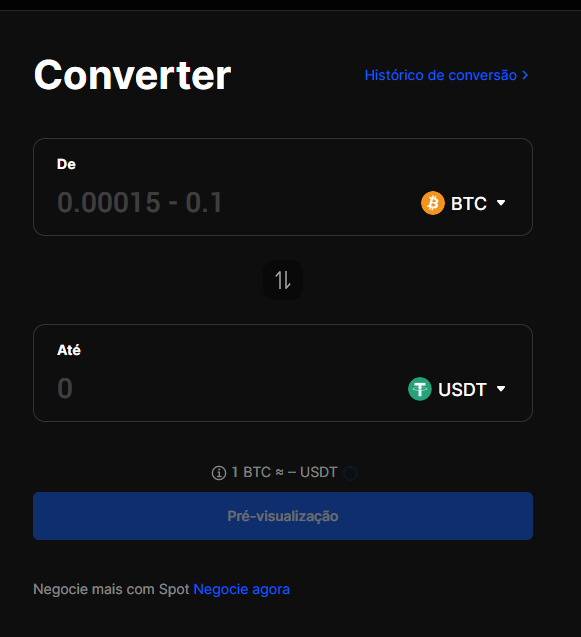
For users who want to convert ETH into USDT or other stablecoins without dealing with the order book, BingX Convert is a practical alternative. The tool enables conversions with a trading fee of 0%, through a simplified interface, reducing the spread variable in more straightforward transactions.
5. Trade During Peak Liquidity Hours
The crypto market operates 24/7, but volume is not evenly distributed throughout the day. The best times to trade ETH with lower slippage are during the overlap between the U.S. and European sessions, from 2:00 PM to 10:00 PM Brasília time. During these hours, trading volume is higher, spreads are tighter, and the risk of slippage declines considerably.
6. Split Large Orders into Smaller Batches
Large ETH sell orders placed as a single trade consume multiple levels of the order book, forcing progressively worse execution prices. Splitting the same transaction into smaller batches over time reduces market impact and improves the average execution price. Institutional traders use TWAP (Time-Weighted Average Price) algorithms for exactly this reason.
7. Avoid Trading During High-Volatility Events
Federal Reserve announcements, Ethereum protocol upgrades, cascading liquidations, and major industry news create perfect conditions for elevated slippage. If the trade is not urgent, waiting for volatility to subside usually results in far more favorable execution.
How to Set Your Slippage Tolerance
Slippage tolerance is the maximum adverse price variation you are willing to accept in a trade. The correct setting depends on the asset and prevailing market conditions.
|
Situation |
Suggested tolerance |
|
ETH/USDT in a calm market |
0.1% to 0.3% |
|
ETH/USDT in high volatility |
0.5% to 1% |
|
DEX trades with strong liquidity |
0.5% |
|
Low-liquidity altcoins |
1% to 3% |
Setting your tolerance too low may cause frequent order rejections. Setting it too high means accepting poor prices by default. The right balance is the one that preserves execution probability while maintaining price protection.
FAQ: Frequently Asked Questions About Slippage in Crypto
1. What is slippage in crypto?
Slippage is the difference between the expected price of a trade and the price at which it is actually executed. It occurs due to volatility, low liquidity, oversized orders, or blockchain congestion.
2. Does positive slippage exist?
Yes. When the market moves in your favor between order submission and execution, you may receive a better price than expected. This is called positive slippage. It is less common, especially in highly volatile markets.
3. What is the formula for calculating slippage?
((Executed Price − Expected Price) / Expected Price) × 100. A negative result indicates execution at a worse price than planned.
4. How can I avoid slippage when selling ETH?
Use limit orders, trade on high-liquidity exchanges such as BingX, split large orders, avoid periods of extreme volatility, and use protection features such as Guaranteed Price for futures trading.
5. Which has more slippage: DEX or CEX?
It depends on liquidity. DEXs with shallow pools can produce extremely high slippage even on moderate orders. CEXs with deep order books tend to offer better execution for most retail traders.
6. Does BingX offer any specific tools against slippage?
Yes. Guaranteed Price (GTD) in perpetual futures ensures execution at the configured price with zero slippage. BingX Convert offers zero-fee conversions. And the Maximum Slippage control for market orders prevents fills at excessively unfavorable prices.
7. Is a 1% tolerance too high for ETH?
It depends on the context. For ETH in a stable market, 0.3% is often sufficient. A 1% tolerance makes more sense during periods of elevated volatility or in pairs with lower liquidity.
Summary: Key Takeaways to Avoid Losing Capital to Slippage
- Slippage is unavoidable, but manageable. With the right tools and strategies, you can drastically reduce its impact on your ETH trades.
- Limit orders are your first line of defense. Never use market orders during high-volatility periods unless you have a very clear reason.
- Liquidity is everything. The choice of exchange matters as much as strategy. Platforms such as BingX with strong liquidity in the ETH/USDT pair offer tighter spreads and executions closer to the expected price.
- Advanced tools exist and should be used. BingX Guaranteed Price, BingX Convert, and Maximum Slippage control are practical features that many traders overlook.
- Timing and order size matter. Trade during the most liquid windows and split large positions to reduce market impact.
- Calculate before you execute. Use the slippage formula to assess the potential impact of each trade before confirming it.